

2026 Preview: Broadening Out as Tariffs + Recessionary Overhangs Fade
- 2025 was defined by tariffs and supply shocks. In 2026 those impacts start to fade, while fiscal support, easier consumer and SME credit conditions, and global manufacturing improve.
- For a discussion of the note below and some broader themes for 2026, listen in here.
- Following the policy-induced volatility of 2025, growth will rebound and broaden out across the economy. For much of the past 3 years, various parts of the economy have been in rolling recessions or quasi-recessions, leading to softness in corporate sentiment and hitting investment and hiring (forward-looking decisions that require confidence).
- Growth in H1 will be faster than in H2 but the whole year see’s above potential growth, averaging to ~2.5% (see earlier takes on the growth outlook and corp. commentary). Consumption stays strong, AI’s contribution will evolve from chips into broader physical buildout and SAAS-like productivity boosts, while other investment remains mixed with housing still sluggish as affordability drags continue.
- With hiring steadying itself after the tariff shock and jobless claims showing less softening in recent months, our baseline remains that labor market slack will ease a bit further through Q1 before starting to tighten in H2.
- The new Fed chair will have their room to ease aggressively limited by the data and still inflation-centric political dynamics. Spot them a cut, or perhaps two, but not more. The Fed will be less consensus driven and we should expect to enter an era of chronic dissent.
Quickly putting some numbers to the outlook for growth and the labor market. We expect GDP growth to be: 3.0% or so in Q1 (depends on Oct-Nov shutdown payback noise, possibly another shutdown, tariff rulings, and how hot the Jan-Feb inflation prints are); 2.7% Q2; 2.1% Q3 and Q4. In a non-recessionary world, risks seem to perhaps a bit slower H1 but hotter H2. The unemployment rate is likely to bounce around 4.5-4.6% in the early part of the year before an improving supply-demand mix pulls it down to 4.3-4.4% in Q4; NFP growth will remains slower than pre-covid benchmarks, around 50-80k, but rebounding off the post-revision sluggishness of much of the last 18months. Inflation’s overshoot is being driven by tariffs, and they will keep it close to 3.0% (once adjusting for the shutdown noise) throughout much of the year before slowing to 2.4-2.6% y/y in Q4. Tariff uncertainties loom large there, but domestic demand growth and nominal spending and income trends are helping set a somewhat higher floor.
Concerns about Fed independence seem less pertinent than they were in the summer even if they are far from resolved. Powell is likely done easing. Waller and Bowman’s refusal to go along with Miran’s more extreme views was a comforting sign, as was the early reappointment of the regional bank presidents; the Supreme Court’s oral arguments in the Cook case, along with prior rulings, seem to suggest that they see the Fed as uniquely and essentially independent among DC’s many executive agencies. The new Fed chair will likely have somewhat limited ability to be data independently dovish, instead facing some constraints from the rest of the FOMC. One rate cut in June should be spotted to the new Chair but beyond that things are much murkier. Market pricing of ~2.4 cuts incorporate a large left tail drag.
For longer-term rates, while some gradual trend higher is our baseline, the limited extent of upside means that the dominant feel of the year will be a range trading one (with that range drifting from 4-4..25% to 4.25-4.5% as the year progresses). With policy much closer to neutral now and 2+ cuts priced in, room for further bull steepening seems limited. Excessively dovish policy, relative to the economic backdrop, could lead to a twist steepener but that’s more of a risk than baseline (given potential risks of QE or other policy actions in that world, commodity and dollar hedges may be a better trade for that).
The Shocks and Shifts Driving the Outlook
Going into the year, 2025 was expected to be the year the economy escaped its multiyear doldrums, accentuated by modest Fed cuts, deregulatory policy, and fiscal stimulus. The data in late-24 had shown some early signs of this being the case, even pre-election. Instead, 2025 was the year of tariffs and AI. 2026 sees recovery forestalled but not derailed as the economy continues to see solid growth, gradually decelerating inflation, and a labor market that eventually starts to steady itself. Rather just outlining the numbers, it seems worth outlining the key shocks and shifts which are driving the outlook for this year:
- Peak impacts on growth and inflation[1] from tariffs were likely in fall 2025 and will start fading as we move into 2026. This applies for both the cashflow impacts’ direct impacts on firms and households as well as the confidence drag from the uncertainty around tariffs and their disruption to existing business practices. A ruling against the IEEPA tariff’s will create a bit more new uncertainty but by removing the most discretionary tool, it still substantially reduces overall uncertainty.
- Fiscal policy will be a modest positive contributor to growth. The OBBB’s fiscal impulse will be concentrated in the first half of the year as a large tax refund season, changes in withholdings, no tax on tips or OT provide modest support to the consumer while the immediate expensing provisions are a boost to corporate investment as well. This likely adds +50bps to growth in Q1 and Q2, with a small tail going into the H2. The potential for IEEPA tariff refunds, pending an eventual Supreme Court ruling, would provide an additional few tenths impulse to growth.[2]
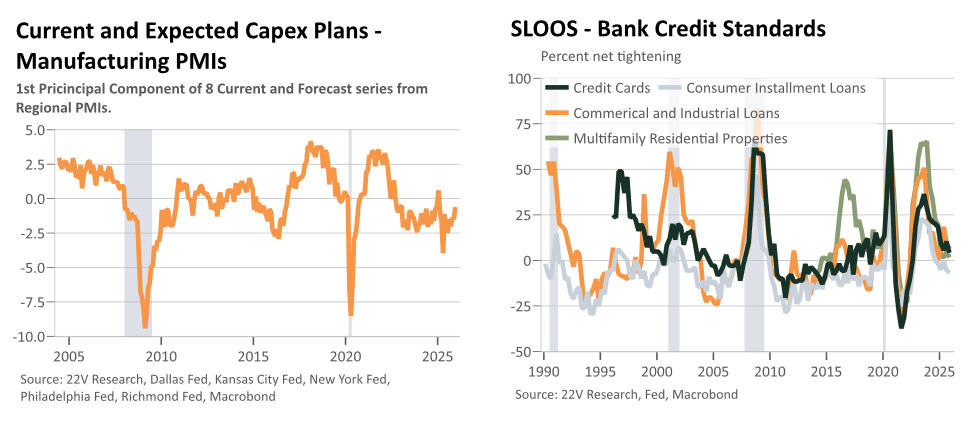
- After years of pre-recessionary prep and weak sentiment, the hesitancy of the late 2022-25 period will start turning a more normal optimistic direction. While financial markets have been buoyant at times, in the real economy caution has dominated despite fairly strong topline growth. Firms’ fading fears will allow somewhat better non-AI related investment and a modest pickup in hiring.
- Since 2022, household have been slowly deleveraging and banks have engaged in the largest ever non-recessionary tightening of credit standards. With rates somewhat lower and recessionary caution slightly fading, the ability of households and firms to start borrowing adds another tailwind to growth. This is normal in non-recessionary environments, what has been unusual is the extent of caution in recent years.
- The AI boom’s buildout is broadening out away from software creation into electrical infrastructure, physical goods, and broader software-as-a-service like support for non-tech corporates. These processes will be gradual and at times bottlenecks will prevent some overheating by placing limits on what can be accomplished in the present. A repudiation of the concept or falsification of many existing business plans (i.e. the bubble starting to pop) remains the key risk for 2026-27 but for now momentum seems to favor more investment.
New Shocks Build Off a Better-than-Appreciated Backdrop
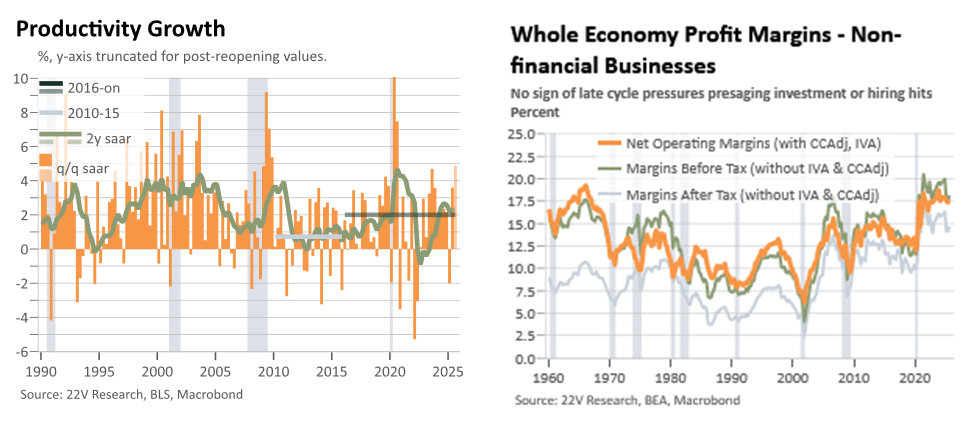
The macroeconomic backdrop remains substantially better than appreciated. While the AI boom is taking investment share, the topline data shows a robust private sector balance sheets, financial flows, and margins. On top of that, productivity growth seems to have accelerated since its immediate post-GFC doldrums and many are anchoring to too slow forecasts of underlying GDP growth.
- The level of fiscal policy is also a key support to growth, perhaps better framed as a risk attenuating feature of the economy, by helping private sector balance financial balances healthy and far from those seen in the tech bubble or GFC eras.
- Corporate margins are also showing little sign, ex-tariffs, of their usual mid-to-late cycle deterioration. That they are at or near cycle and all-time highs suggests that margin-led fears of broad-based layoffs seem unlikely to materialize anytime soon, despite some companies seeing the microeconomic case for them (see more on the above two points here).
- Productivity growth has been consistently surprising to the upside in recent years (see more from Gerard here). Many forecasts continue to excessively anchor to the lower investment and dynamism that characterized the post-financial crisis experience. While the productivity trends of the 1990s and early 2000s are a long way off, the economy does seem to have been jolted into a new somewhat faster growth equilibrium post-covid (many signs of business formation and dynamism have moved modestly higher, one could also say since 2015 or so as the immediate risk aversion, balance sheet repair, and credit rationing dynamics of the GFC started to fade).
Labor Markets Slowly Starting to Heal
This fall has been the third major scare in the labor market since the Fed’s tightening cycle reached its peak. The late-2022 rounds of layoff announcements and the summer 2024 triggering of the Sahm Rule both parts of the stop-start normalization of the labor market from its overheated state. This year’s easing has been somewhat different as labor demand growth fell more sharply, layoff dynamics, despite headlines, have remained steady, and labor supply was buffeted by two countervailing shocks. Immigration flows fell sharply but domestic labor supply appears to be rebounding.
- The unemployment rate is likely to bounce around 4.5-4.6% in early 2026 before gradually starting to decline in the latter part of the year. This recovery will come with only modest NFP growth as labor demand growth remains fairly slow by historical standards.
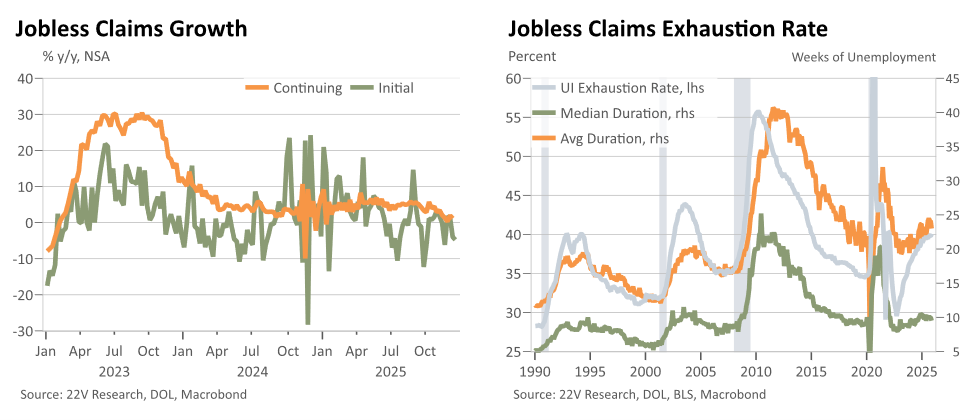
- Labor demand is a mixed bag. Total NFP growth has slowed sharply but at the same time jobless claims growth has been decelerating with initial claims now down y/y and continuing claims were effectively flat in Dec when adjusting for growth in employment.
- In addition to the still low level of layoffs, job prospects for those who have remained closely attached to employment do not seem to be deteriorating. The share of those on unemployment insurance exhausting their benefits is little changed since this spring, hardly the stuff of a recessionary labor market; this closely tracks the decline in the median duration of unemployment.
- Private sector NFP growth has been overstated but recent QCEW data suggest the extent of that is fading (more here). Given the summer trough in private sector NFP growth, this suggests that post-revision hiring growth has been steadily soft for longer than appreciated and might even be improving a bit in recent months.
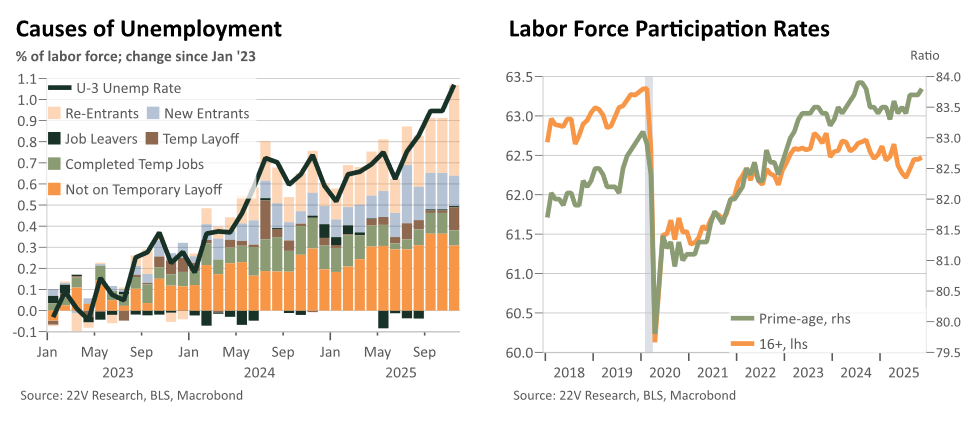
- While faster labor demand growth would be welcome, the data we have suggests that labor supply growth running stronger than expected is that primary driver of the weakening of the unemployment rate this year. The rise in the unemployment rate has been driven by new- and re-entrants with those on layoff accounting for only a small part of the increase in the unemployment rate this year. This positive labor supply shock has come even as the swings in immigration flows and demographics have pulled baseline NFP breakeven rate down below 50k.
- Domestic labor supply growth (labor force participation rates) appears to be showing signs of reverse hysteresis even as wage growth still slows some, job switching remains weak, and hiring has been buffeted by tariff shocks and corporate caution. This is another signal in the economy which seems more mid-cycle than quasi-recessionary, as it usually lags recessionary periods, and should be seen a support to growth over the medium-term not a sign of looming recessionary weakness (misreading labor supply whipsaws’ impact on the urate also happened with the Sahm Rule in 2024).
Inflation Ex-Tariffs is Low Enough but Not at Target
Inflation is entering its 6th year above target. While tariffs have been the dominant contributor to much of the reacceleration in inflation this year, there is more going on than just tariffs.
- Rental disinflation will continue apace for much of the year, likely starting to trough at or a bit below 2% in H2, even as spot market rents are expected to stabilize at historically low levels according to Redfin and Zillow; this gradually easing affordability will support consumer sentiment.
- Core services have been deemphasized by Fed officials eager to see at least a few more cuts take place at recent months; however, they seem to be anchored persistently higher than they were pre-covid and have shown little to no sign of deceleration since early 2024.
- Even without tariffs underlying core goods inflation has likely moved up relative to pre-covid as deglobalization, geopolitical concerns, and rising incomes in the rest of the world limit the deflationary impulse that is possible.
- Tariffs are likely at or just past their peak impact in a monthly sense although if the administration wins at the Supreme Court, we may see another round goods inflation in the winter and spring. A loss likely means some attempts to replace the IEEPA tariffs, but we find it hard to imagine that political concerns will allow for even at attempt at full offsetting.[3]It is possible that part of the lower-than-expected pass through of tariffs so far has been due to firms hesitancy to raise prices into an uncertain legal regime so we may see further pass-throughs after a SCOTUS verdict, even if though the risks there seem sharply skewed around the actual outcome of the case (see more from Harvard researchers here).
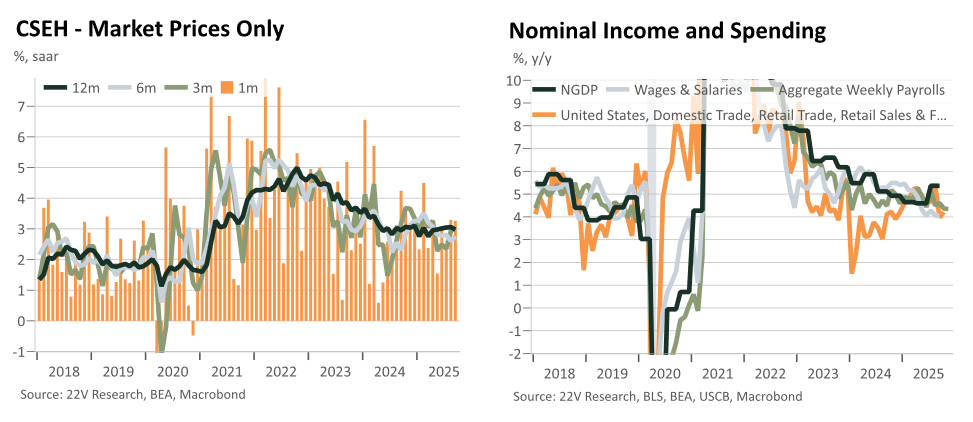
- Recent nominal spending trends (4-5%) and productivity growth (2% or higher), along with minimal employment growth, suggest that inflation is likely floored higher than many of the more dovish seem to appreciate, but at the same time strong productivity growth will likely keep inflation from being too hot to be a problem. Compared to recent years, this would be a benign and cyclically supportive outcome.
- Taken together, the Fed’s disinflationary baseline seems reasonable but risks are underappreciatedly two-sided; the 2.5% core PCE forecast assumes monthly inflation just above target in ’26H2. CPI rents and OER may well move even lower than expected and pull down overall inflation. On the opposite side, domestic services inflation is continuing to run surprisingly hot and has not shown any appreciable sign of deceleration in years.
In a monthly spot sense; the level drags will keep building for some time yet. ↑
While it seems logical enough that if the Supreme Court rules against the IEEPA tariffs, that those tariffs would have to be refunded but there is some legal uncertainty on the matter. For example, COST’s joining tariff related litigation, along with many other companies, was seen as a clear hedge against this risk by making itself a direct party to a suit and direct claimant against the tariffs. ↑
Recent delays and downshifts in tariffs on cabinets, furniture, and pasta all seem to fit with this view. ↑

