

Recent Data Lean Against a Looming Retrenchment
- Amid the beat-miss discussion and attempted pessimistic slicing and dicing of the recent data, three key points supporting our sense of underlying cyclical optimism have been less noticed.
- These are: the continued lack of deterioration in corporate margins, the strength of the private sector financial balance, and the stability of aggregate delinquency data and the misreading of the recent savings rate trend (on which we should never place much if any weight in real-time).
- After years of rolling recessions or pre-recessionary caution, the private sector in the US continues to be healthy with few obvious signs of overextension in the national accounts, even if one might object to the premise of that given the size of the AI boom in markets.
- This sense of recessionary caution likely helped prevent some of the excesses which would’ve made a recession more likely and its fading, temporarily reversed by tariffs, is now a source of cyclical support. Risk sentiment in asset markets has been strong, in the real economy it has lagged.
- This lack of aggregate overextension and vulnerability is one of the key reasons for our baseline optimism. Plenty of risks remain but the basic building blocks of our framework continue to point in an optimistic direction. Signs on positive domestic labor market hysteresis, which would support the cycle as well, are also encouraging (see more here).
The economy has been beset by 3 rounds of recessionary concern since 2023: the SVB and banking stress blowup, the Sahm Rule scare of summer 2024, and the tariff shocks of 2025. Running in the backdrop has been fairly narrow hiring growth, a soft housing market, and weak to dreadful sentiment. All of these were seen as potential recessionary shocks or coincident indicators. However, that has not yet come to pass. Potentially disruptive shocks happen across the cycle, the real question is are those shocks large enough or is the economy overextended enough in some way to jolt it into a new and worse phase of the business cycle. The real differentiator of this cycle has been the lack of macro-financial vulnerabilities which could transmit an acute shock into broader economic stress; in a sense every mid-cycle downshift shares this characteristic but normally they come a bit less close together and after a less weird and dislocation filled period.
Recent data continues to point in an optimistic direction when looking across 3 key areas that often flag building cyclical risks.
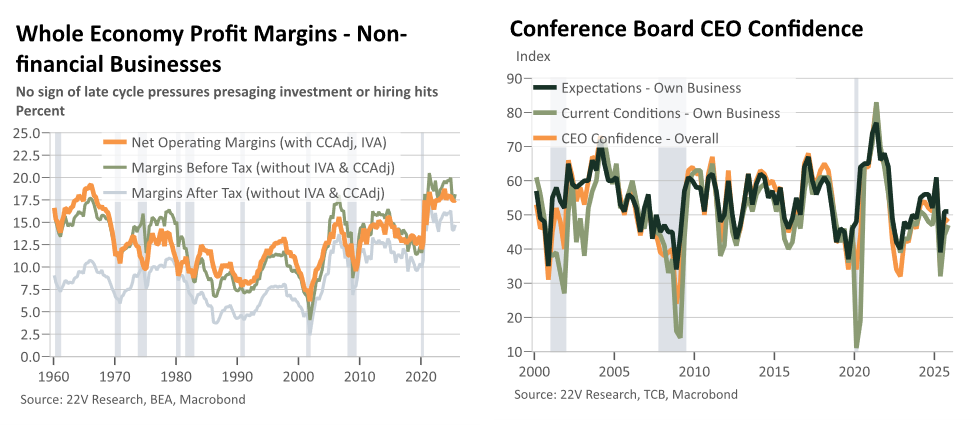
First, corporate margins remained strong and, minus the mechanical impacts of tariffs, are near-their cycle and all-time highs. There is no apparent sign of the usual multiyear deterioration in margins which has historically preceded recessions; this tends to come as workers gain share and firm investment trends towards over-extension. Instead, the past few years suggest that the “recession that wasn’t” dynamic applies beyond just sentiment with firms seeing little late-cycle pressure on margins as caution and normalizing labor markets ruled the day.
This cycle has certainly been different than prior ones (that relates to media coverage and sentiment around the labor market as much as anything else) so the risks of margin preservation layoffs at the highs could be elevated, but historically with demand growth positive there are warning signs and pressures long before mass cyclically reinforcing layoffs begin. The strategy team’s measure of margin sentiment remains near its all-time highs (here). While CEO confidence measures have whipsawed this year due to tariffs, they remain somewhat depressed compared to normal cyclical expansions. This hardly seems an environment of looming retrenchment after overextension. Normalization after the tariff shocks layered on top of the rolling mini-recessions seems far more apt.
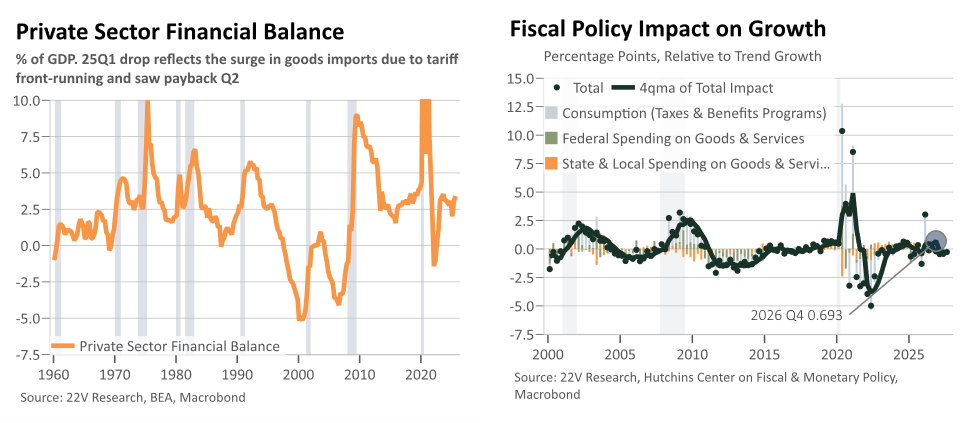
Second, the private sector financial balance has recovered since its tariff induced drop and shows little sign of overall risk to the private sector. While fiscal policy will provide an impulse to growth rates next year, the impact of a structurally lose level of fiscal policy also plays a key role by supporting the income and balance sheets of the private sector. This level effect is often underappreciated and is a key source of counter-cyclical or risk attenuation, in the economy as the private sector continues to see its balance sheet improve. Not every recession coincides with a low absolute level of the PSFB but it tends to show pre-recessionary retrenchment (moving higher) before recessions and low absolute levels are a key warming sign of potential balance sheet issues, whether in equities overexuberance in the late-90s or credit and housing markets in the mid-2000s. This is one of the most glaring differences with the late-1990s tech boom and now.
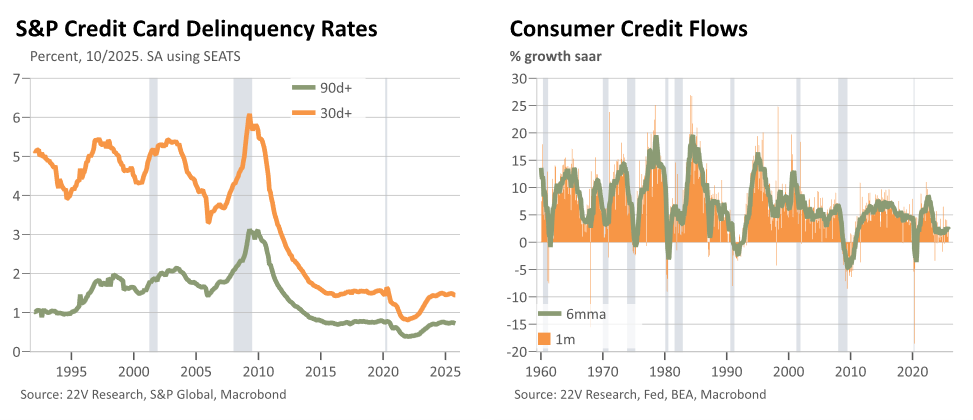
Third, if consumption growth was on as flimsy of a foundation as many seem to suggest[1] the delinquency data would not be as steady as it has been. There undoubtedly some pockets of stress related to student loans, and those corporate most exposed to this cohort have been under a bit of pressure, but the overall picture is a healthy one of excesses from 2020-22 mending not creating new ones. The savings rate has moved down a bit but if there is a cyclical signal there it suggest improved household optimism not caution (on net, household saving rate is flat or moves higher during recessions as precautionary saving far outstrips forced dissaving). Bank commentary suggests that while households may not enjoy the cash buffers they had immediately after covid recent loans continue to season well and delinquencies are stabilizing at very healthy levels (more here). The absence of consumer leveraging in recent years is another sign of broader cautious environment in recent years and a potential tailwind for growth as well.
A key additional point is that one should look for linkages between nominal income trends (which have reaccelerated some as hiring growth has stabilized when looking at the employer survey or the monthly personal income data) and nominal spending. Assuming durability to the real decelerations brought on by the tariff shock is ascribing too much durability to the acute impacts of that supply shock and not the more stable nominal forces. ↑

