November Employment Report Has Something for Everyone
- Slack continued to increase slightly in November but the internals of the data make strong conclusions a challenge, heightened by the noisiness of the household survey this month. Hiring has looked better in the fall. More and more data seems to suggest that the tariff-drag on the labor market and economy is starting to fade, but whether that is enough to stabilize the labor market as expected remains to be seen.
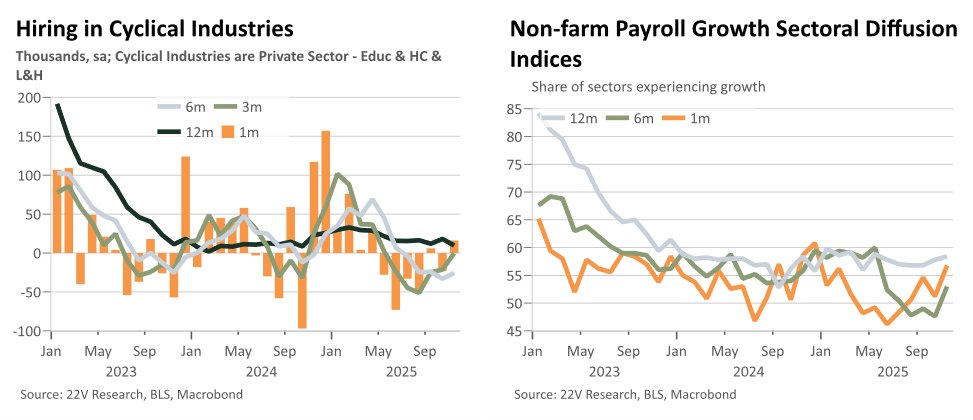
- Private sector hiring seems to be stabilizing after its spring and summer deceleration. Private sector payrolls added 52k in October and 69k in November, with hiring breadth looking a bit better as well in recent months. ADP’s weekly data, while we are a bit skeptical of the level, suggests that momentum has bounced back some after the shutdown. This at least seems consistent with my view that tariffs remain a key and underappreciated drag.
- Overall wages were soft (0.1%) but production workers hours were notably stronger (0.347%). Aggregate weekly take home pay growth has rebounded since the spring and summer too (5-6% depending on lookback).
- The report seems fairly consistent with our read of the signals from ADP and jobless claims.
- The household survey bounce saw the unemployment rate move higher again, partly due to higher labor force participation. The unemployment rate is now likely just a bit above what the Fed would have penciled in. Worth noting the shutdown’s hit to the household survey’s data quality though.
The internals of the household survey were a quite mixed bag despite the move higher in the topline unemployment rate. The urate moved higher but much of the move has been a result of labor supply gains this year with labor force new and re-entrants accounting for a large share of the unemployed. Somewhat inconsistent with the urate move, the average and median durations of unemployment have been falling after peaking in summer ’25 and fall ’24 respectively. Our overall measure of labor market slack was only slightly up on the month.
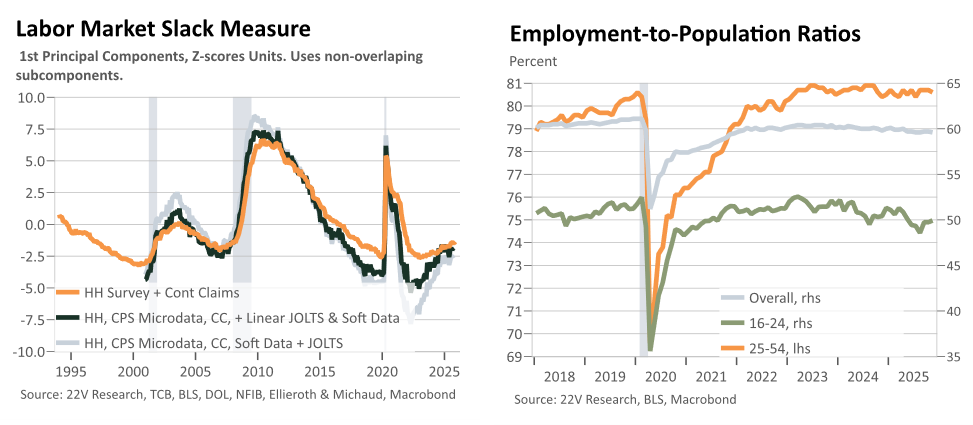
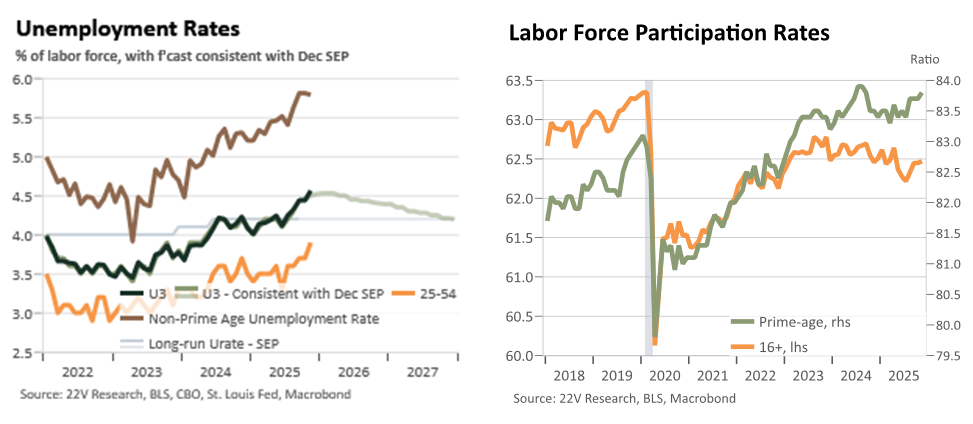
When looking across the internals of the household story, particularly taking into account the NFP data and what we can surmise about aggregate labor supply growth, a tentative conclusion came to mind today. Somewhat surprisingly given still softening wage growth and low levels of job churn, the labor market seems to be seeing some positive hysteresis effects with (ex immigration effects) labor supply looking better. Examples of this include: the rebound in hires from those not-in-the-labor-force (through Sept only so far), overall and prime-age participation rates which troughed in the summer and spring, and the declining durations of unemployment despite low jobless claims. That this has taken place even with hiring flows so sluggish and slack gradually easing, in contrast to usual cyclical dynamics, is strange but it is a strange moment in the economy.
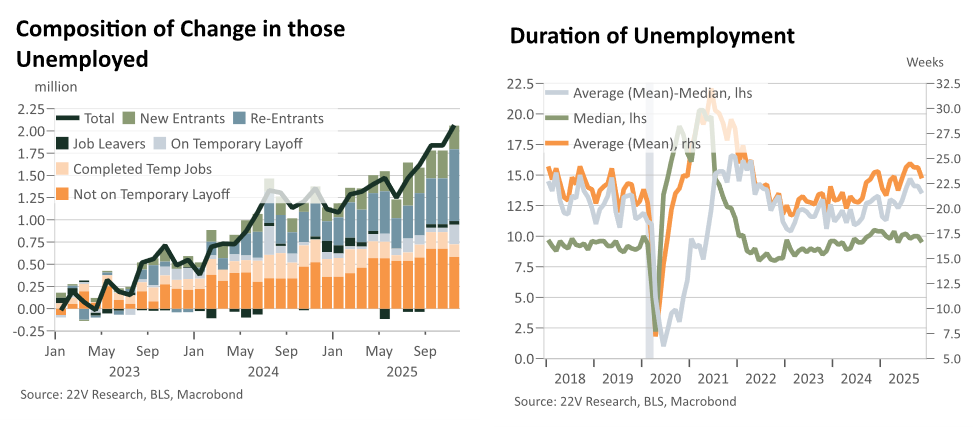
It is also important to flag that due to shutdown-related surveying complications, that the household survey is appreciably noisier than normal this month and that will carry through Q1 data to a lesser extent as well before it stops being an issue. The BLS noted this in their writeup of the release itself. This also has a directional impact on the data as respondents tend to be slightly less likely in to be employed in their initial months of response to the HH survey (see more here); as a result the data was likely biased somewhat more pessimistically this month than usual as the BLS had to include 2x more initial survey respondents to make up for the absence of any new ones in October.
The DOGE resignations were the source of acyclical drag to the Nov topline NFP numbers coming in slightly larger than expected with a 162k hit to federal employment. Many of these workers would have begun job search previously given the long runway which came with the deferred resignation program so the actual direct in terms of number of unemployed would be somewhat smaller but there was likely still at least some direct DOGE impact on the household survey, in addition to the NFP drag.
The employer survey paints a fairly optimistic picture with hiring seemingly having started to stabilize since the spring and summer’s move down. This is consistent with our read of the jobless claims data as having been showing a decreasing pace of softening in recent months, especially cont. claims pace of increase being just barely larger than employment growth, and the underlying signal from ADP’s data, including the evidence for a fade of the shutdown-era drag in today’s weekly data.