Alt Labor Data Roundup for November: It’s Looking Better??
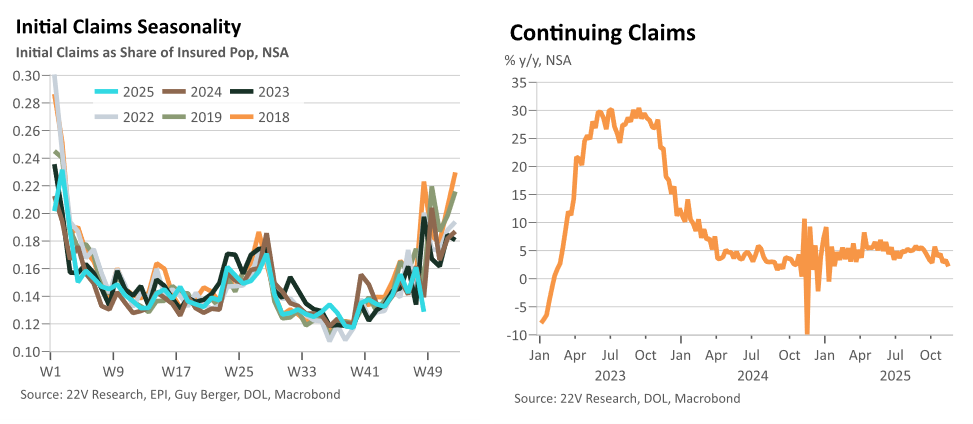
- The best data we get in absence of the employment report is the jobless claims data. Through the end of November claims point to a still very low level of layoffs and a slightly better hiring picture for continuing claimants.
- The Chicago Fed’s urate nowcast, which aggregates a wide range of labor data and surveys, suggests a bit more softening in Oct but better Nov data. On net, it shows little change since Sept and certainly no drastic deterioration (I watch flow-based measure more than the topline nowcast as it contains fewer modeling assumptions).
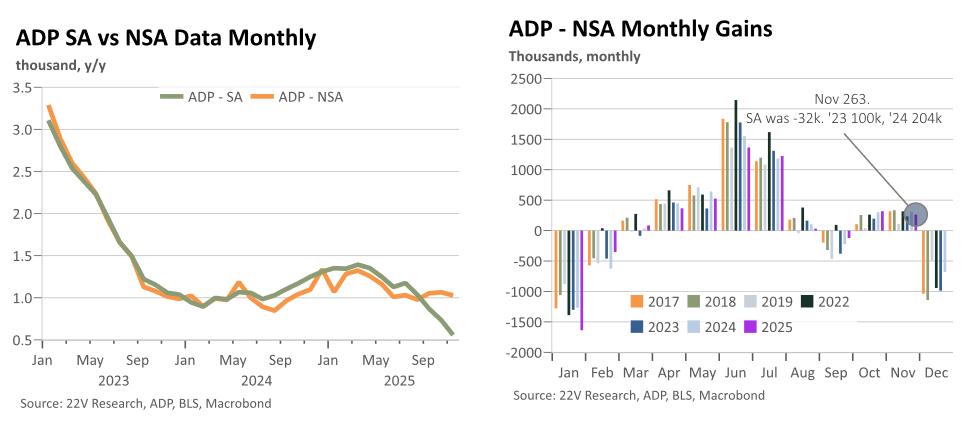
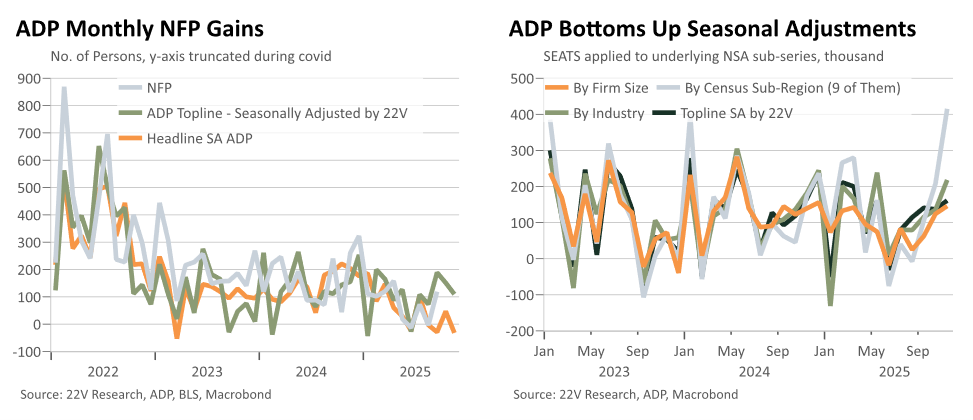
- ADP’s headline series pointed to a very soft November at -32k but has some oddities to it. Using our own seasonal adjustments to the ADP data, the labor market saw slowing hiring in the spring and summer before a tentative rebound in the fall.
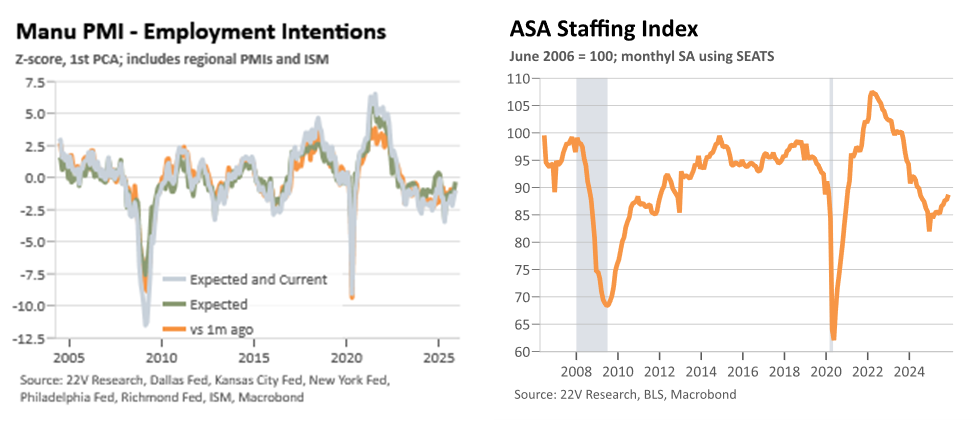
- This is more consistent with jobless claims and card and rev accelerations from Q2-now than the headline ADP or Revelio data is. It is worth noting too that hiring weakness typically lags, not leads, the cycle. Classic leading signals in the labor market, temp and manufacturing hiring, both look to be stabilizing and potentially rebounding.
- The path to a non-cut in Dec runs through continued inflation concern with labor markets not showing concerning cyclical deterioration in claims, the Chi Fed nowcast, and alt ADP.
Job claims are the timeliest labor market data series we get. They are also some of the most reliable due to the minimal impacts that structural shifts in the labor market across industry, geography, or demographics might have. A month of jobless claims data has similar information content as either of the monthly components of the employment report and more than almost all the other data we get.
Initial claims continue show the same overall behavior as we have seen in the 2017-19 and 22-24 periods. That is a healthy and low pace of layoffs. Given some residual seasonality in the data, I tend to focus on the rates of NSA claims, which looks completely healthy. The pace of continuing claims increase is now fairly clearly decelerating in recent months down from the steady 5% it has seen much of the year. The shutdown seems to have led a modest bounce amid the decelerating trend but that has faded away now. Similarly, hiring rates for UI claimants seem to have found a cycle low earlier this year.
ADP More Consistent with Other Stories in Economy if We Do the Seasonal Adjustment
Issues with strange seasonality in the ADP data are not new (see this piece from September’s data and plenty of rants from me over the years on IB), but the problem has only grown over the course of the fall. There is no plausible reason I can think of for such a large discrepancy between ADP’s y/y changes in NSA and SA data, they should be roughly equivalent over time. Y/Y changes in their NSA data suggest no recent deceleration, running at a fairly steady recent ~80k a month pace after a deceleration in the spring. The SA data shows a sharp deceleration since the start of fall.
Using our own seasonal factors for the topline, sectoral, regional, or firm size data tell a different story (ADP makes public the NSA data by census region, industry, and firm size, in addition to the topline NSA numbers). In this alt alt data, the labor market saw appreciable slowing hiring in the spring and summer before a tentative rebound in the fall. The extent of the swing varies a bit by the underlying type of NSA data but nonetheless the qualitative story is consistent across them. It is worth noting too that eventual benchmark revisions to NFP data will likely change all of these levels but should not change the inter-month patterns (ADP has been less than clear on this and there is a possibility that some of the most recent soft topline SA numbers reflects strange incorporation of these revisions after the SA process rather than in the NSA data, which seems quite odd to imagine if maybe possible).
How Much Softening is Happening on the Margin Now?
The point here isn’t that we should take these alternative seasonal adjustments to the ADP data as gospel but rather than the deterioration being shown in some labor market data seems open to at least some degree of skepticism. These alternative seasonal adjustments here, and the y/y NSA ADP data, seem more consistent with the Q4-Q1 bounce in the much of the soft data and then the subsequent spring and summer deterioration than does the official data. In addition, the ramp up in consumer spending trends from Q2 to Q3, seen clearly in a number of travel and retailer beat and raises as well as commentary from basically all the card companies and banks, and absence of broad-based deterioration in consumer credit conditions point to a more benign current state of affairs (see more here).
Labor market slack still seems to be easing a bit but this is largely downstream of very low levels of job quits and gross hires, rather than the net hiring reported by NFP and related data. While events like Liberation Day and the immediate aftermath of it can scramble and compress usual lead-lag relationships inside the economy, labor market slack measures almost always lag the cycle with those incorporating more extensive measures of slack related to labor supply lagging a bit further during cyclical rebounds especially.
It is also worth reminding that while markets and policy makers have been on the lookout for signs of deteriorating leading or coincident signals from the labor market since winter 2023, there have been plenty of false positives and yet the cycle has in its unique post-covid way kept chugging along. Hiring growth has been noisily slowing for some time but it seems to be stabilizing as the recurrent episodes of recessionary fear over the past 3y ebb and flow. Slowing labor supply growth is playing a key role and increases the frequency of false positives in the labor market as sustainable hiring trends slow to much closer towards 0 than they have ever been.
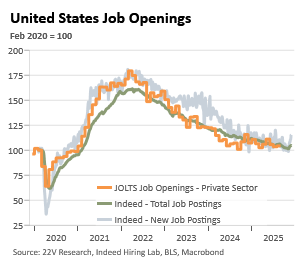
Classically, manufacturing and temporary help services are often seen as leading components of the labor market. In manufacturing the signal remains somewhat muddied with some post-Liberation Day job shedding amid a multiyear bout of softness, but the outlook appears to be turning up. While ISM looks somewhat more pessimistic, S&P and regional Feds point to a moderately improving picture (S&P’s writeup for November noted that “. Hiring intentions remain soft but they are not rolling over and appear to be mildly rebounding. Similarly, the ASA staffing index of temp hiring demand has been rebounding since the early summer, is now in positive y/y territory for the first time since Jan 2023, and appears to be gaining momentum. Indeed’s job posting data also seem to looking better in recent weeks, with a sharp bounce in new postings, somewhat surprisingly and certainly running against the narrative. This data is highly noisy though so I put less relative weight on it until we see it being sustained into the end of the year.