After Further Consideration, ADP Raises More Questions than It Answered
- ADP’s negative (sort of, as the reported -32k incorporated semi-annual benchmark revisions of -43k) print on Wednesday further accentuated weak labor market fears.
- Separately, the much steadier, and seemingly more consistent with generally sluggish labor churn over the past 2.5y, data from Revelio Labs was notably more optimistic at +60k. It is based off online job profile changes.
- The Chicago Fed’s alt-data based estimate of the unemployment rate through September shows an either flat or small increase in the unemployment rate as well, with no shift in the gradual easing trends in the hiring or layoffs rates that are the estimated inputs.
- While ADP has perhaps the single best raw and timely set of labor market data available, it’s seasonal adjustment and revisions patterns remain strange (see an old note on this here).
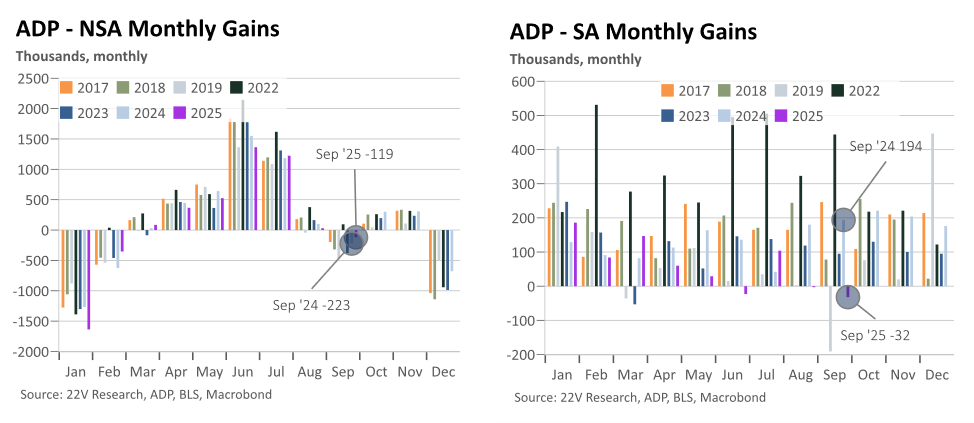
- Looking under the hood of the data doesn’t add much clarity. For September, ADP’s SA (before their preliminary benchmark revisions dragged it down to the as reported -32k in the month) was 11k. Last year’s September in SA terms was 194k. However, in NSA terms this year saw a decline of -119k while last year saw a notably larger NSA drop of -223k which own should suggest a notably larger better report than we saw for this year, unless there is a reason to suspect a massive y/y swing in the seasonal factor. The reported y/y changes are also quite different from one another across measures.
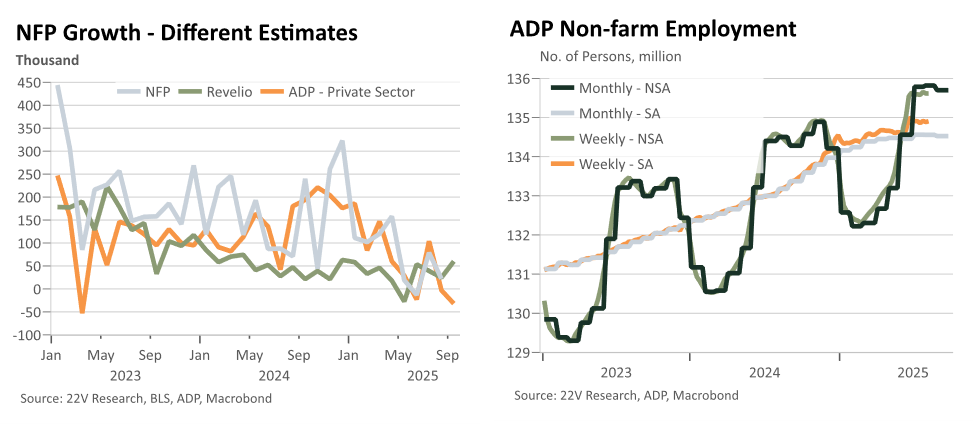
After a conversation with an investor yesterday jogged my memory, it seemed worth checking on if the historical gaps between ADP’s NSA and SA data lead to somewhat different conclusions… and yes, they frustratingly do (ADP’s SA process remains a bit of a mystery and has been a source of a number of issues over the years). Looking at the NSA data doesn’t drastically alter our understanding of the labor market, it will take a lot more to do that than just a reinterpretation of a single data print, but it does lean against some of the marginal pessimism from this week’s weak ADP print.
I will admit that I feel fairly silly for not remembering to check in on these issues when writing up ADP Wednesday. My apologies there.
For September, ADP’s SA (before their preliminary benchmark revisions dragged it down to the as reported -32k in the month) was 11k. Last year’s September in SA terms was 194k. However, in NSA terms this year saw a decline of -119k while last year saw a notably larger NSA drop of -223k. A similar season gain from last year’s would have implied a ~300k gain in this September. While that’s far stronger than could reasonably be expected, the tension between a less bad NSA number and dramatically worse SA number is hard to square.
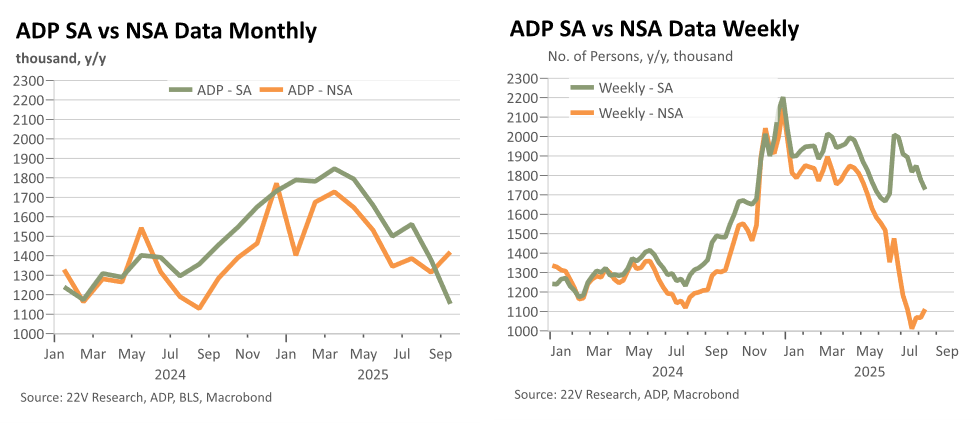
The oddity of the ADP seasonal adjustment process can also be seen fairly clearly in the remarkably large gaps in y/y payrolls growth between the NSA and SA series in recent years. While some small wiggles due to changing and revised seasonal factors could be reasonable, the extent and persistence of them in recent years raises some concerns. Given the issues with the SA data, my prior is that we should weight the relative stability in the NSA data recently (y/y bouncing around flat at roughly 1.4mn) a bit more highly. Similarly, the gaps between the gains in weekly and monthly data, across seasonal adjustments or not, are difficult to reconcile. This will likely decelerate some through the fall as the hot prints from Q4 of last year, but even still it paints a more optimistic picture than does much of the other data in its recent stability, even if sluggishly so.
Unfortunately no particular causal story jumps to mind here. Immigration flows and the whipsawing in labor supply trends could be playing a role and the low-hiring low-firing environment might be impacting underlying seasonal hiring trends that could key off gross hiring flows rather than employment levels (analogous to how the best explanation of Q1 inflation’s residual seasonality in recent years is that with trend inflation elevated seasonals for annual price reset contracts reflect a much larger than historically estimated catchup effect).