

DAILY STRATEGY: Macro risk has been lowered by the recent dovish inflation and labor market data. UST Yield and financial conditions volatility should decline, leaving fundamentals, micro themes and fundamental factors a larger driver of returns. From late June through the first week of August, the market traded in a macro driven risk averse fashion. Financial conditions tightening risk increased over that period. The price momentum factor unwinding, after concentration of Momentum returns and the volatility of the factor became extreme, contributed to the risk averse (low earnings vol outperformed) backdrop.
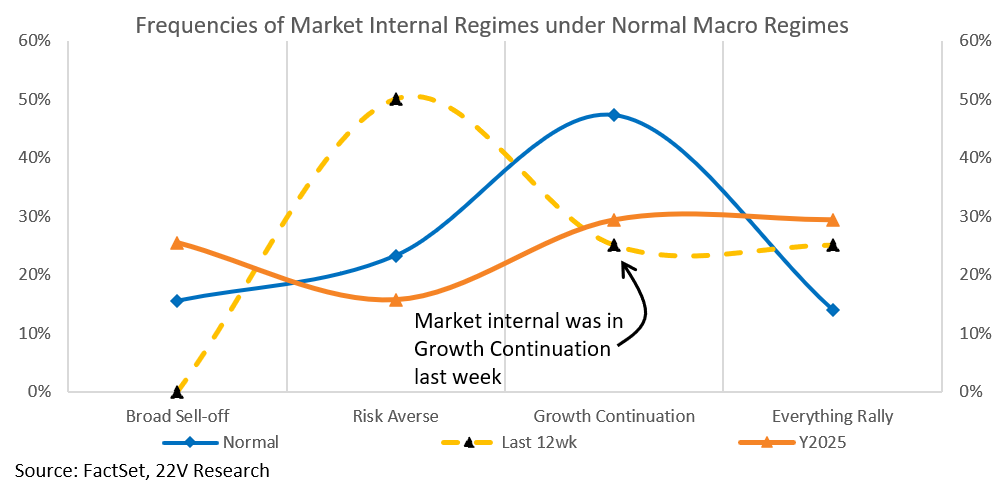
Marking To Market the Market Internal Regime – Our call that a more Risk-Averse market regime would give way to fundamental factors and Cyclicals outperforming (HERE) is taking shape. The internal market regime was classified as Growth Continuation last week. A growth continuation market regime typically supports fundamental factors (EPS Momentum, Value, GARP, Earnings Growth) and is the regime most common during normal economic expansions. FYI – less inflation pressure supports the DURABILITY of the economic expansion. Favoring companies with longer term fundamental supports.
If history is any guide, Growth Continuation internal regimes that favor fundamentals, will be the norm. This assumes macro risks are less prevalent in 2H26.
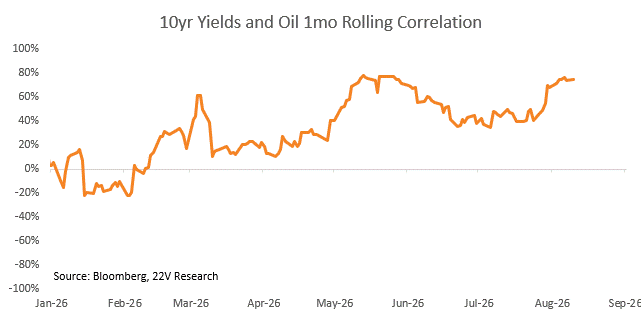
The Strait of Hormuz situation can still lead to macro shocks and move us away from fundamental factors and company specific fundamentals driving stocks. As Jacob Kirgegaard has pointed out (HERE), global oil balance has shown a high degree of flexibility; real adjustments in supply and demand, along with the use of alternative pipeline routes, have mitigated the impact of reduced transits through the Strait. Oil prices are unlikely to move well above $100 if skirmishes remain the norm. If attacks shift to targeting tankers or export facilities, prices can rapidly spike back above $100/barrel. $100+ oil prices would likely mean much higher 10yr yields. The correlation between oil prices and 10yr yields is unusually high and likely to stay that way given the persistence of supply shocks.*
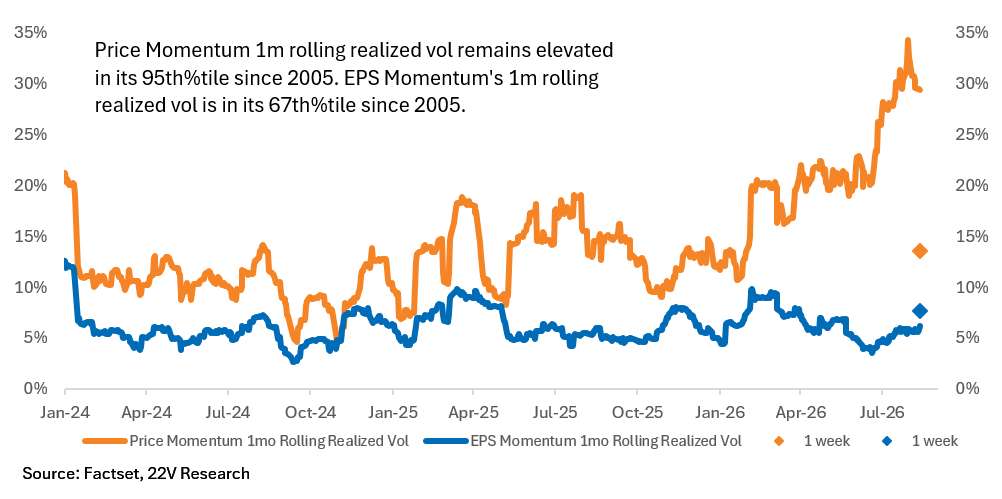
FYI on Momentum – The Price Momentum factor, which is highly correlated to AI Buildout baskets, saw realized volatility surged to its 95th %tile. Realized vol is still unusually high but has started to decline on a short-term basis. Roughly 40% of the top-decile Price Momentum names are Technology and AI-related names, leaving the factor highly exposed to negative idiosyncratic shocks or shifts in sentiment around AI demand. Point being, Price Momentum vol coming down should make investors more comfortable so that they can focus on company fundamentals again.
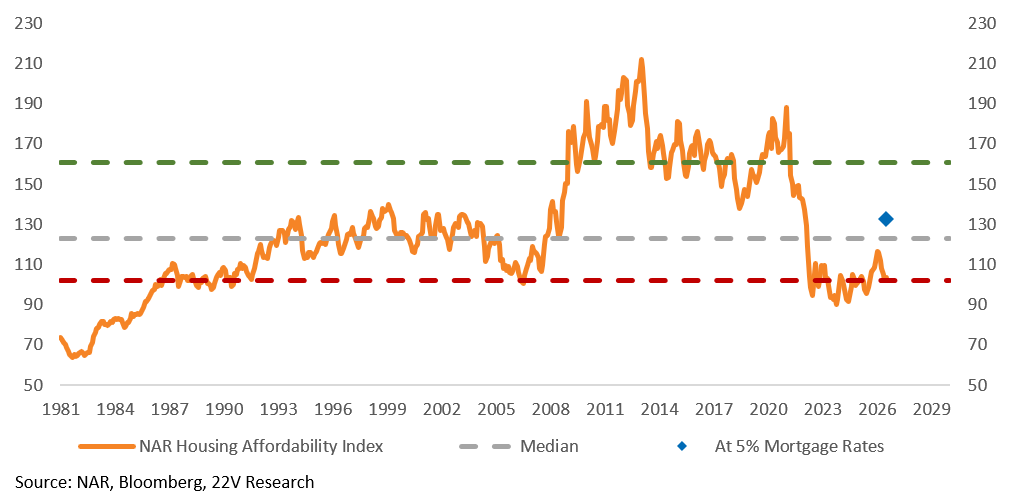
Homebuilders Trade Idea: We had been long Homebuidlers as a trade but no longer. We don’t expect the 10yr to move lower given the high level of nominal GDP (HERE), which is a headwind for Homebuidlers/Housing in general. Housing affordability is currently around the 25th%tile historically (lower affordability = more expensive) and unlikely to improve in a ~4.7% 10yr, 5.25% 30yr and 6.75% 30yr Mortgage rate world.
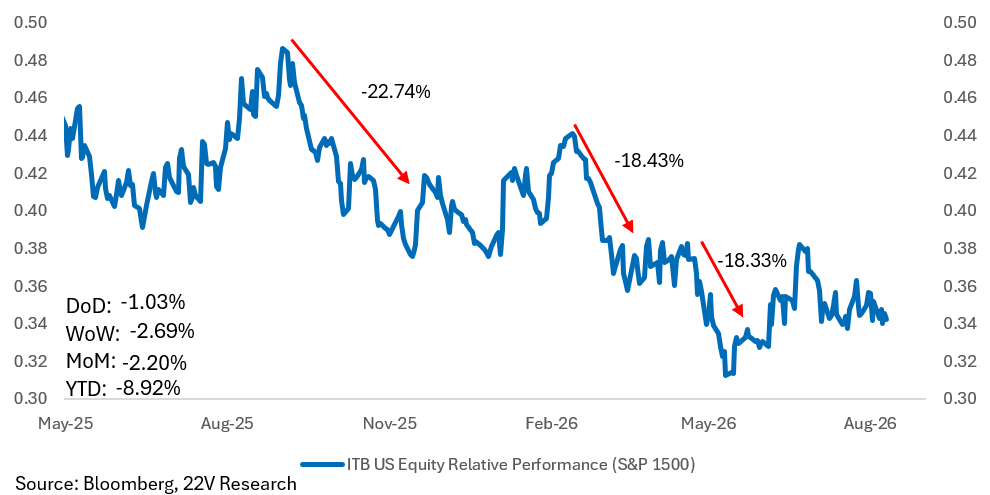
22V Derivatives Strategist Jeff Jacobson, who sees an attractive opportunity to position for downside in Homebuilders. ITB remains roughly 15% above its May lows despite 30-year yields now exceeding their May peak. Similar periods of Homebuilder outperformance relative to bonds have previously ended with sharp declines in ITB—even without a corresponding rise in yields—with the last two reversals producing drawdowns of roughly 18% and 22%. Trade details below.
Housing affordability has moved back down…
HOMEBUILDERS Trade Details (HERE)
Buy ITB Oct 16th $95 puts for ~ $3 (ITB 98.78 Fri closing ref)
Trade Details:
- Buying the less than 3% lower October puts following 16% rally off the May lows and sharp outperformance to where rates are
- ITB has had three declines of at least 17.8% just since September
- Oct puts offer two months of duration and will capture earnings from both Lennar (LEN) and Toll Brothers (TOL)
- Puts can be used to hedge long exposure across the space, or as a limited-risk bearish bet given the attractive setup
- Please reach out to Jeff or the 22V sales team for updated pricing and execution capabilities
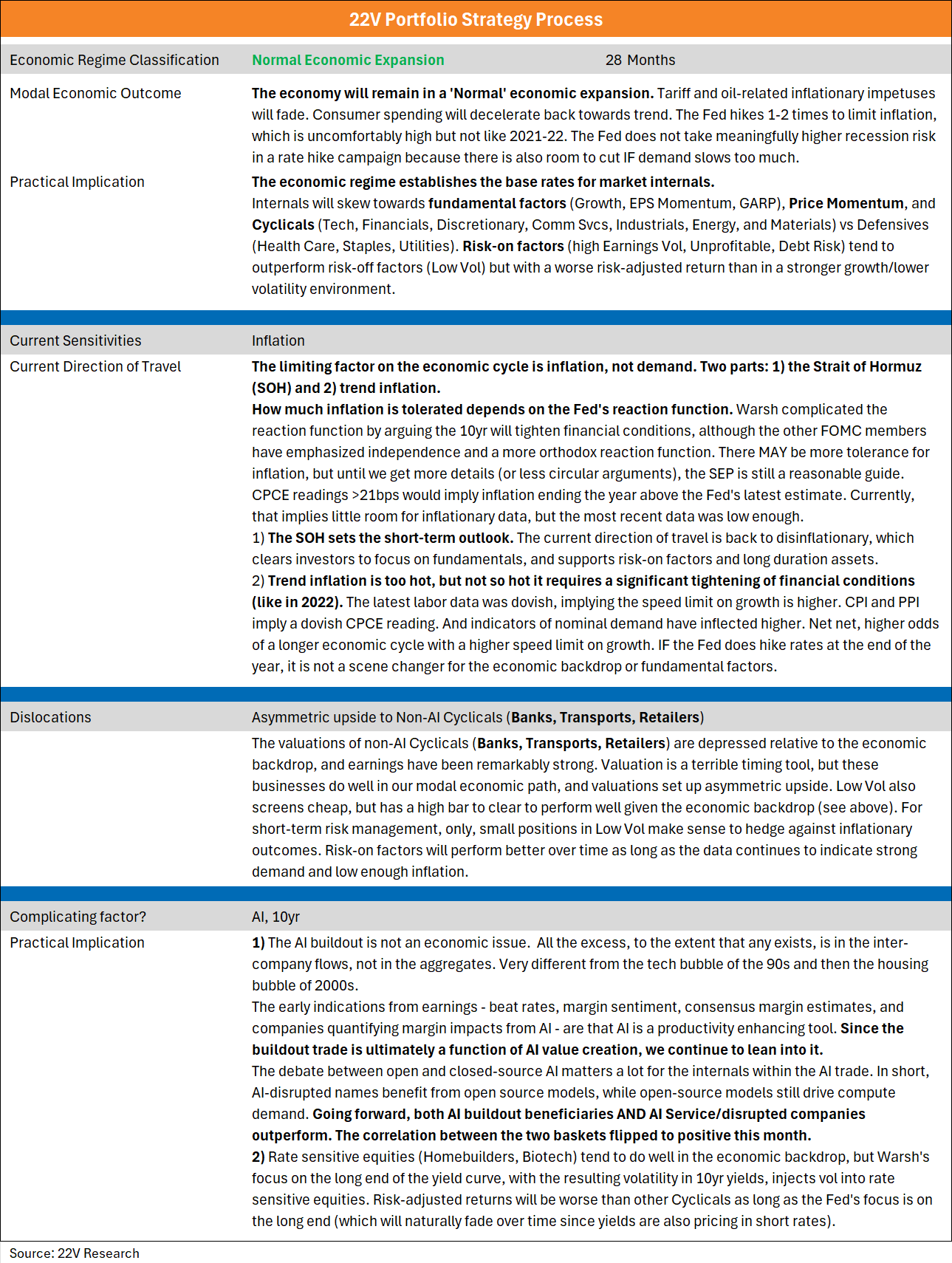
OUR PROCESS: The below graphic details the medium to longer-term outlook (6+ months) for equity internals based on the current economic backdrop, the modal outcome for the economic backdrop, and the sensitivities of the backdrop. When we mark to market our views based on new market and macro data, and talk about short-term risk management, it is always relative to what our background process implies. Below is an effort to lay out the background process in detail.
*Peter Williams view, which echoes Fed Governor Waller, is that the “distribution of global inflation shocks has shifted” toward a higher frequency of supply-driven events. This sequence of shocks threatens to deanchor inflation expectations and sets a higher floor for underlying inflation, potentially forcing the Fed into a more restrictive policy stance than they currently project. Instead of higher oil prices being viewed as a tax on growth that would lower 10yr yields, higher oil prices (or tariffs) are viewed as a supply shock that increases inflation and leads to higher 10yr yields.

