

The repeated tit-for-tat attacks in which Iran recurringly strikes shipping in the Strait of Hormuz, and the United States retaliates by bombing targets in Iran has gotten a little testier this week. The descent into renewed all-out war, however, remains a very low probability, even if it looks likely that the Trump Administration will calculatedly escalate its attacks on Iran in the coming days. Another regionally led diplomatic initiative then looks likely perhaps as soon as the end of this week.
Iran struck a number of ships in the Strait, as well as allegedly targeting U.S. bases in the region, while CENTCOM launched multiple strikes against Iranian targets over several days. More importantly, the Trump Administration revoked the 60 days sanctions waiver covering Iranian oil sales, directly targeting Iran’s economy and capacity to earn money from exporting oil.
The United States is also reported to have struck an Iranian rail bridge, utilized by both Russia and China, in Northern Iran, evidently extending the scope of strikes from the vicinity of the Strait of Hormuz to strategic infrastructure deep inside Iran. If verified, such strikes would signal an escalation from the Trump Administration also directly militarily targeting Iran’s economy.
Overall, these tit-for-tat strikes are the expected outcome of a very vaguely written MoU that essentially kicked the can on all important issues, and the associated repeated attempts by both Iran and the Trump Administration to shape a final agreement in their favor.
Iran has successfully made a direct link between its conflict with the United States and the long war in Lebanon between Israel and Hezbollah. The frontline in Lebanon has calmed down in recent days, as the Trump Administration has promoted diplomatic relations between Israel and Lebanon, and Israel has scaled back its ground offensive. As such, while the risk of escalation in Lebanon remains, it at this point looks less likely to directly scupper an eventual U.S. – Iran negotiation restart.
Similarly with regards to the key nuclear issue, which while retaining by far most long-term importance, at this point is, due to its complexity, more or less mutually agreed to be best left to the future, with only relatively broad guidelines to be agreed at this point.
This leaves the issue of the reopening of the Strait of Hormuz as the main issue in order for negotiations to restart. The fundamental problem, as noted, lies in the vagueness of the U.S. – Iran MoU on this point, or in other words the sloppy or perhaps necessary vague diplomatic language needed to get it signed. Point 5 in the MoU reads as follows;
Point 5: Upon the signing of this MOU, the Islamic Republic of Iran will make arrangements using its best efforts for the safe passage of commercial vessels with no charge for 60 days, only from the Persian Gulf to the Sea of Oman and vice versa. The traffic of commercial vessels will immediately start, and considering the need for removing the tactical and military obstacles and de-mining by the Islamic Republic of Iran will be instated within 30 days. The Islamic Republic of Iran will conduct dialog with the Sultanate of Oman to define the future administration and maritime services in the Strait of Hormuz, in discussion with other Persian Gulf littoral states in line with the applicable international law and the sovereign rights of coastal states of the Strait of Hormuz.
There is no concrete operational description of what a “reopened Strait” will look like, and both sides have hence been trying to define this on their own terms. Iran has very clearly sought to bring all transiting ships under its controls, near its territorial waters, while the U.S. and Oman have tried to establish an alternative “Omani route” outside Iran’s control.
Tehran has violently opposed these attempts, shooting repeatedly at ships, resulting on U.S. retaliatory attacks, and in today’s moderately escalatory tit-for-tat cycle. Iran is clearly and rationally intent on exchanging “control of the Strait” for as much financial gain in the form of U.S. sanctions relief and access to frozen Iranian assets as possible and up front. They initially secured material sanctions’ relief, though that waiver has not been revoked, as a direct consequence of shooting at transiting ships.
The argument that Iran what is actually seeking is long-term complete control over the Strait of Hormuz as a deterrent for future attacks and as a source of major toll income does not stand up to closer analysis. Iran’s deterrence from the Strait of Hormuz comes from geography and the fact that this war has revealed that Iran has the military capacity – if it wants to – to close the Strait, even under full U.S.-Israeli air attacks.
Deterrence has nothing to do with whether a potential Iran-GCC joint entity exercises some sort of surveillance over the Strait. In terms of possible tolls, as argued in an earlier note, any economically meaningful toll on the Strait of Hormuz would ultimately be paid overwhelmingly by the GCC states, as they sell commodities into a global market from a specific location now suddenly subject to “higher cost of doing business”.
Consequently, Iran’s regional neighbors will not accept such tolls, even if international shipping companies are indifferent, as they would simply pass the toll on to their clients. Iran’s ongoing attempts at reestablishing political relations with the GCC region consequently makes the imposition of tolls by Iran a highly unlikely outcome.
In the end, this standoff looks likely to have to be resolved by one or more of Iran’s regional neighbors proposing a design of a “future Strait of Hormuz administrative entity” that is in the end acceptable to both Iran, the United States and the rest of the international community (strongly opposed to the precedent of tolls). When precisely such a proposal emerges remains to be seen, but it could come at any moment.
In the meantime, the basic situation in Iran remains, and likely now that the burial of Ali Khamenei has taken place felt more keenly, an economy in deep recession – some estimates a decline of 10 percent of GDP in 2026 – and millions of Iranians thrown into unemployment. This is not a regime, harsh repressive capacity of its population not withstanding, that can easily afford to continue to ignore the economy. Iran needs money, and that requires a deal with the United States.
The Trump Administration’s new focus on pushing Iran economically by revoking sanctions relief and striking strategically against economically important targets across Iran clearly aims to exploit this situation and put pressure on Tehran to cut a deal.
The Trump Administration, while feeling the economic pressure at home, too, will be encouraged by the recent decline in oil prices and the general relative resilience of the U.S. and global economy in the face of Iran’s strikes against Strait of Hormuz transits. Current oil prices will not compel Donald Trump to make immediate additional concessions to Iran.
This is especially the case, as the multifaceted reasons for oil price behavior looks likely to persist. As highlighted in the IMF’s July 2026 WEO update (Figure 1), real adjustment in both supply and demand for oil has accounted for by far the largest share of adjustment to the Strait of Hormuz closure. This is likely to be an adjustment sustainable even to the effects of renewed Iranian attacks.
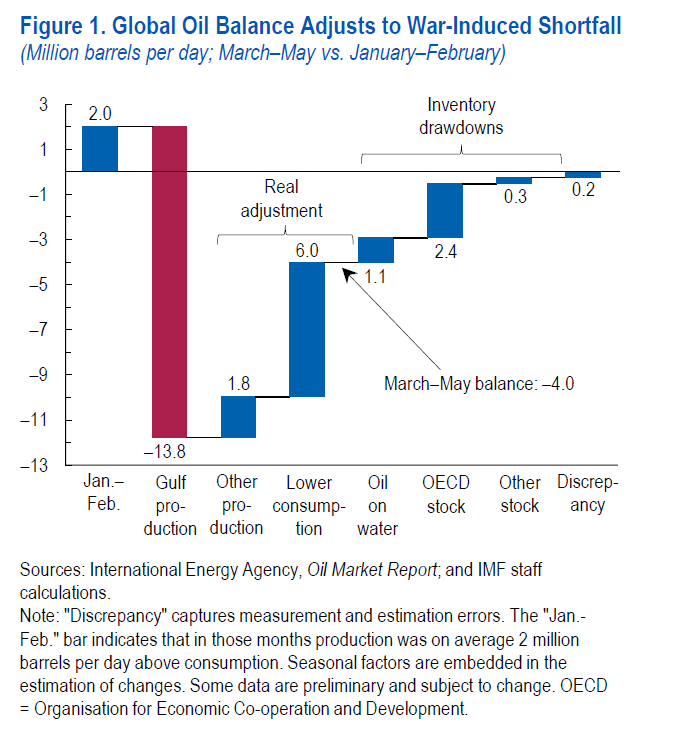
The relative resilience of the U.S. and global economy to the oil shock induced by Iran hence plays into the hands of Donald Trump, as the economic pressure at this point – especially if pushed further by U.S. sanctions waiver revocation and strategic strikes on Iranian infrastructure – may be rising faster on Iran than on the U.S. president.
Hence, Trump looks likely to have ordered sanctions tightening and an increase in precision retaliatory strikes on Iran, knowing that Iran can only really escalate again by renewed and indiscriminate strikes against the entire Gulf region. It is not clear that Iran has the political willingness to take such drastic action, though strikes against U.S. bases across the region are ongoing.
Unlike earlier in the war, when economic pressures rose faster on Trump than on Iran, today and going forward, the roles may now be reversed, and Trump is trying to exploit this. This ultimately makes a negotiated solution more likely and provides the framework for why an eventual return to negotiations remains the base case also in the near-term.
Iran didn’t lose the war but didn’t win it either and does not look likely – given oil market developments – to be able to withstand a concerted U.S. economically oriented sanctions and military pressure campaign.
Jacob

