Bottom Line: Core PCE Readthrough
The readthrough to core PCE is ~0.2% (HERE); That is on the dovish side and a positive for risk assets, all things equal. It was not dovish enough to eliminate the risk of higher inflation and associated need to tighten financial conditions. But good enough to keep the risk of financial conditions tightening in the background relative to fundamentals through earnings. With lower financial conditions tighten risk through earnings, correlations are biased to stay low, and fundamentals should be a large part of driving returns.
Relevant News: AI Baskets Face Less Macro Headwinds Through EPS Season
The recent increase in 2yr and 10yr yields has been a headwind for AI driven stocks. The correlation between 10yr yields and price momentum has been increasingly negative. The threat of financial conditions is clearly not the only thing driving the group, but to the extent that UST yields are more range bound going forward, which is our call post the CPI data, that headwind will fade.
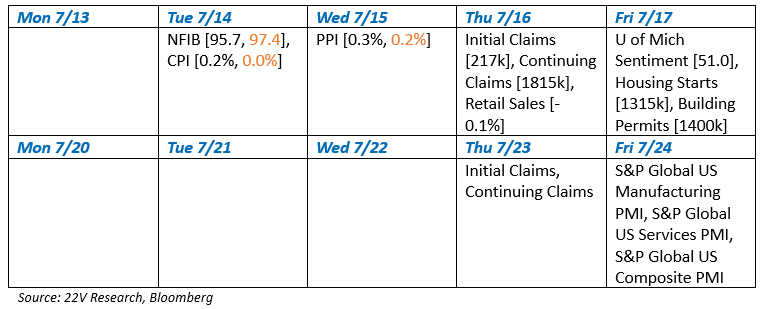
Things to Watch [Consensus, Results]:
Strategy:
CPI Pushed Financial Tightening Risk into the Background, Shifting Focus to Strong Earnings Trends– (HERE)
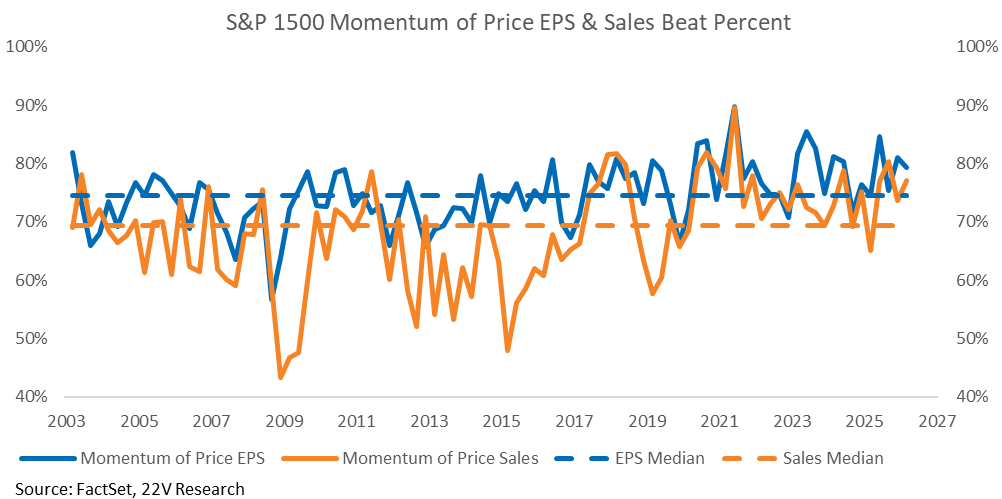
Earnings Momentum, Earnings Growth and Price Momentum (these groups are mostly AI driven) should have tailwinds through EPS season. We don’t have an edge on what the companies will report or signal about the future of AI demand, but earnings expectations for all the groups, particularly Price Momentum, are strong (HERE) and the recent beat rates have been atypically strong (HERE).
China:
Q2 Slowdown Not Bad Enough to Trigger Major Stimulus– (HERE)
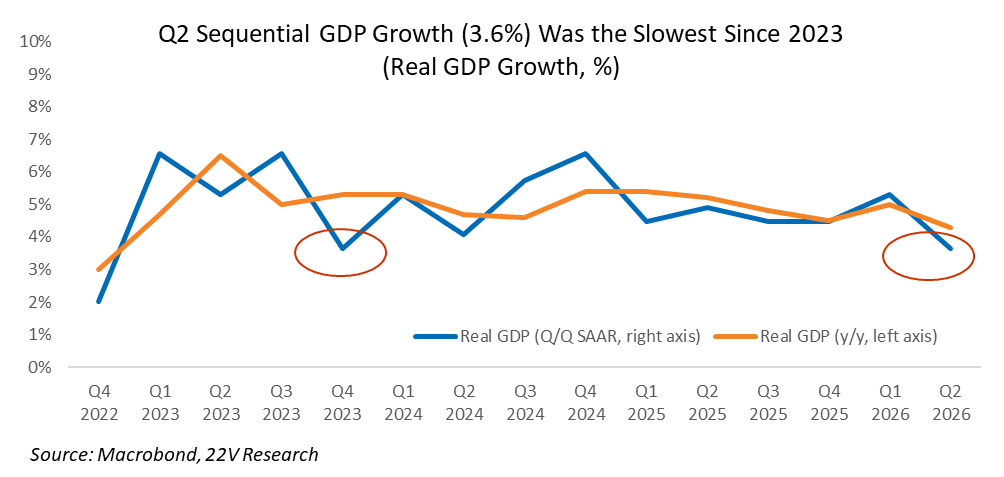
China’s Q2 GDP growth slowed to 4.3% y/y, below the government’s target, but Beijing is unlikely to respond with major new stimulus at the July Politburo meeting. Instead, policymakers are expected to encourage local governments to modestly increase spending within existing budgets, providing only a temporary boost to growth in Q3 before fiscal support fades later in the year. China’s leadership remains comfortable with slower domestic growth as long as exports stay strong and social stability risks remain contained, leaving the economy reliant on external demand while weak consumption and excess industrial capacity persist. The softer growth backdrop strengthens the case for incremental PBOC rate cuts in the second half of the year and supports expectations for a weaker yuan after Xi Jinping’s expected U.S. visit in September. Meanwhile, inventory drawdowns tied to higher oil prices also weighed on Q2 growth, but with oil prices stabilizing, restocking should help lift industrial activity, crude imports, and oil demand in Q3.
Financials:
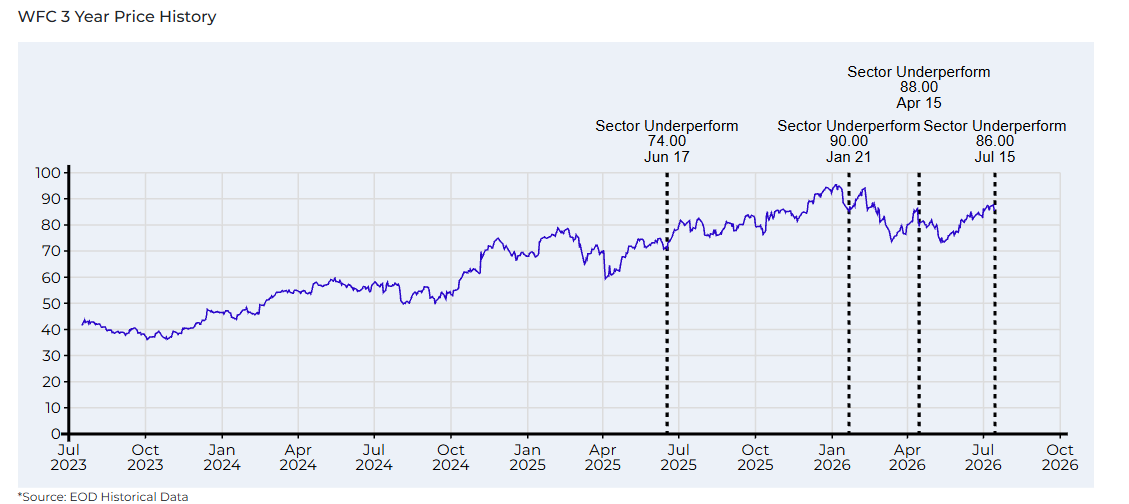
Wells Fargo – Fee Income trajectory improves and expense guide remains flat but our ’27 NII moves lower – Reiterate Sector Underperform– (HERE)
Wells Fargo delivered a strong Q2 earnings beat, driven by better fee income, lower expenses, and improved credit quality, with gains in investment banking, advisory, and trading helping push core fee estimates above consensus for the first time in several quarters. Credit trends also improved, as non-accrual loans declined and net charge-offs remained low. However, these positives were offset by continued pressure on net interest margin (NIM) and net interest income (NII), as higher commercial deposit costs and modest deposit growth weighed on profitability. The higher funding costs create a weaker starting point for 2027 earnings, leading to lower NII forecasts that now sit below consensus. We also see slower capital returns, with buybacks remaining around $3 billion per quarter as management maintains capital levels, while the company’s medium-term 17–18% ROTCE target appears increasingly difficult to achieve given current profitability trends. As a result, FY2027 EPS estimates were cut by 3.6%, the price target was lowered from $88 to $86, and the Sector Underperform rating was maintained.