SUMMARY:
- Despite Q2 GDP growth slowing sharply and coming in below target, we do not expect the July Politburo meeting to announce fresh stimulus measures such as an increased fiscal deficit; Beijing can tolerate weak growth so long as exports are strong and social stability pressures remain contained.
- Beijing will direct local governments to boost spending within their existing budget allocations, partially reversing the spending slowdown in Q2; the acceleration in spending will be modest and transitory, fading in Q4.
- The latest data increase the likelihood of incremental rate cuts by the PBOC in H2, and reaffirm our view of a weaker CNY after Xi Jinping’s expected visit to the US in September.
- Inventory drawdowns also contributed to the Q2 growth slowdown, as firms responded to higher oil prices; unless oil prices regain previous highs on an extended basis, China’s oil consumption and crude import demand should recover in Q3.
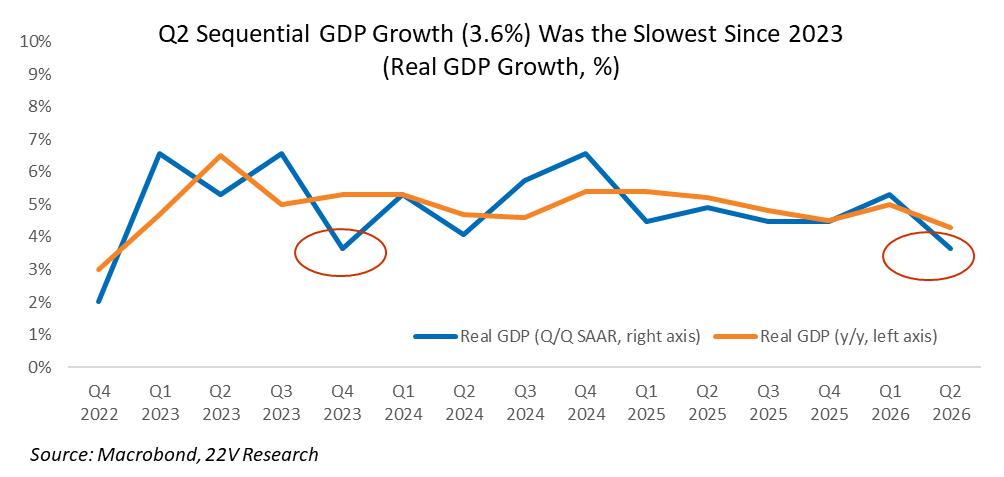
China’s real GDP growth slowed to 4.3% y/y, down from 5% y/y in Q1 and below the 4.5-5% growth target for the year. In sequential terms, Q2 growth was 3.6% q/q SAAR, the slowest rate of growth since late 2023.
Key takeaway: We do not expect the slowdown to trigger announcements of new stimulus when China’s Politburo meets at the end of July for its mid-year review of the economy. Instead, Beijing’s response will be to encourage local governments to boost the pace of spending within their existing budget allocations. This will provide a modest and mostly transitory boost to growth in Q3, with government spending and activity slowing again by the end of the year unless exports falter or domestic social stability pressures increase.
The lack of stronger counter-cyclical measures will leave the economy reliant on exports for growth, while domestic demand remains anemic. A soft labor market will continue to restrain income growth and thus household consumption. Excess capacity will continue to be a problem for the industrial sector. While the GDP deflator turned positive in Q2 for the first time in three years, this was due largely to the energy price shock from the Iran conflict, and we do not expect a sustained turn to reflation unless macro policy becomes significantly more stimulative.
More details below.
IT WILL TAKE WORSE NEWS TO JOLT POLICYMAKERS
Why no new stimulus in Q3? Our discussions on the ground in China last week were consistent with our own views on Beijing’s policy reaction function:
- Beijing feels confident in China’s trade and geopolitical environment. US-China tensions will remain low for the remainder of the year. Europe is increasingly vocal about its trade deficit with China, but thus far lacks the internal political consensus to take tough measures in response. China’s exports are booming (27% y/y in June in USD terms), helped by demand for inputs in the global data center buildout.
- While policymakers would like to see stronger consumption and employment growth, they do not have confidence in policy tools that would spur consumption in the near term – or the appetite for the aggressive fiscal stimulus that would be necessary to boost job and income growth. Instead, Beijing regards the pivot to consumption as a medium-term goal addressed through incremental measures, with the release of the five-year plan on consumption earlier this week reaffirming a gradual approach.
- Unless exports falter or social stability pressures increase – neither of which seem imminent – China’s leadership will focus on its tech and industrial policy priorities rather than growth.
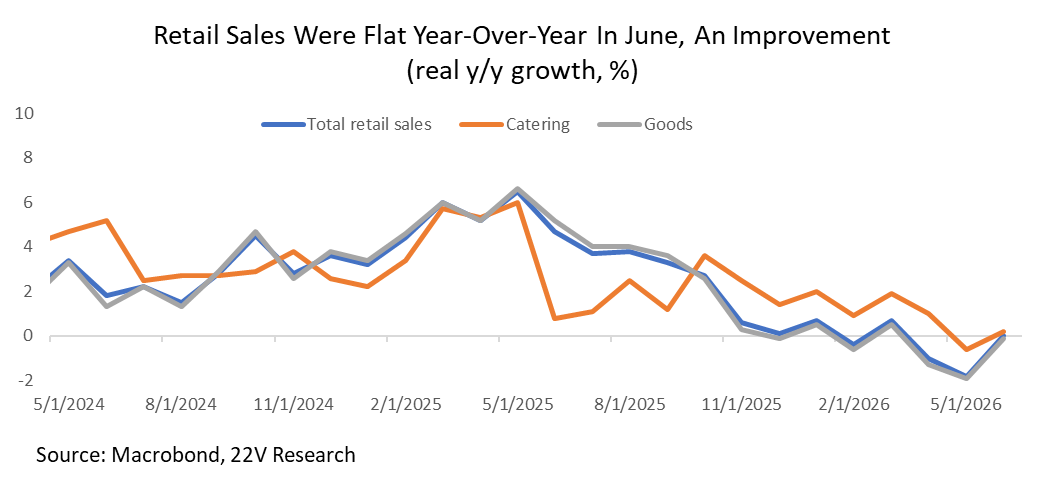
The Q2 economic data are not bad enough to shift this policy reaction function. Other economic data for June, also released today – industrial production and retail sales – showed a modest improvement from May. This will give policymakers optimism that the economic hit from the Iran conflict has peaked, and that they can meet the growth target with modest policy efforts – though of course they will be closely monitoring recent re-escalation.
COMING FISCAL SUPPORT WILL BE MODEST
After strong spending and economic growth in Q1, local governments – picking up on political signals from Beijing – turned their attention from supporting growth to reducing debt. The slowdown in government expenditure was the key factor, along with the Iran energy shock, in the drop in Q2 economic growth. The fact that GDP growth is now below the annual target gives Beijing an incentive to prod local officials to pick up the pace.
However, the acceleration in fiscal expenditure will be modest and transitory. Fiscal investment remained weak in June, with infrastructure investment growth declining from 0.6% y/y in Jan-May to -2.4% y/y in Jan-June. Moreover, fiscal borrowing has been weaker than the seasonal norm since June. These data suggest that local governments continue to face significant financial challenges, and that fiscal expenditure growth in coming months will likely be in the mid-single digits at best. Given Beijing’s reluctance to stimulate growth in recent quarters, and its ongoing focus on local government debt reduction (see our take HERE), the rebound in fiscal expenditure will be transitory, with spending slowing down toward the end of the year.
MONETARY POLICY HAS AN EASING BIAS, WITH DOWNSIDE FOR THE CNY
The case for PBOC rate cuts in the second half has strengthened. Fiscal restraint means the PBOC will have to shoulder more responsibility for supporting growth, while the eventual return of deflation will further reinforce the case for easing. Although any rate cuts will likely be incremental, the direction of policy appears clear. This reaffirms our view (link HERE) of a higher USD/CNY (weaker currency) by the end of the year. Given that Xi Jinping is expected to visit the US in late September, we expect the PBOC to prioritize currency stability through Q3 before becoming more tolerant of depreciation in Q4.
CHINA’S OIL DEMAND SHOULD RECOVER
Besides the fiscal contraction, the latest data suggest that inventory drawdowns contributed to weak Q2 growth. Faced with high oil prices, downstream firms chose to draw down inventories and postpone purchases. Capacity utilization in sectors that are highly sensitive to oil prices, such as chemicals, is down close to 10 percentage points compared with normal levels. Assuming that oil prices stay at current levels, the easing of the price shock and subsequent restocking should help capacity utilization and production rebound in Q3. This also means China’s oil consumption and imports should recover in Q3.
That take is consistent with our conversations last week in China. Contacts in the energy sector believe that temporary factors, including inventory drawdowns and the cessation of exports of refined products, have been the main reasons for China’s lower crude imports. That is, permanent demand destruction, such as through increased electrification/fuel switching, has played only a modest role. Beijing has considerable leeway as it continues to manage these pressures, but underlying demand should recover.