

SUMMARY
- Market attention next week will focus on the official budget deficit target that Beijing announces at the National People’s Congress (NPC); however, this target does not account for local government efforts to resolve their off-budget debts, a key factor in the fiscal outlook.
- Political pressure from the central government means that the drag on growth from local deleveraging will be even larger this year than in 2025; this drag will be concentrated in the second half of the year, with near-term fiscal policy providing moderate support for growth over the next quarter.
- To offset the drag from deleveraging and maintain a neutral fiscal stance, Beijing would need to announce 1.5 trillion yuan in central government bond issuance in 2026; we expect next week’s NPC to announce a smaller amount, reinforcing our subdued growth outlook for the year.
Beijing will release its 2026 fiscal package on March 5, when Premier Li Qiang delivers the government work report on the first day of the annual National People’s Congress. We expect an aggregate fiscal deficit (including the on-budget deficit plus special central government bonds) of around 4.9% of GDP, essentially the same as 2025. But because revenue growth will be weak, on-budget fiscal expenditure is likely to be a small drag on growth (-0.3 pp vs. +0.3 pp in 2025). In this note, we provide an update on China’s ongoing local government deleveraging, which is not part of the budget calculation – and thus difficult for investors to track – but is crucial for correctly estimating the actual fiscal stimulus for this year. When deleveraging of local government debt vehicles (LGFVs) is factored in, it reinforces the view that the overall fiscal stance will be a drag on growth this year.
Since 2023, Chinese local governments have diverted significant amounts of new borrowing to repay the debt of their LGFVs (see chart below). These debt repayments crowd out fiscal investment. By our estimate, ~3.5 trillion yuan, or close to half of local government net borrowing, was used to repay debt in 2025.
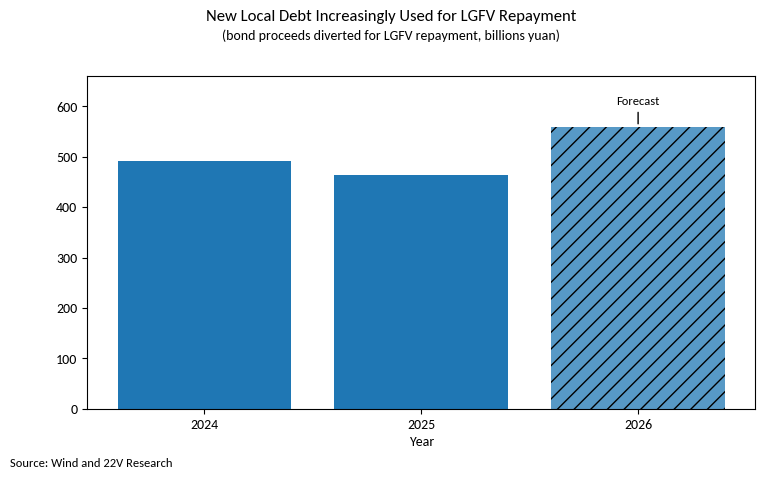
Local government deleveraging is unlikely to moderate in 2026. Beijing has set a mid-2027 deadline to resolve LGFV risk, and a 2028 deadline to resolve all local government off-balance sheet debt. PBOC announced that as of September 2025, 62% of LGFV debt had been resolved and 71% of LGFVs had either exited the market or been converted to fully commercial or fully public entities. While this would suggest that the bulk of the LGFV debt problem has been resolved, political factors suggest deleveraging headwinds will be even more aggressive than in 2025.
In the Chinese government system, local governments compete with each other during policy campaigns like local government deleveraging. This translates to a preference for achieving goals earlier and overdelivering. As a result, we expect the majority of Chinese regions to declare that they have completed LGFV deleveraging by the end of this year. The Party’s anti-corruption body has been handing down harsh punishments for local officials hiding debts, which means that these declarations will be more than just window dressing.
Indeed, the central government also wants the deleveraging campaign to end with strong momentum. China’s leadership has highlighted the LGFV issue during recent high-level policy meetings, including the December 2025 Central Economic Work Conference. Finally, local governments tend to deal with low-hanging fruit first, which means the remaining debt will be more costly to deal with than the liabilities resolved in past years.
The net result is that Beijing will have to announce a substantial increase in central government borrowing – at least 1.5 trillion yuan – to offset local government deleveraging and avoid a negative fiscal stance in 2026. We expect a lower amount – perhaps 1 trillion yuan, as we will note in our upcoming NPC preview.
The math is as follows:
- We expect local governments will devote 3.7 trillion yuan, 200 billion yuan more than 2025, to pay down LGFV debt in 2026. In the meantime, local government interest payments will increase by at least 150 billion yuan in 2026, while land sale revenue will decline by around half a trillion yuan.
- We expect the NPC to increase the special local government bond quota by 200 billion yuan, which is far from enough to offset the drag from deleveraging and declining land sales.
- Based on the above, local government off-budget expenditures (excluding interest payments) will contract by ~0.5% of GDP, which is slightly larger than 2025. And the risk is biased toward a larger drag as deleveraging is likely to be more aggressive this year.
- Central government borrowing will need to be at least 1.5 trillion yuan for the overall fiscal deficit to be neutral.
The fact that we expect central government borrowing to be less than needed to offset these factors is a key reason for our subdued outlook for China’s economy this year (link HERE). However, we should also note that we expect fiscal spending to pick up in the near term, providing a temporary stabilization of activity in March and into Q2. Additionally, with local government refinancing front-loaded in H1, liquidity stress will be relatively low initially. This should result in a comparatively favorable macroeconomic backdrop for the first half, followed by a more pronounced deleveraging drag in the second half of the year.
Note that the end of the LGFV deleveraging campaign in 2027 does not mean that LGFV debt risk will be fully mitigated. The campaign is focused on off-balance-sheet liabilities that account for less than half of total LGFV debt, and more than half of the “deleveraging” is actually in the form of refinancing with long-term debt. As a result, LGFV debt will continue to be a main vulnerability for the Chinese economy.

