This is part II of our China 2026 outlook, focusing on the economy and markets. In part I (link HERE), we examined China’s geopolitical backdrop and US-China relations.
SUMMARY:
- The easing of US-China tensions comes at the risk of increasing Beijing’s complacency towards supporting growth, despite weak domestic demand; the fiscal stance in 2026 will be growth-neutral at best, and monetary policy will also stay restrained.
- Consumption will remain weak due to a soft labor market and the reluctance by policymakers to try bold policies; property investment will continue to contract by more than 10% in 2026.
- The economy will not see significant reflation due to a lack of strong demand-side stimulus and the early stage of absorbing excess manufacturing capacity; nominal GDP growth will be around 4%, the same as in 2025.
- The subdued macro backdrop, and policymakers’ reduced urgency to boost growth and confidence, are headwinds for domestic equities; one bright spot beyond tech-related themes is Chinese listed firms’ ability to tap overseas markets for growth.
Growth On the Back Burner
Three key factors will shape China’s economic climate in 2026: stimulus, household spending, and the prospect of easing deflation. We do not expect any of these three to provide major positive catalysts, however, and exports will provide only modest support as an offset to weak domestic demand. As a result, this will be another challenging year for growth despite renewed enthusiasm over China’s tech sector. Headline real GDP growth will look decent (4.5-5%, compared to 5% in 2025), but will be flattered by production numbers that mask weakness on the demand side of the economy. Nominal GDP growth, a better barometer of the state of the economy, will be around 4% (the same as last year) as deflationary pressures persist.
As we explained in Part I of the outlook (link HERE), a broadly favorable geopolitical backdrop for China in 2026 reduces pressure on Beijing to support the economy. US-China détente has lowered tariffs and should limit escalation risks through US midterm elections in November. At the same time, Trump’s confrontational foreign policy is reducing the willingness of third countries, such as European allies, to forcefully pushback on China’s massive trade surplus. With external pressures reduced, Beijing has signaled limited urgency to boost near-term domestic demand despite sliding growth momentum (see our write-up of December’s Central Economic Work Conference HERE). Instead, policymakers will concentrate on the longer-term priorities in the 15th Five-Year Plan (2026-2030), which comes out in March. These center on technological and industrial self-sufficiency.
Indeed, confidence in external stability is increasing Beijing’s tolerance for domestic policies that are potentially negative for short-term growth and confidence:
- The US-China détente in the fall made it tolerable for Beijing to allow property developer Vanke to default on its onshore bonds, with less concern about a confidence shock.
- Beijing signaled an expansion in the scope of local government debt that will be subject to deleveraging, and local governments have themselves tightened rules on overseas borrowing by state-owned enterprises.
- Regulators have stepped up enforcement actions, including a recent anti-trust investigation into Trip.com.
Broad fiscal policy will be growth-neutral at best in 2026, with risks to the downside from local government deleveraging:
- We expect on-budget fiscal expenditure to be flat as a percentage of GDP, a growth-neutral stance. Note that with budget revenues expected to be flat y/y and land sales to continue to decline, China will need to borrow at least 1 trillion yuan more than in 2025 just to maintain a neutral fiscal stance. Initial debt issuance plans will be formalized at the National People’s Congress in March.
- With off-budget spending by local governments included, the broad fiscal stance will be growth-neutral at best. Beijing is maintaining political pressure on local governments to control off-budget spending, without providing sufficient transfers or stimulus to offset the impact. This state of affairs is not sustainable in the long run. A potential political shift to loosening these constraints is one of our most important watchpoints for China’s economy, but we do not expect it to come this year.
Monetary policy is also unlikely to become more proactive. The strength of the yuan means that the PBOC is less concerned about the potential for monetary easing to increase depreciation pressure. However, PBOC continues to worry that rate cuts will further erode banks’ already narrow net interest margins. Unless there is greater pressure from the leadership to support the economy, PBOC will aim to muddle through with only modest easing. We expect a 25 bps RRR cut and 10bps LPR cut this year.
Cautious Households, Conservative Policies
Chinese households are still cautious and reluctant to spend:
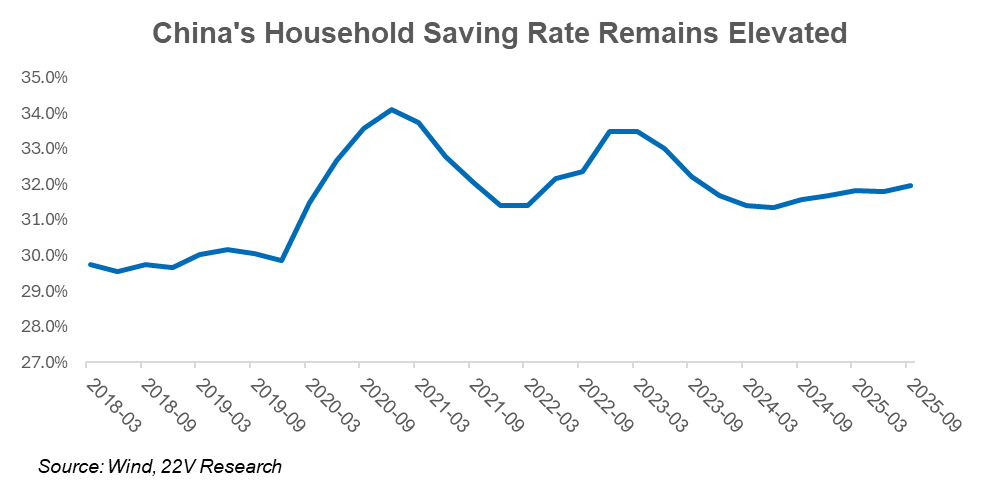
- The surveyed household savings rate has stayed at ~32% since 2024, which is about 2 percentage points higher than pre-pandemic (chart).
- This caution is a rational response to elevated job insecurity. The PMI employment sub-index has remained subdued at ~47 (well below the expansionary mark of 50), and shows no signs of improvement. Construction-sector employment is declining by ~5 million jobs per year. More than 240 million workers (~30% of labor force) are now in the gig economy.
The high household saving rate limits Beijing’s boldness in trying to stimulate growth through consumption:
- To be effective and achieve a growth multiplier above 1, consumption-focused stimulus needs to be large enough to reduce the saving rate. We estimate this would require at least 1 trillion yuan in funding.
- While that amount is manageable from a fiscal perspective, policymakers are not yet bold (or desperate) enough to try consumption initiatives at scale. Indeed, the fleeting results of recent incremental consumption measures is reinforcing their caution. Weak retail data in recent months have already indicated the diminishing effectiveness of trade-in incentives used in 2025.
- We thus expect the composition of stimulus to continue favor investment over consumption. Fiscal expenditure that directly targets households will likely be flat y/y, with a reallocation from trade-in programs to goods to services categories like kindergarten fees.
The same dynamic is holding back a recovery in housing. Subdued household economic confidence will also dampen the effectiveness of incremental property support measures. This, in turn, decreases Beijing’s willingness to try to stimulate the sector. With bold measures off the table, we expect property construction will continue to contract by more than 10% in 2026.
No Meaningful Reflation
Despite the ongoing anti-involution campaign, we do not think there will be meaningful reflation in 2026: we expect China’s nominal growth to be around 4% in 2026. This view is based on our forecast of mediocre demand growth, and the observation that the economy is still at an early stage of reducing excessive capacity.
Without stronger demand, supply cuts merely redistribute profit between up and downstream, not broad reflation across the economy. When demand is weak, upstream price hikes cannot be passed through to end consumers without hurting demand. This means supply-side measures, Beijing’s current toolkit for addressing deflation and “involution,” are unlikely to improve revenue or earnings growth on a sustained basis. At the macro level, because higher prices destroy demand, broad supply-side measures will likely lead to weaker real GDP growth while nominal growth remains broadly unchanged.
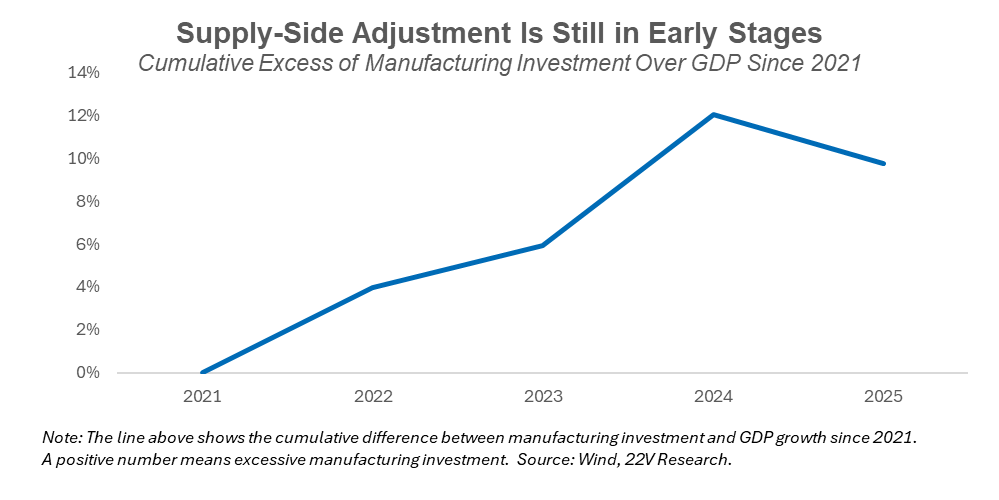
While manufacturing investment growth has slowed down since summer, there is still a long way to go in solving excessive capacity. As a share of the economy, the manufacturing sector has already peaked and is currently on a declining trajectory. This means that the level of manufacturing investment growth that is consistent with normal utilization rates and returns on capital is lower than nominal GDP growth. Yet since 2022, cumulative manufacturing investment growth has outpaced nominal GDP by more than 8% (chart). We estimate that at least two years of negative manufacturing investment growth is required to absorb that excess in investment. Despite the recent slowdown, 2025 full-year manufacturing fixed investment growth is still a positive 0.6%. At this pace, we are unlikely to see meaningful progress before mid-2027.
Exports Will Continue to Be a Driver, But Only Incrementally
Despite the impact of the trade war, China’s exports managed to grow by 5.5% last year. It will be hard to significantly top that in 2026:
- One reason for China’s strong export performance is impressive global trade growth (6% in 2025, according to UNCTAD). Assuming global trade growth will exceed China’s nominal growth—our baseline—exports will continue to grow faster than other parts of the Chinese economy.
- However, given increased global unease about China’s trade surplus, we doubt that China can further gain market share in global exports (14.5%). Thus, our baseline is for export growth that is around the level of global trade growth.
- Furthermore, the trade-weighted CNY index was at its weakest level in recent years through 2025. We are skeptical of the case for major appreciation in 2026, as we discussed in December (link HERE). Still, the CNY is more likely to appreciate than depreciate, which would offset some of exports’ boost to China’s GDP.
Markets: Equities to Receive Limited Help from Macro
Chinese equities rose close to 30% in 2025, despite a weak domestic growth backdrop. Tech narratives were a key source of support and will continue to play out in 2026, as discussed in our recent webinar on the China AI outlook (link HERE). However, without a major improvement in demand or deflationary dynamics, it will be challenging for equities to extend gains of last year’s magnitude.
Indeed, we would highlight two risks:
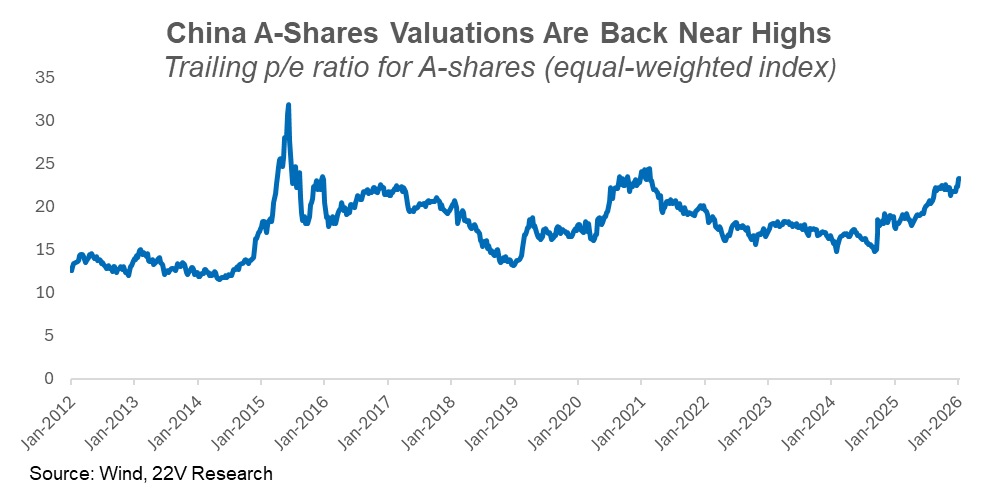
- Equities gained in part due to expected inflows from increased household equity allocation, which has yet to fully materialize. So far, data indicate that actual increase in equity allocation has been very modest. On the other hand, A-shares’ (on an equal-weighted basis) valuations have increased by close to 50% since July 2024 and is already at the expensive end historically. If earnings are not improving and household allocation remains limited, current A-share valuations seem vulnerable to a pullback or at least a stall.
- Another uncertainty is Beijing’s increased tolerance for growth-negative policies. As noted above, policymakers seem to perceive current stability in the U.S.-China relationship as a window of opportunity to take necessary actions that are negative for growth and confidence. We do not expect a repeat of the broad crackdowns on big tech that happened in 2021, but even the prospect of reduced government support can weigh on highly leveraged private companies, especially those in the overcapacity sectors, such as electric vehicles (EVs).
On the upside, we see more room for Chinese firms to boost their overseas earnings. Chinese firms usually have significantly lower margins compared to global peers, which makes overseas markets attractive as an opportunity to boost selling prices and profitability. At a time when China is under criticism for “dumping,” Beijing has an incentive to encourage Chinese firms to raise prices when selling overseas. Beyond exports, many Chinese companies are expanding their overseas sales not only through exports but by expanding operations, including a new crop of retail companies with strong brands (from coffee/tea chains to Pop Mart’s Labubu). Overseas revenues of Chinese listed firms have grown considerably but still lag well below listed US firms.