

SUMMARY
- Domestic economists are increasingly calling for Beijing to make a strategic pivot to a strong CNY to boost domestic consumption and reduce reliance on exports.
- While Beijing may signal somewhat more tolerance for CNY strength in coming months, we doubt that large appreciation is desirable for policymakers or feasible given the weakness in the domestic economy; a strategic pivot in currency policy is unlikely until Beijing decides to reflate the economy, which is not imminent.
- Neither Beijing nor China’s main trading partners will view a stronger CNY as the main tool to manage trade frictions; a major political agreement involving currencies is unlikely as an outcome of Trump’s visit to China in April.
The Calls (for a Stronger CNY) Are Coming from Inside the House
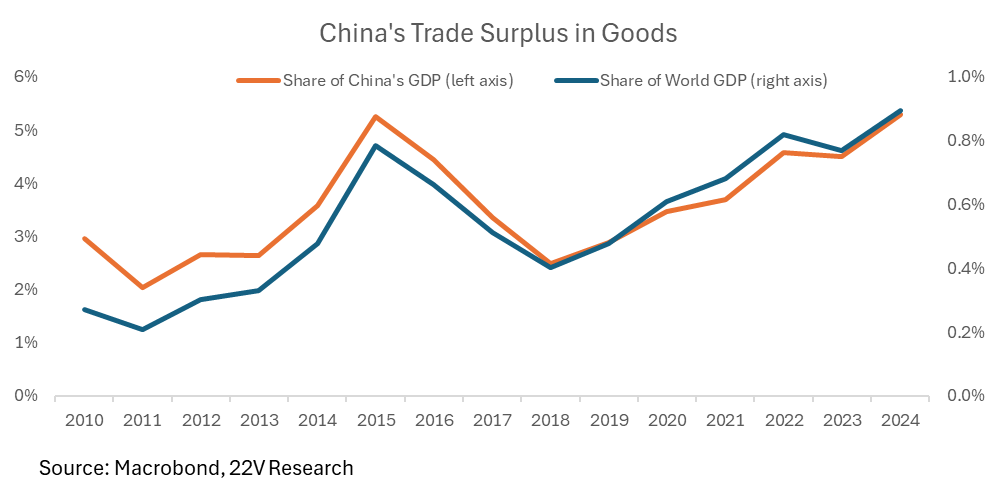
Calls for China to promote a stronger currency are growing. Surprisingly, some of the loudest voices are domestic rather than the usual suspects overseas. Miao Yanliang, the chief economist at CICC – who previously worked for SAFE, the foreign exchange regulator – is among the economists who have recently called for CNY appreciation. The main argument, also articulated well by PAG chairman Shan Weijian in the FT (link HERE), is that a stronger currency would help promote domestic consumption (by increasing real household incomes) and reduce China’s reliance on exports. This comes at a time when China’s trade surplus is back at peak levels (see chart), creating political and economic risks for China as trade tensions rise.
On the international side, the IMF has recently concluded that the CNY is undervalued and started to nudge China on the issue again after a long hiatus. And with Trump due to make a state visit to China in April, speculation is likely to increase over whether CNY appreciation could be a potential deliverable.
While it is hard to argue that the CNY is not undervalued, we do not think that the domestic and international political conditions have come together for a sustained move to a strong CNY. Our base case is that USDCNY is mostly flat (+/- 2%) through H1 2026. The main upside risk to this call is that the broad dollar weakens, which would allow more room for the CNY to appreciate against the dollar while limiting its strength relative to other currencies.
Domestic Policy: Not Ready to Reflate
One key constraint to a strategic pivot in currency policy is that the PBOC will want to make sure that such a move is sustainable and backed by fundamentals – otherwise, signaling a tolerance for a stronger currency would invite short-term capital inflows that could quickly reverse once market participants assess that appreciation is done. This is, after all, still a domestic economy facing significant weakness, including a property sector that has yet to bottom, deflationary pressures (and the expectation of loose monetary policy), and soft household consumption.
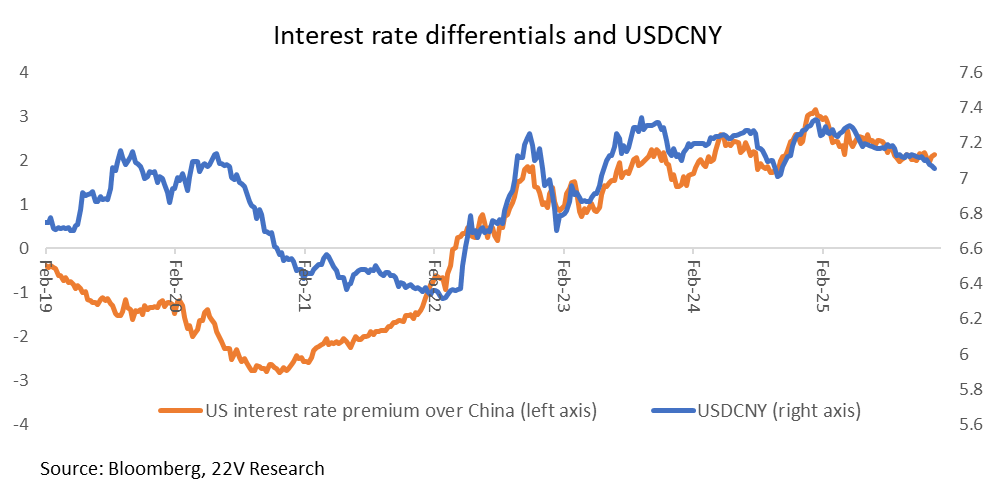
For these reasons, we doubt that Beijing will be comfortable changing currency policy until it makes a broader decision to reflate the economy, especially through fiscal stimulus. More aggressive demand-side stimulus would put upward pressure on domestic interest rates, which is necessary for CNY appreciation against the dollar to be sustainable. As the chart below shows, USDCNY has closely tracked US-China interest rate differentials in recent years. It is unlikely that Fed cuts will close much of that gap in 2026, so developments in China would need to do much of the work.
However, Beijing’s current low level of urgency towards the economy (see more HERE) suggests that a decisive move to reflate the economy is not coming anytime soon. The probability goes up as China moves closer to the next political transition in the fall of 2027. In the meantime, the most likely trigger would be signs that weak demand and deflationary pressures risk a serious financial crisis and social unrest.
Trade Policy: CNY is Not the Focus of Trade Frictions
President Trump designated China for “currency manipulation” in his first term but has been exceedingly quiet on the currency since taking office. One reason is that the USDCNY exchange rate has been mostly stable despite US tariffs; the USDCNY exchange rate is back to where it was when Trump was elected in November 2024. Another reason is that US tariffs have succeeded in lowering the bilateral US trade deficit with China. This has reduced the salience of the issue, even if it is mostly offset by an increase in the US trade deficit with other countries as the result of rerouted trade from China. The bilateral deficit may increase again following Trump’s 10% reduction of tariffs on China imports in November. Finally, it also helps that a weaker CNY (in real terms) has kept US inflation lower than it otherwise would, during a period in which “affordability” is the most sensitive issue for US voters.
As Trump looks towards his China trip in April, he is likely to be much more focused on tangible deliverables – Chinese commitments to purchase US goods, and perhaps invest in the United States – than the more abstract and diffuse goal of currency appreciation. The latter will matter more to Treasury Secretary Bessent and the Council of Economic Advisers’ Stephen Miran once he returns to the White House from his current stint at the Fed. But Bessent and Miran are unlikely to get much traction in having Trump expend political capital on a “Mar-a-Lago Accord” on currencies and economic rebalancing when the President is focused on soybeans, Boeing planes, TikTok, and semiconductors and rare earths.
Trump’s tariffs have worsened the flood of Chinese exports to Europe and other trade partners, but these third parties are not going to pick up the slack in speaking up on the currency issue. French President Macron wrote about the need to rebalance trade relations with China in the FT this week (link HERE) and plans to make it a focus of his G7 presidency next year, but did not even mention currencies. The scale of China’s manufacturing dominance has become so large that trade partners, with good reason, have little confidence that currency appreciation will make much of a difference. Macron, and Europe in general, are pressing China to reduce industrial subsidies but even more so to move more manufacturing to Europe.
For China’s leadership, administrative tools are more attractive for managing trade tensions than the currency. China’s potential administrative toolkit to boost export prices include reducing export tax rebates; strengthening firms’ compliance in paying export taxes; setting a minimum price on exports; and limiting export licenses for specific firms (e.g., weaker firms with major excess capacity). These measures have benefits of raising revenue for Beijing (e.g., tax instruments) and/or boosting the competitiveness of Chinese industry leaders by throttling weaker players (export licenses). Indeed, preventing weaker firms in excess capacity industries from exporting their way to survival is consistent with Beijing’s “anti-involution” efforts, and officials have called on firms not to “export involution” to other markets. Beijing can also use administrative tools to pledge to boost imports (such as through state-owned companies) and encourage Chinese manufacturers to invest in production overseas.
By contrast, currency appreciation is a blunt tool. Stakeholders in China will worry about the risks to growth and to overall export competitiveness at a time when China’s industrial modernization remains Beijing’s top task in the coming Five-Year Plan (link HERE). Finally, Beijing will be deeply skeptical of political agreements on currencies that smack of the 1980s Plaza Accord and its successors. Many in China view the Plaza Accord as a trap that the US sprung on Japan, with yen appreciation contributing to the inflation and then popping of Japan’s asset price bubble (despite the fact that this is a minority view even in Japan).
The bottom line is that a strong and sustained rally in the CNY is unlikely without a move to reflate the economy. In the meantime, Beijing will try to muddle through with only modest stimulus, using administrative tools rather than CNY appreciation to manage trade tensions.

