

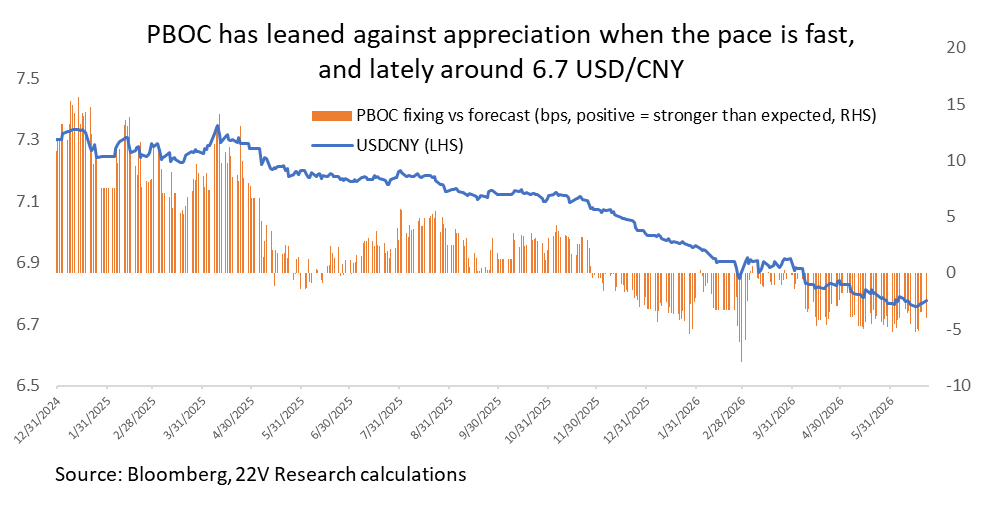
At the end of 2025, we pushed back on expectations in some quarters for major appreciation of the CNY (link HERE). Since then, the CNY’s appreciation against the dollar has been 4%, better than our base case of a more modest appreciation (~2%/year).
With China continuing to post large trade surpluses, and the CNY undervalued by most conventional metrics, the political noise around the currency continues to ratchet up. At a G7 meeting last week in which global imbalances were a main agenda item, German Chancellor Friedrich Merz called for collective action to address China’s currency and invoked the 1985 Plaza Accord as a template.
However, we see meaningful risk that USD/CNY ends the year above the current forward-implied level of 6.7. A domestic growth slowdown, the risk of Fed rate hikes, and recent crackdowns on capital outflows will create substantial headwinds for the currency. As a result, the recent CNY strengthening trend is likely to stall, with the trajectory biased toward a higher USD/CNY.
Economic Outlook Does Not Support CNY Strength
One of the key factors for the CNY is the strength of the domestic economy, as this encourages Chinese exporters to repatriate their overseas earnings. On this point we are not optimistic. While China’s growth has weakened significantly since Q2, we think the policy response will likely be restrained and behind the curve, particularly in terms of fiscal stimulus (see our take HERE). Weak domestic growth depresses capital returns, deterring inflows.
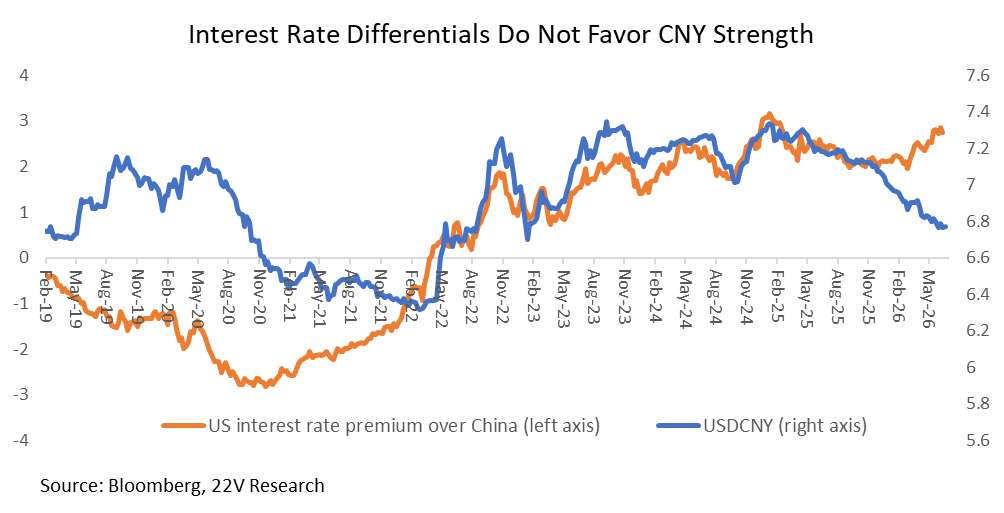
Another factor, interest rate differentials, is also unlikely to be favorable. PBOC is likely to pursue incremental easing in the coming months. Beijing has made fighting deflation a top priority for the PBOC, which means the central bank will need to ease if PPI deflation returns. As long as oil does not move higher, China’s PPI will likely resume deflation in early Q3. Under restrained fiscal policy, monetary easing is likely to be bearish for CNY. The fact that the Fed is close to hiking rates adds further pressure to CNY.
Finally, recent regulatory tightening over capital outflows will likely reduce capital inflows in the coming months. Beijing has tightened regulations around outward direct investment and cracked down on popular brokerages that Chinese households rely on to invest abroad. Greater difficulty in sending money abroad means households and firms, especially exporters, may become more reluctant to bring capital into China because they worry it could be harder to move it out again later.
Trade Tensions More Bark Than Bite
Trade tensions are also unlikely to support the CNY:
- While the EU has recently ramped up criticism of CNY undervaluation, the bloc lacks the internal consensus to take aggressive trade measures, punting again at a summit last week. Beijing does not appear to be in any hurry to reach an understanding with the EU on trade.
- The Trump administration is largely checked out on China’s currency. Tariffs have reduced the US bilateral deficit with China, reducing its political salience, and Trump is focused on securing Chinese purchase commitments.
- In the meantime, to the extent that China’s surging trade surplus affects Beijing’s policy thinking, it is more likely to lead to a reduction in export tax rebates than to CNY appreciation. Reducing export tax rebates would create direct fiscal benefits, while CNY appreciation would not generate much direct benefit for the Chinese government. And while Chinese policy advisors continue to warn about the risks of export-led growth, Beijing views economic rebalancing as a long-term, gradual goal.
The bar is particularly high for any kind of Plaza-type accord in which China, along with Japan and South Korea – whose currencies have been even weaker of late – agree to a coordinated approach to promoting appreciation. Beijing believes the Plaza Accord set a trap for Japan’s economy in the 1980s and lacks the trust and incentives to agree to a reprise today – especially absent pressure from Washington.

