

China’s May data suggests the economy weakened further throughout the month. Key indicators of domestic demand, from retail sales to investment, softened compared to an already weak April. In particular, lackluster property data cast doubt on hopes for a housing market bottom (which we warned against last month). Property price declines accelerated, while sales continued to contract by double digits.
Infrastructure investment growth also continued its downward trend, with year-to-date year-over-year growth plunging from 4.3% in April to 0.6% in May due to the fading effects of a front-loaded fiscal stimulus. Meanwhile, government bond issuance remains weak month-to-date in June, and recent leadership speeches have shown little urgency regarding new stimulus. Consequently, we believe fiscal expenditure growth is unlikely to accelerate anytime soon.
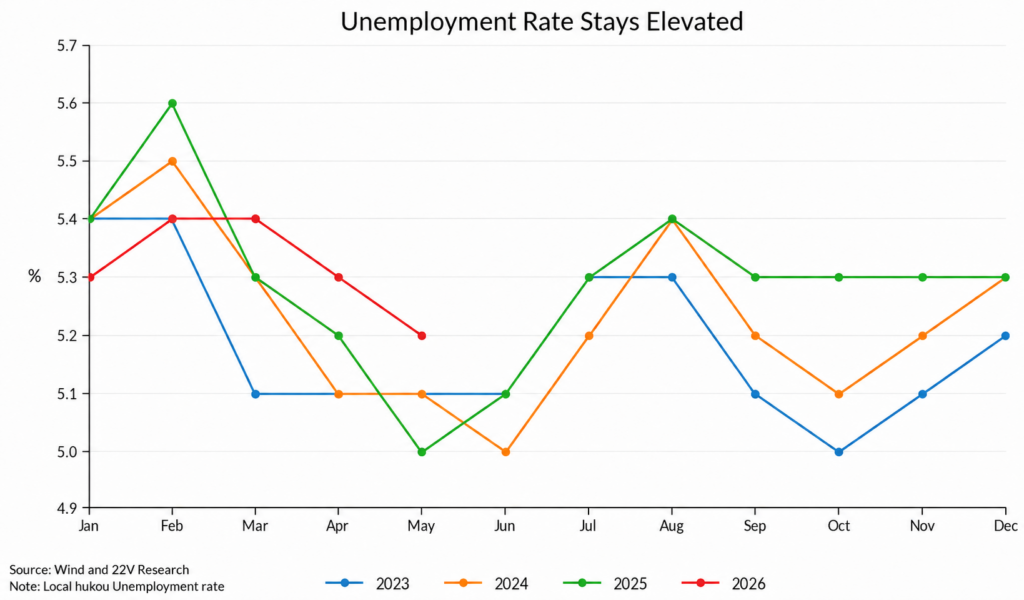
Furthermore, falling oil prices are unlikely to provide a significant boost to Chinese growth. Thus far, there is little evidence that previously high oil prices crowded out spending in other sectors; in fact, retail sales for oil products actually declined YoY. Instead, sales softened across 13 out of 16 retail categories in May. This widespread contraction indicates that consumer pessimism is the root cause of consumption weakness, likely driven by recent labor market softening. Notably, the unemployment rate for workers with a local hukou (residency permit) – which corrects for an underreporting bias due to unemployed migrant workers returning home – is 0.2 percentage points higher YoY (see Figure). As a result, without a meaningful recovery in the labor market, lower oil prices alone will not trigger a consumption rebound.
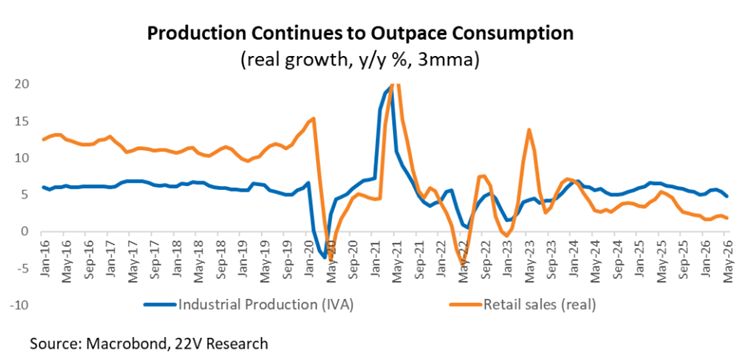
Of the headline series, only production improved (4.5% y/y, from 4.1% in April), and this was on the strength of strong export numbers reported earlier in the month (13.8% y/y). China’s growth is increasingly reliant on exports, especially high-tech exports related to the global data center buildout (about one half of export growth this year). But this is a narrow base to support the economy, and it increasingly shows.
Despite the growth slowdown since March, we maintain modest expectations for further economic stimulus.
First, even under an optimistic revenue forecast, the remaining fiscal deficit room for this year is only sufficient to support a neutral fiscal stance, translating to roughly 4% expenditure growth—in line with nominal GDP expansion. Beijing could decide to increase the fiscal deficit, but that decision would likely come in the fall and only if the leadership feels a high degree of urgency.
Second, the stabilization of US-China relations reduces the urgency for aggressive stimulus. We believe the September 2024 policy pivot was, to a large extent, a defensive measure preparing for a second Trump administration and the restart of trade war. However, once Washington and Beijing reached a truce in mid-2025, the subsequent domestic policy response became “too little, too late.” As we expect the US-China relationship to remain stable, a lower risk of confrontation will continue to diminish Beijing’s urgency to pump up the economy.
Third, Beijing has increasingly adopted a “whitelist” approach to approving fiscal investments by local governments to restrain growth in local debts. Consequently, outside a narrow selection of centrally endorsed projects, local governments face constraints when trying to pursue their own investment initiatives.
In sum, we view the risks surrounding the policy outlook as asymmetric. The government’s response remains biased toward being insufficient and behind the curve. Our baseline is that July politburo meeting will start modest acceleration of fiscal expenditure, but this stimulus is unlikely to last more than three months. There is a meaningful tail risk that stimulus turns out to be weaker than this baseline, and Beijing decides to tough out the year, reporting full-year official GDP growth numbers that meet the bottom end of the targeted range (4.5-5%) but reflect an economy continuing to suffer from domestic malaise.
Potential triggers for a more aggressive stimulus could include faltering exports, and social stability pressures caused by mounting strains in the labor market. Neither looks imminent, and there will be a high bar for Beijing to react forcefully.

