

After more than four years of downturn, China’s property market is showing some signs of improvement. In first-tier cities, property prices and sales in the secondary market have rebounded year-to-date. This has led to optimism that other cities will soon follow, and that the market will soon bottom out. Yet we believe it is still too early to call a property bottom.
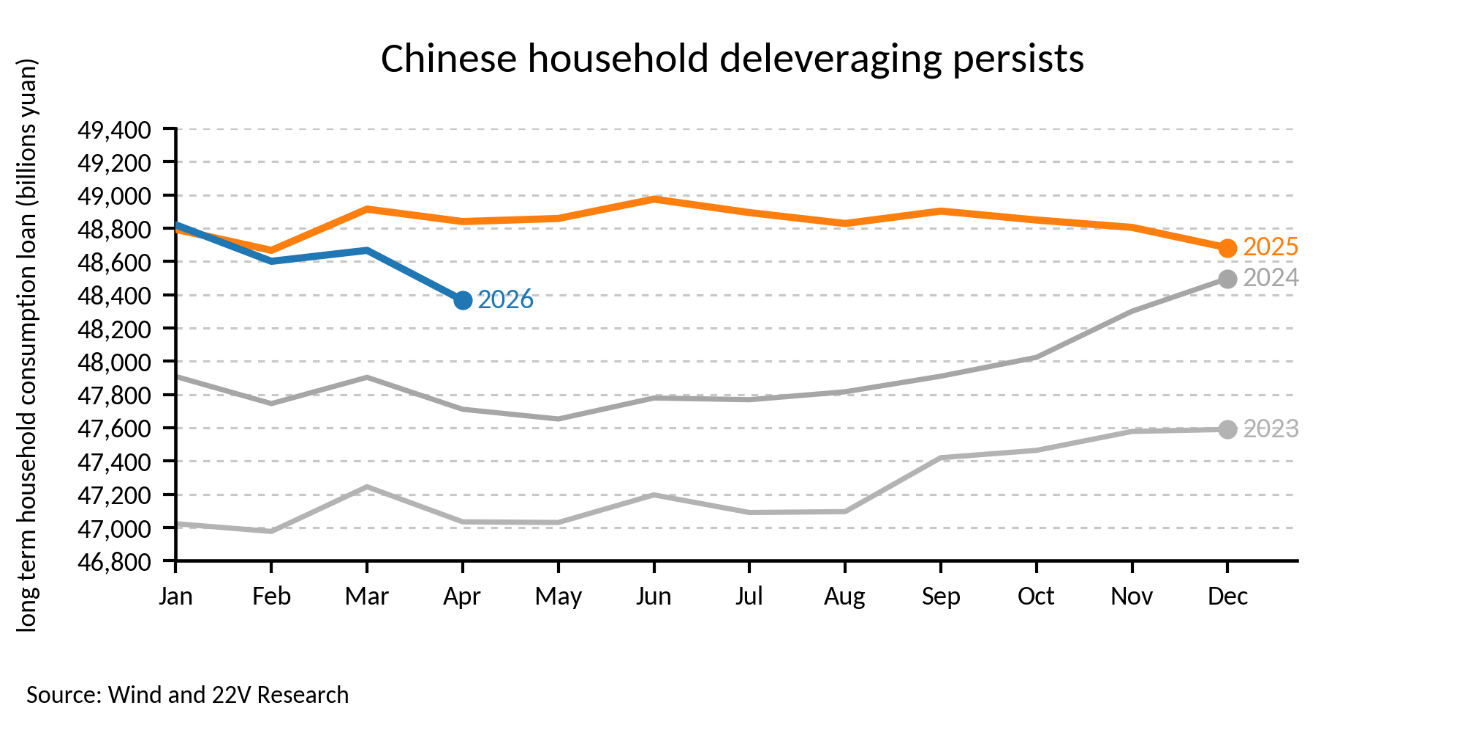
First, restrictive fiscal policy is adding to the macroeconomic headwinds in the property sector. A sustainable property market recovery requires households to stop deleveraging, which they continue to do this year (see chart). The key driver is a soft labor market, which is making households cautious; the household saving rate, already elevated, increased by almost 1 percentage point in 2026. Investors are looking for a property market rebound to boost broader growth, but we think this sequence is reversed: a property market recovery will likely come only after growth has improved enough to spur an improvement in the labor market and re-leveraging by households.
Fiscal policy, Beijing’s key lever for boosting growth, has turned from stimulative in Q1 to restrictive in Q2. Our base case remains that fiscal policy will stay restrictive until Q3, and the risks are skewed toward delayed stimulus (see our recent take HERE). For one, lower U.S.-China confrontation risks following Trump’s China visit reduces Beijing’s urgency to stimulate the economy, potentially on a long-term basis. In addition, China’s official data likely understate the current weakness of growth, which increases the risk that policymakers fall behind the curve. A significant share of official monthly and quarterly value-added data is imputed under the assumption of constant margins. However, as upstream inflation has been meaningfully stronger than midstream and downstream inflation since March, it is more likely that margins have shrunk for most midstream and downstream sectors. Restrictive fiscal policy will lead to a worse labor market in the coming months, with households postponing their property purchases.
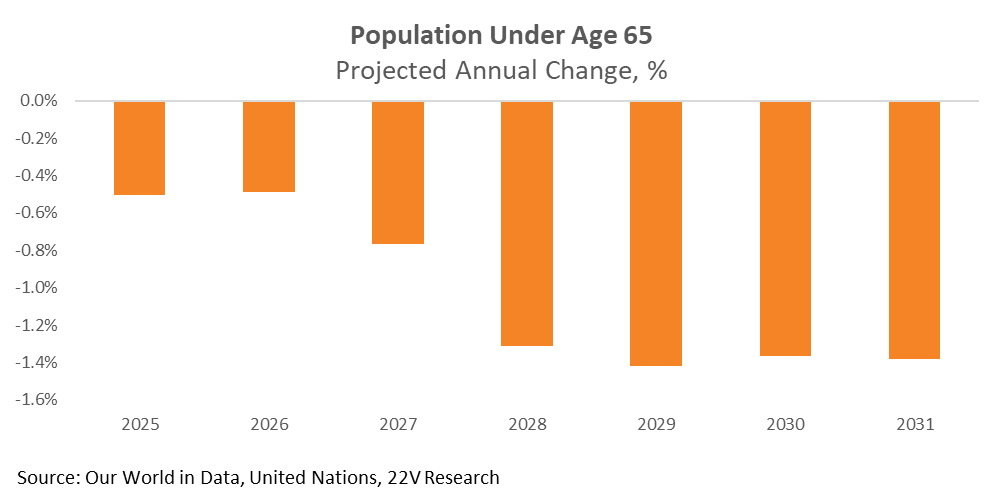
Second, long-term demographic challenges imply limited upside for property. While cities such as Shanghai can still increase their populations through internal migration, China as a whole is expected to experience population decline of at least 0.2% per year in the coming years; the population under age 65 (which is more likely to purchase homes than the elderly) will decline at an even faster rate (see chart). This means national-level property demand and valuations will likely remain subdued even after the market manages to stabilize. And this also makes betting on an early property rebound less rewarding.
Finally, the recent property improvement has a lot to do with one-off factors. Many large cities eased property purchase restrictions in late 2025, and historically, similar easing measures have usually created only transitory rebounds. Nonetheless, even in Shanghai, which has shown the most improvement among Chinese cities, households continue to deleverage.
In summary, the combined drag from fiscal policy and from demographics means a high bar for betting on an early property market recovery. We would watch improved macro backdrop, for which more supportive fiscal policy will be key.

