June FOMC Preview: a Pause for Now but Hawkish Momentum Builds
- The inflation outlook keeps deteriorating, the labor market seems to have stabilized, and growth is surprisingly robust given the bevy of shocks hitting the economy.
- Fundamentally, the economy already appears close to or below (short-run?) neutral.
- Officials assessments of labor market and growth risks will move towards balance, while the inflation baseline deteriorates and its risks remain skewed to the upside.
- While hikes are not yet most officials’ baseline, the easing bias will be removed from the statement and the dot plot will show most with neither hikes not cuts this year and a rough balance between those two active policy choices.
- A sequence of 2-4x hikes starting in late 2026 or early 2027 seems increasingly plausible. Many officials will want to look through the next few months of inflation given war + tariffs but if that data goes poorly, or the cleaner reads in the fall keeps forcing forecasts higher, not responding becomes increasingly implausible. Easing within the next 12 months would likely take a large swing in baseline inflation forecast and deterioration in labor market risks beyond just a further small linear softening.
The SEP Shows a Shifting Balance of Risks and Reheating Baselines
Given the data over the past few months, the hawkish directional shifts in the SEP will hardly be surprising. Inflation will move higher, growth fairly steady, and the unemployment rate forecast will decline. High frequency data has been surprisingly strong and shows that ex-gas real spending has not declined in the face of the war, surprising most hawkish-optimistic expectations from a few months ago. Corporate commentary in recent weeks has varied between strong and very strong, something which Fed officials are likely to have heard more of in their recent pre-meeting briefings (see more here and here).
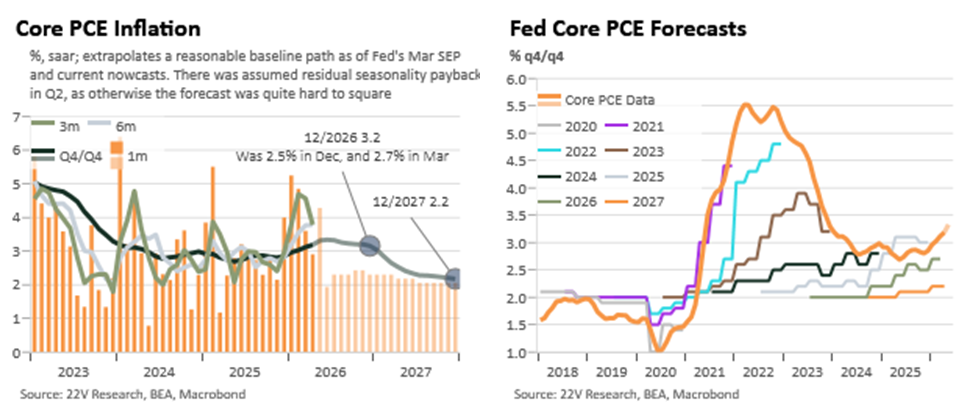
- The core PCE forecasts will have to move up at to at least 3.2% for 2026 just given the data in hand since the last meeting. It seems hard to imagine the rest of 2026 and early 2027 forecasts not seeing some additional upward pressure given that core impacts of the AI boom and war have not yet started impacting the data. My tentative view is 3.3% core PCE for 2026 and 2.4% in 2027. In March’s SEP it seemed like the Fed embedded either Q2 residual seasonality or H2 post-war core whipsaws. There’s not much evidence for either but it is a troubling possibility that we have actually seen downside residual in Q2 it is just being swamped by upside pressures.
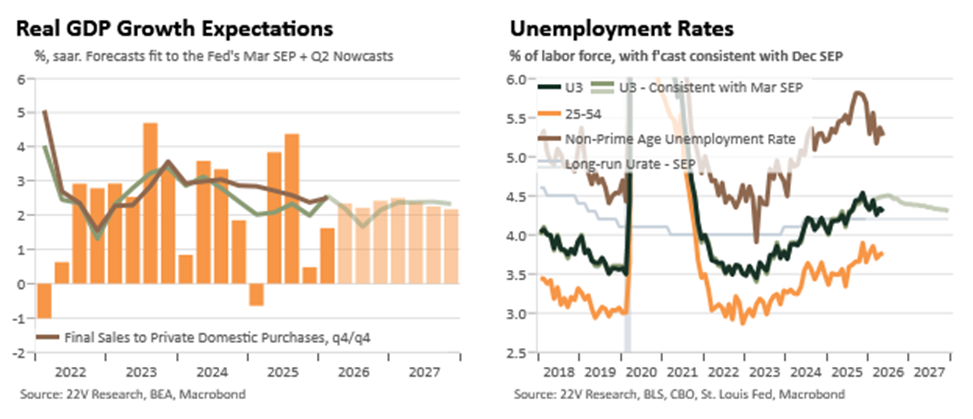
- GDP growth expectations will likely be marked down three tenths to 2.1% in 2026 reflecting the softer Q1 but still solid tracking for Q2 with implied dynamics for H2 and beyond relatively unchanged with better data offsetting war-related drags.
- The unemployment rate forecast will likely dip to 4.3% in 2026 before its shown returning to its long-run level of 4.2% across the rest of the forecast horizon. With the inflation outlook where it is, it seems a struggle to imagine that Fed officials will show the unemployment rate moving back into tight territory under their appropriate policy baseline. That may well ultimately happen but in the SEP it would likely be a lagging rather than predictive one. At the moment there is likely, or at least should be, a strong correlation between Fed officials who think that the labor market start to reenter tight territory and those calling for hikes. Inflation is driving the hawkish momentum but its return to target becomes appreciably more challenging if the labor market starts to reheat.
- The risk assessments will shift in an anti-dovish direction as well. It is unlikely that many, or any, will see risks tilted to the downside for the unemployment rate but there will be a large swing towards balance rather than upside risks to the unemployment rate. For inflation, almost all the participants already saw upside risks, which have been partially realized.
- The shifting baselines and risk balances are reducing dovish officials expectations of future cuts and pushing the median ever closer to thinking that hikes could be the appropriate baseline.
Dot Disagreement Around a Flat Policy Path
The dot plot will lag a bit and likely not show outright hawkish changes from the median though as most Fed officials hope that the current stance of policy can be restrictive enough to keep inflationary pressures in check once the current series of policy-induced supply shocks start to fade out of the data. The economy’s resilience in the face of the supply shocks, despite rates still appreciably above the Fed’s estimate of long-run neutral, suggests that underlying policy is somewhat less restrictive than expected.
- The median dot for 2026 will shift up 25bps and show an unchanged fed funds rate. That +25bps shift is likely to carry on into 2027 as well where the median will show a single cut but it may move up by 50bps to no cut. The shift in the inflation forecasts is simply too large not call for at least a bit higher policy, relative to the counterfactual, over the next few years.
- In 2026 there will be a rough balance between those calling for cuts and hikes around the no change policy rate baseline.
- One of the fundamental issues though is that the Fed’s real policy rate expectations for 2026 will have eased appreciably over the course of the past 6 months and many will be increasingly uncomfortable with that given the stabilization in the labor market and worsening inflation outlook. Fully correcting for this will not take place at this meeting but is the underlying source of much of the upward pressure on rates across the outlook.
- The long-run dot may shift higher again or at least the directional shifts in those dots will be a bit higher as some of the median and below numbers keep slowly moving up. The process of recognizing a higher neutral remains in place as the economy continues to show less responsiveness to rates at statedly modestly restrictive levels than expected.
- It seems possible that Warsh will not submit a new set of dots so Miran’s maximally dovish ones will drop out. This would hint at Warsh’s likely future views on the future of the dot plot itself while also depriving us at least a bit of an informed guess about his policy views.
The Press Conference and Chair Warsh: Into the Unknown
There is little reason to expect Chair Warsh’s read of the economy and outlook to change too notably from what we heard during his confirmation hearings although he now has to temper those views with his role as leader of a Committee that is rapidly growing more concerned about inflation.
Warsh’s press conference will likely feel quite different from Powell’s but exactly how remains up in the air. His desire to reform Fed communications and reduce or outright remove forward guidance will likely reduce the discussions around policy outlooks and the dot plot, not that Powell was ever one for pre-commitment once we left the zero lower bound.
The press conference will have some politically tinged questions but I expect that Warsh communicate the views of the FOMC clearly enough and perhaps offer some helpful updates on how his views on the inflation and productivity outlooks have evolved in response to the most recent data. Warsh has few allies in this supply-side dovishness on the FOMC though which means the inflation data will have to start validating that view soon if it is to win out. The recent TFP data raises cautions around assuming continued strong productivity growth (it looks like there may be an analog to the usual post-recessionary productivity bounce in the data). If productivity growth is durably surging that would almost surely raise the neutral rate under most conceptual models implying a better inflation outlook but not a lower policy path (Goolsbee and Williams both made this point in the intermeeting period). The associated easing in financial conditions and surge in investment activity also are raising at least short-run neutral for most Fed officials who have spoken on the subject.
The initial outside advisors Warsh has appointed have been historically hawkish (one who worked on Project 2025 supported a single inflation mandate Fed, something Warsh can implicitly take on board but would require statute to change). While he has personally been dovish in policy preferences recently due to a supposed forward-looking supply side boom, his underlying economic framework and reaction function have always centered around inflation, fiscal policy, and the credit and market sentiment cycles. It is hard to say that any of those features seem particularly, or at all, dovish at the moment.
Warsh has expressed a clear preference for focusing more on trimmed mean inflation rather than the more traditional core measure. The main issue is that the most common measure of trimmed mean PCE we have is asymmetrically trimmed, calibrated around the great moderation period, and has plenty of cautions as a result (something the Dallas Fed has noted). Given the recent data flow and obvious risks of switching measures to the most palatable one mid shock, if he leans into this view particularly strongly during the press conference we should it as a potential source of disagreement with the rest of the FOMC and I imagine the we’d see a market response that shows a bit more evidence of credibility concerns (long-end and USD selling off) versus the very recent conventional response priced in. Perhaps the Board staff will start publishing a non-asymmetric trimmed mean PCE measure and other alternative carefully constructed inflation indicators, that do not duplicate the work already done by the reserve banks, in due course.