The US Consumer is Resilient Amid the Stresses
- Given the spike in gas prices that is dragging down real incomes (April y/y weekly real avg earnings were negative on net for the first time since May 2023), sentiment around the consumer, and consumer sentiment, remain quite soft.
- However, the data continues to come in strong. With solid nominal wage growth, a low unemployment rate, a positive wealth effect, and some support from tax refunds, it all adds up to a “healthy consumer as we see it” (MA, 5/20). Services and travel spending trends have been particularly robust. The k-shaped dynamic seems steady, not worsening, on net.
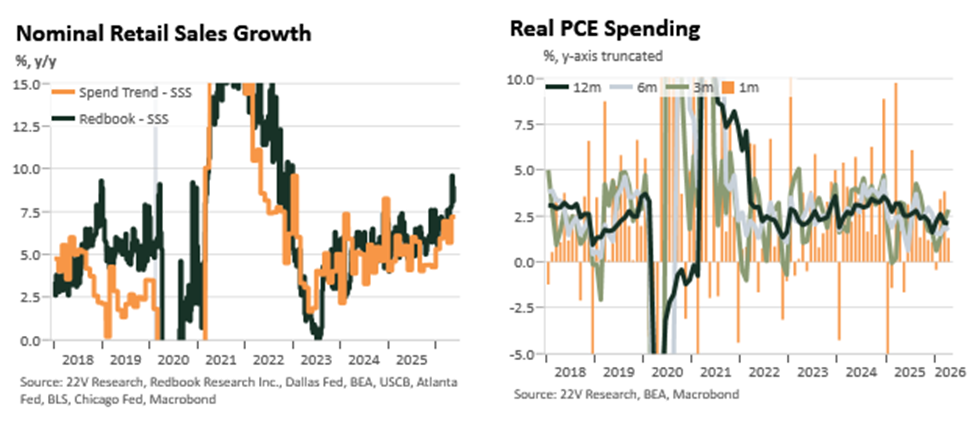
- Banks and card companies continue to report steady or a bit faster 5-8% growth rates in their clients’ spending. Comparable sales at major retailed shows notable strength; WMT saw 4.1% (with a 100bp drag from pharmacy pricing), COST reported a steady 6.8% y/y growth when adjusting for FX and gas prices, TGT was 5.7%, and 6% at TJX.
- The rest of the note dives into major consumer theme I noted from recent earnings calls or conference presentations. There are lots of quotes to let management speak.
Overall Demand Growth Remains Strong and Nominal Spend May Be Accelerating. Reporting from mainline retailers, card companies, and banks shows that overall nominal spending growth seems to be accelerating a small amount in response to the oil price shock. Spending has proved remarkably steady since consumers started adjusting to the oil price shock. There is some variation on whether or not nominal spending growth is accelerating appreciably depending on the source but that spend is either steady or up. There may be a bit of demand softening ex-gas in real terms as gas eats into consumer budgets but that seems company specific with overall trends quite steady.
Reduced energy sensitivity of the US economy, strong balance sheets along with the AI boom, and a sense of non-permanence to the shock are all combining to help consumers maintain fairly strong spending trends so far (to summarize Richmond Fed Pres. Barkin last week). If the Strait was to remain closed, eventually a greater degree of price rationing in energy markets and disruptions in materials inputs would take place but for now that second round inventory-driven shock remains in the future.
- “What the numbers all showed was an enormous amount of resilience, strong consumer spending, broad-based. If you look at the United States discretionary and non-discretionary, both remaining very stable and resilient.” – V. Their US spending was up 8% in their last quarter, up from 6.5% prior.
- “We gave you in our last earnings call an outlook into the April data as well and the growth in consumer spending has continued into May, the first two weeks as well, where we saw stable to slightly better consumer spending.” – MA. Their last quarter saw 4% growth, adjusting for the impact of COF’s card migration it would have been 7%.
- “I’ve seen what’s kind of gone on through the first two weeks of May. I would tell you, by and large, across our metrics, we’re seeing stable to slightly better trends.” – JPM
- Spending is growing at “5% for this month so far, the first 20 days over last year. In April, it moved likewise. In the first quarter, it moved likewise, which is consistent with a strong underlying economy.” – BAC
- “But when you look at consumer spend, consumer spend is actually even stronger than it was a couple of weeks ago, a couple of months ago. People are spending more on fuel. They’re not spending less on other things and they’re actually spending some more on some of those other things.” – WFC
- Costco noted that “we continue to comp excluding gas in that 6% to 7% range. And we haven’t really seen any variation from that performance.”
- WMT is a bit on the more pessimistic end, showing same store sales ex gas growth decelerating a bit to 4.1% in the Feb-Apr quarter from a steady ~4.5% before that.
- “We continue to see very consistent customer behavior, which is a customer that’s under a little more pressure but still resilient.” – BBY
Evidence of a Worsening K-Shaped Narrative is Mixed. WMT noted that they see their lower-end consumers as being more stressed, with somewhat great signs of cashflow constraints particularly around gas prices. Other retailers painted a more optimistic picture as well, with some signs of underlying reacceleration, although trade down possibilities and idiosyncratic stories might mask underlying stresses.
- “We’re seeing spend across different – from low-spend bands to high-spend bands, all being quite healthy. So, all the indications, US continues to be quite healthy.” – V
- “If you look across spending bands from the highest spending bands down to the lowest spending bands, resiliency.” – V
- “It’s true that it’s differentiated across different wealth levels. That’s not new but it’s not really spreading but it’s also not getting better for the lower end.” – WFC
- “We see with our customers that the high-income customer is spending with confidence into many categories, while the lower income consumer is more budget conscious and perhaps navigating financial distress.” – WMT
- “When I take apart the data from this past quarter, and we look at our store base by income demographic, all of our cohorts are comping positive in this past quarter.” – DLTR
- “Top economic earners are out – in terms of overall growth are outpacing the growth you see for mid and lower tier, okay, but they’re all up.” – AAL
- “Overall comp sales were up an outstanding 6%… across all geographies, income, demographic bands, we’re very pleased with what we saw.” – TJX
- “First quarter net sales grew by 6.7%, reflecting a 5.6% increase in comparable sales… Broad-based strength across guest demographics and cohorts, and momentum around both key seasonal events and everyday moments.” – TGT
- “We did not see a variation across income levels. Actually, all income levels were very strong.” – ROST
- “What we’ve seen so far is what we’ve seen all year long, and that is we’re operating in what we would describe as a K-shaped economy where the higher-income consumer spends and they’re spending on innovation and they’re spending on things to modernize their home, and the lower-income consumer is a little bit more cautious.” – LOW
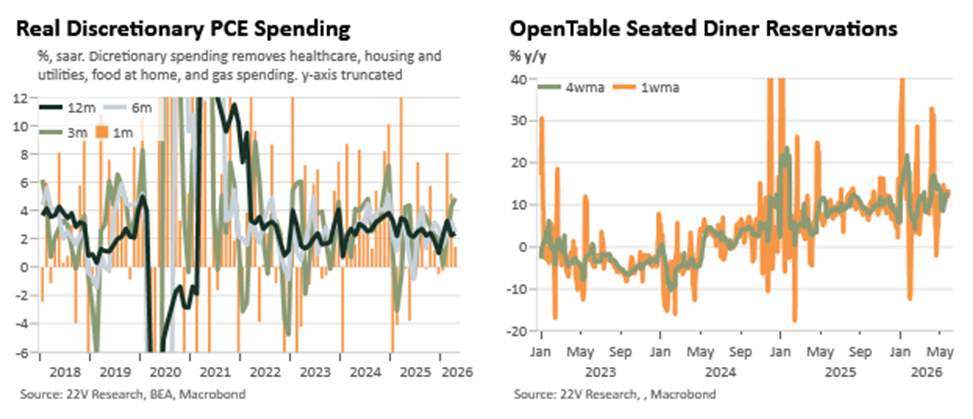
Services Looks Particularly Strong. Earlier in the earnings season the strength of travel-related spend stood out as a highlight for the consumer. There were real questions though as to how durable that spending impulse would be with potential supply impacts to airlines, more so overseas than in the US, and price hikes. So far, all the evidence suggests that the consumer continues to place a premium on travel; some of this may reflect higher demand rotation away from higher goods, some reallocation in spend due to lower housing turnover, and
- “Gas spending is up. But that’s, the other spending is up. What’s happening with travel? So airline spending is up, but the numbers of charges are up, which means there’s more tickets bought, even though the price is driving it higher. So and restaurants are up. And so people are spending money, and that’s because, frankly, they’re employed.” – BAC
- “I can tell you in April, we had 9% airline growth. So, people are on planes. They’re flying. We had record travel bookings in the first quarter.” – AXP
- “I feel great about demand overall.” – AAL
- “You can’t expect Q to not change, but the demand environment is pretty strong.” – UAL
War and Oil Prices an Unhelpful Shock. Fiscal Support has Been an Important Offset. Earnings season provided a number of anecdotes around fiscal spending as an initial offset for the impact of gas prices but, as noted above, this was rarely mentioned as the sole driver of good news.
- “Tax refunds came in higher than what I think most people expected. And certainly, there’s probably some macro benefit as those tax refunds come in. There might be some – an upward lift on general merchandise, but I don’t want to ascribe all of that to macro.” – WMT
- “We believe this year’s higher tax refunds were a source of upside to consumer spending in Q1, and that benefit will be fading over the rest of the year.” – TGT
- “We do believe we could still see some benefits in Q2, in particular from higher income consumers. And we’ve contemplated that in our outlook here for Q2 and the balance of the year.” – LOW
- “While we attribute a portion of this growth to the increase in tax refunds versus last year, we are quite pleased that the underlying fundamentals of our growth were extremely healthy.” – ROST
- “We know that we did probably enjoy a benefit from [tax refund season], feel like it’s about what we thought it was going to be. And certainly as we got into May, we do feel like there’s a little bit of what’s sitting in May strength as well related to it.” – BBY
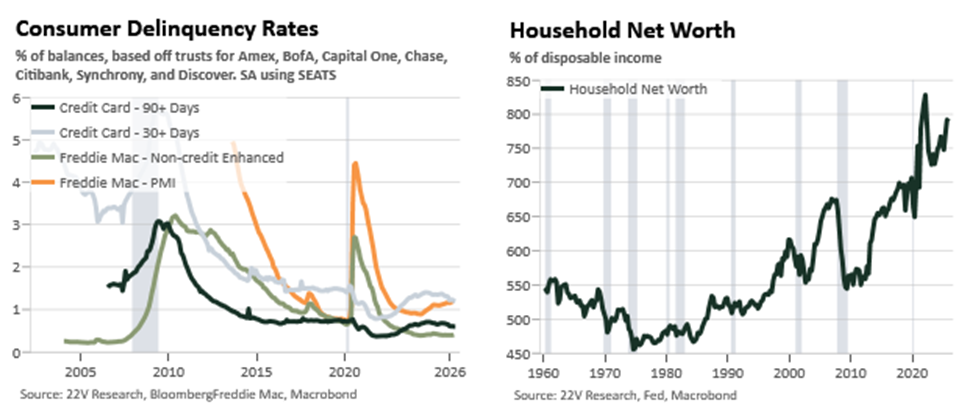
Delinquencies Don’t Show Stress Yet. Taking all of that together it does seem reasonable to wonder about possible spike in consumer delinquencies, particularly for lower-end consumers. Certainly some data suggests that at least for borrowers in stress, conditions continue to get worse as balances and fees roll forward. But banks were quite sanguine with almost all of them that we’ve heard from in recent weeks reporting flat or improving delinquency trends. With a
- “Near-term, you obviously look at near-term delinquencies, all this stuff which are in good shape and improving, and et cetera.” – BAC
- “[Hotter nominal spending]’s not at the expense of delinquencies because delinquencies are flat to down across almost all of our products. And savings rates are still really strong across both deposit products and investment products.” – WFC
- “Our delinquency nine out of the last 10 quarters has been like 1.3%. The other quarter it was 1.2%. So, we’ve been pretty steady from a delinquency perspective.” – AXP
- “Delinquencies, four quarters in a row they’ve been down. Flow to losses are kind of at or near all-time lows” – Ally