Back Economic Research

A Quick Caution in the Productivity Data

Published on May 22, 2026

Download the PDF Report

By

Peter Williams

A Quick Caution in the Productivity Data

  • Recent productivity data has been fairly strong, continuing the improved trend from 2018-on as the economy moved past post-GFC credit crunch and labor market slack dynamics.
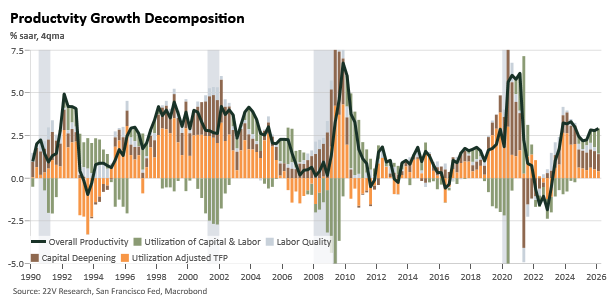
  • The SF Fed’s total factor productivity data shows that capital deepening (a good thing) and more intensive, but ultimately unsustainable, procyclical utilization of capital and labor are driving productivity growth over the past few years. TFP growth’s post-covid whipsaws, combined with the current boost from increasing utilization, seems consistent with typical post-recessionary patterns and yet another indicator of the ongoing underlying cyclical recovery in the US.
  • Much like the internet or electrification booms, AI may take some time to show up in the broader data as it slowly shifts business practices across the economy.
  • Other shocks are playing a role too. Immigration’s decline may be temporarily boosting productivity growth. Deglobalization and tariffs are likely a drag as they allocate capital towards less efficient, perhaps more robust or societally optimal, business practices.
  • On net, we should be cautious in assuming further acceleration in productivity growth from here and a mild near-term deceleration cannot be ruled out. This is another reason for some caution around the inflation outlook as well.

Overall labor productivity growth (output per hour) has shown a moderate reacceleration from its post-GFC lows when weak investment, elevated commodity prices, and very slack labor markets. This process has been ongoing since roughly 2016-18. In recent years there has a potential further reacceleration but it seems far too early to count on that sustaining, particularly given that so many features of the US economy have exhibited recessionary and rebound like dynamics since 2022.

Economists at the SF Fed produce a quarterly decomposition of overall labor productivity (output per hour) growth into investment, improvements in labor quality (education, etc), and total factor productivity (technology and efficiency gains).

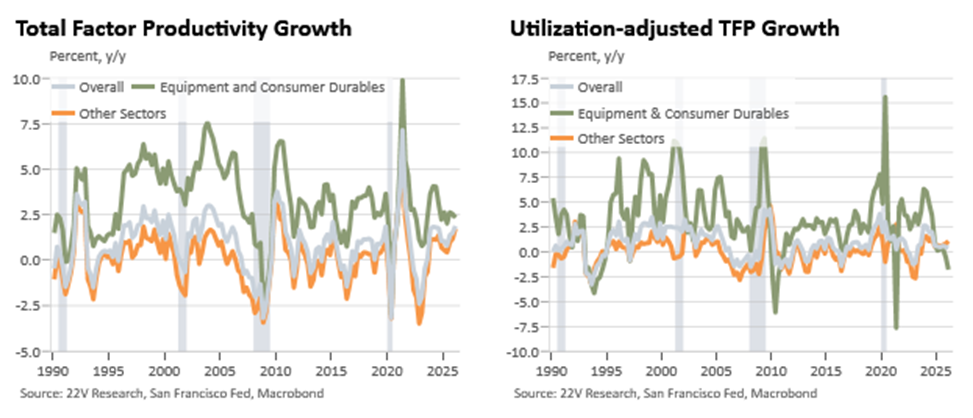
Total factor productivity is the ‘unexplained residual’ after removing the impacts of the labor and capital factors we can most easily measure. TFP growth has shown a more modest recent reacceleration. However, these researchers make the case we also need to adjust for more intensive intra-cyclical shifts in the utilization of capital and labor to get a clearer read of underlying technological progress. Unfortunately, this adjustment casts a more sobering view of the data. TFP growth is currently being driven by a surge in the utilization of capital and labor, as often happens coming out of cyclical downturns. Utilization-adjusted TFP growth has shown much less sign of reacceleration.

We should not overly extrapolate what the current data means about the medium- and longer-term future of productivity growth. AI may well provide a substantial lift to TFP, it may be mostly a capital-based shock (where the surge in investment largely accounts for the output/hr gains), or it may simply be a revolution of work tasks but ultimately shift macro-level productivity less than the optimists currently expect.

As economist Robert Solow famously (at least among economist circles) quipped in 1987 that you could see the PC “everywhere except the productivity statistics.” The canonical discussion is the very slow diffusion of electrical power innovations across factories over the span of decades, The Dynamo and the Computer. It took some time but eventually the IT revolution did show up. This took place as both a mild increase in capital deepening (an increase in capital / hours worked) and the surge in total factor productivity growth showing a true shift in underlying technology and more productive business practices that lasted for almost a decade.

This data suggests that there may be some early signs of the AI boom but they are very early signs. Utilization-adjusted TFP growth in the consumption sector (what the authors refer to as the rest of the business economy outside equipment and consumer durables) seems a bit better than its post-GFC doldrums, but the acceleration there is modest overall. This possible further acceleration will be building off of the OK but far from booming recent underlying (capital deepening, labor quality, and TFP) productivity data.

On a cautionary note, the rapid slowdown in immigration and surge in deportations are likely temporarily flattering the productivity growth data at least a little bit. This because these workers tend to fill relatively lower wage and productivity roles whose absence reduces aggregate hours worked more than GDP. The impact of tariffs and broader forces of deglobalization will be a net drag on productivity growth as well, as historic most efficient practices have to be recreated. This is likely at least partly behind the current drop in utilization adjusted TFP growth in the equipment and consumer durables industries. Demand whipsaws may also be playing a role. These are shorter-lived forces but so many shocks hitting the economy at once make getting a sense of underlying activity, let alone productivity, trends a challenge.
DISCLOSURES AND DISCLAIMERS

Analyst Certification

The analyst, 22V Research Group, primarily responsible for the preparation of this research report attests to the following: (1) that the views and opinions rendered in this research report reflect his or her personal views about the subject companies or issuers; and (2) that no part of the research analyst’s compensation was, is, or will be directly related to the specific recommendations or views in this research report.

Analyst Certifications and Independence of Research.

Each of the 22V Research analysts whose names appear on the front page of this report hereby certify that all the views expressed in this Report accurately reflect our personal views about any and all of the subject securities or issuers and that no part of our compensation was, is, or will be, directly or indirectly, related to the specific recommendations or views of in this Report.

22V Research (the “Company”) is an independent research provider. The Company is not a member of the FINRA or the SIPC and is not a registered broker dealer or investment adviser. 22V Research has no other regulated or unregulated business activities which conflict with its provision of independent research.

22V Research, LLC is a professional services and independent publication organization. 22V Research, LLC is not a securities broker-dealer, not a member of the Financial Industry Regulatory Authority (FINRA), not a registered investment advisor (RIA) and not a member of SIPC.

Securities transactions, when offered, are offered by 22V Securities, LLC through LPS Capital, LLC. Certain employees of 22V Securities, LLC are dually registered as securities representatives of LPS Capital, LLC or Analyst Hub Securities, LLC. 22V Securities, LPS Capital and Analyst Hub Securities are members FINRA, SIPC.

https://brokercheck.finra.org/

Current Ratings Definition.

SECTOR OUTPERFORM: An “outperform” rating anticipates the company will outperform the S&P Regional Banking Index (peer group).

SECTOR PERFORM: A “market perform” rating anticipates the company will perform in line with the S&P Regional Banking Index (peer group).

SECTOR UNDERPERFORM: An “underperform” rating anticipates the company will underperform the S&P Regional Banking Index (peer group).

Limitation Of Research And Information.

This Report has been prepared for distribution to only qualified institutional or professional clients of 22V Research Group. The contents of this Report represent the views, opinions, and analyses of its authors. The information contained herein does not constitute financial, legal, tax or any other advice. All third-party data presented herein were obtained from publicly available sources which are believed to be reliable; however, the Company makes no warranty, express or implied, concerning the accuracy or completeness of such information. In no event shall the Company be responsible or liable for the correctness of, or update to, any such material or for any damage or lost opportunities resulting from use of this data. Nothing contained in this Report or any distribution by the Company should be construed as any offer to sell, or any solicitation of an offer to buy, any security or investment. Any research or other material received should not be construed as individualized investment advice. Investment decisions should be made as part of an overall portfolio strategy and you should consult with a professional financial advisor, legal and tax advisor prior to making any investment decision. 22V Research Group shall not be liable for any direct or indirect, incidental or consequential loss or damage (including loss of profits, revenue or goodwill) arising from any investment decisions based on information or research obtained from 22V Research Group.

Reproduction And Distribution Strictly Prohibited.

No user of this Report may reproduce, modify, copy, distribute, sell, resell, transmit, transfer, license, assign or publish the Report itself or any information contained therein. Notwithstanding the foregoing, clients with access to working models are permitted to alter or modify the information contained therein, provided that it is solely for such client’s own use. This Report is not intended to be available or distributed for any purpose that would be deemed unlawful or otherwise prohibited by any local, state, national or international laws or regulations or would otherwise subject the Company to registration or regulation of any kind within such jurisdiction.

Copyrights, Trademarks, Intellectual Property.

22V Research Group, and any logos or marks included in this Report are proprietary materials. The use of such terms and logos and marks without the express written consent of 22V Research Group is strictly prohibited. The copyright in the pages or in the screens of the Report, and in the information and material therein, is proprietary material owned by 22V Research Group unless otherwise indicated. The unauthorized use of any material on this Report may violate numerous statutes, regulations and laws, including, but not limited to, copyright, trademark, trade secret or patent laws.
