Surprisingly, Green Shoots Not Gas Price Stress
- Conference commentary from card companies and banks today has been very strong.
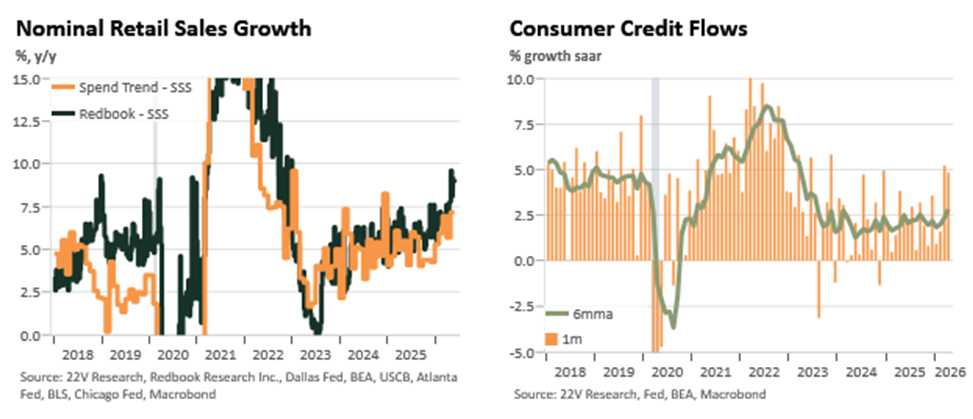
- Delinquencies are below expectations, nominal spending growth robust and potentially accelerating, and real spending and breadth seem better than late last year. To quote from COF today, “if we didn’t read any news and all we did was just really look at the data that we see in the economy and the data that we see on our portfolio, we have a really quite positive view.”
- Some of the recently updated spending numbers are a bit mind boggling: WFC at 9% y/y in May, COST +13.7% SSS in the US in May (8.7% ex-gas), and AXP pointing to >9% QTD.
- SYF, which tends to have a higher beta to middle and lower income consumers, also stood out with mentions of green shoots in discretionary spending.
- Risks of bit deceleration due to real income stress and fading tax refund benefits in H2 are present but we need to layer those onto the new data, not the more pessimistic view from months ago.
Going into the gas price shock it seemed reasonable to expect that consumer spending would retrench at least a little bit. So far, the data has been pushing in the opposite direction. Qualitatively, my baseline was that nominal spending would accelerate a little bit while volume growth would be steady or see a bit of mild weakness.
- “[Purchase volume] accelerated into the beginning part of the first quarter, and it’s actually maintained that pace in the mid to high single digits… But what we really saw, green shoots with regard to, you know, discretionary purchases and you know, what the consumer is willing to do.” – SYF. For context, it was 0.1% across 2025 and 5.6% in Q1.
- It is not our belief that high gas prices will “tip is the consumer, but it most certainly can impact spending, behavioral patterns and payment behavioral patterns. Really in the latter, the latter part of 2026, if it’s unabated from the levels that it is today.” – SYF
- “Various surveys are reflecting considerably more caution than what we actually see in the numbers, whether that’s consumer spending, you know, still, you know, mid-single digits.” – BAC
- “In May, across our debit and credit card spend, it was up 9% year-on-year. That includes the impact of gas being higher across that portfolio… But we’re not seeing any real changes in the other aggregate categories of any substance.” – WFC
- “Numbers in terms of billing growth were slightly stronger than Q1. And you might remember that when we talked about Q1 billing growth, I think it was like 9%, uh, effects adjusted. And we talked about that was the strongest quarter we had in three years, right. So Q2 so far is actually slightly better than that.” – AXP
- “Just like everybody, you know, gas spend kind of like increase dramatically as a result of the price changes. But it’s not like we are seeing an offsetting decline elsewhere.” – AXP
- “I think there will be some sort of resolution and the underlying strength of the economy will stick. And we said it in our first quarter call, but our private equity companies had 10% revenue growth in the quarter” – BX
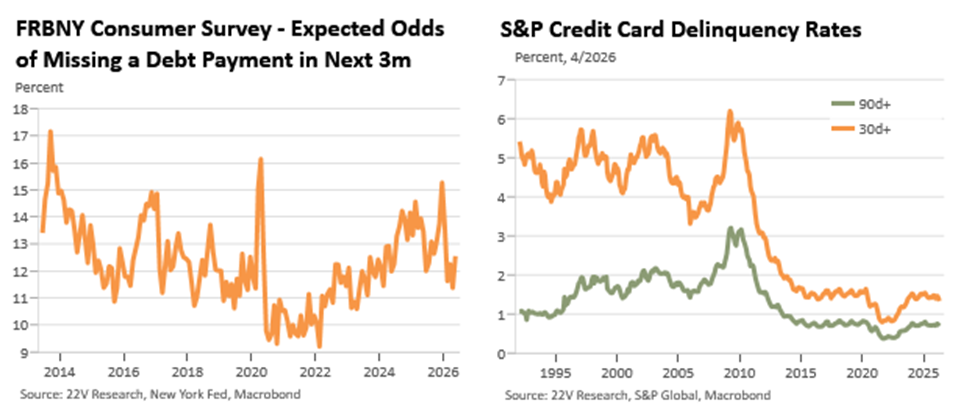
Tax refunds have been partially spent and are likely flattering the consumer a bit, but signs of stress are generally improving across bank card portfolios even when taking this into account. While there is almost surely some spending lift from larger tax refunds and changes in withholdings this effect is one of many positive supports, not the only one. The FRBNY consumer expectations survey for May saw a bit of a jump in debt repayment ability concerns, but it remains consistent with pre-covid levels and aligns with most of the hard data and commentary around delinquencies as well.
- “Pre-pandemic, we were in a benign credit environment and we still are… We gave you a range of 3.3% to 3.6%. We’re at the low-end of that range.” – JPM
- “We’ve been a little flattered over the last couple of months with higher tax refunds and lower tax bills that coincided at the same time as higher energy prices. So it sort of muted the impact of that, you know, for the lower-income customer, about somewhere between 20% and 25% of that incremental money as a result of higher tax refunds has been spent through the first two months of higher energy prices… as we sit here today, the consumer is resilient, the metrics are good and everything looks fine, but there are an increasing small, but nevertheless increasing number of people for whom wage inflation is not currently keeping pace with inflation and that will likely be the thing to watch.” – JPM
- “We have pulled out our magnifying glass to look at tax for the tax refund effect. And there are a few things that we see that suggest to us that the beneficial credit that we’re all observing is probably not – it’s probably transcends a little bit the tax refund effect… the delinquencies we have seen in January and February, which were better than seasonality, happened before most of the tax refund effect was even coming anyway. So if I pull way up, I think at the margin, there may be just slightly, good news emerging on the credit front, but all that in the context of a consumer that we think is in a pretty stable place and performance across all of our metrics that indicates the combination of the consumer and the choices that we’re making in a good place” – COF
- “The employment picture across the country is still quite good. We’re certainly seeing a little bit of strength now in the last couple of readings, maybe start to reemerge there. And that’s translating into really good credit performance across all the portfolios. So it’s a little bit better than we model each month.” – WFC