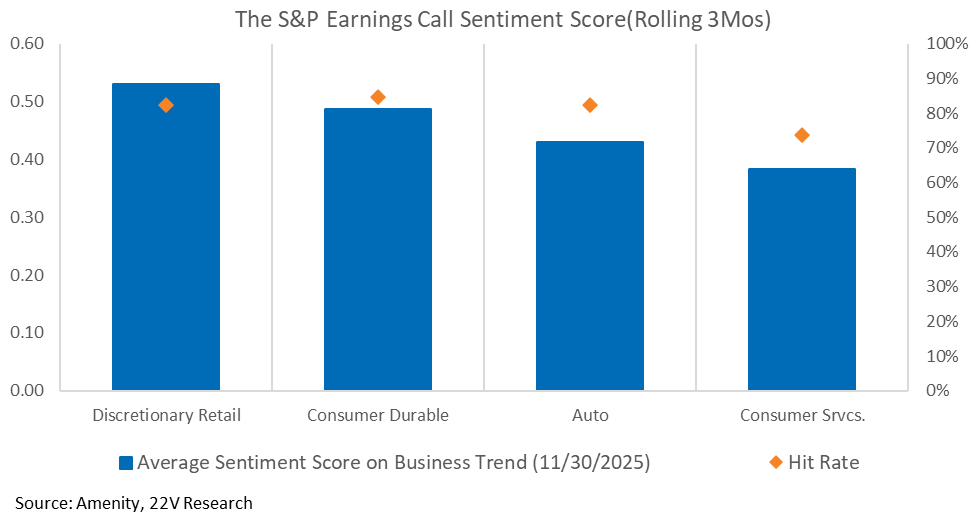
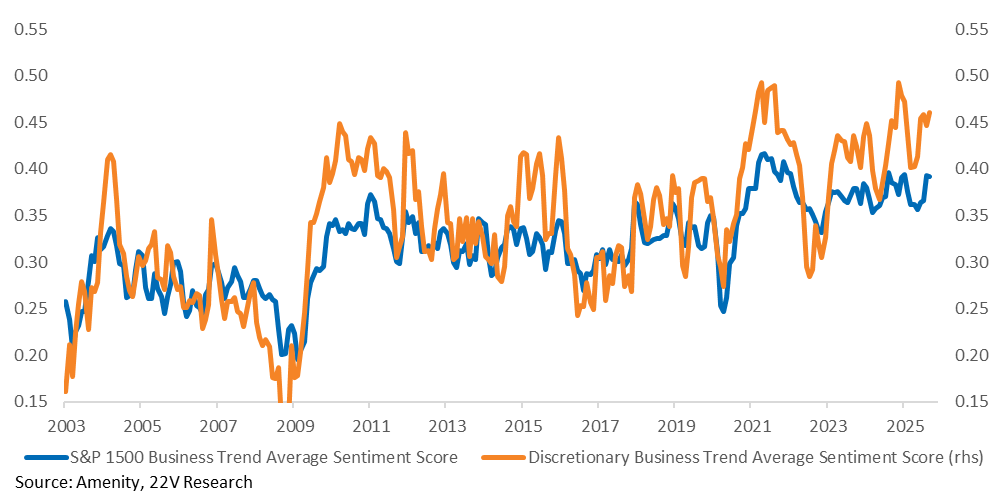
It’s Black Friday – Time To Be Long Discretionary Stocks: 3Q Discretionary earnings have been better than expected and the macro backdrop is supportive. Taken in aggregate, Discretionary company managers had 97th percentile business trend sentiment score in 3Q. The underlying trend for Real Personal Consumption expenditure growth looks like it is close to 2.5% (HERE). For context, in the post GFC period real Personal Expenditure Growth tracked in the 1.25% range. Labor income continues to outpace job growth, suggesting 1) strong economy wide productivity trends and 2) little reason to expect companies to fire employees.
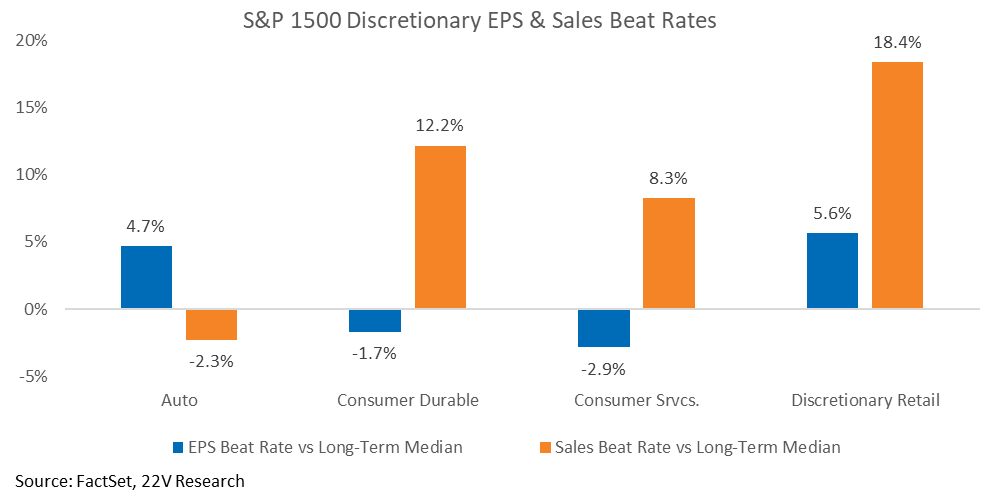
By industry group, Retailers stand out as having the best sales and beat percentages, and the best earnings sentiment (which is indicative of the forward earnings outlook). We like XRT as a long. Jeff Jacobson, 22V Derivatives specialist, put together two XRT trades HERE.
Labor market tail risks, tariffs and lower end consumer headwinds have been an overhang on the group. Those headwinds are fading. The lower end has struggled, but they should see short term relief from the OBBB in 1H26. Employment growth looks to have bottomed in the wake of the initial tariff shock and rebounded to near the breakeven rate (estimated monthly job growth required to keep the urate flat). Given the political consequences of increased cost of living, the direction of travel appears to be less onerous tariffs going forward. In short, the commonly cited macro overhangs for the Discretionary sector are fading some.
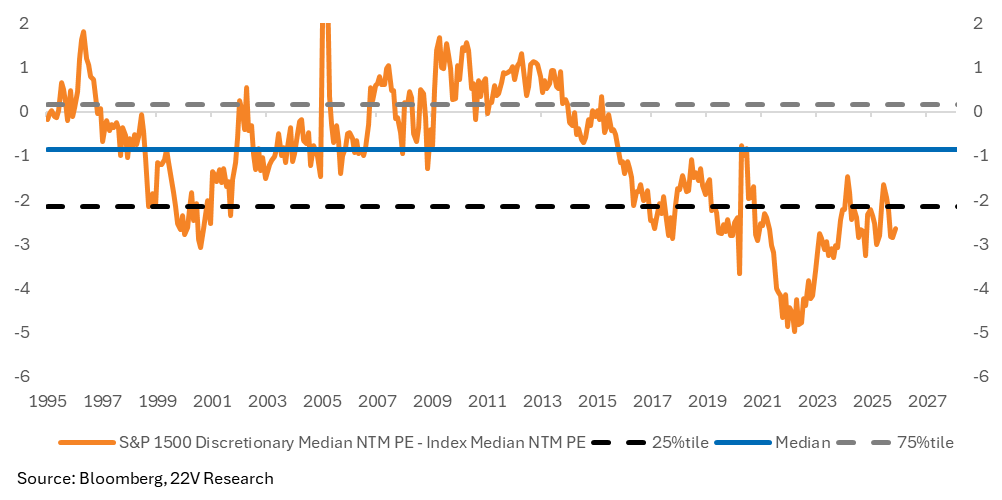
FYI, the median NTM PE of Discretionary is at its 15th percentile relative to the S&P 1500. A return to the median implies a relative return of +12%. The risk-reward from a valuation perspective is compelling.
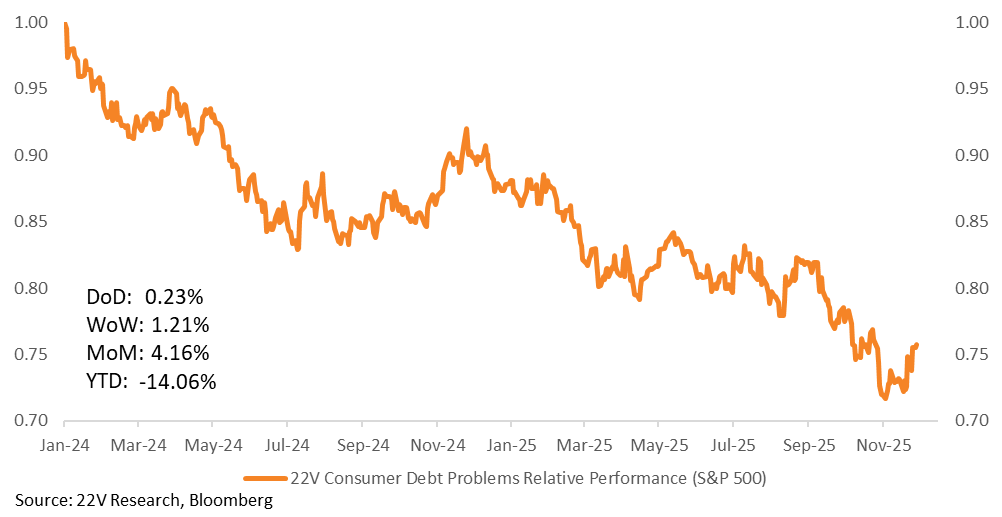
For a high beta play, check out Consumer Discretionary names with high debt risk. Our swap –MS22CDET Index on Bloomberg – is up +9% week-over-week.
Lackluster margins have been the main fundamental headwind, so within the sector, we like focusing on Discretionary companies who are referencing specific use cases of AI, and companies with the best forward margin sentiment. These companies are most likely to improve margins going forward. Both lists are in the full report below. Correlation within Discretionary is low, so stock picking within the sector is effective. Presumably, less onerous tariff policy COULD help improve Discretionary margins.
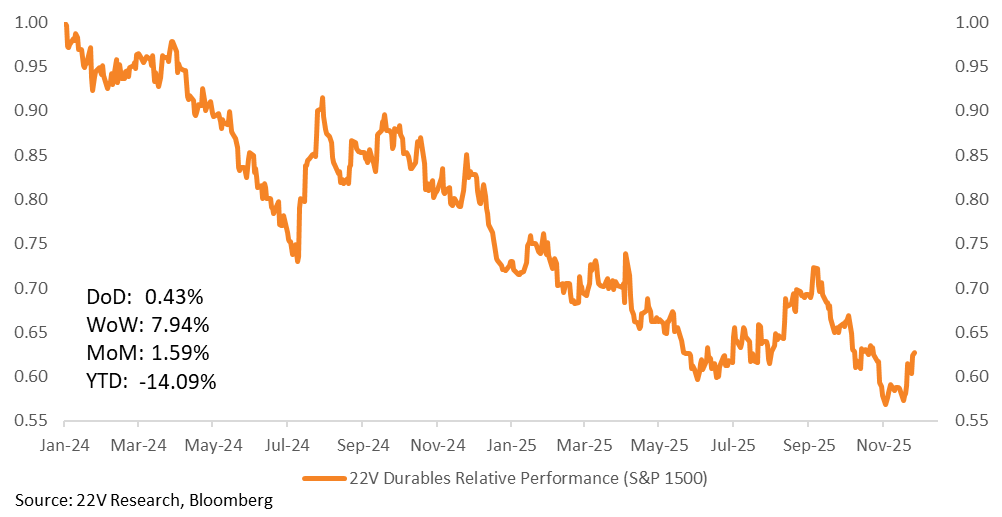
Homebuilders and Durables have been the laggards this cycle. AI capex and consumer spending have effectively crowded out the ability for Housing and Durables to contribute to the cycle. We have taken off our Homebuilder short, but it could become interesting again if yields rise back towards 4.5% (conditions for that HERE). Homebuilders could also be an interesting long for even better productivity growth, which would alleviate the ‘crowding out’ problem. Check out MS22DURB Index on Bloomberg for a tradeable swap to position with.
Deep-dive details below…
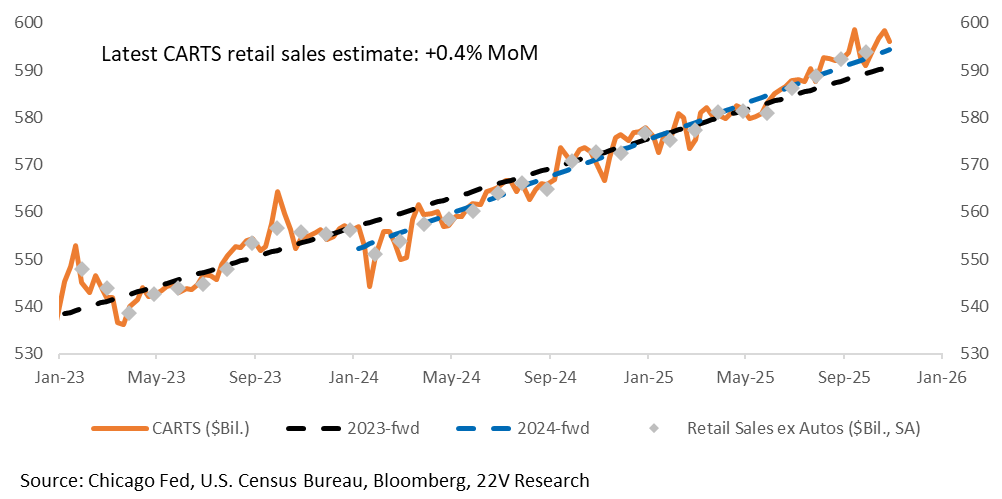
Retail sales data showed that goods consumption continues to grow at a rate of ~4% ar, a trend rate above the post-GFC pre-COVID rate of ~3.6% ar. Chicago Fed’s aggregation of high frequency data, which is more current than the delayed retail sales data, indicates retail sales has continued apace.
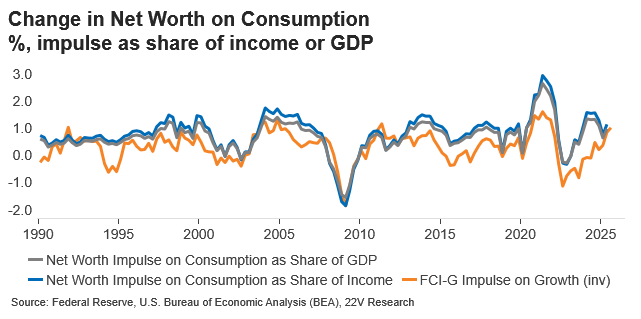
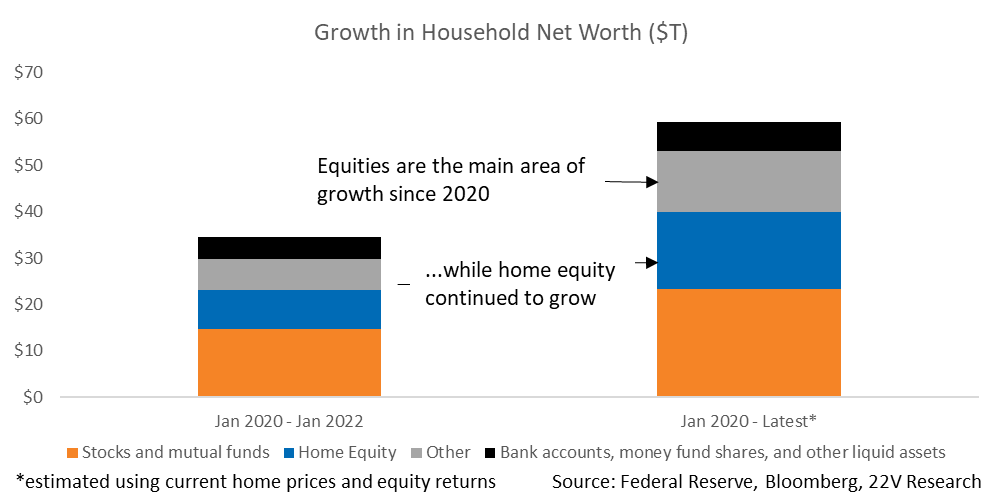
The macro backdrop supports an elevated rate of consumer spending. The latest Payrolls report indicated the labor market is showing signs of firming (HERE), a good sign for labor income. There is no reason to expect a higher savings rate (lower marginal propensity to spend) with household net worth at a record high (+$50T in household net worth since COVID).
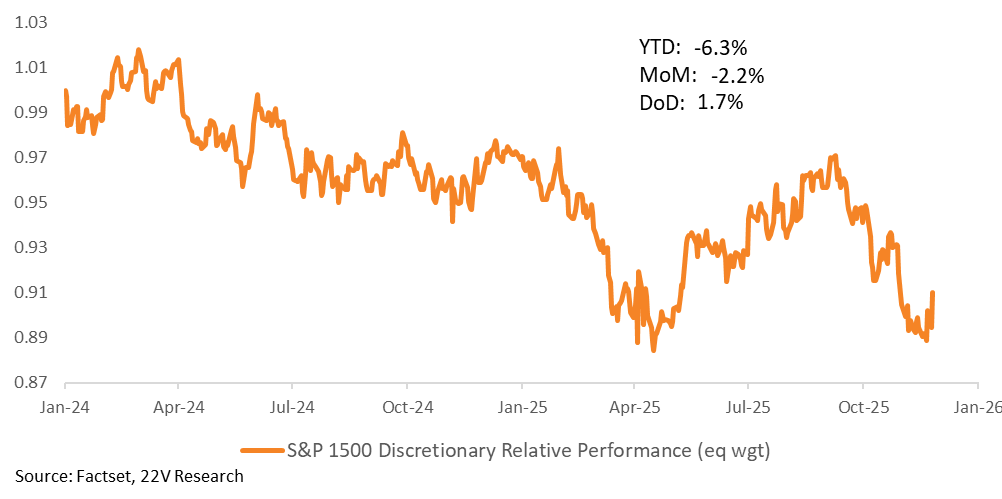
Discretionary fundamentals were better-than-expected in 3Q. Most recently, Best Buy, Dick’s, and Kohl’s, reporting on Tuesday, all saw 3Q accelerations in sales, contributing to the XRT increasing +4% Tuesday. Taken in aggregate, Discretionary management companies had a 97th percentile business trend sentiment score in 3Q. This is a good sign for a group that has underperformed by -6.3% YTD, equally weighted, but potentially bottomed two weeks ago.
The NTM PE of Discretionary (median, to avoid distortions from AMZN) relative to the S&P 1500 index is at its 15th percentile. FYI, a return to the median implies a relative return of +12%.
For a high beta play, check out Consumer Discretionary names with high debt risk. Our swap –MS22CDET Index on Bloomberg – is up +9% week-over-week. The list is Discretionary companies with a negative or deteriorating interest coverage ratio, a debt ratio >1, top decile cash flow volatility, and the quickest increases of debt relative to assets.
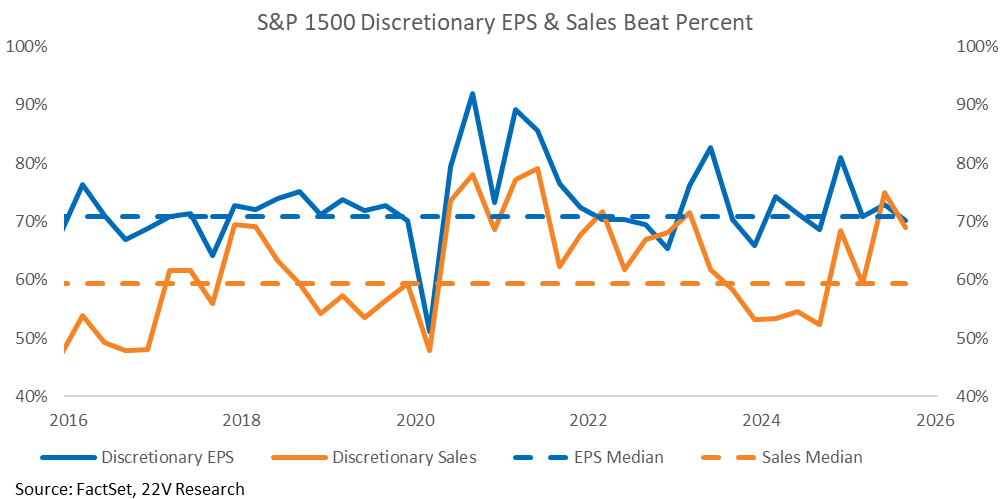
In 3Q, the sales beat rate was significantly above the historical median, and the earnings beat rate was in-line. Both are good readings, though it does show the underlying headwind to Discretionary, lackluster margins.
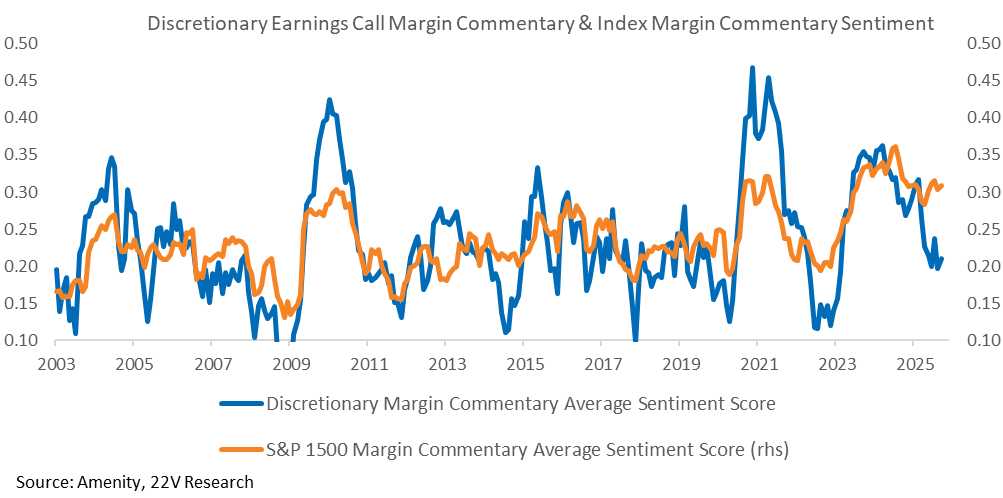
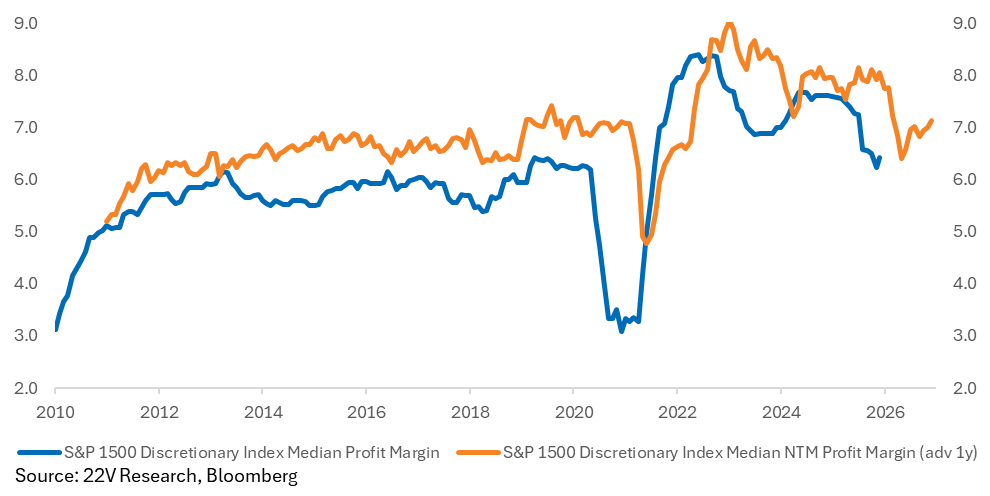
Margins have failed to meet analyst expectations. Management teams have expressed pessimism over their forward outlook for margins, even after margin sentiment bounced in the summer after some of the Liberation Day tariffs were removed. FYI, we’ve done work on how better margins lead to “richer” PEs (HERE). Tariff fading some could be a positive boost to margins going forward.
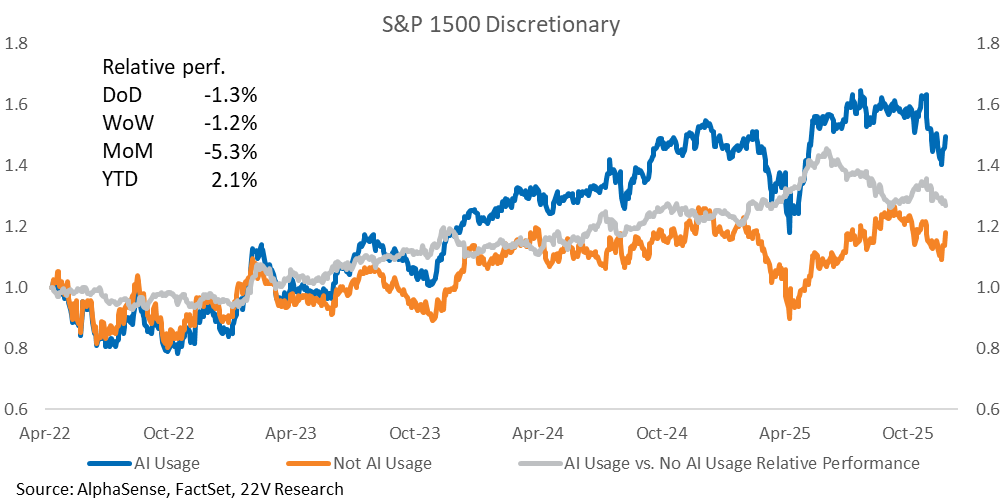
We have been hearing from clients who cover Discretionary that AI represents a significant potential tailwind to Discretionary margins. That would be a broad-based tailwind, but it’s also worth looking at the Discretionary names who have referenced specific use cases of AI, and the Discretionary names with the best margin sentiment. Both lists are below. Going long-short companies who have referenced specific use cases for AI vs those who haven’t has been a profitable strategy within Discretionary. These stocks were also caught up in the recent AI drawdown, which represents a buying opportunity.
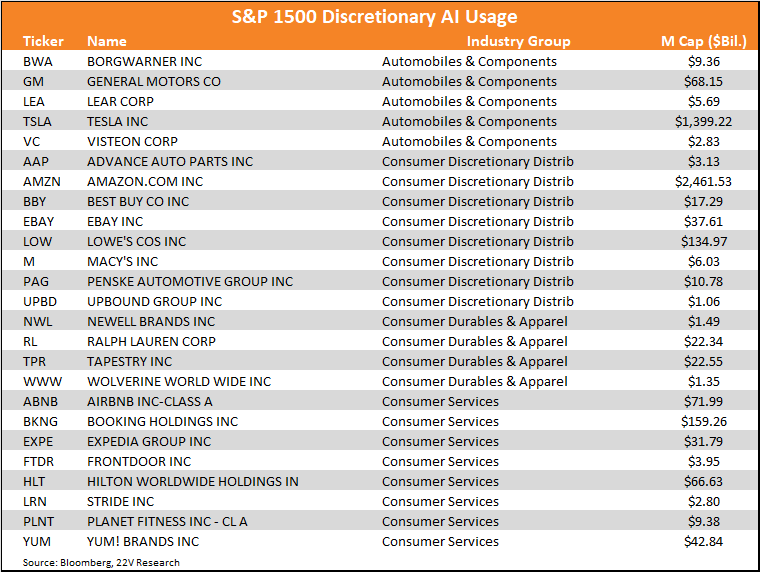
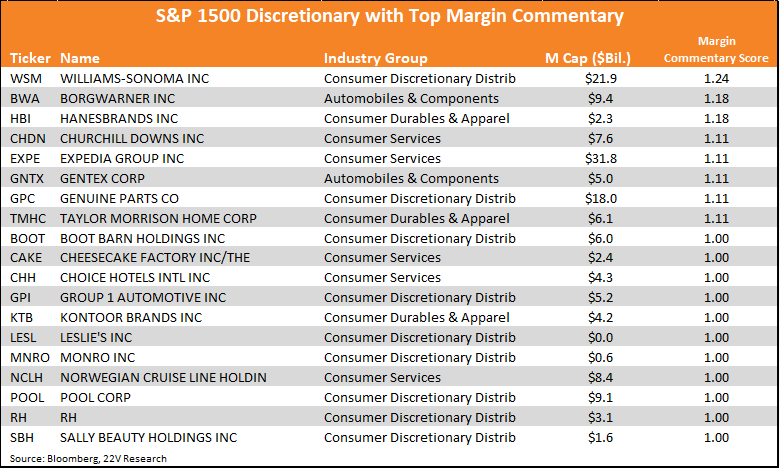
We can also source the Discretionary companies with the best margin sentiment. That list of stocks is here.
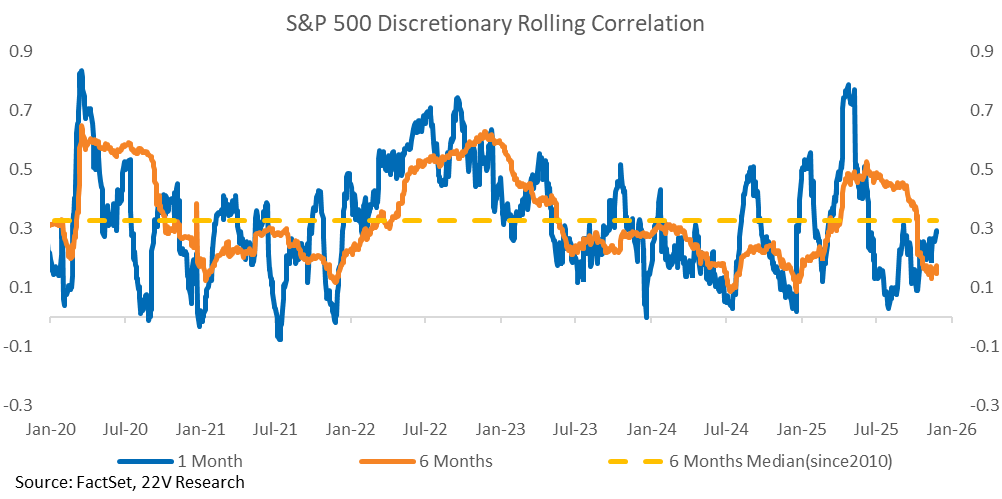
Intra-sector correlations are low right now, so successful stock picking within the sector will generate returns.
Economic growth is concentrated in AI capex and personal consumption. We’ve detailed the outlook for personal consumption above, while the outlook for AI capex remains very strong. Investment sentiment from the hyperscalers is extremely high, and estimates of AI capex from the hyperscalers on their own earnings calls was stronger than expected as well. The debate around ROI is important, but for now, the spending is keeping up regardless. A competition between hyperscalers nets out to more AI capex over the short to medium term.
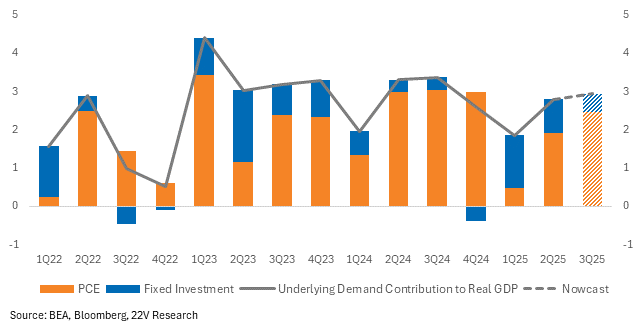
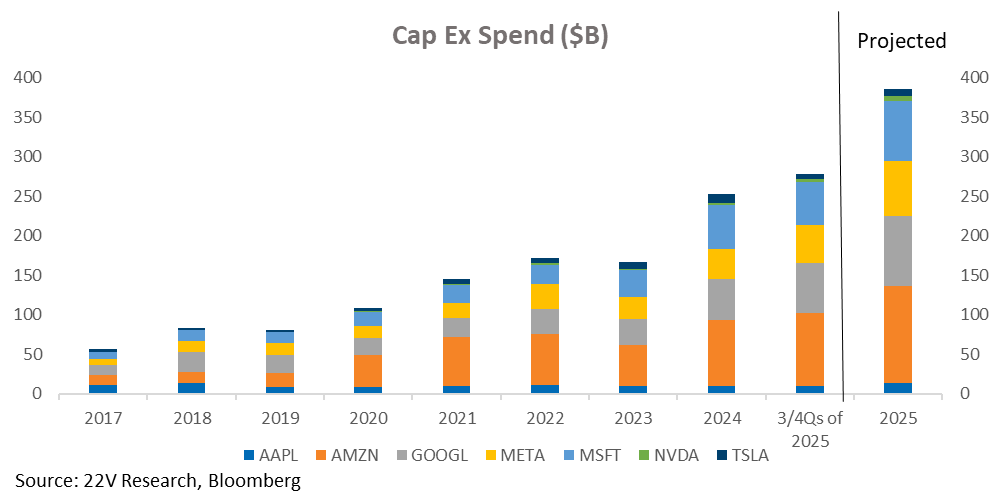
The practical implication for Discretionary is that this investment crowds out the ability of Housing and Durables to contribute to growth. That’s been the pattern so far this cycle, and it will continue to be the pattern. Housing will work if productivity growth is even better than its current trend, and/or as inflation comes down to target. FYI, we have a tradeable swap through Morgan Stanley to position for this. Ticker MS22DURB Index on Bloomberg. To be clear, we aren’t outright short Homebuilders now, but that could become more interesting if yields rise back towards 4.5% (HERE).
By industry group, Retailers stand out as having the best sales and beat percentages, and the best earnings sentiment (which is indicative of the forward earnings outlook). We like XRT as a long. Jeff Jacobson, 22V Derivatives specialist, put together two XRT trades HERE.