SUMMARY: The basis for our risk-off market framework (didn’t work) and market internals (worked well) was a view Fed policy would react slowly to mildly dovish data. That assumed demand growth would remain solid (it has) and the unemployment rate stable (this changed). A Fed slower to react to dovish data would flatten the curve, increase longer term recession risk, and be a headwind for Deep Cyclicals, Value, and Small caps relative to the S&P 100 (OEX).
A Change at The Margin for Now: We ARE NOT pressing the risk-off call FROM HERE (on internals, still no strong view on the overall market) and think a few key data points (CPI/PPI) could justify a higher conviction long Risk-on and small caps call. The payroll report was important and has led to a macro debate that SKEWs risk factor positive.
This Is Why We COULD Be Setting Up for a Small, Value & Higher Vol/Earnings Risk Rotation: As Gerard points out, the economy’s short-term potential growth rate has increased over the past two years by a higher population (undocumented immigration). As a result, even 3% output growth has arguably been below-potential, allowing the unemployment rate to rise in a mostly helpful way. And wages, although higher than expected from the payroll report, have moved lower OVER TIME (see below). The doves will press this point and it shouldn’t be dismissed. It likely means the Fed will have a quicker reaction function to weaker than expected economic data. That changes the skew on the Fed funds path relative to a week ago.
The problem with pressing the positive risk-on trade TODAY is the LEVEL of wage growth is consistent with 3% goods and services price inflation (HERE). That is too high and suggest the labor market is still somewhat tight. We shouldn’t expect outright dovish from the Fed. BUT, as Gerard points out (HERE), “Under the status quo – of a stubborn Fed – the labor market may ease further, and the last mile of disinflation may be achieved without much turbulence”. And if inflation data is not alarming Wednesday, the skew will favor cuts vs hikes. The central case will remain 2 cuts with relative firm demand growth. Financial conditions will remain stable. That is risk positive. Bottom line.
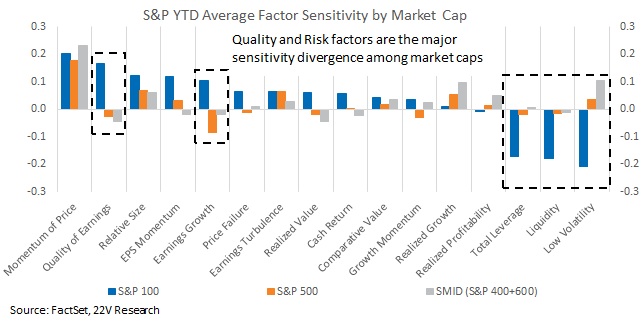
Factor Implications: Breaking down YTD returns, most of the return divergence across caps can be explained by factors. Industry group divergences have been small. Earnings and Risk factors explain most of the divergence, with strong earnings quality and growth of mega caps explaining most of their outperformance. Within small caps, higher Growth, stronger Momentum, and Lower Vol names have been favored, while unprofitable, higher vol names have fallen sharply. Value has lagged. A benign CPI/PPI reading Wednesday and economic growth in the ~2.5% level would reduce uncertainty around the inflation/FCI outlook. That would be negative for Low Vol factor and favor Earnings Risk and high Vol and Value.
Full report below….
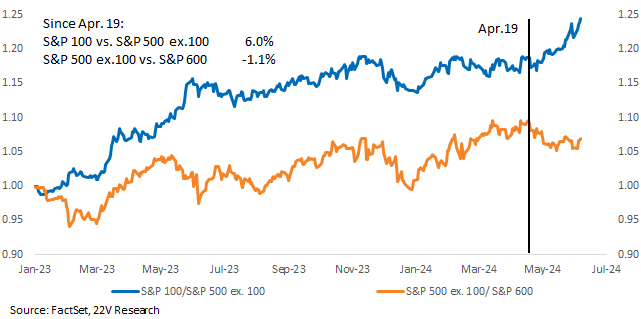
MARKET VIEWS: We called for market consolidation and negative internals over the past few weeks. The market consolidation/correction call didn’t do so well. The internal market risk-off call did. The basis for that call was a Fed that would be slower to react to dovish data. If demand growth remained solid (it has) and the unemployment rate was stable (it wasn’t). That would favor flatter yield curve. A fed that is slower to react to some dovish data increases longer term recession risk, which has been a headwind for Deep Cyclicals, Value, and Small caps relative to the S&P 100 OEX. The OEX has been the big winner during the volatile risk period, outperforming the rest of the S&P by ~6%. Interestingly, Small caps have outperformed the S&P, ex the 100, since April 19th, but were a very poor performer over the past week.
From Here, we ARE NOT pressing the risk-off call and think a few key data points (CPI/PPI) could justify being high conviction long in risk-on factors. The payroll report was important and has led to a macro debate SKEWs risk factor positive. That doesn’t mean it will be risk factor positive, but that seems like the skew. In short, the economy’s short-term potential growth rate has increased over the past two years by a larger population (undocumented immigration is the driver). As a result, even 3% output growth has arguably been below-potential, allowing unemployment to rise in a helpful way (larger labor force). And wages, although higher than expected, have been moving lower OVER TIME (see below). All the above means that the Fed will have a quicker reaction function to weaker than expected economic data.
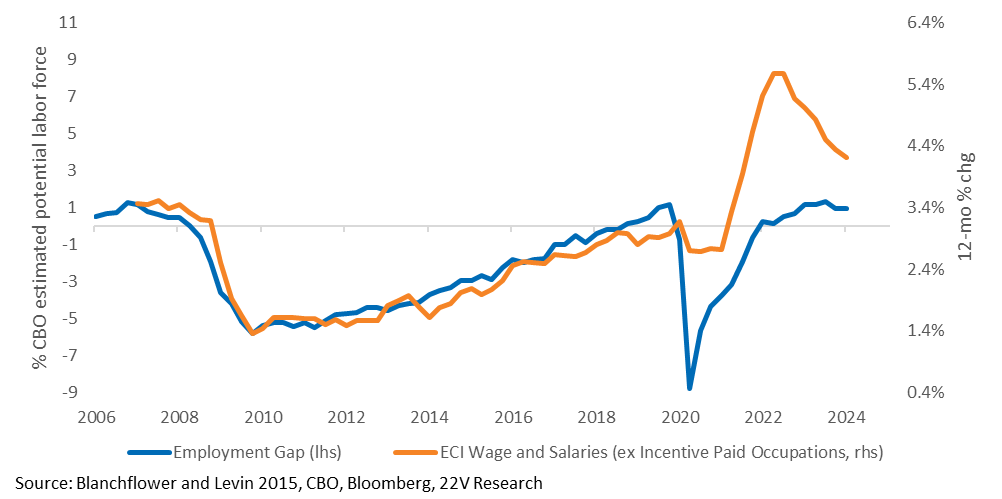
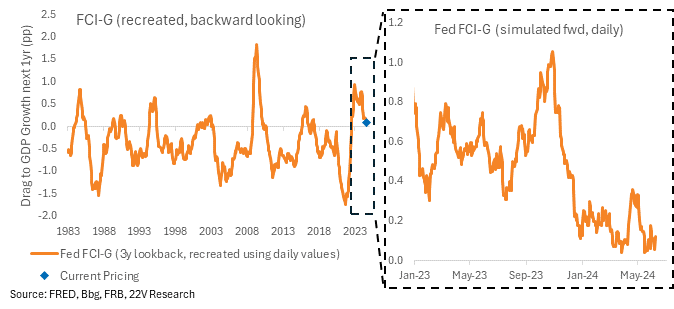
The problem is the current LEVEL of wage growth seems consistent with 3% goods and services price inflation (HERE), that suggest the labor market is still somewhat tight. So we shouldn’t expect outright dovish from the Fed. BUT, as Gerard points out (HERE), “Under the status quo – of a stubborn Fed – the labor market may ease further, and the last mile of disinflation may be achieved without much turbulence”. And if inflation data is not alarming on Wednesday, the skew will continue to favor cuts vs. hikes. The central case will remain 2 cuts with relative firm demand growth. That is risk positive as financial conditions would remain around current levels and more importantly, FCI Vol would decline. No economic drag from FCI (the Fed’s FCI-G model below) might be necessary to maintain full employment IF potential GDP is closer to 3% short term. We just don’t know.
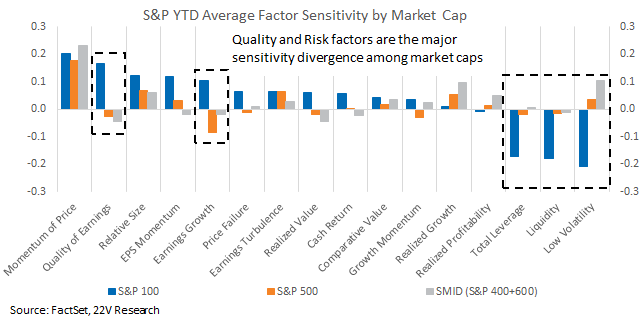
What the above means for factors is as follows. As noted in a Quant report Friday (HERE) breaking down YTD returns, most of the return divergence across caps can be explained by factors. Industry group divergences have been small. Earnings and Risk factors explain most of the divergence, with the strong earnings quality and growth of mega caps explaining most of their outperformance. Within small caps, higher Growth, stronger Momentum, and Lower Vol names have been favored by investors, but unprofitable higher vol names have fallen sharply.

Factor sensitivity shows that the major contributors to the Large vs. Small cap divergence comes from Earnings and Risk factors. Strong earnings quality and growth of mega caps explain MOST of their relative performance vs the rest of the market (Momentum remains a positive contributor across caps). Investors prefer small cap names with lower risk and higher Growth and Momentum. That helps explain the WIDE divergence between profitable small caps (+80bps YTD) and unprofitable small caps (-11% YTD).
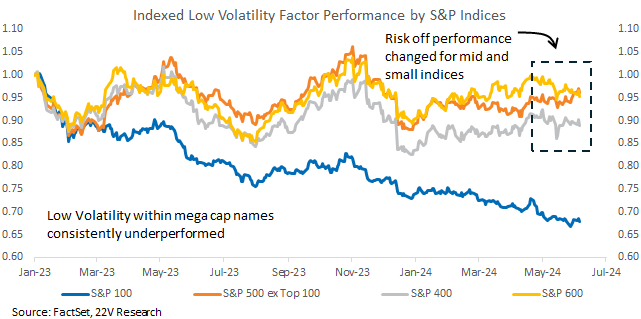
The difference in the importance of Low Vol is clear from the wide returns to the factor between mega caps and the rest of the market. Within mega caps, stocks with higher risk have been consistently rewarded. In all other cap ranges, Low Vol names have outperformed YTD. Economic growth has been strong, so we do not see a reason to expect at change in the Low Vol trends until there is less uncertainty over the inflation/FCI outlook. Again, a benign CPI/PPI reading and economic growth remains around ~2.5%, would leave a less uncertain inflation/FCI outlook. That would be a negative for the Low Vol names within smaller (ex OEX) market segments.
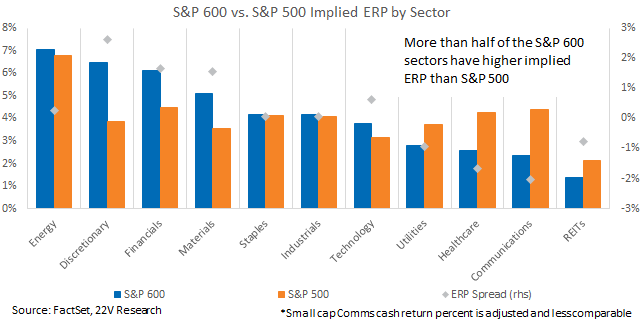
In generally, larger caps have higher Quality, Growth, and Momentum, while smaller caps are more Risk-on and Value exposed. When we look at ERP across sectors, the “riskier” and Value sectors have much higher implied ERPs. Large Cap Energy and Financials have higher relative ERPs as well. In small caps, Energy, Discretionary, Fins, and Materials have unusually high ERP. i.e., investors have been discounting the uncertainty risk. That uncertainty has a chance to fade.
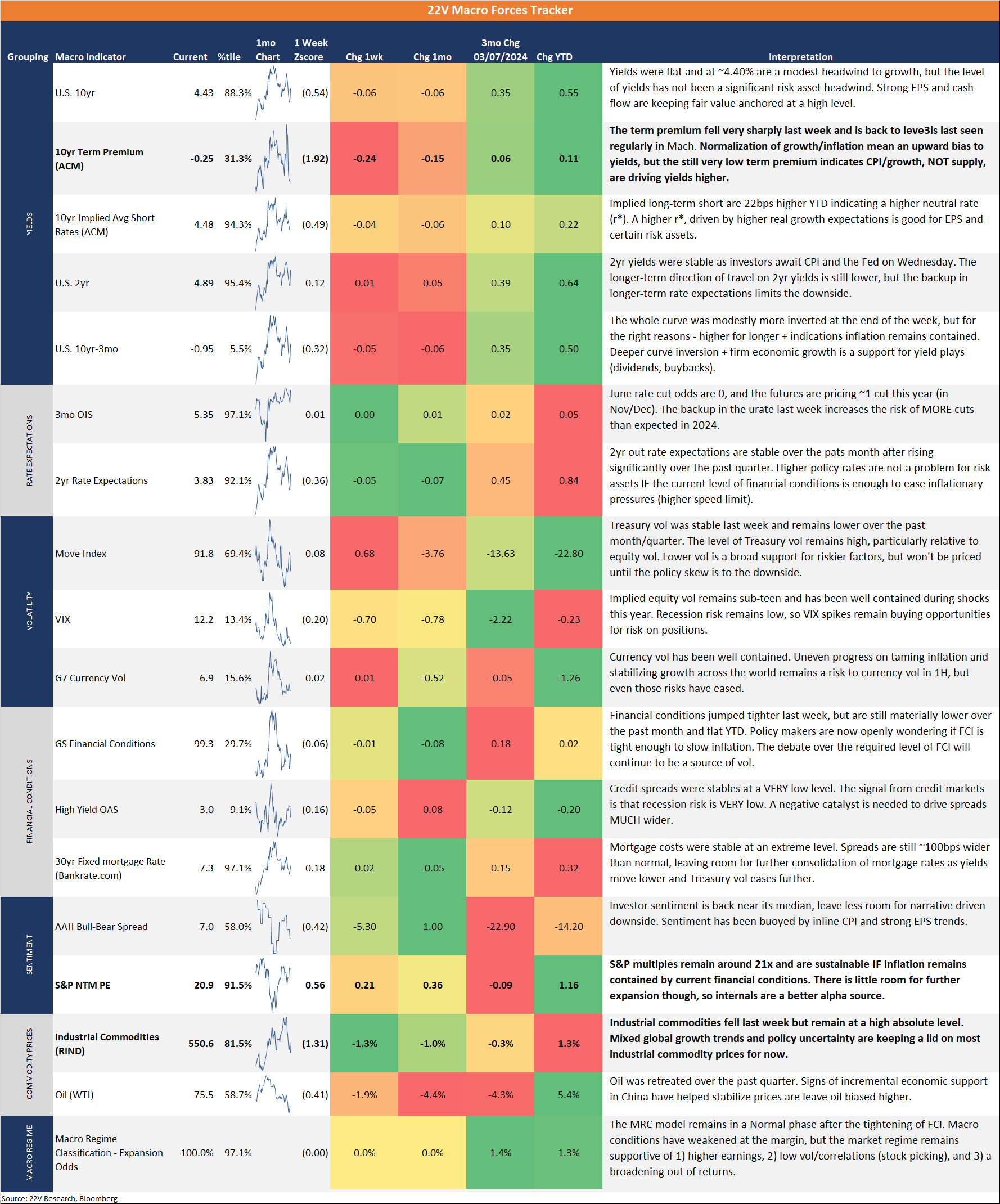
Macro Tracker: Large caps continued to benefit from low conviction on the path of inflation and policy. The cap weighed S&P was +1.3% while the equally weighted index was down -0.7%. At a factor level, Growth led Value, and Low Vol led Earnings Risk and Liquidity. The recent zigzags in both risk (risk on – risk off) and fundamental factors (Quality-Debt, Profitable-Unprofitable, and LightGBM) show investors have not reached a consensus on the direction of macro/market moves. The payroll report on Friday provided an important insight into the skew of potential forward moves that could help resolve this period of macro uncertainty. Payrolls were stronger than expected, but 1) wage growth moved higher, and 2) the urate increased on a lower labor force. One of the big debates preventing a factor trend from tacking hold is the question over if FCI are tight enough to deliver slower inflation and growth, or if the Fed will need to tighten conditions further. A backup in the unemployment rate (one not driven by increased population) is a classic signal of slower growth and increasing recession risk. Today, recession odds are still VERY low, but the Fed expects policy to impact the real economy with long lags. The urate moving higher today means slower growth and lower inflation in the future, under Fed thinking. With inflation expectations well contained, if the CPI print this week is tame (in-line is enough, lower is even better), a risk-on factor rotation is increasingly likely. That would benefit the smaller caps, Value, and rate sensitive names that have struggled over the past few weeks. A more sustained risk-on trend requires inflation to remain on a Fed friendly path lower (falling, not collapsing).