This report is the latest monthly update of 22V’s China Economic Sentiment Series (CHESS), which uses ChatGPT to analyze shifts in sentiment among economists commenting in China’s domestic media. For more background on CHESS, please see the white paper HERE.
SUMMARY
- Key policy meetings in July have boosted analyst expectations of stimulus, but the improvement is modest relative to downbeat sentiment towards the broad macro outlook; expectations for fiscal policy, which will be the key swing factor in H2, remain subdued
- Domestic demand is the key weakness in China’s outlook, with property sentiment in the doldrums and expectations for consumption losing recent momentum; exports are the bright spot for sentiment, but could be vulnerable to a slowdown in US growth and to trade tensions
- Relevant sentiment categories provide few reasons to expect a near-term upturn in China’s domestic equity markets
What the latest sentiment signals show
Our previous monthly CHESS update (link HERE) flagged a broad downturn in economic sentiment in June. We noted that weak confidence in the outlook had raised the stakes for China’s leadership to reset expectations at two key policy events in July: the Third Plenum (July 15-18) and mid-year Politburo meeting on the economy (July 30). So, did Beijing clear that bar?
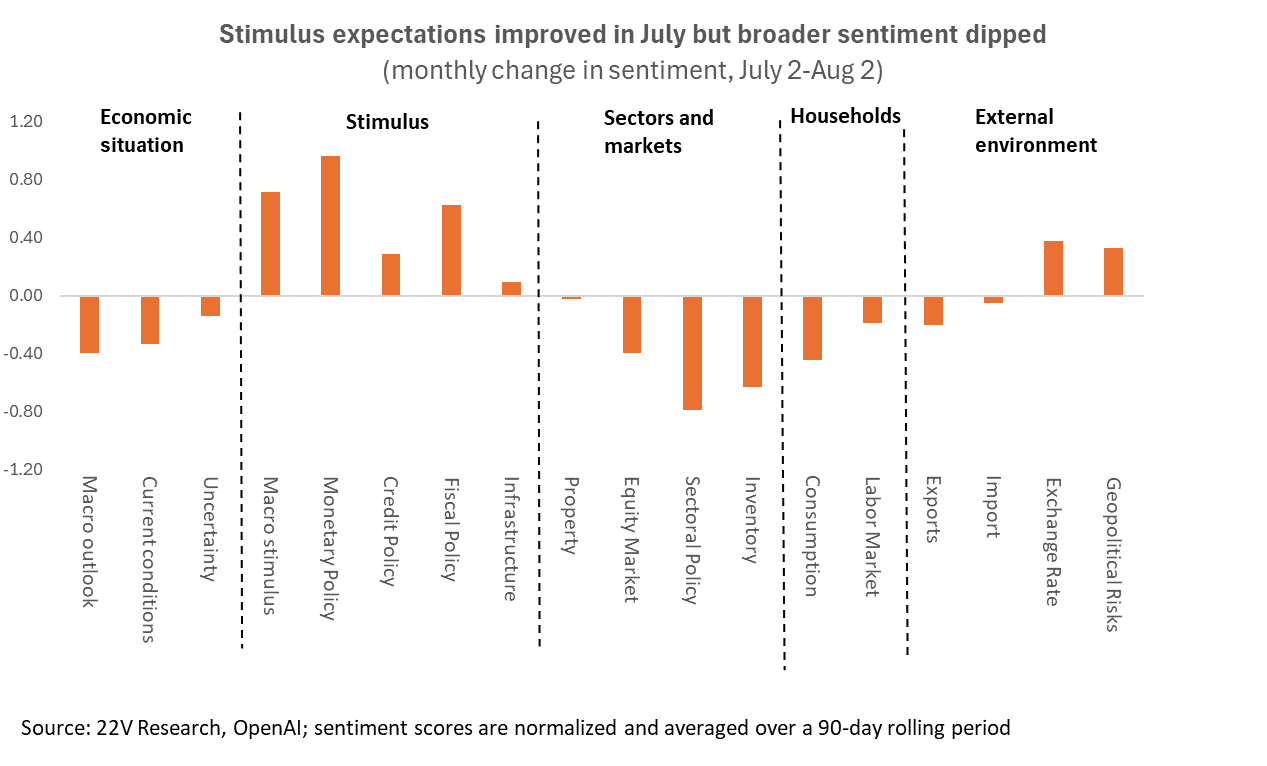
While expectations towards stimulus picked up in July, the improvement was modest relative to the broader macro backdrop, which remained subdued. Stimulus hopes cued off an affirmation that at the Third Plenum that Beijing intends to meet its full-year GDP growth target of “around 5%” despite disappointing growth in Q2 (4.7% y/y). Sentiment improved mainly in terms of monetary stimulus, which we believe will play only a supporting role in Beijing’s H2 support, while the more impactful area of fiscal stimulus saw only a small improvement in expectations.
Sentiment towards the macro outlook and most other categories worsened in July (see chart above). Analyst views on domestic demand remained downbeat, with property sentiment still negative despite recent support measures and consumption sentiment trending down. The only CHESS sentiment category with strong positive sentiment right now is exports. But foreign trade is too small on its own to carry China’s broader growth, and reliance on exports carries risks from slowing US growth and a potential increase in trade frictions after the US presidential elections.
Market implications:
- The signals from CHESS sentiment are consistent with 22V’s view Beijing’s stimulus is still too restrained to break out of deflationary dynamics. Sentiment suggests (and we agree) that the bump to activity in coming months from stimulus will be modest.
- There are few reasons to expect a near-term boost to China’s domestic equity markets. The CHESS categories with the strongest historical correlations with Chinese equities were mostly modestly negative in July.
- China’s demand for metals is also unlikely to see a major improvement in the near-term. The expected improvement in infrastructure stimulus remains small, and property sentiment has yet to show signs of life.
Please see charts and further details below.
A modest boost to stimulus expectations
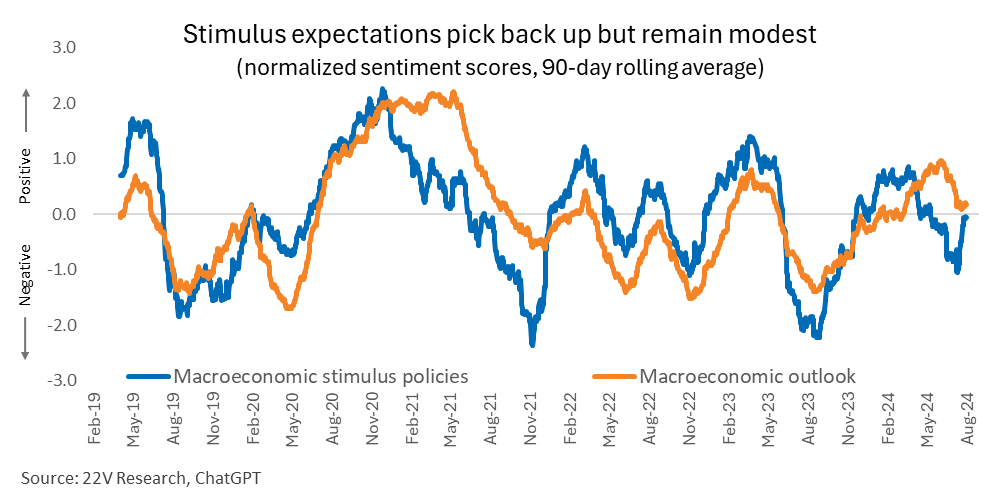
We dive into the analysis with a comparison of two key CHESS indicators: sentiment towards overall stimulus (blue line below) and sentiment towards the broad macro outlook (orange line). As the chart shows, inflection points in stimulus sentiment tends to lead those of sentiment towards the outlook. In other words, stimulus sentiment is the most forward-looking of the sentiment indicators.
Stimulus sentiment improved notably in the second half of July, but that was enough to offset only some of the deterioration in expectations of policy support seen in recent months. At the very least, analysts expect Beijing to avoid fully repeating the policy mistake of 2023, when stimulus stayed tight throughout the summer and activity slowed sharply. But overall expectations for policy support remained restrained. With sentiment towards the outlook continuing to fall in July, it will likely take a much more significant boost in stimulus to boost activity and broader economic confidence.
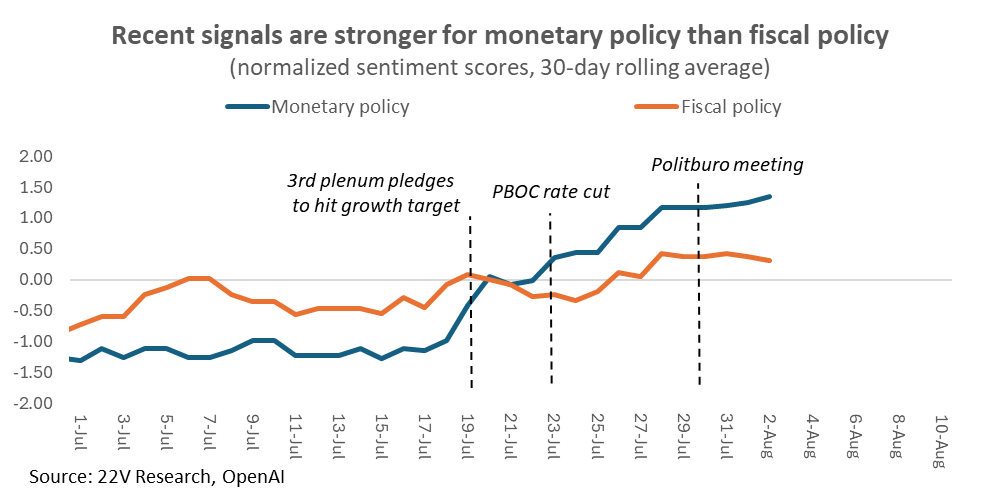
It is worth taking a closer look at what is driving the recent increase in stimulus expectations. The chart below compares monetary and fiscal stimulus over the last month. A few observations stand out:
- Monetary policy sentiment responded to key policy signals. On July 18, the communique from the Third Plenum contained a short paragraph reaffirming Beijing’s intent to achieve the full-year GDP growth target of “around 5%.” Then, on July 21, the PBOC cut its main policy rate (the 7-day reverse repo) in a surprise to markets. Thus, analysts see PBOC becoming more supportive in H2 as Beijing seeks to stay on track with its target.
- By contrast, these policy signals and the Politburo meeting failed to lift fiscal policy sentiment. This lackluster response matters because, as we noted in our Politburo preview note (link HERE), fiscal policy has been the main disappointment for growth this year and is the key swing factor for the H2 outlook. The Politburo meeting pledged faster implementation of bond issuance and fiscal spending within existing targets, while holding the door open for additional measures to expand the deficit “at the appropriate time” (see our quick take HERE). This underwhelming message was what we expected from the Politburo meeting, and the flat response in analyst sentiment indicates that others agreed. Going forward, we expect Beijing to announce additional fiscal measures in Q3, on the order of CNY 300-500bn (USD 42-70bn) in additional spending. This would provide only a limited boost to demand, consistent with nominal growth this year of around 4% y/y (weaker than 4.6% y/y in 2023).
Implications: CHESS signals suggest only a modest pickup in stimulus, particularly where it counts most – fiscal spending. Additional support will be necessary to significantly boost activity and broader confidence in the outlook.
Property and consumption sentiment lags; exports are the bright spot
The outlook for stimulus is especially important given that Q2 and July economic data underscored the weakness of underlying domestic demand. Key culprits are the property sector and household consumption (see our analysis of the Q2 data HERE). Signals from CHESS suggest few reasons to be encouraged about the outlook in either area, including in forthcoming July activity data (to be released August 14). The result is likely to be continued deflationary pressures.
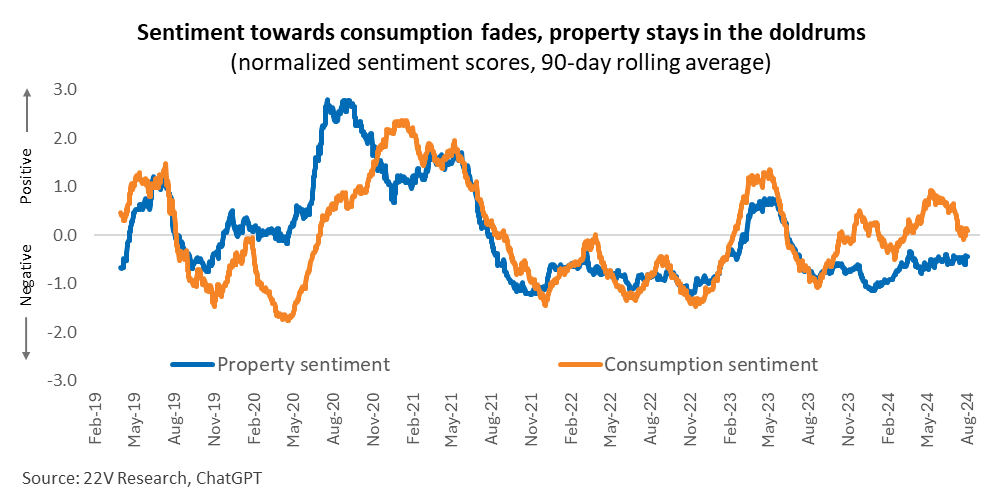
Consumption sentiment (orange line above) peaked in May and has steadily declined since then. Beijing’s program to promote consumer upgrades is underwhelming as a stimulus measure, especially given the macro headwinds holding back household spending. The key problem is anemic job creation, resulting in household income growth that is much weaker than the pre-pandemic trend.
Sentiment towards the property sector (blue line above) continues to tread water at depressed levels despite the rollout of incremental property support in recent months. In contrast to the Q1 Politburo meeting in late April, analysts did not expect any changes in property policy at the Q2 meeting and did not find any (see chart below).

Export sentiment remains the main bright spot for China’s outlook (chart below). Exports have buoyed growth this year, but the broader weakness in macro data – including the July manufacturing PMIs – demonstrates that China’s economy is now too large for exports to offset the impact of weak domestic demand. There are also reasons to worry about the outlook for exports, given recessionary risks in the US as well as the potential for escalating trade tensions should Donald Trump win the US presidential election in November. In the meantime, import sentiment has been weaker than export sentiment, another signal of subdued domestic demand.
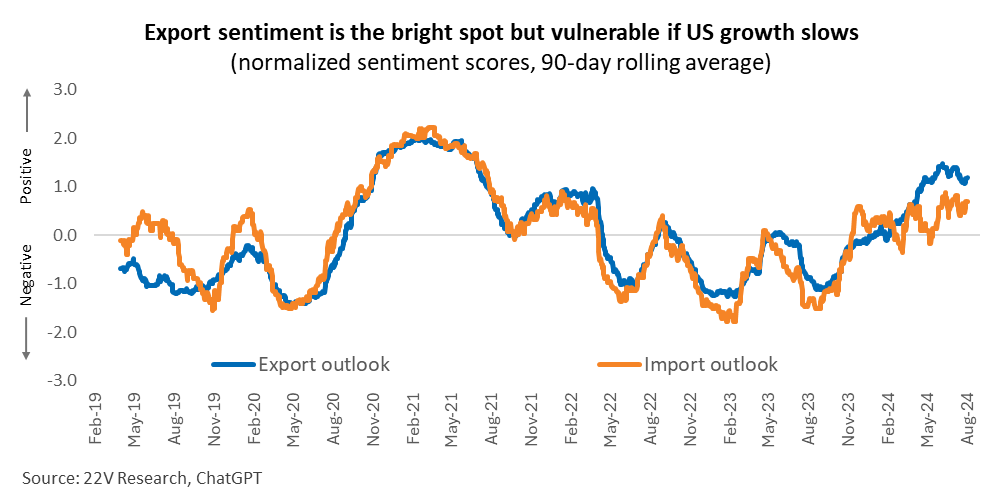
Implications: CHESS signals suggest domestic demand will stay weak, consistent with ongoing deflationary pressure. Exports remain a bright spot for now but are at risk of slowing growth abroad and an increase in trade tensions.
Few obvious catalysts for Chinese equities
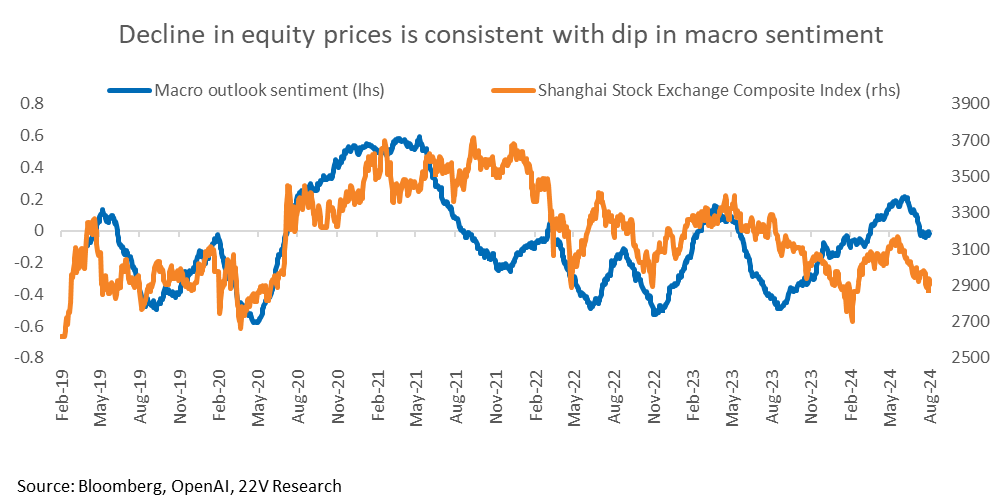
As explained in the CHESS white paper (link again HERE), sentiment is more useful for looking at inflection points in equity markets rather than trying to forecast levels. The CHESS categories with the strongest historical correlation with equity prices and valuations generally saw modest declines in July. These include equity market sentiment, macro outlook sentiment (show in the chart below), export sentiment, and current conditions sentiment. Of the indicators most relevant to equities, only exchange rate sentiment saw a positive change in the last month.
Implications: The latest CHESS data provide few reasons to expect a near-term rebound in China’s domestic equity markets.