SUMMARY
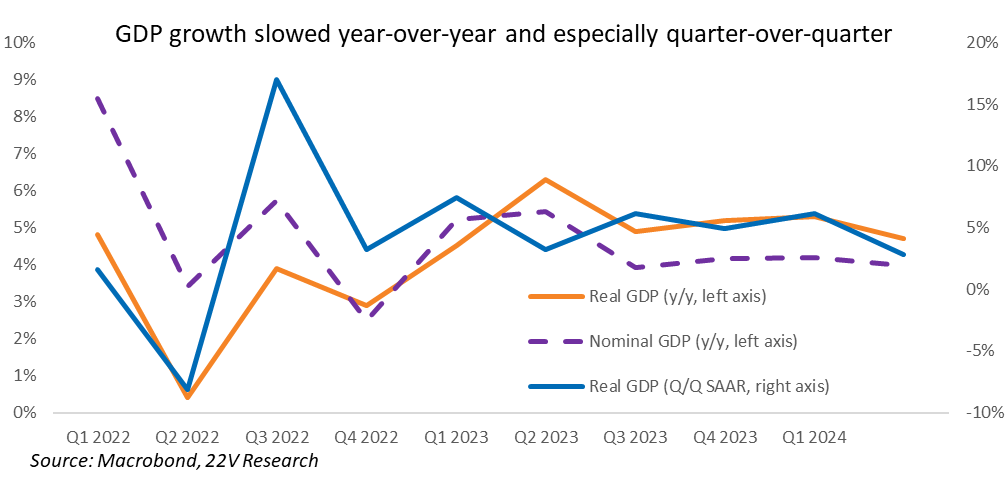
- China’s Q2 GDP missed forecasts, with ongoing weakness in consumption and the property sector dragging down sequential growth (2.8% SAAR) and year-over-year growth (4.7%); nominal GDP growth (4% y/y) slowed amid a fifth consecutive quarter of deflation.
- Despite the miss, Beijing will largely adhere to its strategy of financial discipline and promotion of advanced manufacturing at this week’s Third Plenum and the end-July Politburo meeting; the main upside surprise for both meetings would be aggressive efforts to boost central government fiscal support to struggling local governments.
- Assuming that Beijing makes only incremental tweaks to its policy mix, the rest of the year will see a continuation of subdued domestic demand, deflationary pressures, and a large trade surplus that increases trade frictions ahead of the US presidential election.
China posted real GDP growth of 4.7% y/y in Q2, a sizeable miss from the consensus forecast of 5.1%. The shortfall comes at an important juncture for policy. The Third Plenum meeting, which takes place every five years to lay out the economic reform agenda, kicked off today in Beijing (see our preview note HERE). Later this month (exact dates TBD), the Politburo will hold its quarterly meeting on the economy to preview policies for the second half.
While these meetings provide a potential opportunity for Beijing to look to reset weak expectations (see our latest analysis of economic sentiment HERE), our basecase for the outlook remains subdued. Despite further signs of needed support for domestic demand, Beijing will likely adhere to strategy that emphasizes financial discipline and all-out efforts to boost innovation and advanced manufacturing.
KEY POINTS ON THE DATA RELEASE
Quarterly GDP slowed as consumption struggled:
- Real GDP growth slowed significantly on a sequential basis, from 6.1% Q/Q SAAR in Q1 to 2.8% Q/Q SAAR – the slowest pace of sequential growth since Q2 2022. On a year-over-basis, real growth slowed to 4.7% y/y, from 5.3% y/y in Q1.
- Nominal GDP growth slowed to 4% y/y in Q2, from 4.2% in Q1. This was the fifth straight quarter of deflation, though the fall in the GDP deflator eased a bit to -0.7% y/y, from -1.1% in Q1.
- While the statistical bureau has not released the breakdown of GDP by expenditure, the weakness of consumption was no doubt a key factor behind the growth slowdown. China’s quarterly household survey showed per capita nominal consumption slowing from 8.3% y/y in Q1 to 5% y/y in Q2. This was due to slow nominal income growth (only 4.5% y/y in Q2), driven by continued weakness in the labor market (see below). The saving rate was flat at 32%.
June’s monthly activity data showed production resilient but domestic demand weak:
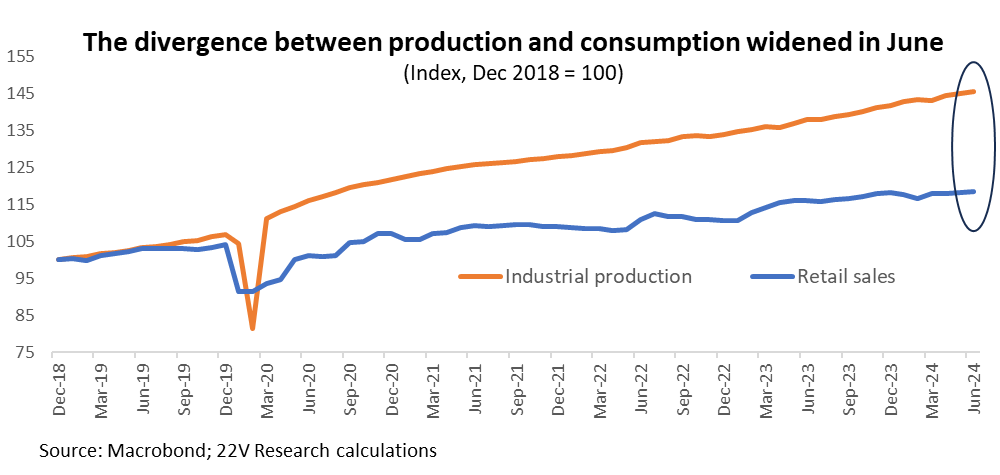
- Industrial production grew 5.3% y/y, ahead of consensus (5% y/y), as strong exports (8.6% y/y) offset weak domestic demand. While 5.3% y/y was a slowdown from the 5.6% y/y pace in May due to base effects, production accelerated sequentially to 5.2% m/m SAAR from 3.2% in May.
- Retail sales were very weak, at only 2% y/y (nominal), compared to 4.1% y/y in May and the consensus of 4% y/y. Sequential growth of retail sales was negative (-1.4% m/m SAAR) for the first time since July 2023. As we anticipated, China’s main consumption stimulus this year, a trade-in program for old appliances and autos, has been clearly underwhelming in light of modest funding from the central government and the macro headwinds of a soft labor market and weak housing sales. Auto sales fell by -6.2% y/y (from -4.4%) exacerbated by a price war in the sector. Housing-related consumption was very weak, with appliance sales falling -7.6% y/y (from 12.9% y/y in May) and furniture sales up only 1.1% y/y (from 4.8% y/y in May). While the surveyed unemployment rate remained flat at 5%, a more reliable indicator – the PMI employment series – showed ongoing weakness in hiring.
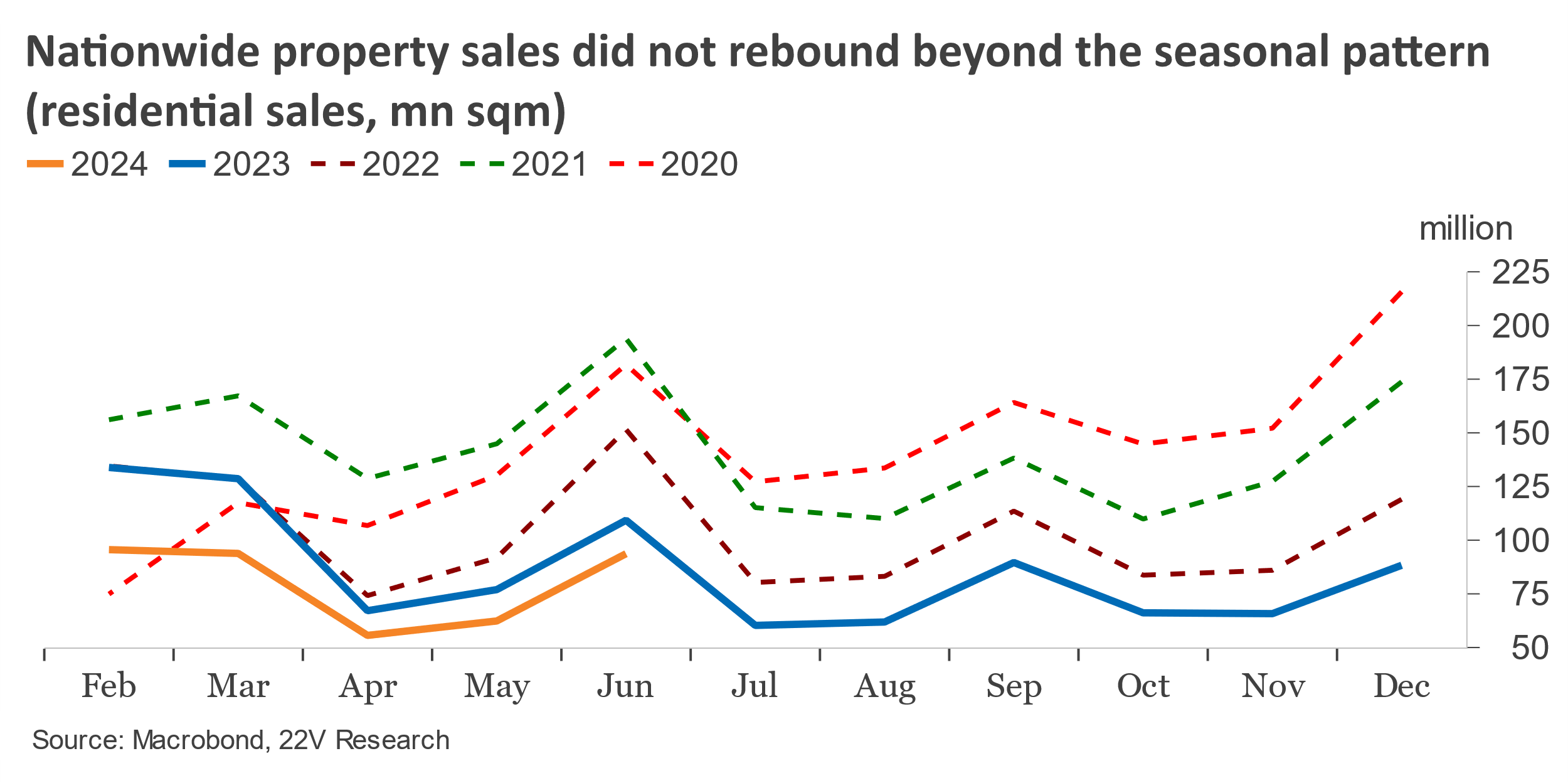
- Beijing’s recent flurry of property support measures is not yet showing a decisive effect. The decline in housing prices moderated a bit in June, and the spokesperson for China’s statistical agency noted a pickup in sales month-over-month in tier one cities. But that rebound could be short-lived, coming after a round of loosening measures in the tier-one cities in May and June. And nationwide housing sales do not show a meaningful recovery in demand (see chart further below).
- Fixed asset investment (FAI) slowed slightly from 4% y/y in Jan-May to 3.9% in Jan-June, in line with expectations. Manufacturing investment was strong (9.5% y/y ytd, from 9.6% in May), supported in part by Beijing’s equipment upgrading stimulus program. Infrastructure FAI slowed to 5.4% y/y YTD (from 6% in May) as weak land sales revenue and debt restrictions on provinces constrained local government spending. Real estate investment stayed depressed at -10.1% y/y YTD, which was the same as the YTD pace in May.
The overall takeaway is that while booming exports carried growth to start the year, they cannot fully offset the weakness of domestic demand. The supply side of China’s economy (manufacturing production and investment) continues to outpace domestic demand. Strong exports are helping to plug the gap in demand but only so far, as is also clear in continued deflationary pressure. The weakness of domestic demand is due to three main factors:
- The ongoing property correction
- Subdued consumption, particularly of durable goods, due to weak household income expectations and a lack of housing-related spending
- Restrained stimulus, particularly fiscal stimulus, with depressed land sales and restrictions on borrowing constraining local government spending
POLICY IMPLICATIONS AND OUTLOOK
While the sequential slowdown in growth will be a concern to policymakers, the leadership will likely respond with only incremental increases in stimulus and its overall macro strategy. There are three main reasons:
- Economic conditions are not so poor as to throw Beijing into panic. Economic conditions on the ground are worse than headline growth figures represent but basic social and financial stability is not at risk. At 4.7% y/y, GDP growth is still broadly in line with Beijing’s annual target of “around 5%.” The leadership will aim for incremental support in the second half to bring full-year growth to the 4.5-5% range.
- Beijing does not have attractive solutions to current problems without changing its economic strategy – which Xi Jinping is loath to do. Beijing does not lack policy space to support demand. Instead, the dilemma is that the three constraints on demand are the property sector, household consumption, and local government spending – all areas in which China’s leadership is disinclined to increase support as Xi emphasizes financial discipline and an innovation agenda of “new productive forces.” Beijing’s property policies aim to cushion further downside risks but to restore the sector’s role as growth driver. Near-term support for consumption is negligible: Beijing is not ready to use fiscal resources for direct consumption stimulus, and Xi’s focus on advanced manufacturing rather than more labor-intensive services limits the strength of policies to support job creation and accelerate income growth. While the central government has stepped up this year to provide more financial support to struggling local governments, it is reluctant to give up further control of resources to local officials or to relax pressure on them to contain new borrowing.
- Beijing also wishes to preserve flexibility to adjust macro policies in 2025 depending on the outcome of the US election this November. That could include the decision to stimulate domestic demand more aggressively next year in the event of a renewed trade war should Donald Trump win the US election.
While there is room for upside surprises, we expect Beijing’s to largely stay the course at upcoming meetings:
- The Third Plenum meeting will lay out long-term structural reforms to guide the next five years, focusing on Xi’s innovation and industrial policy priorities. As our preview report noted (link again HERE), the plenum is likely to signal greater policy efforts to boost urbanization and fiscal reform – both areas that are important for long-term domestic demand. Our basecase is that these reforms will be incremental. An upside scenario for the plenum would be fiscal reforms that are faster and more ambitions than the incremental pace we anticipate. Such signals would include announcements of the central government shouldering significantly more spending responsibilities and/or allowing local governments to keep a larger share of tax revenue, or signals of central government debt relief for local governments. Major urgency from Beijing towards these fiscal reforms would also increase the prospects for more significant fiscal stimulus at the upcoming Politburo meeting.
- We expect the Politburo meeting to show modest increases in demand-side support in the second half. Our basecase for fiscal stimulus is that the Politburo will focus on speeding local government bond issuance (within its existing annual quota) to support infrastructure projects, and that it will show openness to but not immediately announce an increase in the fiscal deficit for this year. That announcement would come in Q3, in the form of another round of central government issuance of special treasury bonds. An upside scenario would be an immediate announcement of these plans (or other new fiscal support). For property, the upside surprise for the Politburo meeting would be a significant expansion of PBOC funding for local governments to buy unsold properties. While there is some scope for modest PBOC rate cuts and an RRR cut in coming months, especially as the Fed approaches its own likely rate cut, overall monetary and credit easing will be constrained by concerns over exchange rate stability.
If these baseline expectations hold, one should expect a continuation in the second half of subdued domestic demand, a very large trade surplus, and deflationary pressures:
- Without a major shift in the scope or nature of stimulus, overall domestic demand will remain subdued. It is hard to see consumption or property staging a major rebound in coming months.
- Weak nominal growth and continued deflationary pressure will continue to weigh on corporate revenue and earnings growth and thus the macro backdrop for Chinese equities.
- China’s trade surplus will continue to stoke trade tensions. The merchandise trade surplus reached a monthly record of $99 billion in July, which will only add to growing trade frictions with the US, EU and other trade partners. The large surplus puts an even larger bullseye on China trade should Trump win the US election.
The next watchpoint is the results of the Third Plenum when it concludes this week. As reminder, the meeting will likely conclude with a communique on Thursday that outlines the main decisions at the meeting. A more detailed “Decisions” document will likely come out several days later.
With thanks to Houze Song for his contributions to the analysis.