

With the Third Plenum now concluded (see our analysis HERE), the focus for China’s outlook shifts to the end-July Politburo meeting. The Politburo meets monthly, and the end-July meeting reviews the economy mid-year to lay out stimulus policies for the second half. Since the Politburo rarely meets on the weekend, the meeting will likely take place on Monday, Tuesday, or Wednesday (7/29-31).
In the run-up to the meeting, Beijing has signaled somewhat more urgency to boost growth in H2 2024. In sequential order, the key signals have been:
- The Third Plenum communique issued last Thursday reaffirmed Beijing’s intent to meet its full-year growth target of “around 5%”, despite Q2 GDP slowing to 4.7% y/y. The communique pledged to “actively expand domestic demand” (see our recap HERE).
- Last Friday, Han Wenxiu, an official in the Party body that coordinates macro policy, implied that Beijing would step up the intensity of fiscal spending in H2 (see our summary HERE). But Han’s reference to “positive developments” in the property sector implied that Beijing will not announce major new property policies in the near term. The Third Plenum communique also seemed to signal no major change in property policies.
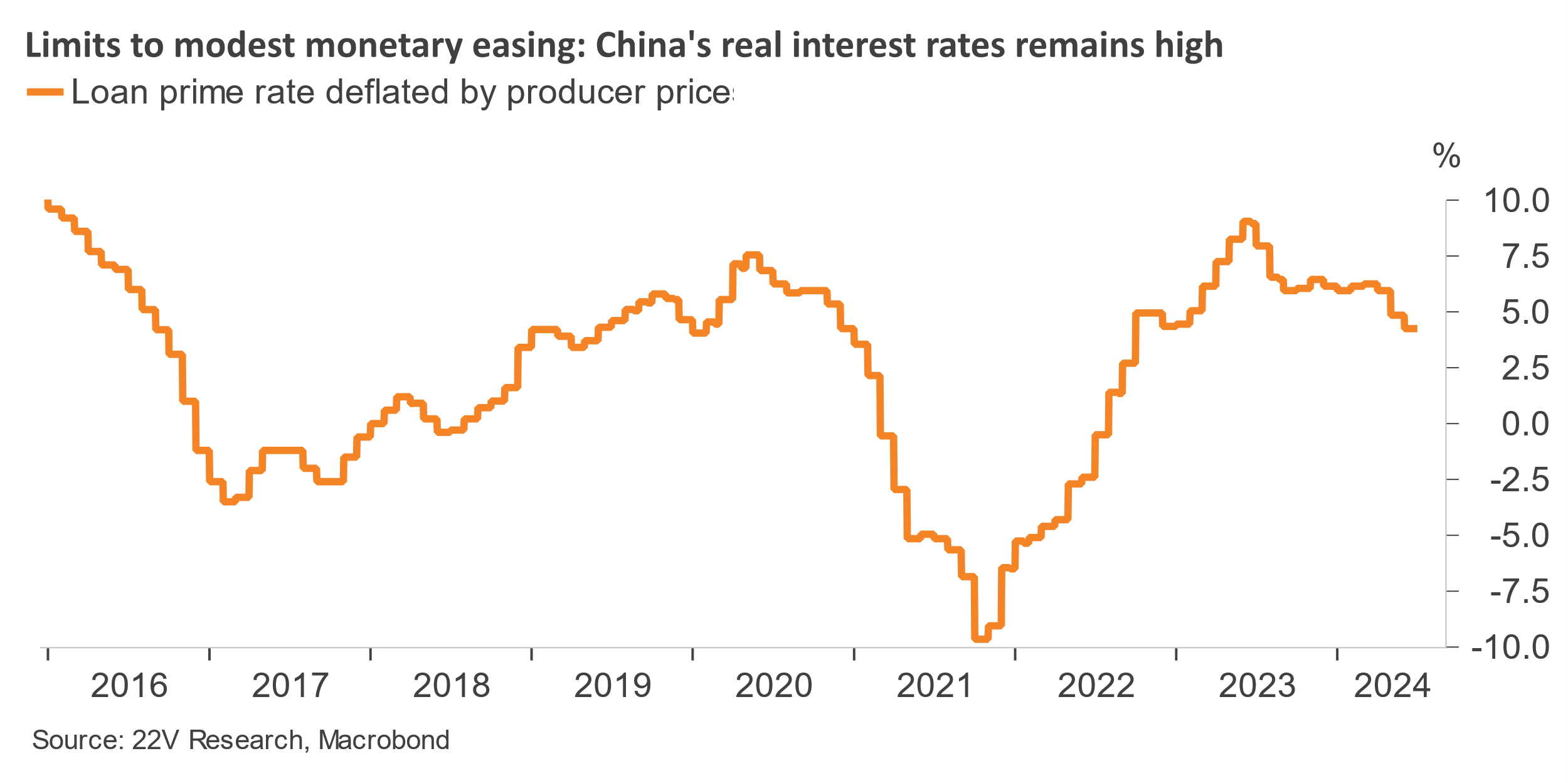
- Over the course of this week, the PBOC made surprise cuts to three policy rates: the 7-day repo (most important), the loan prime rate, and the medium-term lending facility. Major banks also announced a drop in deposit interest rates. The magnitude of these cuts was modest, especially in terms of real rates (see chart below). The reluctance to add to further depreciation pressure on the currency remains the main obstacle for the PBOC, at least until the Fed moves closer to cutting. The series of cuts this week are thus a message not that the PBOC will ease aggressively, but that it is acting in a relatively comprehensive manner by lowering funding costs for banks and for borrowers.
- Yesterday (Thursday), the National Development and Reform Commission (NDRC) put numbers on the State Council’s announcement last week of central government funding for the industrial equipment and consumer product upgrading program announced at the March National People’s Congress. Beijing will provide CNY 300 bn (USD 41 bn) from the proceeds of “ultra long-term special treasury bonds,” to be split equally between the industrial and consumer upgrade programs. The funding is way too small to significantly boost consumer goods spending but is at least a baby step in Beijing coming around to consumer stimulus. The key hurdle for strong consumer spending is macro: weak job growth and income growth.
All eyes on fiscal:
The key watchpoint for the Politburo meeting is how much fiscal support Beijing signals is coming in H2. Government spending has lagged this year because of the weak finances of local governments, that depend on the property sector for perhaps half of all revenue. This underperformance should not have been a surprise: we noted in our NPC coverage in March that the budget was based on overly optimistic revenue projections. Zhang Bin, an economist at the Chinese Academy of Social Sciences and one of the strongest proponents for more aggressive stimulus, pointed out this week that broad fiscal expenditure through May was down -2.2% y/y, worse than -1.5% y/y in Q1. The government has executed 33.5% of the full-year budget, compared to 36.8% in the same period last year, per Zhang. This leaves some room for a bump to H2 growth if the government catches up on the pace of budget execution, though this will require a push from China’s leadership (such as relaxing some debt constraints on local governments) and likely an increase in the fiscal deficit to make up for lost land sales revenue.
Our base case for H2 is that the Politburo will announce an acceleration of local government bond issuance and spending within the existing budget envelope, while leaving the door open to an expansion of the deficit later this year. The eventual expansion of the deficit would be modest, on the order of CNY 300-500 bn (USD 41-79 bn). That increase could come in the form of another round of ultra long-term special treasury bonds or lending through China’s policy banks. The deficit increase would likely go to infrastructure spending and general expenditures of local governments rather than an expansion of consumption stimulus.
That base case is probably the bare minimum necessary to keep real GDP growth for full-year 2024 within the government’s target range of “around 5%,” which leaves leeway for real growth to go as low as 4.7%. But in many ways nominal growth is the more important barometer for China’s economy this year, with real growth flattered by production-side statistics that overlook the weakness of domestic demand. Nominal GDP growth slowed to 4% y/y in Q2, from 4.2% in Q1, the fifth straight quarter of deflation. The base case of modest additional stimulus is probably necessary to keep nominal growth in 2024 from falling below 4%, compared to 4.6% in 2023. Weak nominal growth is of course a particular drag on Chinese equities, hurting revenue and earnings growth.
A downside scenario for H2 would be no increase in the deficit this year, which would likely mean that nominal growth falls below 4% in full-year 2024. Lack of any signaling by the Politburo of an increase in the deficit later this year would indicate the downside scenario is a real danger.
Finally, a realistic upside scenario would be a significant expansion in the fiscal deficit in H2, such as another round of CNY 1 trillion (0.4% of GDP) issuance of ultra long-term special treasury bonds. That would likely put real GDP growth on a path to achieve or come close to the 5% target, though nominal growth would still come in below 5%. The Politburo would either announce the expansion immediately or (more likely) hint that it will follow in the coming months.
The lesson of past cycles in China and elsewhere is that powerful easing across multiple areas of policy – fiscal, monetary, and likely property – is necessary to break out of deflation. China’s leadership simply does not have this level of appetite for bold measures. The overall economic strategy, reaffirmed by the Third Plenum, is to focus on supply-side measures to promote advanced manufacturing and innovation, and to employ targeted demand-side measures as necessary to protect bottom-line growth and social stability targets. Until there is a major shift in Beijing’s priorities, the nominal blues will continue.

With thanks to Houze Song for his insights.

