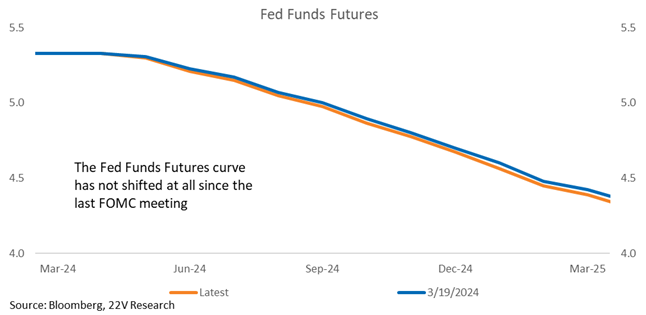
SUMMARY: The latest FOMC meeting was considered dovish, but the Fed funds futures curve has not shifted. I.e., the expected cuts are about the same as the day before the last FOMC meeting. What has likely impacted market internals, which have been decidedly risk-on since the last FOMC meeting, was the confirmation that Powell wants to get started with rate cuts. Here is the money line from Peter Willaims on Powell, which was reinforced following Powell’s talk last Friday: “Powell seems to want to get an initial 50-100bps of risk management cuts taken care of. The timing of the first cut, and likely all of the initial round of cuts, will be spot inflation data dependent. After that, the depth of the cutting cycle will depend on whether or not there is any appreciable sign of weakness in the labor market.”
Bottom Line: We know that the Fed assigns a high cost to changing the direction of policy. The first cut is very important in that regard as it is likely to be followed by more cuts. We can debate the timing and how much, but if what Peter lays out above is correct (50-100bp of cuts and take it from there as Powell just wants to get started), the direction of travel for the Fed funds rate seems clearer to investors. That clarity is positive for risk assets. Odds the economic cycle will extend increase, and investors can extrapolate the improved earnings outlook for small caps, Value, and Deep Cyclicals (HERE) with more confidence. Unless data over the coming weeks changes the odds the FOMC can start the cutting cycle. That is a risk, but not a base case. Unless we get hot labor market data and two 0.3% or above Core PCE readings.
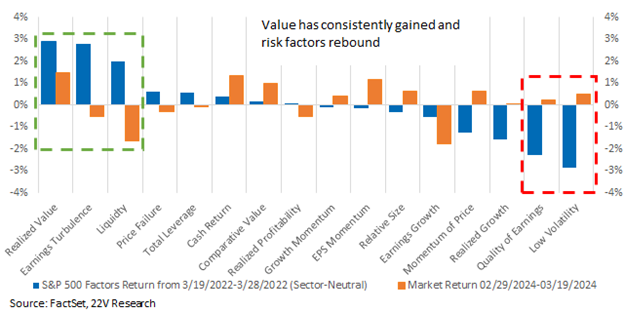
We remain bullish on risk-on factors (Value, Deep Cyclicals, Small caps) and continue to fade Price Momentum, Quality, and Low Vol stocks. The latter group HAD significantly outperformed YTD.
Labor Market Data This Week: Powell has leaned on the JOLTS data to highlight some loosening in the labor market. Assuming headline job growth is roughly in-line with expectations, the FOMC needs to see wage growth tick down in line with the decline in QUITS rates (Quits come with the JOLTs data). If that happens, it will be positive. FYI – 22V as a firm has faded the JOLTS data as a reliable indicator, but since Powell keeps mentioning it, it will remain a focus for investors. At some point, wage growth must move lower, or the JOLTS data will be dismissed. We get a Quits update with the JOLTS data tomorrow and a wage update with Payroll on Friday.
Full report below…
MARKET VIEWS: Core PCE came in dovish (HERE) and Powell’s speech Friday reinforced his dovish lean. Peter’s main point is that “Powell seems to want to get an initial 50-100bps of risk management cuts taken care of. The timing of the first cut, and likely all of the initial round of cuts, will be spot inflation data dependent. After that, the depth of the cutting cycle will depend on whether or not there is any appreciable sign of weakness in the labor market.” Interestingly, the last FOMC meeting was considered dovish, but the Fed funds futures curve has not shifted. I.e., the expected cuts are the same as the day before the last FOMC meeting.
Equity market internals have been very clearly “risk-on” since the FOMC meeting despite rate cut expectations being unchanged. Value and Earnings Risk factors have significantly outperformed. Quality and Low Vol have come under pressure, and last week, Price Momentum was one of the worst-performing factors. Investors have internalized that the Fed assigns a high cost to changing the direction of policy. The first cut is very important in that regard as it is likely to be followed by more cuts. We can debate the timing and how much, but if what Peter lays out above is correct (50-100bp of cuts and take it from there) as Powell appears to want to get going on rate cuts, that is positive for risk assets. The odds that the economic cycle will extend increase…

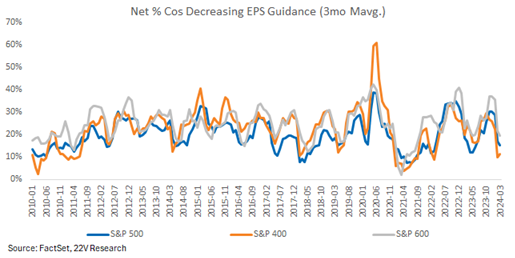
….and investors can extrapolate the improved earnings outlook for small caps (HERE) with more confidence. FYI – the Net % of companies decreasing EPS guidance has collapsed across market caps. Small and mid-cap stock earnings bouncing back are an important step in justifying the recent broadening of market leadership.
Important Data Week: As we have noted before, the FOMC’s three-cut assumption is premised on a dovish forecast, and Powell has discussed downside RISK to labor markets. Powell’s labor market focus has led to debates and speculation on how much the Fed is leaning on the Sahm Rule (HERE). Or how concerned the Fed is about the recent uptick in the unemployment rate. Bottom Line – Powell has leaned on the JOLTS data to highlight some loosening in the labor market. Assuming headline job growth is roughly in-line with expectations, the FOMC needs to see wage growth tick down in line with the decline in QUITS rates (Quits come with the JOLTs data). FYI – 22V has faded the JOLTS data as a reliable indicator, but since Powell keeps mentioning it, it will remain a focus for investors. At some point, wage growth must move lower, or the JOLTS data will be dismissed.
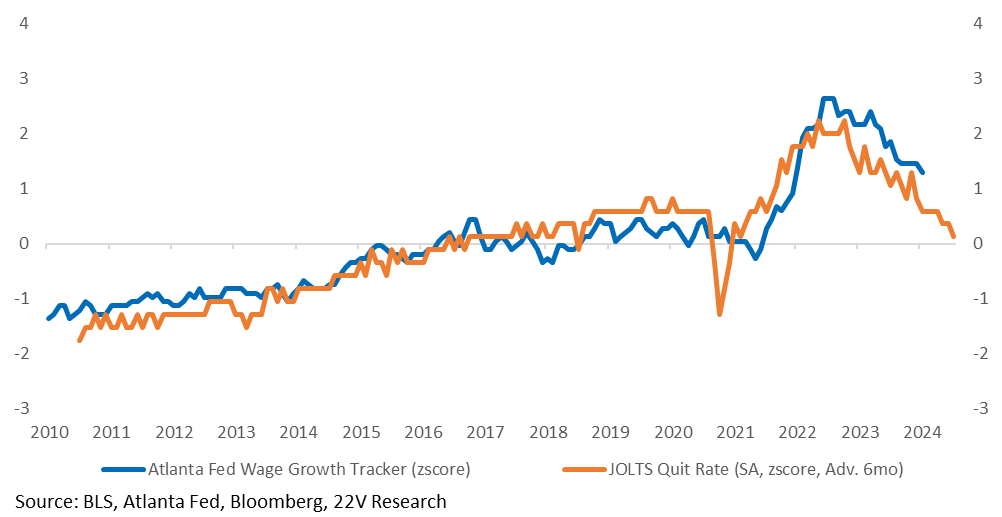
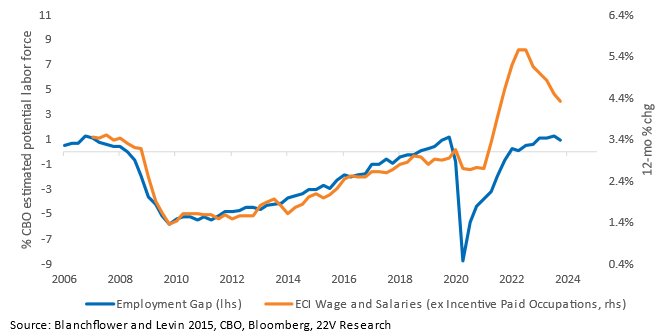
If wage growth follows QUITS rates lower, the investing world will be much more confident that wages and salaries will track toward the current level of the employment gap. And the Fed can go ahead and cut rates back to whatever level of neutral they come up with over time (Peter thinks it is in the 3%-4% range). The employment gap shows a clearly tight labor market, so wage growth declining from here, without the unemployment rate going up, is very important.
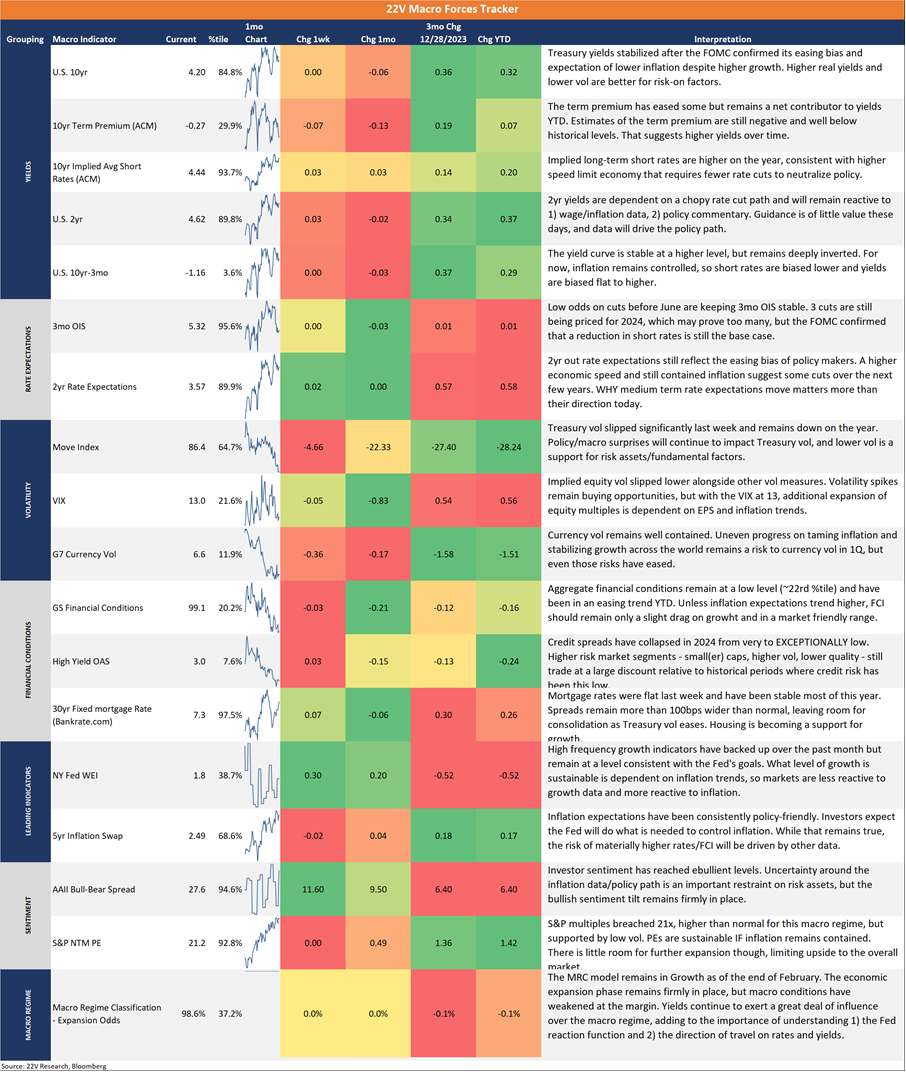
Macro Tracker: Last week saw a broadening out of the risk-on shift that has been getting underway over the past several weeks. Sensitivity to Value factors was high across market caps (mega through small) and Value was one of the most important active exposures as well. Price Momentum’s underperformance and the Price Failure’s outperformance in the broad markets further suggest that this risk-on rally might have overturned the risk-off sentiment that has lingered YTD. Treasury vol moved lower, tracking the decline in volatility across other assets. Inflation data remains consistent with the Fed being able to reduce rates this year, but this week brings important payroll data, and CPI the following week needs to be in line. A quick aside on what “landing” means. A “soft landing” is widely accepted to be a decline in inflation and an easing of monetary policy that avoids a sharp decline in economic growth. A “hard landing” is a recession or at least a market that discounts a recession. Less well defined, and thus subject to a wide range of mappings, is the “no landing” scenario. Inflation firming but NOT accelerating meaningfully could lead to a no landing with few or no rate cuts. An alternative is growth accelerating meaningfully, raising the specter of no rate cuts or hikes. Both scenarios would increase downside risks to markets, but the internals would differ. Higher real yields are better for risk-on factors. Higher inflation is better for risk-off. This should reinforce the idea that the path of policy, while important, is less impactful than the REASON for that path.