

Perhaps the oddest aspect of Fed Chair Powell’s comments during the Press Conference following the FOMC meeting last Wednesday was his repeated reference to the “risk” of a sudden faltering of the labor market. He was so adamant on this point that, at first, I suspected that the Fed’s own processing of the underlying ADP payroll servicing data had signaled to them that the BLS data – and ironically ADP’s own report — are wrong and that labor demand has already begun to turn unnervingly lower. But when questioned Powell was quite clear that there is “no evidence” yet that labor demand has already begun to falter. So, I don’t think they are getting a negative signal from their generally nonpublic inferences from the underlying ADP data. I will check if the minutes make a reference, as they have done once in the past.
One possibility is that Powell is influenced by the logic of the so-called Sahm Rule, which posits that increases of the unemployment rate tend to be self-feeding in their early stages, on the standard logic of the cycle. There are obviously many ways to apply that logic, and the Sahm Rule is perhaps the most prominent of them. As always, beware of data mining, though.
Very close to Classic Sahm — and assuming the February unemployment rate holds in March and April
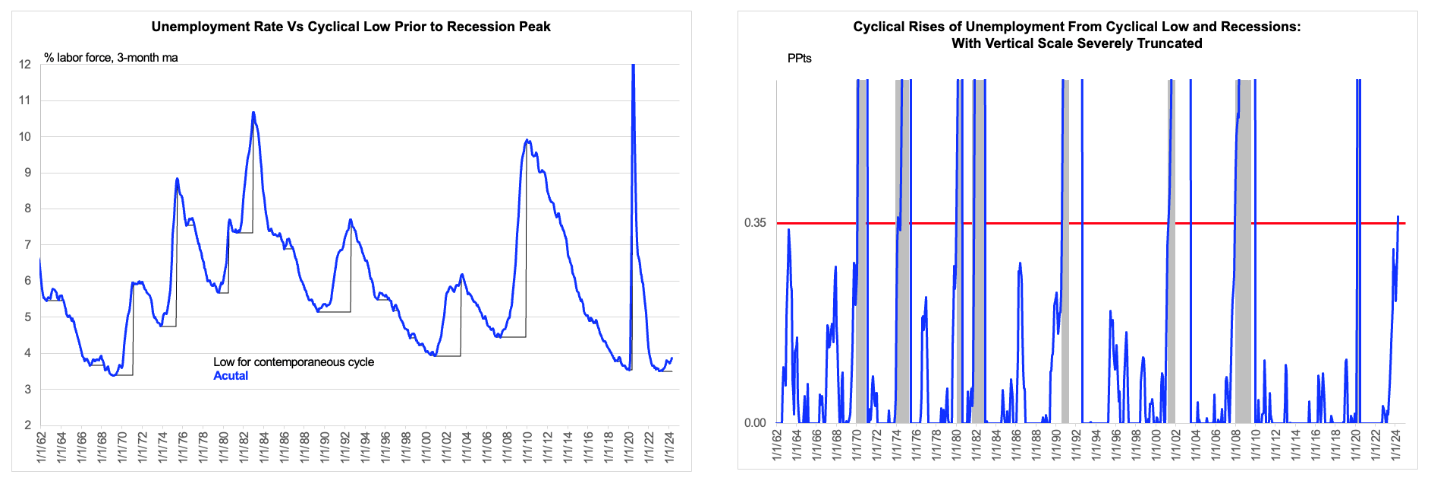
Data are actual to February and simulated to April.
In the chart above, I show a riff on the Sahm Rule that was suggested to me by analysts at Goldman Sachs. Whereas the Sahm Rule triggers off the gap between the 3-month moving average of the unemployment rate and its 12-month low, Goldman suggests measuring that gap relative to its absolute low for the current cycle. As I read it, that distinction matters in one postwar cyclical episode, during which the Goldman approach works better. And because of that the Goldman signal can be a bit more sensitive to the change of the unemployment rate. But the difference is worth only 15 bps, so if the unemployment rate were to rise just a bit further and stay there, both rules would be triggered.
Anyhow, the riff rule is that recessions are associated with the smoothed unemployment rate rising 35 basis points relative to its low for the cycle, something that would be achieved if the February unemployment rate were to hold in March and April. I choose my words carefully when I say, “associated with.” Sahm-type rules do not really lead. Rather, their main virtue is that they pick up recession very shortly after it has begun. And it is possible that Powell is worried not so much that a recession has already begun as that the basic logic here applied. That is, weakness might beget weakness. And one can see why he might be worried about that given the difficulty the Fed has faced in nudging the unemployment rate up just a little bit, as seems now to the plan – still.
Researchers at the San Francisco Fed have tried to improve on Sahm type rules, to correct for their failure actually to lead. The risk of data mining is inevitably present in such efforts, but they find that they can use the unemployment rate to get a lead on recession by measuring the rate of change and the rate of change of the rate of change. When the unemployment rate is rising at a quickening rate, or when there is literally an inflection higher, recession tends to develop subsequently with a lead of eight months. I have not yet been able to replicate their work because they are very chatty, rather than algebraic, about how those first and second derivatives are measured. And accordingly, I have sent an email to the relevant researcher, which I am sure will be returned with great dispatch, as is the typical pattern with such enquiries. For now, I would just say that demand bulls, a group in which I typically include myself, should probably want to see the unemployment rate stall here for a bit. That would not make the recession risk go away on the logic of my riff on the Sahm Rule, because I benchmark to the unemployment low for the cycle, rather than its recent low. But logically, the slower the bleed here the better, regardless of which formulation you happen to choose.
In San Francisco Bad Things Happen just past Midnight


