Weekly: The FOMC substantially reduced its pessimism toward the growth outlook – their median 2024 GDP forecast moved to 2.1% from 1.4% – and is assuming an above-trend growth (>1.8%) for all years in their forecast. BUT, FOMC reductions to the 2025/2026 cut forecast were mild Implicit in that forecast is much less restrictive policy than previously implied. That explains the risk-on internals following the meeting. Expect that risk-on rotation (small, Value, Cyclicals, GARP) to continue unless the core CPI data proves to be too strong on April 10th.
At the FOMC press conference, Powell noted seasonal factors likely played a role in the hot January and February core CPI/PPI data. Seasonal influences impacting CPI data are widely acknowledged not to impact March readings. If there is a reversal of seasonals on inflation, broader financial conditions will remain stable. The risk-on internal rotation would continue. If March inflation data is too high for the Fed (around last month’s reading on core inflation would be bad), Powell will need to give up on the seasonal excuse. The Fed funds futures curve would shift higher, and financial conditions would tighten. The risk-on internal rotation would be short circuited. Between now and the April 10th CPI report (Payroll on April 5th is important as well), there is not much that is likely to change the financial conditions/risk-on backdrop.
Stepping Back – As Peter Williams Highlighted (HERE), The FOMC is gradually adapting to a higher-for-longer world. Consistent with that view, the 22V call is that “Powell wants to get an initial 50-100bps mid-cycle correction done, re-symmetrize their views of the risks, and then wait and see”. Assuming the Fed forecast is roughly correct, yield curves should steepen some, the USD has less downside risk, and stocks that benefit from an extension of the economic cycle should outperform. Some of those groups are Small caps, Cyclicals in general, and, for now, Deep Cyclical. GARP remains our favorite factor profile given growth uncertainty. The Low Volatility factor would suffer. Low vol had a tough week last week. Price Momentum would have some SHORT-term downside risk given its leverage to size, quality, and low vol factors.
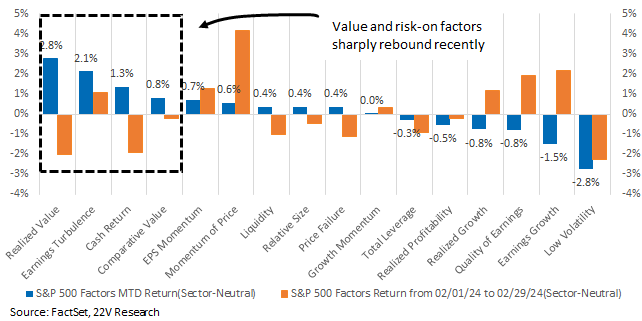
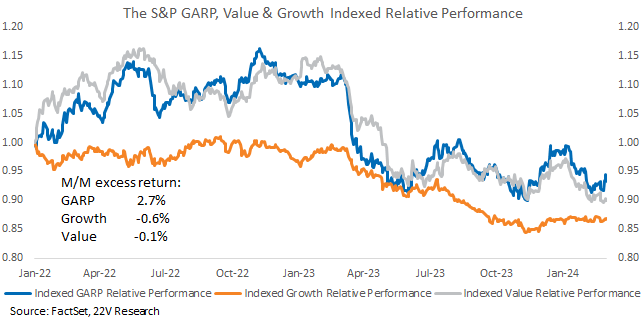
The Value rebound has supported the GARP basket, which rebounded in March. Near term, the Value and risk-on outperformances are likely to continue until the next payroll April 5th and inflation April 10th. We are not negative on Growth factors longer term. Both Value and Growth tend to do well in the current economic regime, which we covered in our 2024 Outlook (HERE).
Financial Conditions & The Macro Backdrop: Last week’s housing data was more evidence of a rebound in the most interest rate sensitive sector (HERE). Wage growth remains elevated relative to the sharp decline in goods inflation. The risk remains inflation stays stuck at too high of a level given the above. The consumer has downshifted (HERE) though. Real personal consumption expenditure growth appears to be running in 1.5% range (down from 3% in 4Q23), which is why the Atlanta Fed GDPNowcast is around 2.1% for 1Q24. If economic growth is running around 2%, we are not going to worry much about financial conditions being too tight or too easy longer term. Tail risk will be lower. Unless it the supply side proves to be so weak that even 2%ish GDP growth leads to sticky high core services inflation. FYI – the supply side has clearly shown that it can accommodate stronger GDP growth recently.
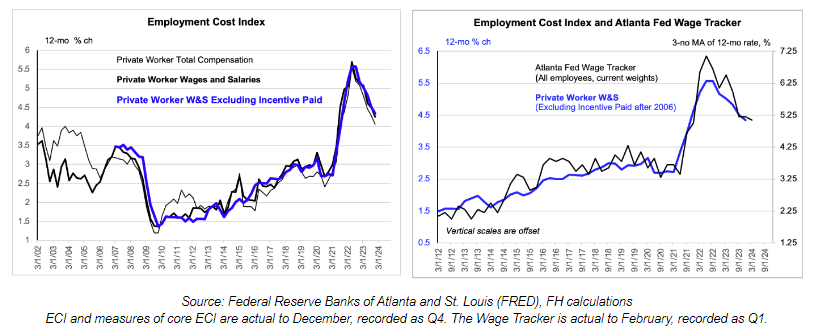
Bottom Line: Our call is for core inflation to gradually decline as economic growth stays around 2% and wage growth slowly decelerates. The Fed will be able to cut 50-100bps, total, in that scenario. That call will be wrong if wage growth does not decelerate toward 3.5% (current Atlanta Fed wage tracker 5%). If economic growth remains well above 2%, our call will also be wrong. Both scenarios lead toward much tighter financial conditions risk, which would increase longer-term recession odds (beyond 12 months) and hurt stocks dependent more on high odds the economic cycle last >12 months. Small caps, Deep Cyclicals, Value would suffer.
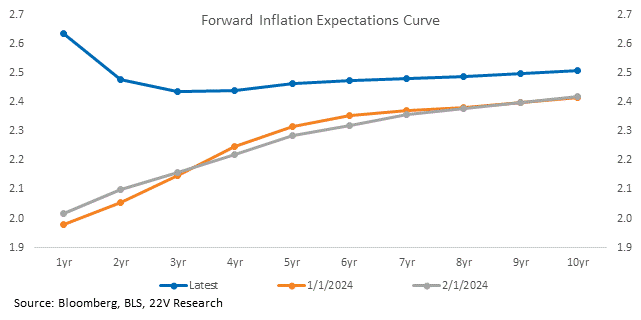
Sector Implications of Inflation Remaining Sticky Relative to Growth: We have noted a few times over the past two weeks that inflation has remained sticky as economic demand downshifts. The forward inflation expectations relative to economic growth trends confirm this view. Short-term inflation expectations have shifted meaningfully higher relative to the start of 2024 and futures pricing on 2/1/24. Longer-term inflation expectations remain anchored and basically in line with how 2024 started. All the increase in inflation expectations has been in the shorter term.
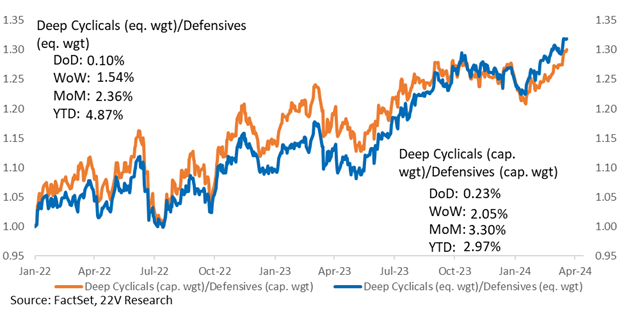
This shift to inflation being a larger driver of nominal GDP relative to 2024, is consistent with the shift in market internals. After a slow start in January, when short-term inflation expectations were VERY low, Deep Cyclicals (Energy, Industrial, Materials) have significantly outperformed Defensives (Staples, Utilities, Pharma) YTD after the unusually strong gains in February.
Charts and commentary below…
Indicators – Bullets From Peter Williams To Start:
- Powell wants to get an initial 50-100bps mid-cycle correction done, re-symmetrize their views of the risks, and then after that wait and see.
- In base case-like world it will be hard to realize even this upgrade SEP forecast for cuts in the out years
- Housing cycle has clear tailwinds and is rebounding, and the global IP looks to be turning up
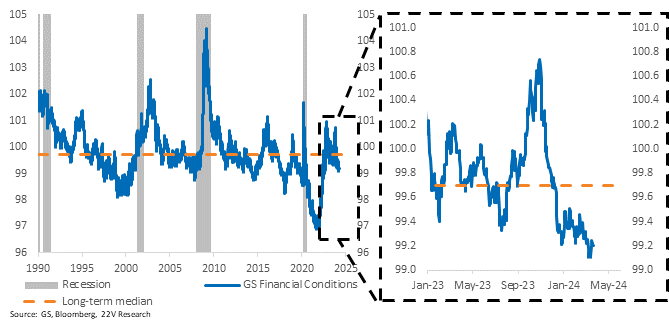
- Despite Fed rhetoric, it is hard to see how the financial conditions impulse/rate tightness is a real drag. Certainly, there is some drag from the level of rates, but the more impactful spreads and rate of change dynamic goes the other way.
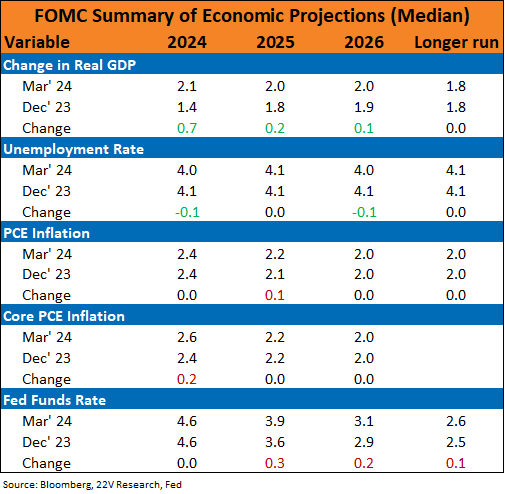
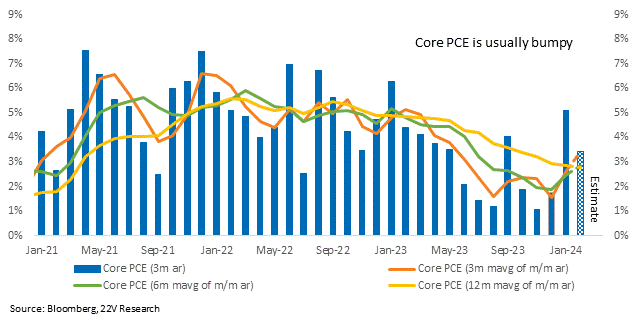
Powell directly addressed seasonal effects on the Jan/Feb inflation data, emphasizing the bumpy path of inflation. He didn’t dismiss the hot data, but there was equal emphasis on not extrapolating the data. And you don’t get 2.6% core PCE for 2024 in the SEP without Jab/Feb having a season give back assumption. That was great for risk assets, and we are on to the March CPI print next month.
Powell also directly addressed the labor market, arguing it doesn’t need to loosen if supply keeps growing. He said wage growth has to continue declining (gradually). Gerard has argued wage growth could be an issue (HERE), but the trend is still lower for now, and we’ll have to continue watching the data.
Powell’s insistence that financial conditions are tight is also dovish, albeit a little odd. The Fed’s own financial conditions index doesn’t show a drag on growth, and this week’s housing data was more evidence of a rebound in the most interest rate sensitive sector (HERE). We disagree with leaning on the JOLTS data as proof of weakness (more on that HERE). But his insistence is dovish. Our call is for inflation to come down as economic growth stays around trend and wage growth decelerates, so we’re not going to fight against Powell’s FCI take.
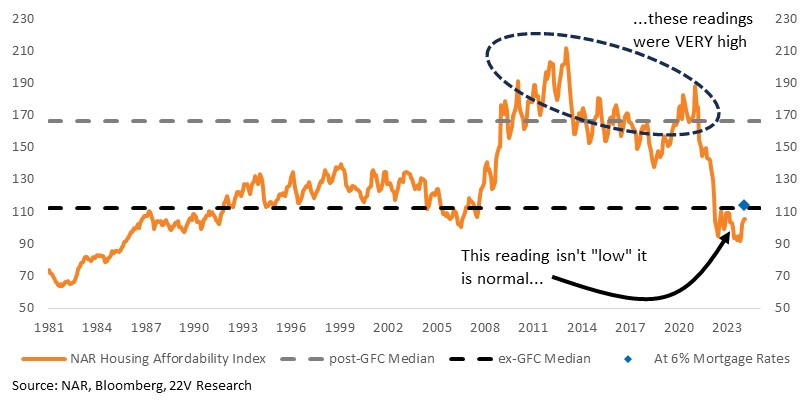
Housing Affordability Not as Low as You Think – Unless You Think the Post-GFC Deleveraging Backdrop Was the Norm: Existing Home Sales (EHS) were much better than expected yesterday and have inflected higher over the past few months. This is happening despite the widely held view that people will sit on 3.5%ish mtg rates forever and that low affordability will keep home sales pinned at unusually low levels.
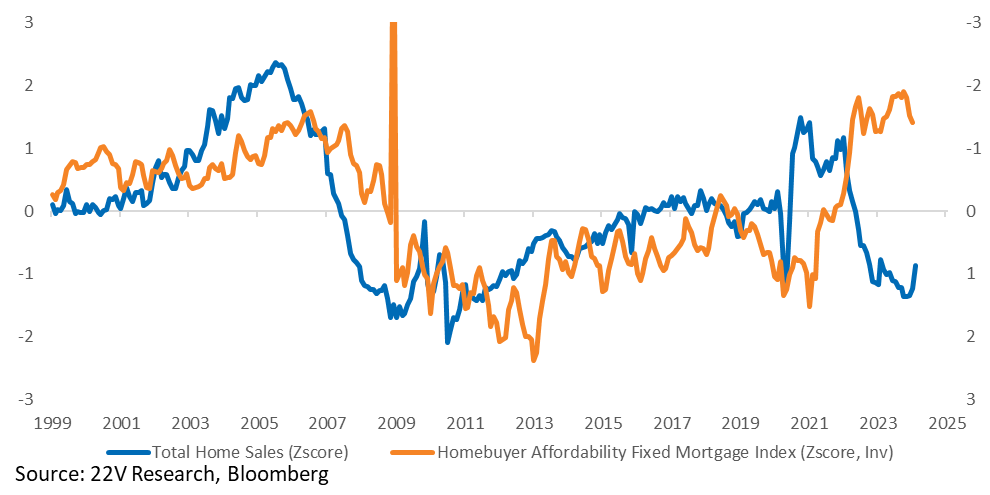
If you are using the post-GFC housing affordability as the base case, keep in mind that extremely high affordability was necessary to offset the household deleveraging cycle. With the economic cycle looking more like the pre vs post-GFC landscape (we have been over this many times), housing affordability is back in the range of the pre-GFC period. And when affordability was at those levels, Existing Home Sales were much higher than today. People could afford to buy homes and move around the country because nominal demand was firm. Higher nominal demand means higher nominal interest/mtg rates.
The Value rebound has supported the GARP basket, which sharply rebounded in March. Near term, the Value and risk-on outperformances are likely to continue until the next payroll April 5th and inflation April 10th.
Implications of Inflation Remaining Sticky Relative to Growth: We have noted a few times over the past week that inflation has remained sticky as economic demand downshifts. The forward inflation expectations relative to economic growth trends confirm this view. Short-term inflation expectations have shifted meaningfully higher relative to the start of 2024 and what was assumed on 2/1/24. Longer-term inflation expectations remain anchored and basically in line with how 2024 started. All the increase in inflation expectations has been in the shorter term.
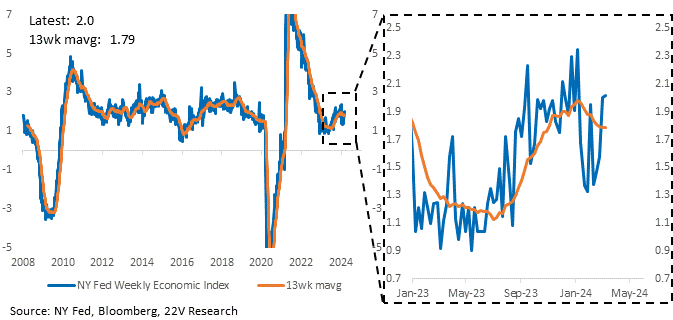
At the same time, the trend in economic growth has rolled over some. Economic growth is still firm but has started to downshift relative to inflation. The NY Fed Weekly Economic index has started to roll over after a sharp acceleration in 2023.
This shift to inflation being a larger driver of nominal GDP relative to 2024, is consistent with the shift in market internals. After a slow start in January, when short-term inflation expectations were VERY low, Deep Cyclicals (Energy, Industrial, Materials) have significantly outperformed Defensives (Staples, Utilities, Pharma) YTD after the unusually strong gains in February.
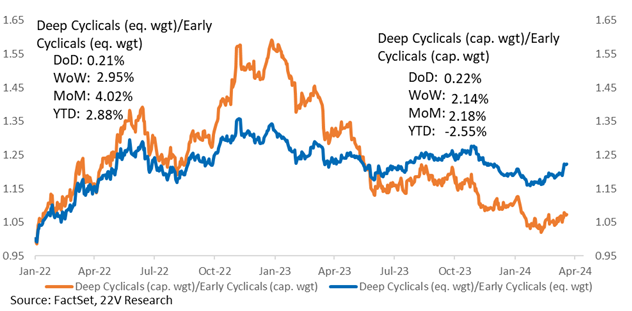
Deep Cyclicals are outperforming Early Cyclicals (Tech, Discretionary, Communications) on an equally weighted basis YTD. They are catching up on a cap weighted basis, but still have room to go.
And our favorite factor, GARP, has had a significant outperformance MoM. Value has outperformed the S&P MoM, and we expect that to continue if inflation remains sticky. FYI – we expect inflation to remain sticky, but for the Fed to maintain an easing bias. Inflation is slowing, not reversing the Fed’s path. That is why Deeper Cyclicals and Value can outperform as inflation remains sticky. If the Fed needs to tighten financial conditions aggressively again, that would be a problem for Deep Cyclicals, Value, and GARP.
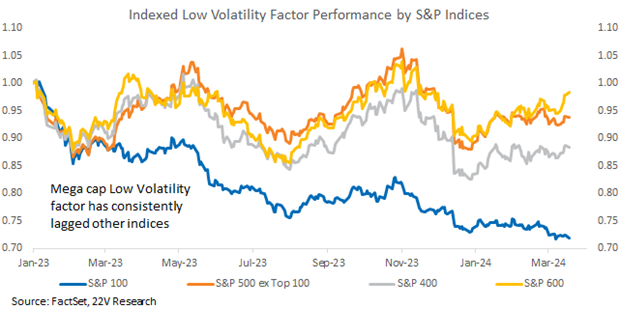
FYI on the Low Volatility Factor: The Low Vol within mega caps has consistently lagged behind all other indices. Investors are willing to take on more risk within mega caps. For other indices, Low Volatility outperformed high Volatility names broadly YTD. That has been especially true for smaller caps, where financial condition influence, specifically credit risk, is higher. Stable financial conditions, which are likely to be in place for a while, would encourage a rotation out of Low Vol, particularly in the SMID space.