Back Economic Research

March FOMC Delivers a Somewhat Dovish 2024 and a Higher-For-Longer Medium-term

Published on March 20, 2024

∙ Download the PDF Report

By

Peter Williams

March FOMC Delivers a Somewhat Dovish 2024 and a Higher-For-Longer Medium-term

Key Takeaways

  • The stickiness of the 2024 dot, perhaps nudged in that direction by the Chair, suggests that the Fed continues to want to cut rates ‘soon’ (to quote from Powell in front of Congress a few weeks back) but that the hotter inflation and better growth data has shifted the distribution of possible rate outcomes up (1-3 being the central tendency vs 2-4 in December).
  • However, the move up in the growth forecasts for all years, the 2025-26 rate forecasts, and the longer-run dot, all suggest that the FOMC is gradually adapting to a higher-for-longer world and there is less reason to expect deep (>150bps) non-recessionary cuts.
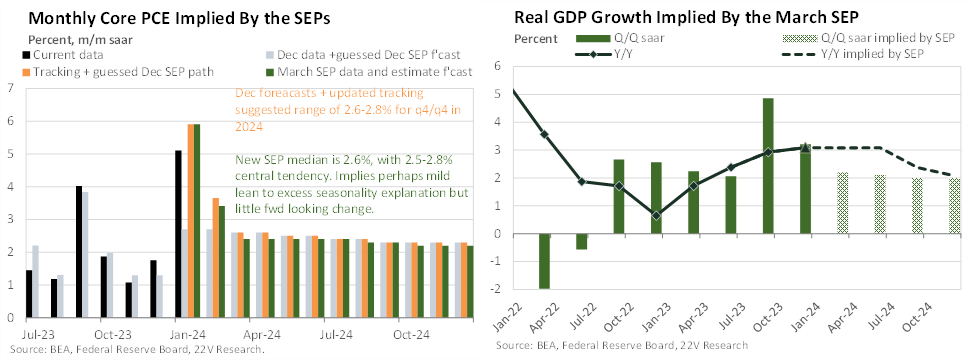
  • The 2.6% core PCE forecast for 2024 shows a Fed which prudently paying attention to incoming data, analyzing it, but not hawkishly extrapolating it out. This is the dovish side of the middle road path I had expected from the Fed, which was highly unlikely to not update its forecasts after two hot months of hot data as many had implicitly seemed to expect.
  • A June initiation of rate cuts seems most likely, but it is certainly not guaranteed if there’s another upside surprise in the March or April inflation data. The Fed feels comfortable hawkishly ruling out options as Powell did with March in January, but the data has to knock in dovish optionality.
  • My suspicion is that Powell wants to get an initial 50-100bps mid-cycle correction done, resymmetrize their views of the risks to both sides of the dual mandate (which are clearly close to balanced already given how much we are discussing further cuts in their baseline), and then after that wait and see. Deeper cuts will be dependent on subsequent additional disinflation (to at or below target on a trend basis), a possible market shock, or any signs of acute labor market weakness that proactively pull rates down.

The SEP and Dot Plot

  • The pattern of revisions points to a Fed with a somewhat agnostic to mildly concerned view of the near-term inflation outlook given the hot data seen since the December meeting (2.6-2.8 was my ‘treat it as one off but don’t fade it’ range for the 2024 core PCE forecast) and substantially reduced pessimism on the near-term growth outlook with growth shifting to an above trend pace for all years in the forecast.
  • Implicit in these forecasts is policy which is much less restrictive than their old forecasts. Powell suggested that they still financial conditions as weighing on growth and the labor market, which seems much harder to defend at this point given the composition of growth than it was a year ago, but the forecasts tell a different tale.
  • The dot plot suggests that Chair Powell got his way after wanting to keep cuts ‘soon’ open in 2024. My suspicion is that if the median had moved to 2 it would have killed June in the markets eyes IMO, which suggest a very tentative 3 cut baseline means a desire to start cuts in June.
  • The shifts up in the 2025, 2026, and long-run dots all suggest greater confidence in the outlook and further continued moves up in the long-run dot taking place over the course of this year.
  • The forecasts for growth and inflation are much closer to what I would think of as having symmetric risks around them. For both, especially inflation in risk-adjusted terms, there remains some upside skew but this is a Fed which is responding quite accurately to the data in hand and willing, but not eager, to revise its forecasts as things evolve.
  • The central tendency range shifts up from 2-4 cuts to 1-3 cuts. This suggests that the hotter inflation data to start the year and substantial positive growth forecast revisions both favor less dovish policy. The shift down in growth and unemployment rate forecast uncertainty and better risk balances, combined with the increased assessment of the upside risks to the inflation forecast agree with this shift in the distribution of preferred cutting paths (which always have a risk management lean to them, even in a base case world).
  • It reasonable to read this SEP + Dot Plot as dovish for 2024. And to some extent I think that’s true given the likely/possible forcing of the issues in 2024 for keeping the median at 3, which keeps June as a ‘things evolve as expected’ base case. Given the tight margin (only one away from shifting the median) and level shift up in the central tendency from 2-4 cuts to 1-3, 3, even if cuts begin in June, remains tentative, particularly as we get farther out into the year one has to take the keep in mind that a pretty-close-to-expected economy could result in fewer cuts than the current median.
  • When taken as a whole, this is an FOMC which is clearly becoming more comfortable with a higher-for-longer environment. In theory that could or even should be neutral for markets (if neutral has really moved up) but as some reset cuts take place the Fed may end up feeling much less of a pull to keep cutting (especially if financial conditions remain fairly easy and there aren’t any notable RoW or market blowups) which I think remains a notable shift from many investors medium-term baselines.
  • Beyond 2024r’s pricing, which is fairly close to the SEP at this point, ability of the rate cycle to continue beyond an initial 50-100bps of cuts is a real question given the medium-term forces facing inflation and the durability of growth since the hiking cycle began. The move up in longer-term UST yields today, on an ostensibly dovish day, suggests that markets may be coming around to the implications of a mid-cycle correction with still robust growth and somewhat lose conditions in risk asset markets.

Press Conference – Powell Wants to Cut (Some) but Still Needs Permission from Inflation

  • In his opening remarks, Chair Powell continued to emphasize that the Fed remains “highly attentive to inflation risks,” which were only partially balanced by the risks to the labor market. Given that inflation remains above target and the unemployment rate remains at 3.9 this is unsurprising but important
  • Powell noted that the presumption towards eventual cuts this year is built on a still rebalancing labor market, continued, if noisy, disinflationary progress, and longer-term inflation expectations measures which remain at roughly target consistent levels. This is the necessary backdrop for them to feel comfortable with a gradual return of inflation towards target and cutting rates even when inflation is somewhat above target.
  • Regarding the recent move up in inflation and the lean against a March cut that they had, he said that, “if you look that incoming inflation data… that suggests that we were right to wait until we’re more confident. I didn’t hear anyone dismissing it.”
  • He repeatedly mentioned that, particularly in the context of the past few years’ inflation shock, “you need to be careful about dismissing the data you don’t like… [While he noted some possible seasonal effects to start the year] I take the two of them together and I think they haven’t changed the overall story of inflation moving down on a sometimes-bumpy road back towards 2%.” But “I don’t think those readings added to anyone’s confidence that we’re moving closer to that point.”
  • This is the joint answer for why we got a larger than expected by consensus revision to the core PCE forecast. The Fed isn’t willing to embrace the residual seasonality explanation’s full implications, but because they expect this process to be bumpy, they didn’t shift their forecast views much, if at all in response to the incoming data.
  • Powell, in a comment which is quite spot dovish but is harder to frame over the medium-term given their substantially revised growth forecasts, said that “we do think that financial conditions are weighing on economic activity. A great place to see that is in the labor market.” This has a been a consistent Fed view for some time and implicitly places a primary emphasis on the fed funds rate, and its gap to neutral, in framing financial conditions. Given that alternative measures, including the Fed’s own FCI indices, suggest some spot drag that is rapidly easing all the way to somewhat easy conditions this suggests that the Fed may have substantial inertia in how it adapts to broader market conditions if it remains primarily focused on the level of rates in assessing policy’s impact on the economy.
  • Relatedly, I noted that I didn’t catch Powell mentioning the real fed funds rate much, if at all, in his discussions of the current stance of policy, reasons for cuts, or the impulse from financial conditions. The period around the turn of the year where the Fed seemed particularly focused on real spot rates was, in retrospect, a dovish head fake which seems more grounded in PhD/econ-theoretic logic about the mechanics of how policy flows threw into the economy (no offense to those readers with a PhD) rather than the evolving data dependence of the current moment.

DISCLOSURES AND DISCLAIMERS

Analyst Certification

The analyst, 22V Research Group, primarily responsible for the preparation of this research report attests to the following: (1) that the views and opinions rendered in this research report reflect his or her personal views about the subject companies or issuers; and (2) that no part of the research analyst’s compensation was, is, or will be directly related to the specific recommendations or views in this research report.

Analyst Certifications and Independence of Research.

Each of the 22V Research analysts whose names appear on the front page of this report hereby certify that all the views expressed in this Report accurately reflect our personal views about any and all of the subject securities or issuers and that no part of our compensation was, is, or will be, directly or indirectly, related to the specific recommendations or views of in this Report.

22V Research (the “Company”) is an independent research provider. The Company is not a member of the FINRA or the SIPC and is not a registered broker dealer or investment adviser. 22V Research has no other regulated or unregulated business activities which conflict with its provision of independent research.

22V Research, LLC is a professional services and independent publication organization. 22V Research, LLC is not a securities broker-dealer, not a member of the Financial Industry Regulatory Authority (FINRA), not a registered investment advisor (RIA) and not a member of SIPC.

Securities transactions, when offered, are offered by 22V Securities, LLC through LPS Capital, LLC. Certain employees of 22V Securities, LLC are dually registered as securities representatives of LPS Capital, LLC or Analyst Hub Securities, LLC. 22V Securities, LPS Capital and Analyst Hub Securities are members FINRA, SIPC.

https://brokercheck.finra.org/

Current Ratings Definition.

SECTOR OUTPERFORM: An “outperform” rating anticipates the company will outperform the S&P Regional Banking Index (peer group).

SECTOR PERFORM: A “market perform” rating anticipates the company will perform in line with the S&P Regional Banking Index (peer group).

SECTOR UNDERPERFORM: An “underperform” rating anticipates the company will underperform the S&P Regional Banking Index (peer group).

Limitation Of Research And Information.

This Report has been prepared for distribution to only qualified institutional or professional clients of 22V Research Group. The contents of this Report represent the views, opinions, and analyses of its authors. The information contained herein does not constitute financial, legal, tax or any other advice. All third-party data presented herein were obtained from publicly available sources which are believed to be reliable; however, the Company makes no warranty, express or implied, concerning the accuracy or completeness of such information. In no event shall the Company be responsible or liable for the correctness of, or update to, any such material or for any damage or lost opportunities resulting from use of this data. Nothing contained in this Report or any distribution by the Company should be construed as any offer to sell, or any solicitation of an offer to buy, any security or investment. Any research or other material received should not be construed as individualized investment advice. Investment decisions should be made as part of an overall portfolio strategy and you should consult with a professional financial advisor, legal and tax advisor prior to making any investment decision. 22V Research Group shall not be liable for any direct or indirect, incidental or consequential loss or damage (including loss of profits, revenue or goodwill) arising from any investment decisions based on information or research obtained from 22V Research Group.

Reproduction And Distribution Strictly Prohibited.

No user of this Report may reproduce, modify, copy, distribute, sell, resell, transmit, transfer, license, assign or publish the Report itself or any information contained therein. Notwithstanding the foregoing, clients with access to working models are permitted to alter or modify the information contained therein, provided that it is solely for such client’s own use. This Report is not intended to be available or distributed for any purpose that would be deemed unlawful or otherwise prohibited by any local, state, national or international laws or regulations or would otherwise subject the Company to registration or regulation of any kind within such jurisdiction.

Copyrights, Trademarks, Intellectual Property.

22V Research Group, and any logos or marks included in this Report are proprietary materials. The use of such terms and logos and marks without the express written consent of 22V Research Group is strictly prohibited. The copyright in the pages or in the screens of the Report, and in the information and material therein, is proprietary material owned by 22V Research Group unless otherwise indicated. The unauthorized use of any material on this Report may violate numerous statutes, regulations and laws, including, but not limited to, copyright, trademark, trade secret or patent laws.