

SUMMARY
- Weakness in the CNY is due to a widening interest rate differentials with the US, China’s disappointing recovery, and slowing exports.
- Beijing’s restrained stimulus is unlikely to bring relief to the currency in the near term. Modest additional monetary easing will widen the interest rate differential, while stimulus is unlikely to be strong enough to quickly boost growth.
- Tail risks of sharp currency depreciation and capital outflows are low as the PBOC has an effective toolkit and the will to prevent a runaway depreciation dynamic similar to 2015-2016.
The onshore (CNY) and offshore (CNH) Chinese yuan are flirting with their weakest levels against USD since fall 2022, when the zero-Covid growth implosion was reaching its peak. In this note we briefly survey the factors behind the weakness and how it plays into China’s evolving stimulus response. In a subsequent note, we will examine the longer-term topic of how to think about RMB internationalization amid the recent resurgence in buzz over “de-dollarization.”
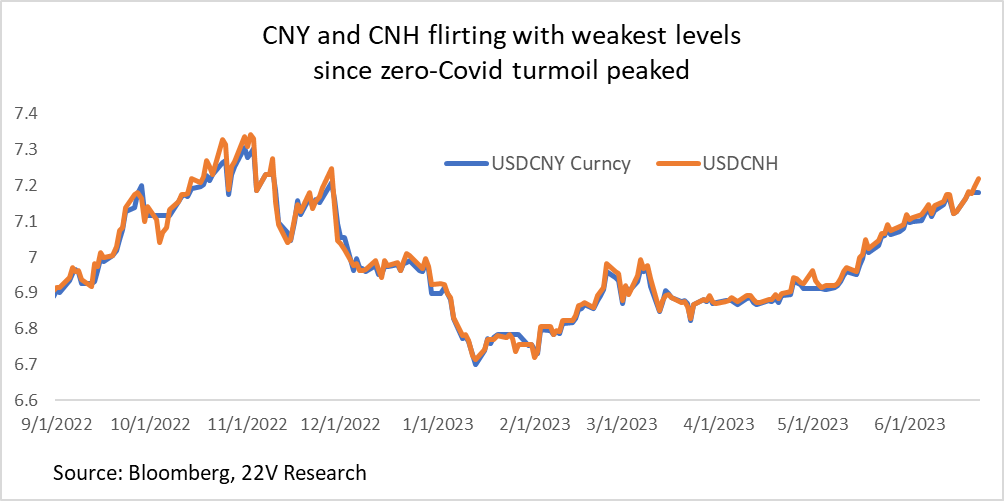
Key causes: Lack of carry, disappointing growth
The CNY’s weakness since the start of the year is particularly pronounced against the USD (-4%), but the currency has also weakened (-2%) against the CFETS trade-weighted basket that is a key reference for the PBOC’s exchange rate management (see chart below). Much of the decline has come since April, as China’s growth has disappointed while the US macro outlook and expectations for further Fed hikes have picked up.
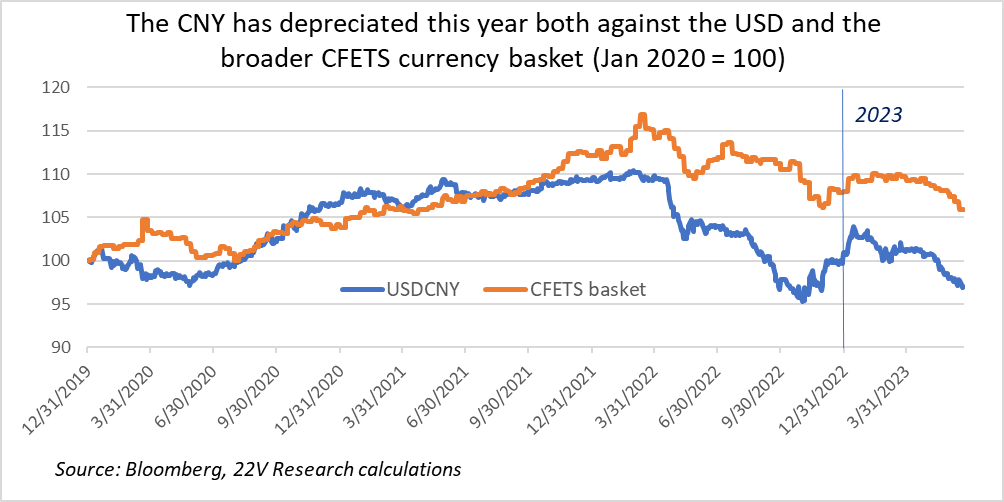
The main factors are:
- Widening interest rate differentials: The premium of US interest rates over CNY rates has continued to rise (with 1-yr government bonds shown in the chart below). The spread is likely to further widen in H2, given an outlook of modest additional easing by the PBOC and Fed hikes later this year.
- Disappointing growth and market performance. China’s disappointing recovery has weighed on corporate and portfolio investors’ interest in the currency, particularly since April.
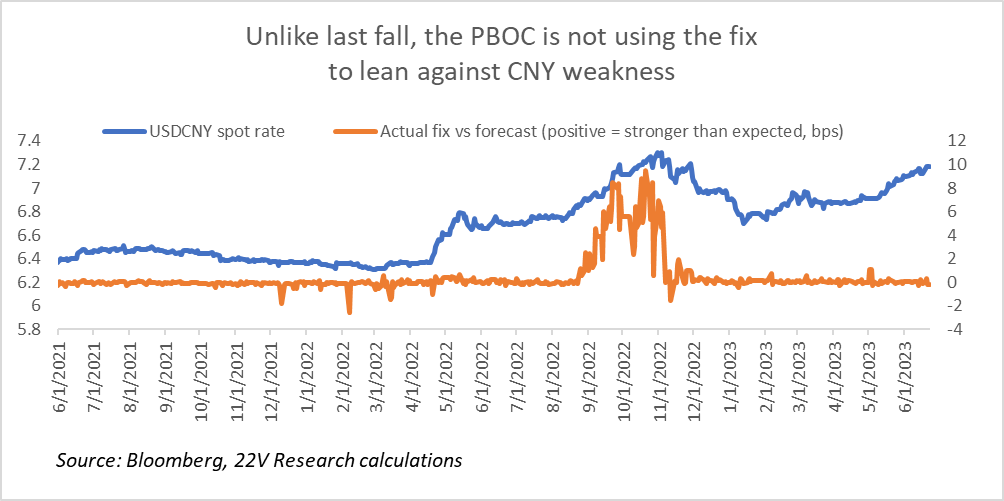
- Slowing exports. While China’s trade surplus is still quite large relative to the pre-pandemic trend, it has declined since Q1 as exports have slowed. While we do not think that Beijing sees currency depreciation as a major solution for China’s growth predicament, it is still notable that PBOC has not yet used its fixing rate to lean against market forces taking the currency weaker (see chart). PBOC is likely to step in, however, if depreciation continues unabated (more below).

Beijing’s stimulus unlikely to bring quick relief
Currency weakness is both a victim of China’s restrained stimulus policies and a contributor to them. That is, one of the factors holding back the PBOC from more aggressive monetary easing is the concern that this would further widen interest rate differentials between China and advanced economies and fuel more rapid currency depreciation.
A prominent economist associated with the China Academy of Social Sciences, Zhang Bin, has been advocating for aggressive rate cuts to boost economic growth and arguing that fears of resulting currency depreciation are overstated. The key to Zhang Bin’s analysis is that due to capital controls, trade-related enterprises play an outsized role in China’s FX markets, while financial institutions and households play a smaller role than in most economies. He holds that empirically, China’s PMI index is a more important driver of China’s capital flows than are interest rate differentials or the DXY index. When domestic economic conditions are favorable, enterprises’ demand for RMB increases and they are more apt to repatriate export earnings rather than keeping them in foreign currencies. In Zhang Bin’s view, the PBOC needs to lower lending rates significantly to repair the balance sheets of firms and enterprises and boost activity. The result would be short-term currency depreciation but an eventual strength as growth improves.
I don’t have strong views on whether Zhang Bin is right about the magnitude of these various effects – one could argue (as are most Chinese economists right now) that monetary easing will be less effective than in the past, given ongoing deleveraging by firms and households and structural drivers behind weak confidence (shrinking population, the end of the real estate boom). As a practical matter, it is extremely unlikely that PBOC will decide to aggressively ease policy, and not only because of concerns over the exchange rate. In an interesting talk in Washington at the Peterson Institute in April (video link HERE), PBOC governor Yi Gang articulated something of a distinctly Chinese approach to monetary policy, which strives for much smaller shifts in interest rate policy than is the case for the Fed. Indeed, PBOC believes that one lesson from Silicon Valley Bank was the need to avoid sharp increases in rates, and thus PBOC is not inclined to lower rates now and be forced into such a disorderly transition down the road.
Still, Zhang Bin’s focus on the importance of China’s growth outlook in driving capital flows is worth noting, because it implies that China’s stimulus strategy is unlikely to provide a lift to the RMB anytime soon. Our base case is that while Beijing has clearly moved into a mode of more active support, coming stimulus measures will mainly remain targeted (see HERE, HERE and HERE). As explained in recent notes, the package will likely include an acceleration of infrastructure investment, local-level easing of property restrictions, and modest monetary easing. This is not quite the “worst of all worlds” for the exchange rate, but it is weak tea:
- Modest additional monetary easing will widen the interest rate differential with advanced economies, especially if there are further rate hikes coming from the Fed and ECB.
- At the same time, upcoming stimulus will not be of the strength or nature as to quickly accelerate growth and trigger the PMI effect that Zhang Bin notes.
What would be the ideal response? A support package that features direct fiscal stimulus to the household sector to boost consumption. This would likely be more effective in spurring domestic demand than just additional infrastructure spending and small rate cuts. It would also reduce the burden on monetary easing and the potential for a further widening of interest rate differentials. However, as we have laid out in recent notes, strong pro-consumption fiscal stimulus is unlikely despite an increasingly loud of set of calls within macro circles in China.
Outlook for the currency: Muddling through, but major tail risks are limited
While not a forecast for the currency, the policy dynamics above imply little quick relief for CNY/CNH – particularly before end-July. We do expect Beijing to outline some stimulus measures in the next few weeks, with the full package to be announced at or close to the end-July Politburo meeting on the economy. Such measures will take time to impact real economic conditions and will aim to secure the 5% GDP growth target rather than sharply accelerate growth.
Prospects for the currency to gradually strengthen would presumably improve later in Q3 and Q4, as China’s slow recovery eventually gains a footing, but this will also depend of course on Fed actions and the evolving global outlook. Geopolitical tensions should be moderately lower in coming months as the US and China resume engagement (see our summary HERE), but the approach of the Taiwan’s January 2024 presidential election will be important to monitor (see our Taiwan special report HERE).
How will PBOC look to manage pressures on the currency if they persist? PBOC has been keen to move towards a more flexible exchange rate and avoid perceptions that it will defend the currency at a specific level. However, PBOC will seek to avoid a rapid pace of depreciation and one-way bets of further weakness; that would risk setting a vicious cycle of currency depreciation and capital outflows (akin to the 2015-2016 cycle) that could threaten the fragile recovery underway and even financial stability. PBOC does not appear in danger of that dynamic yet (expectations are reasonably well anchored) but it is probably close to stepping in to slow the pace of depreciation and avoid the perception that it is promoting weakness to boost exports (which would also threaten renewed tensions with trade partners).
PBOC has a well-developed but not unlimited toolkit to avoid out-of-control depreciation, including (in rough order of sequence):
- Setting the daily fix stronger to signal decreased tolerance with depreciation
- More assertive verbal intervention from policymakers
- Tweaking macro-prudential measures such as the required reserves for FX deposits
- Formal intervention or informal intervention in FX markets through the state banks
- Informal capital controls not focused on portfolio investors (e.g., making it harder for households and firms to convert RMB into FX, pressuring exports to repatriate FX earnings)
- Formal capital controls on portfolio investment. We view this as extremely unlikely in anything but a severe crisis, given the damage it would do to Beijing’s efforts at promoting the RMB as a reserve currency

