SUMMARY
- China’s May economic data show continued weakness in demand, particularly in the areas of property activity and private investment; however, the data were not so bad as to compel Beijing to abandon financial discipline and embrace aggressive easing measures.
- Beijing will step up its stimulus in weeks ahead to try to boost demand and confidence, but the policy package will consist mainly of targeted measures unless the 5% annual GDP growth target looks in jeopardy; the package will likely include additional demand-side and supply-side support for property, but the leadership will not seek to aggressively reflate the sector or bailout developers.
- It will be important to watch for signs that Beijing may drop its restraint, particularly its reluctance to use the central government’s balance sheet for strong fiscal stimulus.
China’s May data were weak, mostly missing analyst estimates and reflecting a recovery short on demand and struggling to gain momentum. However, my initial take is that the data were not so bad as to force Beijing to bring out the stimulus bazooka and abandon financial restraint (such as through aggressive monetary easing, expanding the scale of investment plans or the fiscal deficit, or trying to reflate the property sector). After surprise rate cuts this week – an effort by PBOC to get ahead of the weak data – Beijing will roll out a package of mostly targeted measures in June and July to shore up confidence and secure China’s 5% GDP growth target for 2023. I still expect key measures along the lines outlined in our preview note yesterday (link HERE):
- Accelerating the pace of already planned infrastructure investment
- Some local-level easing of property policies but staying well within Xi Jinping’s campaign against a speculative model for the sector; supply-side support to property developers, including the possibility of PBOC using its lending facilities to aid specific projects
- Targeted fiscal support to boost demand in specific industries (such as EV sales in rural areas)
- A potential cut to reserve requirements in July but with monetary policy focusing on ensuring liquidity rather than aggressive cuts to rates
- High-level pledges to improve the environment for private firms (not a quick fix)
There has not yet been much official messaging in response to the May data so this is initial take amid a fluid policy dynamic.
Property activity and private investment are the key concerns
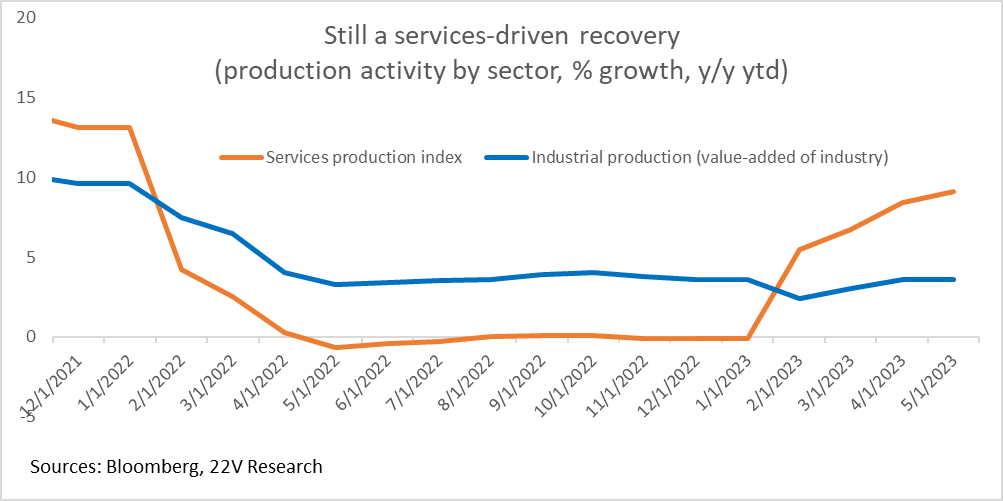
The broad pattern remains that China’s service sector activity is driving growth while industrial and fixed investment activity are much weaker. The overall recovery still faces serious challenges, particularly from weak property activity (and its ripple effects) and dormant private investment. But while April data had showed sliding momentum virtually across the board (outside of services), May data were more mixed.
Overall fixed asset investment slowed from 4.7% y/y in Jan-April to 4% y/y in Jan-May, though it accelerated month-over-month after three previous declines. The biggest concerns of China’s leadership will be weak property investment and private investment:
- The contraction in property investment widened from -6.2% y/y in Jan-April to -7.2% y/y in Jan-May. Demand for housing is soft, with property sales dropping -19.7% y/y in May from -11.8% in April. Developers are devoting resources to paying back debt and completing existing projects rather than starting new projects (new housing starts fell by -28% y/y, roughly even with April). Beijing will look to spur demand by giving local governments more latitude to ease purchase restrictions and lower mortgage rates, though still staying within the confines of Xi’s determination not to reflate property as a form of stimulus. There is also a good chance of additional financial support to developers, including (as Bloomberg has reported) the possibility of PBOC using its lending facilities to help developers complete projects.
- Private fixed asset investment contracted by -0.4% y/y in Jan-May, from 0.4% y/y in Jan-April. This reflects the weakness in property investment as well as subdued manufacturing investment (6% y/y in Jan-May) amid an export slowdown. Trying to lift private confidence will be a key focus of policymakers in the coming weeks. Policymakers will likely try a mix of targeted support to boost demand in select industries (e.g., subsidies for EV sales in rural areas), accommodative credit conditions and high-level pledges to improve the overall operating environment for private firms.
Shoring up infrastructure investment will also be a key focus for policymakers in the coming weeks. Infrastructure FAI decelerated to 7.5% y/y in Jan-May, from 8.5% y/y in Jan-April. This was partly policy-induced as Beijing tightened scrutiny over local government off-balance sheet borrowing. Beijing is very likely in coming weeks to speed approvals of a new round of special bond issuance by local governments and to provide additional financial support through the PBOC’s lending facilities and policy banks. This will be an acceleration of already planned investment; I do not expect an increase in local governments’ annual bond quotas, which would be an upside surprise.

A bit more resilience elsewhere
Looking at the rest of the activity data in May, it is important to note that base effects distort the headline growth numbers. The lockdown of Shanghai and several other major cities peaked in April 2022 but had started to ease in May 2022. Hence, comparing year-over-year growth between April and May exaggerates an apparent slowdown – it is helpful to also look at two-year compound growth rates (CAGR) and sequential growth when available.
Year-over-year growth in industrial production slowed from 5.6% in April to 3.5% in May (in line with the Bloomberg consensus) but this seems to overstate the degree of weakness. Industrial production expanded month-over-month (0.63%) after contracting in April, and the two-year compound growth rate also accelerated slightly (2.1% in May, from 1.3% in April). The key issue for manufacturing remains weak demand, both external and domestic.
Service sector production slowed from its torrid pace as reopening momentum faded, but not precipitously (11.7% y/y in May, from 13.5% in April).
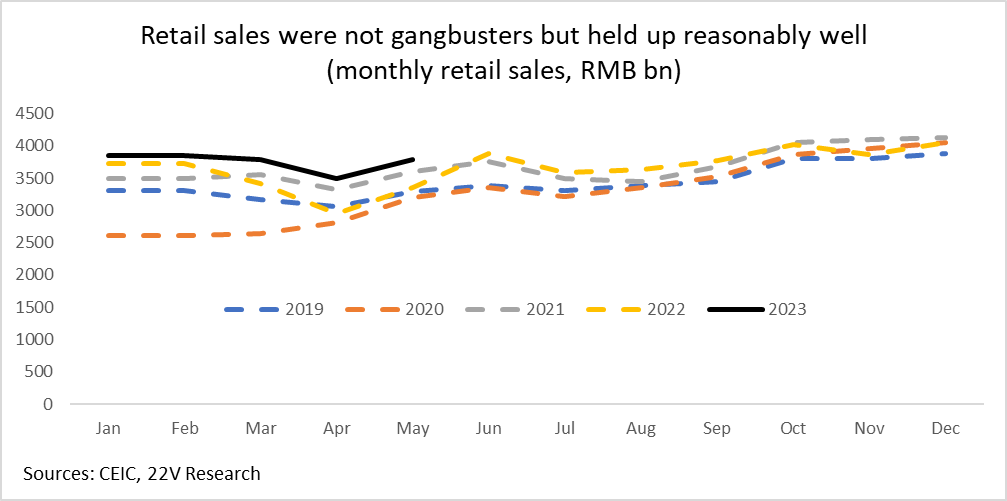
Retail sales missed estimates but held up reasonably well (12.7% y/y in May, from 18.4% in April; two-year CAGR 2.6% in May, unchanged). Households are still more inclined to spend on services rather than goods, but the latter picked up a bit (two-year CAGR of 2.5% in April from 2.3% in May). Auto sales were also decent (two-year CAGR of 3.2% in May, from -0.9% in April). Consumer spending is showing strength at the high end (luxury goods) and low end (basic staples) but weakness in areas such as appliances.
The official unemployment rate held steady at 5.2%, while youth unemployment ticked up to reach a new peak of 20.8% (from 20.4%).
Gauging the evolving policy response
Dynamics around China’s policy response are highly fluid. The struggles with the recovery, and especially confidence, are challenging Beijing’s determination to keep stimulus restrained and avoid exacerbating long-term financial risks. PBOC’s surprise cut is among the recent signs that Beijing is finally moving into active response mode. The key question is how effective Beijing’s policy response will be relative to the challenges.
Policymakers perceive two urgent tasks: boosting demand and lifting confidence. While these are closely linked, they are not completely the same. Measures to directly boost demand are the purview of classic stimulus. Confidence is an issue that Beijing (correctly) also regards as structural, with a need to address unease about the business environment and long-term growth outlook among the domestic private sector as well as foreign firms. This focus on confidence has two implications:
- Policymakers will aim to show greater responsiveness in the coming weeks and outline a series of measures across multiple ministries and areas of policy;
- A good portion of these measures will focus on issues related to the business environment rather than stimulus per se, and those will not bring a quick fix. Weak private sector and foreign confidence stems in part from unease over geopolitical tensions (including US-China decoupling) and Xi’s governance model, which are unlikely to see much in the way of adjustment. And significant structural reforms, if they are in the works, will take time develop and may wait until the Party holds its “third plenum” meeting this fall (the third plenum after a Party Congress lays out the key economic reform goals for the five-year term).
On the demand side, a key limitation remains Beijing’s reluctance to expand fiscal stimulus. Local governments (who are responsible for most spending) are under major financial strain and the leadership wants to protect the central government balance sheet to preserve policy room down the road. The state-run Economic Daily had a high-profile editorial on Wednesday calling for fiscal and monetary policy to work together to boost demand, and Chinese ministries in recent days have been outlining plans for fiscal support to drive demand in sectors such as EV sales to rural areas. But unless Beijing is willing to expand its support beyond its deficit target (3% of GDP) – such as by issuing special treasury bonds, which do not count against the deficit target – the scale will remain modest.
To sum up, my key conclusions are:
- Beijing is shifting into active support mode, so expect more policies to be announced in coming weeks and at latest by the end-July Politburo meeting
- Many of these policies will aim to boosting private sector confidence rather than direct stimulus per se
- China has plenty of room to boost stimulus if it so chooses; the key obstacles are concern over financial risks and the reluctance (so far) to leverage the central government’s balance sheet to expand fiscal stimulus
- It will be important to watch for evolving signals as to whether Beijing is ready to relax its restraint given the weak recovery; for now, however, I do not see China’s leadership has panicked enough to move beyond a package of mostly targeted measures.
As a final note, US Secretary of State Antony Blinken will visit Beijing this weekend, the first cabinet-level visit to China since 2019. Both sides are keeping expectations modest and we advise investors to do the same. The trip is an effort to reestablish communication amid mutual recriminations and mistrust rather than produce concrete deliverables. We will have more on the visit and US-China dynamics in a forthcoming note.