

SUMMARY
- PBOC’s surprise rate cut implies a greater sense of urgency by policymakers to support the economy in response to flagging momentum; however, Beijing is still intent to maintain discipline in its stimulus and will tolerate a subdued, services-driven recovery so long as the 5% growth target is not in jeopardy.
- We continue to expect that Beijing will roll out stimulus measures in June and July that will mostly be targeted, such as an acceleration of already planned infrastructure spending and demand-side support for property policies.
- If the release of May data (10pm ET on Wednesday) show a serious deceleration in activity, policymakers will reluctantly dip further into their basket of “emergency measures”; the goal will be to secure the 5% target rather than aim for an aggressive growth rebound.
Expectations for China’s stimulus are rising after surprise rate cuts by the PBOC on Tuesday and a Bloomberg report that the State Council (cabinet) is discussing a broad set of support measures, including on property. In this note we outline latest views and what we will be watching for in the May activity data that comes out on Wednesday morning Beijing time (Wednesday 10pm ET).
PBOC’s surprise move shows that policymakers feel a greater urgency to respond to the string of weak data and fragile confidence. Additional measures are coming in June and July. However, Beijing is still intently focused on staying disciplined against financial risks, which will constrain the scale and nature of stimulus. Xi Jinping has signaled numerous times that he will accept a subdued recovery rather than chase short-term growth (such as through reflating the property sector) in ways that jeopardize his long-term agenda.
Policymakers will focus on protecting the 5% bottom line for growth this year and refrain from aggressive easing unless necessary to achieve that goal. There is little willingness for a “shock and awe” support package. The mental image here should be policymakers selectively firing their thrusters to prevent the recovery from falling back to earth, not igniting a booster rocket to gain altitude.
It remains essential to examine China’s stimulus in the context of the specific problems facing the recovery, which we detailed in a note last week [link HERE]. Households, firms and local governments face constrained balance sheets (or ‘cash flow statements’), which limits their willingness and ability to spend; weak demand is in turn hampering private sector confidence. Monetary easing has limited effectiveness in such an environment, particularly in the confines of what will still be a restrained response by PBOC (below). The most powerful tool for boosting demand is the central government’s balance sheet, which Beijing wants to preserve for future policy space and potential contingent liabilities from an aging population and indebted local governments.
Reading PBOC’s rate cut
On Tuesday, PBOC lowered the 7-day repo rate and the rates for its standing lending rate facility (SLF), which serves as the upper end of its interest rate corridor. These moves make it very likely that on Thursday, PBOC will also lower the rate for its medium-term lending facility (MLF), which in turn will lead to a decline in the loan prime rate (LPR) that serves as the reference for bank lending.
The central bank was likely acting in part to get ahead of China’s credit data, which was released on Tuesday and came in below expectations, and the upcoming activity data. The increase in aggregate financing (total social financing) in May was down 45% y/y and bank lending was also below the typical pattern for May. Medium-term loans for the corporate sector stayed fairly strong (reflecting stimulus support for investment projects); household mortgage loans picked up a bit from the record low in April but remained very soft. The overall picture continues to be weak demand for credit from the private sector. It is also worth pointing out that with mounting PPI deflation (-4.6% y/y in May, the lowest since 2016) PBOC is acting to keep real borrowing costs for firms from rising further.
However, PBOC will on the whole aim to stay disciplined. In a speech last week, PBOC governor Yi Gang hinted that the bank would increase its “counter-cyclical” response, but implied that monetary policy is already loose and that it will take time (not looser monetary conditions) for households and firms to repair their balance sheets and for demand to recover. There is scope for a cut to reserve requirements in Q3 but PBOC will mainly aim to keep support targeted, such as through using its lending facilities to support local government infrastructure projects.

Options for other support measures
Our overall expectations are still consistent with the table of potential stimulus measures that we laid out last week (shown below). PBOC’s easing move was outside of our basecase and in the “emergency measures” category. This does imply greater perceived urgency on the part of policymakers, but we would not expect policymakers to dip much further into the basket of emergency measures this month unless the May data suggest the growth target is in jeopardy (see next section). If the data are middling but not very weak – and this will be an admittedly subjective judgment – Beijing will likely respond mainly with the basecase measures and other targeted moves but front-load them for the next few weeks rather than waiting until mid- or late July. Among our basecase expectations is an acceleration of local government special bond issuance (within the existing annual quota) for infrastructure projects, aided by PBOC’s lending facilities and policy banks.
Property policy is a key watchpoint. Bloomberg reported that the State Council is considering demand-side measures such as relaxing purchase restrictions and mortgage rates at the local level (within our basecase), but also contemplating using the PBOC’s lending facilities to help developers finance the completion of stalled housing projects. This would be a useful step and upside surprise, with the short-term benefit of boosting construction activity to complete projects, and the medium-term benefit of drawing down the stock of stalled projects which is essential to providing the space for developers to move on to new projects – and that, in turn, would boost ailing local governments’ revenue from land sales.
The caveats with property sector measures still apply. Beijing remains intent to move to a new model for the sector, which means not trying to reflate the sector as a means of stimulus or providing a major financial backstop for developers. As in other areas, they are responding to a recent weakening of data – property activity slid in April and likely in May after showing “green shoots” in March – rather than shooting for a sharp rebound (which isn’t coming). The headwinds for a property recovery remain stiff – subdued household income and economic confidence, diminished expectations that property will be a rewarding investment, and on the supply side the large debt burdens of private developers.
We continue to expect that China isn’t willing to deploy major fiscal stimulus to support consumption, as useful as this would be.
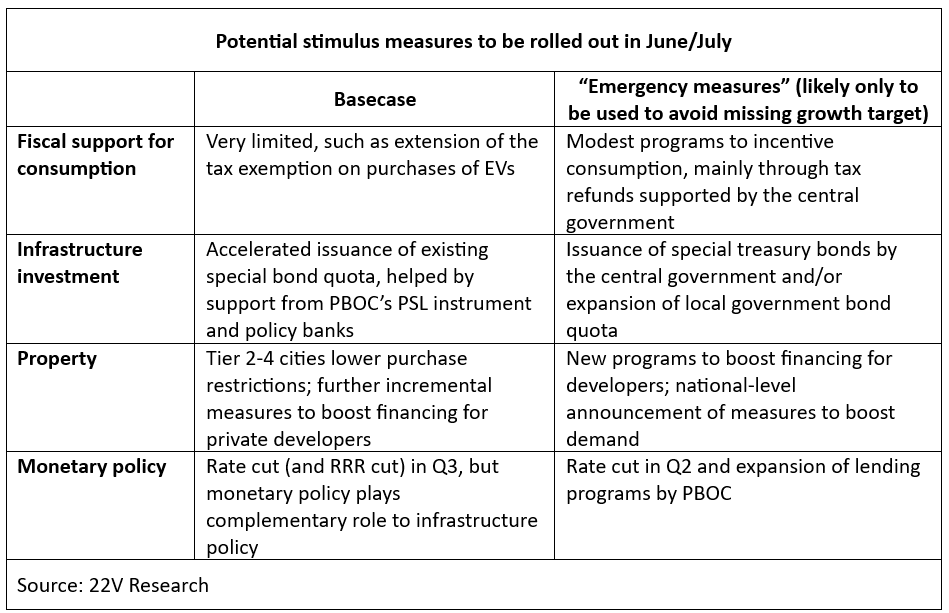
May data: the total picture is key
There is no single number to watch for in the May data, since policymakers (and investors) will be looking for a broad sense as to the overall degree of momentum in the recovery. Given that service sector activity will likely remain buoyant, a key focal point should be what we call the “missing middle” in the recovery: private investment (including property activity) and household spending on goods rather than just services. These areas are critical to shore up demand, particularly in the manufacturing sector. If private investment, property activity, and retail sales of goods all show a major further deceleration from April to May then policymakers are more likely to respond with emergency measures to preserve the growth target. An important point is that “deceleration” will also be a judgment call due to statistical distortions: Shanghai’s lockdown last April flattered the year-over-year growth numbers in April data, but this effect will fade and comparing year-over-year numbers between April and May will exaggerate a slowdown. As with April data, we will thus also look at two-year growth rates (comparing May 2023 to May 2021) and month-over-month data (when available) for a more accurate picture.

