

SUMMARY
- Beijing will aim to stay restrained in its stimulus response in coming months, focusing on an acceleration of already planned infrastructure investment and targeted support for property; this package is unlikely to be highly effective in breaking China out of its current predicament, which is a vicious cycle between soft demand and weak confidence.
- Beijing does have options for more aggressive stimulus, such as issuance of special treasury bonds to expand investment; however, it is unlikely to use these tools unless necessary to avoid missing the 5% annual GDP growth target.
- Given the restrained stimulus outlook, China’s economic recovery will remain subdued and driven by services activity; there is a real risk that policymakers fall further behind the curve and are forced to take aggressive measures in Q3 and Q4 to secure the growth target.
The continued string of soft data for China – including, most recently, surprisingly weak exports in May (-7.5% y/y) – is fueling speculation as to whether and how Beijing will stimulate the economy in coming weeks. I held a Webinar on Tuesday outlining my expectations (replay available HERE) and provide further details in this note.
The main theme of our analysis has been to emphasize Beijing’s overall policy stance of restraint. While Chinese policymakers will respond to an evolving economic outlook – making it important to gauge May data as it comes out over the next ten days – the bar is quite high for China’s leadership to announce aggressive stimulus measures. The policy reaction is more likely to disappoint, with Beijing falling behind the curve if conditions worsen, than it is to produce a major positive surprise.
What we expect on stimulus
By setting a conservative GDP target of 5% growth at the National People’s Congress in March along with limited stimulus, Beijing signaled that it is comfortable with a gradual recovery this year. As long as China is on track to achieve this growth target – which still seems to be the case – stimulus measures will remain disciplined and mostly targeted.
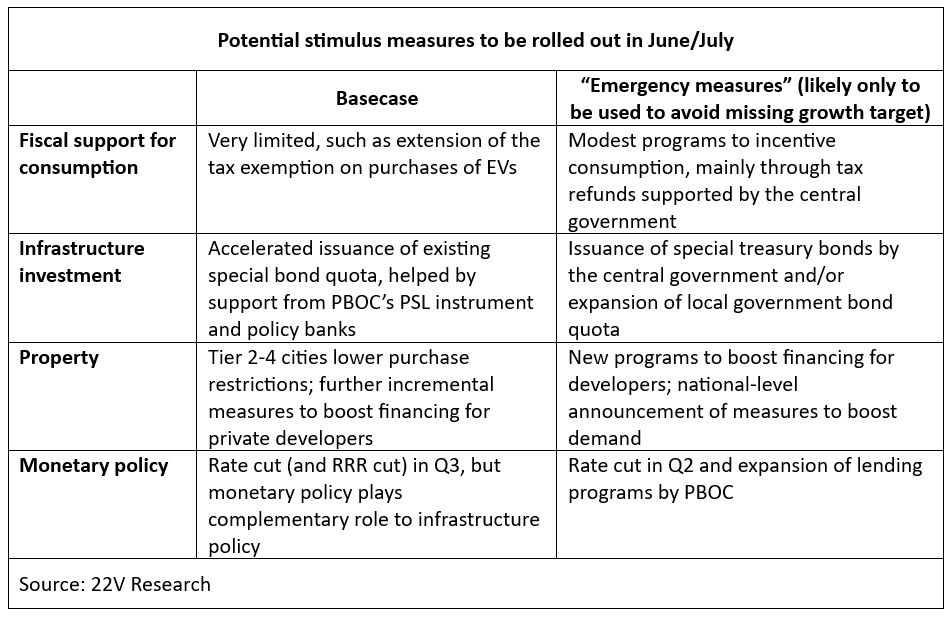
Our base case is that Beijing’s stimulus response in coming months will mainly consist of:
- Accelerating already planned infrastructure investment, including through additional funding from policy banks (to be announced in July, possibly June)
- Adopting targeted measures to boost property demand, mostly at the local level (June-July)
- An interest rate cut (probably Q3) but with monetary policy mainly focused on supporting infrastructure and keeping bank funding costs low
While we don’t have strong conviction on timing, we think that China’s leadership will prefer to wait until July, close to when they hold the quarterly end-July Politburo meeting on the economy, to lay out most of these measures. In the meantime, one should expect a steady drip of mostly targeted measures to support property demand and encourage employment and consumption.
If forthcoming data in May (and incremental data for June) show a continued slowdown in momentum sufficient to jeopardize the growth target then Beijing will move up the measures above and could also introduce additional tools, such as issuance of special treasury bonds to expand central government financing of infrastructure and other projects beyond what is already planned (see table below).
Why Beijing remains restrained
The symptoms of China’s shaky recovery are obvious: demand is weak, particularly in the manufacturing sector. We’ve been referring to this phenomenon as the “missing middle”: China’s recovery is being led by services activity (benefitting from the lifting of Covid controls) and infrastructure stimulus; what is missing is private investment (particularly property investment) and household spending on goods (particularly durables), which – combined with weak exports – has limited demand for manufactured goods. (See our discussion of the growth predicament, following the release of April data, HERE).
This overall pattern should not be a shock to markets. We warned at the beginning of the year that the recovery would be gradual and driven by services and consumption, with less positive spillovers to global growth than a cycle driven by industry and investment.
Still, the extent of recent weakness has been notable. What is the diagnosis? China’s household sector, firms, and local governments all entered the year in impaired financial condition due to the impact of the pandemic and the severe real estate downturn. It is increasingly clear that this has created something of a vicious cycle between soft demand and fragile expectations: financial constraints are limiting spending and investment by households, firms and local governments, which in turn is hampering an improvement in the outlook and recovery of confidence – and so on back to demand. There is an active debate within China as to whether this vicious cycle represents a “balance sheet recession,” “debt-deflation cycle” (probably premature) or “liquidity trap.” But the consensus is that the services-led recovery is not generating enough demand to create the “escape velocity” to break free from the gravity of this dynamic. The global context is not supportive: exports – which helped sustain demand in China in 2020-2022 – not coming to the rescue this year, while geopolitical tensions, including US-China decoupling pressures, are adding to anxiety in the business community.
The classic prescription in these circumstances would be for the central government, whose balance sheet remains relatively healthy, to provide the stimulus necessary to boost demand and short circuit the vicious cycle. However, China’s leadership continues to emphasize a patient approach to the recovery and a focus on targeted measures. This is partly due to timing: the leadership would prefer to wait until closer to the end-July Politburo meeting, which traditionally lays out measures for H2, to roll out its stimulus. This would provide policymakers more time to see if the recovery regains some momentum, but also increases the risk that they fall further behind the curve and then resort to aggressive actions late in the year to achieve their growth target.
A lack of options palatable to Beijing
The deeper issue is that Beijing is intent to avoid exacerbating systemic financial risks (a positive) while also being conservative in using the central government balance sheet in new ways – such as direct fiscal stimulus to boost consumption. This is due to a desire to preserve policy space down the road but also for reasons of political economy. The net result is that Beijing’s menu of palatable stimulus options is, for the tastes of the leadership, relatively limited:
- Fiscal policy: There is a strong case to be made for Beijing to stimulate consumption directly through measures such as consumption vouchers and cash payments to households. But it is unlikely to happen at scale, due to Beijing’s lack of confidence that this would work (officials worry that households still won’t spend), lack of institutional experience (compared to the well-oiled mechanisms in China’s system to push out infrastructure stimulus), and a desire to avoid setting a precedent for “handouts” to the population in the future. Outlook: demand-side measures to boost consumption programs will remain modest.
- Monetary policy: PBOC perceives that rate cuts will have limited effectiveness in a climate where the key issue is lack of confidence (not availability of credit), while exacerbating depreciation pressure on the currency and encouraging financial speculation. Outlook: There is scope for a rate cut (and perhaps a cut to reserve requirements) in coming months, if only to keep real borrowing rates low amid PPI deflation, but monetary policy will mainly focus on supporting infrastructure stimulus and ensuring that overall liquidity remains ample. Recent administrative steps by the PBOC to instruct banks to lower their deposit rates are an effort to keep bank funding costs low (to encourage continued lending) and discourage households from stashing money in banks, while refraining from broad rate cuts.
- Property policy: With signs that property activity is losing momentum after initial signs of recovery in Q1, Beijing will ease on the margin but within the confines of Xi’s campaign to move the sector to a new, less speculative model. Outlook: More tier 2 and tier 3 cities are likely to follow the recent example of Qingdao (Shandong province) in relaxing purchase restrictions in non-core areas of the city. There is less scope for easing in the tier 1 cities (Beijing, Shanghai, Guangzhou) where demand is already strong and policymakers will guard against speculative pressures. Policymakers may also increase financial support for private developers but stop well short of bailouts. These measures will help on the margin but a robust restart of the property cycle is not close at hand. We continue to emphasize that even as property sales start to recover, developers will need to use the proceeds to pay back debt and complete stalled housing projects; new housing starts will thus continue to lag, as will land acquisition by developers and thus land sales revenues for local governments (which fund infrastructure projects).
Given the limitations above, infrastructure investment (see next section) will remain Beijing’s main tool for stimulus this year, but concerns over local government debt burdens limit how much more support to demand it can provide – policymakers are focused on avoiding a fall in infrastructure investment in H2 rather than scaling it up. In this sense, Beijing’s stimulus dilemma reflects a broader theme in China’s growth story: old demand drivers, such as property investment, are no longer as effective as in the past while new demand drivers (such as consumption) are not yet able to pick up the slack.
Don’t expect too much more from infrastructure
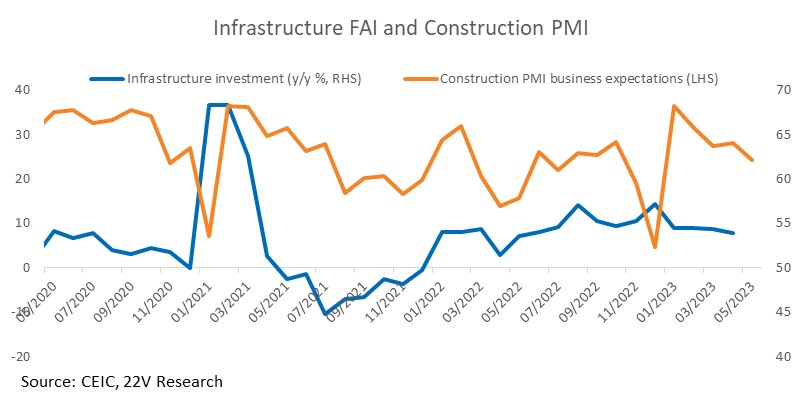
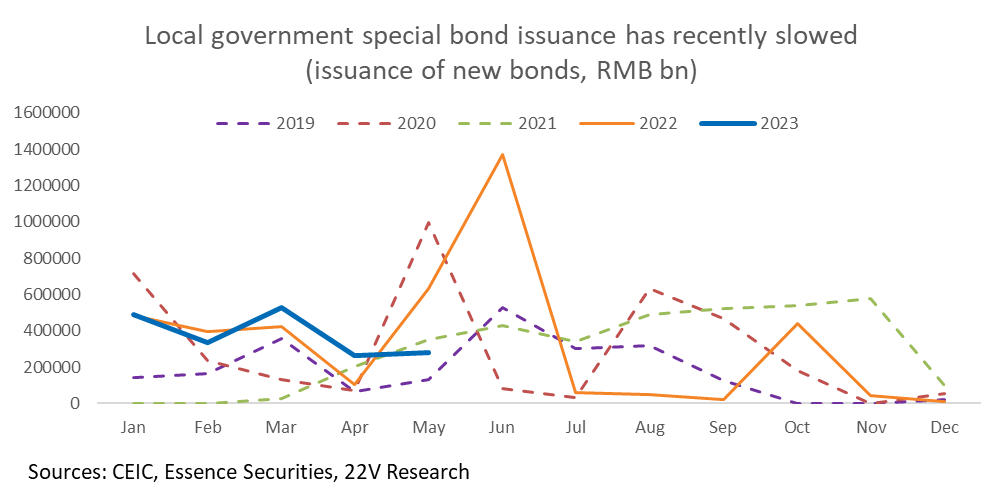
Infrastructure investment slowed from 8.7% y/y in March to an estimated 7.9% y/y in April and appears to have slowed further in May; signs of this include weakness in construction materials and a deceleration in construction sector PMI indices (see chart below). This slowdown is due to continued weakness in local governments’ land sales revenue (a key source of infrastructure financing), and Beijing’s scrutiny over local government debt issuance. Regulatory pressure is particularly intense when it comes to preventing a further expansion of “hidden debt” by local government financing vehicles (see our recent report HERE) but even issuance of official special bonds by local governments to fund infrastructure slowed in May (see chart). According to estimates by Essence Securities, local governments had issued RMB 1.9 trillion in special bonds through May, one half of their annual quota for the year, which is below the pace of 2022.
 Given the weakness in China’s overall demand, Beijing is likely in coming weeks to approve a second batch of special bond issuance (still within the existing RMB 3.8 trillion annual quota), and to announce central government financial support to help accelerate construction of approved projects. This is likely to take the form of financing through the PBOC’s Pledged Supplementary Lending (PSL) facility and a designated credit quota for the policy banks to lend into infrastructure projects (perhaps announced in July). Beijing used these same tools to sustain infrastructure in the second half of 2022; given the continued weakness in local government land revenues and LGFV finances, infrastructure investment would slow sharply year-over-year in H2 the absence of such tools. For that reason, the use of these tools is widely expected and probably largely priced in.
In other words, we expect coming measures to reverse the recent infrastructure slowdown in April/May, which has contributed to weakness in prices of commodities such as iron ore, but this would not mean a new wave of infrastructure investment or shift expectations for the overall scale of infrastructure investment in 2023. And although infrastructure stimulus will likely emphasize employment-intensive projects, this will do relatively little to quickly fill in the “missing middle,” particularly when it comes to spurring household consumption.
An upside surprise, not in our basecase, would be if Beijing were to take extraordinary measures such as expanding local government debt quotas or announcing the use of special treasury bonds issued by the central government. Special treasury bonds are used only in exceptional periods and are not included in China’s official budget deficit, thus representing new fiscal space that could be used to finance projects in infrastructure (or potentially in housing or other areas).
In looking at the outlook for infrastructure stimulus, both this year and over the medium-term, the chart below provides an important reference point: infrastructure activity has historically been closely linked to local governments’ land sales to property developers (here I show data from the developer side). Land sales are a key direct source of financing for infrastructure projects, but also have leverage effects by (implicitly) collateralizing the debts of local government financing vehicles. Although land sales collapsed with the crackdown on property developers in late 2021 and are recovering only slowly, infrastructure finance has stayed robust due in part to Beijing’s approval of greater bond quotas for local governments. Still, there are limits to the extent that these trends can be separated, unless the central government is willing to use its own balance sheet to fund most infrastructure spending (very unlikely). Infrastructure is unlikely to suffer a collapse along the same lines as property, but its key role as a demand driver will diminish over time.

Conclusions and watchpoints
China’s growth outlook for H2 depends on the interaction between demand, confidence, and stimulus. Three notional scenarios below capture the main ways this could play out, with probabilities just to give a rough sense as to how we see the relative likelihoods. The purpose of sketching out these scenarios is to understand the likely policy reaction function, not to make a precise growth forecast:
- Muddling through a subdued recovery (60% probability): In this scenario, momentum behind the recovery improves a bit in the May and June data relative to the disappointing data in April. Beijing adopts the restrained stimulus measures outlined in our basecase. The result is full-year growth that comes in ahead of the growth target (say, 5.5-6%) but continues to be driven by services activity and is limited in terms of strength and breadth; the “missing middle” fills in only gradually.
- Falling behind the curve (25% probability): Momentum and expectations continue to fade in the May and June data, but Beijing still adopts a relatively restrained approach. The result is that by late summer, the growth target is potentially in jeopardy, requiring more aggressive policy easing to meet the target. Full-year growth comes in right around the growth target (5%), though this scenario could also include a more serious dynamic in which financial risks in property and local government risks worsen and the growth target is potentially in jeopardy.
- Front-loaded show of force (15%): Beijing moves quickly in June to announce a suite of aggressive stimulus policies, such as issuance of special treasury bonds to boost investment and significant property sector support. This package puts growth on a clear trajectory in Q3 to exceed the growth target and helps lift demand for commodities and other inputs.
Again, these scenarios are not meant to be exhaustive or overly precise. But they reinforce an overall expectation of subdued recovery, with risks tilted more to the downside (“falling behind the curve”) than to the upside (“show of force”).
The key watchpoints in the weeks ahead include:
- Release of May data over the next week, particularly activity data on June 14. The base effect from Shanghai’s lockdown last year will fade relative to April, so it will be important to dig beneath the headline numbers for a sense of whether momentum is improving.
- Central-level policies: Will Beijing increase the level of urgency in its messaging on the economy, or stay restrained? We will also be monitoring dynamics around regulatory policies and other reforms, including the possibility of a National Financial Work Conference this summer that could outline a path forward on local government debt risks.
- Local-level policies: The key here will be whether local officials have the leeway from Beijing and the financial space to increase support in areas such as property policies. It will also be critical to watch the ongoing dynamics between Beijing and local governments on debt issues, such as the degree to which the central government provides support to struggling localities and their LGFVs.

