

SUMMARY
- Local government financing vehicles (LGFVs) are under pressure from weak economic conditions, rising maturity payments, and regulatory scrutiny from Beijing; these dynamics reinforce our basecase of disciplined stimulus and subdued growth this year, though we continue to expect government measures to modestly accelerate infrastructure investment in Q3.
- In coming months China’s leadership will look to avoid central government bailouts of LGFVs but also prevent disorderly defaults that risk financial stability; a first-ever default on an LGFV bond could come in Q4 if the economic and political conditions are in place.
- Infrastructure finance is closely linked to property development in China, and both face long-term headwinds that will crimp growth in demand for commodities to feed China’s construction sector.
Another fly in the ointment for the post-Covid recovery
China’s local government debt problems have hit the headlines in recent weeks as more localities show signs of stress:
- This week authorities in Kunming (capital of Yunnan province) pushed back on media reports from a leaked call with analysts that a local government financing vehicle (LGFV) is having trouble paying worker salaries and making debt payments.
- Guizhou province received an injection of support from state-owned firms last month to help address debt issues but officials are lobbying publicly for more assistance. Late last year one of Guizhou’s LGFVs, Zunyi Road and Bridge Construction Group, caught market attention with a 20-year rollover of its bank loans.
- Bloomberg has a profile this week of Hegang (Heilongjiang province) which has been a poster child for municipal debt problems since 2021 and continues to struggle.
What is going on? It is worth starting with the fact that these developments have been concentrated in provinces that are poor and/or struggling, such as in the southwest (Yunnan, Guizhou) and industrial northeast (Heilongjiang). These are generally where China’s local government debt problems are most acute, which means that the macro impact is less serious than if the strains were in coastal provinces more important for growth.
The incidents do, however, reflect broader pressures that are building in China’s local government financing system, and which entail risks to growth – particularly infrastructure investment – and to China’s longer-term financial stability.
The problems are most acute in local government financing vehicles (LGFV). As a quick refresher, LGFVs are a legacy of the pre-2014 period when local governments in China were prohibited from issuing debt. Local governments established LGFVs to serve as their platform for obtaining financing, backed by local assets (particularly land) and government guarantees. Borrowing by LGFVs grew explosively after 2008 as part of China’s massive infrastructure stimulus in response to the Global Financial Crisis.
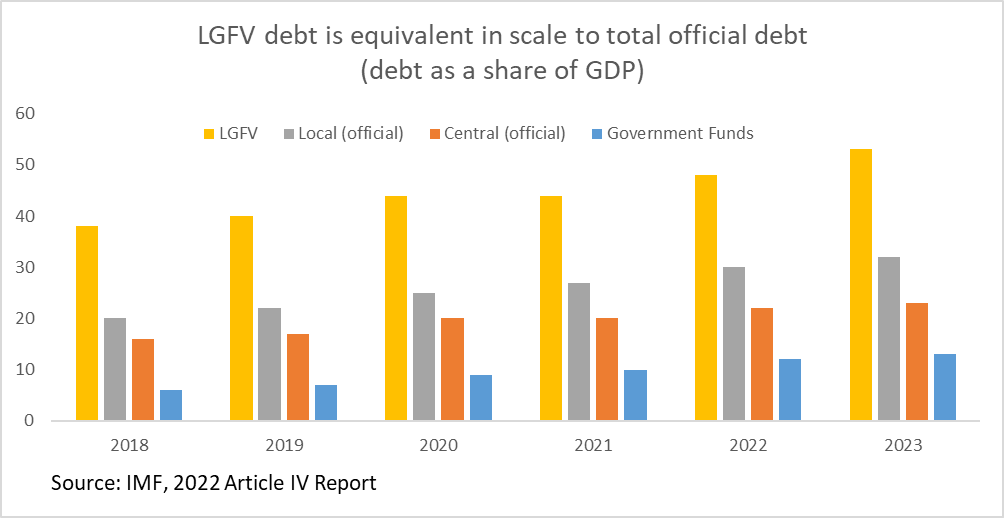
Since 2014, when Beijing began allowing local governments to issue bonds under their own authority, it has been trying to rein in local government borrowing through LGFVs. But LGFV debt has continued to grow as local governments borrow to meet under-funded mandates from Beijing and – increasingly – simply to roll over maturing debt. Estimates of LGFV debt vary widely, with the IMF (chart below) projecting the scale at 53% of GDP this year – roughly equivalent to total official government borrowing (53%). (Beijing insists each year to the IMF that LGFV debt carries no guarantee and thus should not be counted as government debt).
That LGFV debt is a form of Ponzi finance is no secret – particularly to a Chinese leadership focused on reducing financial risks. LGFVs fund infrastructure and other projects that typically have a low return on investment; the IMF estimated in 2022 that LGFVs depend on external financing for 80-90% of their spending. What has kept the financing coming is local government guarantees for LGFV debt, though officials have had to become increasingly creative to get around tightening restrictions from Beijing.
LGFVs face mounting pressures this year:
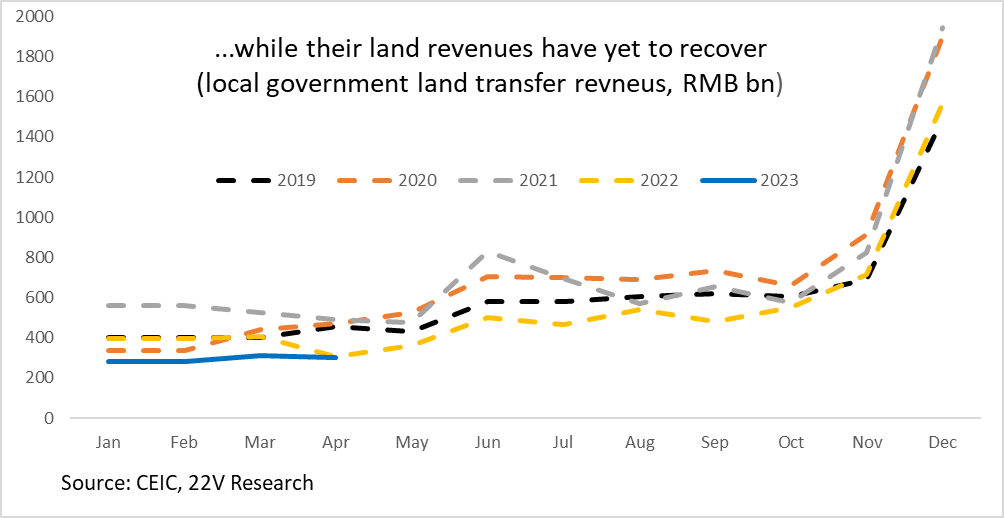
- Worsening economic conditions: China’s real estate downturn and pandemic battered local government finances and LGFVs with them. Local governments have seen a collapse in revenues from land sales, which they use to support LGFVs directly and which stand behind the perceived creditworthiness of their implicit guarantees. Local governments have also had to lean more heavily on LGFV spending to support growth, including to purchase land. Various estimates suggest LGFVs were responsible for roughly half of all land purchases last year – that is, local governments were purchasing land from themselves. While local government tax revenues are showing signs of a recovery this year, land purchases from property developers remain dormant; property sales remain lackluster, and developers are using even those scant proceeds to complete stalled projects and pay back debt, not start new projects.
- Tougher policy: At the Central Economic Work Conference in December, General Secretary Xi Jinping signaled that Beijing would be doubling down on efforts to contain the flow of new hidden debt and to dispose of the stock. The latest move from Beijing in the regulatory whack-a-mole has been to crack down on “structured” bonds, a technique in which lower quality LGFVs – many of which have been shut out of bond market financing since 2021 as creditors have become more nervous – have found ways to tap markets and lower their coupon payments through affiliated entities.
All this is occurring just as local governments face an increase in maturity payments on both their official bonds and LGFV bonds (see chart below). Estimates from the National Institute for Finance and Development (NIFD), a Chinese state think tank, using data from WIND, put total debt maturity payments at 5.4% of GDP in 2023, up from 4.4% in 2022 and less than 3% before the pandemic.

Outlook for the rest of 2023: navigating between bailouts and defaults
The combination of economic and political/regulatory pressures on LGFV debt will persist this year, bearing on China’s growth outlook as well as financial risks. In assessing how serious these are, it is important to pay particular attention to the political/regulatory side, where there is the most room for uncertainty. China’s leadership is navigating between two key policy objectives: keeping up the pressure on local governments to reduce their hidden debt – having warned not to expect bailouts from the central government– while avoiding systemic financial risks through uncontrolled LGFV defaults.
Markets are particularly focused on the potential ripple effects from an LGFV default on either an offshore or onshore bond, which has never happened but is only a matter of time. Views on the impact range from an LGFV bond default representing a potential “Lehman moment” for China to an expectation that markets would take it in stride.
On the “Lehman moment” side, it isn’t hard to paint a scenario where defaults have serious reverberations to financial sector soundness, economic growth, and fiscal stability:
- LGFV bonds account for roughly 40% of China’s non-financial corporate bond market, and most of these bonds are held by banks and insurance companies. A series of defaults that leads to a broad pullback in LGFV bonds would hit bank balance sheets directly – through their holdings of those bonds – and then indirectly, as a loss of liquidity impairs LGFVs’ ability to service debts to banks. The IMF estimates that even a 5% rise in the default rate of LGFVs would increase China’s banking system NPLs by 75%. The exposure would be greatest at the smaller regional banks, which lend heavily to LGFVs are also the weakest part of the banking system.
- Loss of financing for LGFVs would in turn hamper infrastructure and property investment, hurting economic growth and thus local governments’ ability to stand behind LGFVs and other state-owned enterprises – and so on in a debt-growth ‘doom loop’. There are also extensive (and underappreciated) crossholdings between LGFVs and state and private firms (see the IMF paper for more).
The main arguments for a more benign take are that (1) markets are already pricing in significant risks for LGFVs, and (2) that these risks are highly differentiated within the LGFV universe. Spreads between LGFVs of financially weak vs strong localities have widened in recent years. A Bloomberg Intelligence analysis, for example, concludes that a significant number of LGFVs in Guizhou province are already pricing in default and restructuring, so the risk of contagion is “negligible.” Defaults – properly handled – could start to introduce the discipline that China’s leadership is seeking to promote, while allowing healthy LGFVs to continue to access financing while they evolve over time into commercial entities.
In our view, Beijing will want to avoid defaults on LGFV bonds until it sees progress on several fronts:
- Recovery takes hold: Growth in 2023 remains heavily dependent on infrastructure investment, of which LGFVs play a key role. Before flirting with defaults, Beijing will likely want to see signs that a broader recovery is taking place, including stabilization of property activity (which would help support LGFV creditworthiness) and employment.
- Delineation of LGFVs’ functions: Since 2018, Beijing has pushed local governments to distinguish between LGFVs that are fulfilling public service functions – and thus should be officially brought within the government umbrella – and those that serve more commercial functions, which should stand on their own financial footing. The Ministry of Finance is now pushing local governments to accelerate this work with a deadline by the end of the year, and reportedly working on broader guidelines for LGFV commercialization. This delineation could be critical in managing defaults and limiting the ripple effects within the LGFV universe.
- Preparing the financial system. At the March National People’s Congress, Beijing announced a major overhaul of financial sector governance, including a beefed-up super regulator, a consolidated securities regulator, expanded local-level regulation, and two new Party bodies to oversee it all (see our analysis HERE). Addressing local government debt – including limiting the ripple effects from rising defaults – was likely a key motivation for these changes. Beijing may hesitate to introduce new shocks while these institutional reforms are still taking shape. Another key consideration is ensuring that regional banks – the most exposed to LGFV debt distress – are sufficiently capitalized and able to handle additional stress. Recent banking problems in the US are a reminder to the Chinese authorities and a reason to be cautious in this regard.
The factors above suggest that Beijing is more likely to wait until Q4 or 2024 before allowing significant defaults on LGFV bonds – but this is subject to considerable uncertainty. The dynamics around LGFVs to some extent resemble a game of chicken between Beijing and local governments seeking a bailout. The next several quarters will likely see a muddle-through, with Beijing avoiding formal bailouts but providing partial assistance through central enterprises (Guizhou has reached several such agreements in the last month). However, if there is a case that Beijing feels is particularly egregious in terms of financial irresponsibility – particularly involving an LGFV not essential for public services – Beijing could move earlier to allow a default as a signal to the rest of the system.
Near-term implications for growth and stimulus
Recent dynamics around local government debt are not a surprise. Beijing’s focus on controlling debt risks has been a key part of our basecase for 2023, thus far born out, of restrained stimulus and a recovery driven by services rather than investment. In January we also noted LGFVs as being among the key risk factors this year:
Two risks that could hit the headlines are debt distress among local government financing vehicles (LGFVs) and weakness/failures among smaller regional banks. These are unlikely to raise systemic concerns this year, with the authorities moving proactively to avoid a hit to confidence. But managing LGFV risks will be another headwind for fiscal stimulus, including infrastructure investment, and a broader reminder to investors of China’s longer-term vulnerabilities.
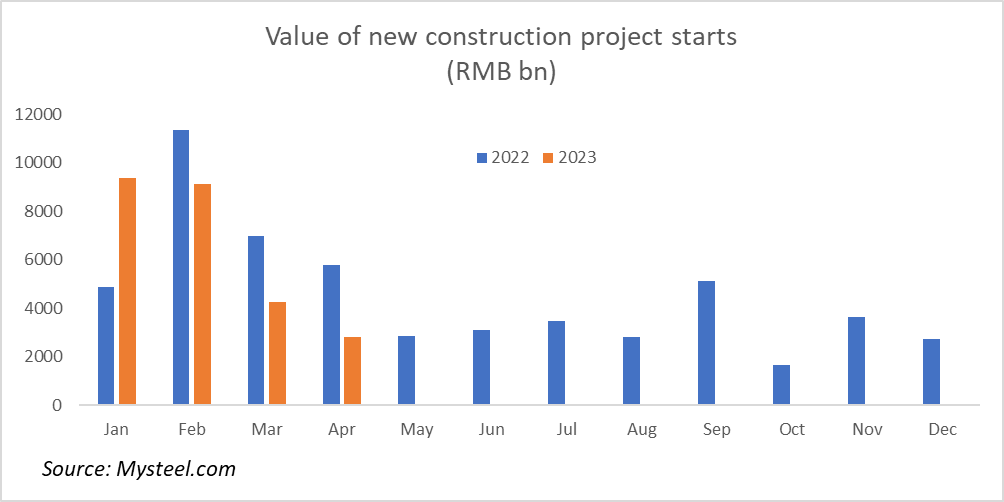
We continue to expect infrastructure stimulus in Q3 (see our recent take HERE), but LGFV problems underscore that it will be modest in scale. Beijing will largely accelerate funding and other support for existing projects rather than announce new ones. The overall impact will be modest – perhaps bringing H2 construction projects closer to matching the level of 2022 (see chart below). A key watchpoint ahead will be the extent to which Beijing leverages the central government balance sheet (such as the policy banks) to fund major projects. This was a key source of support for H2 2022 investment.
While we see a limited role for cuts to policy rates and RRRs this year as a main tool of stimulus, PBOC will look to cushion LGFV risks – and facilitate rollovers/restructuring of LGFV loans by banks – by keeping liquidity ample and bank deposit costs down.
Medium term outlook: Another challenge to an investment-heavy growth model
Beijing’s desired end state is for local governments to eliminate financial obligations to LGFVs and any other sources of hidden debt using their own resources. Wealthier localities such as Beijing and Shanghai have made substantial progress towards this goal, but for many provinces it is a practical impossibility. This is due to the structural gap between their spending responsibilities and limited revenue sources – particularly now that the boom years for property investment are over as demographic headwinds mount.
Beijing will likely need to bring at least some implicit local government debt on to the central government balance sheet – perhaps through a future swap program – while taking steps to wean local governments off their dependence on land sales revenue, such as through reforms to the tax system (e.g., a greater role for income taxes and introduction of a property tax).
Property and infrastructure are closely linked in China’s fiscal system and political economy, and together have represented around two-thirds of China’s fixed asset investment activity. The fact that both are hitting limits is an obvious, long-term headwind for demand for commodities that feed China’s fixed investment cycle. At the same time, Beijing has yet to set out a convincing path for rebalancing demand towards household consumption, which will involve deep-rooted reforms to shift economic resources from the state sector to the household sector – and which are somewhat in tension with Xi Jinping’s governance model.
Coming years will also see a complicated process of delineating which LGFVs should stand on their own as commercial entities. Progress in allowing some of those firms to fail, along with broader reform of non-LGFV state-owned enterprises, will be critical to reducing distortions in China’s allocation of credit and capital and boosting productivity. This process will likely deepen growing divergences in economic growth between coastal provinces and poorer regions in the interior and northeast.

