

Clients often ask about the geopolitics of Taiwan and the risks of conflict between China and the United States. It is a topic worthy of attention though also full of noise. The media often focuses exclusively on a potential Chinese invasion of Taiwan, which is an extremely high impact but very low probability event at least for the next several years; we frequently remind clients that there are less severe and more probable scenarios (such as a partial Chinese quarantine of Taiwan) that would still matter deeply for markets – not least because of Taiwan’s critical role in semiconductor supply chains. Taiwan faces an important presidential election in January 2024 that will bear directly on the risks above as well as the level of tensions in the US-China relationship.
In this report we answer clients’ most frequently asked questions about the Taiwan issue and the implications for investors. This is a deep-dive reference piece, so readers looking for the key takeaways can find a short video HERE and summary bullets below.
SUMMARY:
- Taiwan is the most sensitive issue between Beijing and Washington; it is largely intractable to political solutions, and thus will keep US-China tensions at a high level for years to come.
- The probability of a Chinese invasion of Taiwan is low (perhaps 5%) through 2027 but rises to 25% by 2035;
- There is a much higher probability that the US and China confront a crisis over Taiwan in coming years that falls short of an outright invasion but would still be highly impactful for global markets; one such scenario involves China imposing a selective quarantine of Taiwan, posing difficult questions for Washington in how to respond.
- The dominance of Taiwan Semiconductor Manufacturing Corp (TSMC) in producing advanced semiconductors means that a conflict or crisis involving Taiwan could be hugely disruptive for the global economy; the extent to which TSMC represents a “Silicon Shield” that deters China is less clear.
- A victory by Vice President William Lai in Taiwan’s January 2024 presidential election would increase cross-Strait tensions over the next four years; a victory by the opposition KMT party, on the other hand, would likely significantly lower tensions for at least a year.
- Other key watchpoints for cross-Strait risks include the 2024 US presidential election, rhetoric that would suggest Beijing is running out of “strategic patience” with Taiwan, and indicators such as stockpiling of commodities that would suggest Beijing is preparing for conflict; watchpoints that are more ambiguous as indicators of conflict risk include the frequency of Chinese incursions into Taiwan’s airspace, and pronouncements by US officials on the timeline for a potential invasion.
THE BIG PICTURE
Why should global investors care about geopolitical risks involving Taiwan?
- A conflict between China and Taiwan would very likely draw in the US and be devastating to the global economy. A war risks disrupting global semiconductor supply chains (90% of high-end chips are produced in Taiwan), international shipping (nearly half of global container ships pass through the Taiwan Strait, notes think tank CSIS), and the output of the Chinese and US economies as well as trade between them. A 2016 study by RAND estimated that a year-long conflict between the US and China – admittedly on the extreme end of the spectrum – would reduce China’s GDP by 25-35% and US GDP by 5-10%.
- Even less dramatic and probable scenarios would be deeply concerning to markets. Examples here would include a Chinese partial blockade of Taiwan to force political concessions, or military standoff between the US and China caused by an accident such as collision. These could temporarily disrupt global supply chains, spark fears of escalation into a larger conflict, and lead to intensified US sanctions and export controls on China. Investors tend to overlook these scenarios, which get less attention in the media than the risk of invasion.
- Taiwan is the millstone weighing down the US-China relationship. As the most sensitive issue for Beijing, the Taiwan issue sets the tone for the rest of the US-China relationship. Concerns over a conflict help drive US policies in areas such as technology controls (to slow China’s military advancement) and Beijing’s efforts to reduce vulnerability to those controls and financial sanctions. Monitoring dynamics over Taiwan is thus important for gauging broader policy risks in the relationship.
Why are US-China tensions over Taiwan rising?
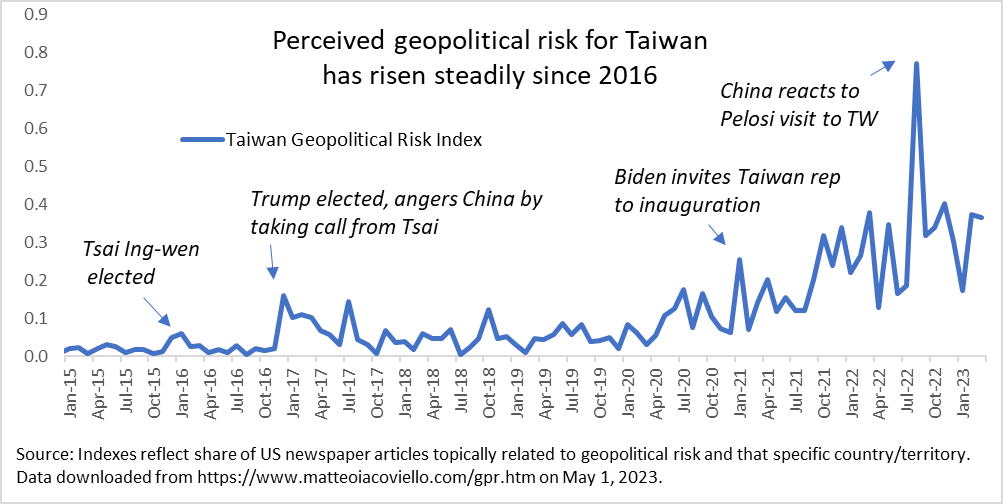
From 1996 to 2016, Washington and Beijing were generally able to keep tensions over Taiwan from erupting. That began to change in 2016, precipitated by two political developments: first, the election of Tsai Ing-wen as president, which returned the Democratic Progressive Party (DPP) to power; the DPP favors de facto (if not formal) independence from China. Second, the election of Donald Trump as US president, which ushered in a more confrontational phase of the US-China relationship. As the charts below show, perceptions of geopolitical risks involving Taiwan have spiked since 2016; this largely tracks China’s more frequent saber-rattling – especially incursions of PLA aircraft into Taiwan’s airspace – in response to actions that Beijing considerations provocations by Taipei or Washington.
At a more fundamental level, the equilibrium that allowed for stability in the Taiwan Strait has come under increasing pressure from several key drivers:
- China’s growing military power and its assertiveness under Xi Jinping. Western analysts have often exaggerated the extent to which Xi’s pronouncements on Taiwan (such as linking reunification to “national rejuvenation”) differ from those of his predecessors. But there is no escaping the fact that Xi has intensified China’s military modernization and buildup with a special focus on the ability to deter the US from aiding Taiwan. Moreover, themes of sovereignty have become more potent under Xi’s nationalistic governance style. All of this means that China is becoming more confident and assertive in extending its claims of sovereignty over Taiwan.
- Declining support in Taiwan for close engagement with China. China’s leadership would much prefer to accomplish reunification without bloodshed. While Beijing continues to hold out hope for peaceful reunification, grassroots sentiment in Taiwan has shifted decisively away from support for political union and even cultural identification with China. This is a long-term trend that accelerated after Xi’s political crackdown in Hong Kong in 2020, which has evaporated any credibility behind Beijing’s ultimate commitment to a “one country, two systems” framework – which was originally proposed for Taiwan.
- Washington’s more overt support for Taiwan, which has taken on outsized political and strategic importance amid rising tensions with China. President Trump’s administration adopted a highly risk-tolerant approach to engaging with Taiwan, increasing military sales and official dialogue without concern for Beijing’s reaction. Biden has largely continued these policies, while also becoming more vocal in offering support for Taiwan in the face of China’s saber-rattling: Biden has repeatedly stated that the US would come to Taiwan’s defense if attacked, contrary to a long-standing informal policy of “strategic ambiguity” on this point. Congress has become especially bold in its support for Taiwan, including with then-Speaker Nancy Pelosi’s visit to Taiwan in August 2022, the first at that level since the 1990s.
In Washington, stepped-up support for Taiwan is viewed as necessary to deter an increasingly assertive China and, over the last year, to prevent it from becoming “the next Ukraine.” To Beijing, Washington’s more overt support for Taiwan appears to be salami-slicing the One China Policy and providing encouragement to “separatists” in Taiwan pursuing independence. This result is a vicious cycle that has made Taiwan the most serious flashpoint in the relationship.

GAUGING RISKS OF INVASION AND OTHER SCENARIOS
What are the chances that China invades Taiwan in coming years?
- We view the probability of a Chinese invasion of Taiwan before 2028 as very low (5%). However, it rises significantly in future, to perhaps 25% by 2035.
- There is a much higher probability of a foreign policy crisis that does not start as an invasion but could escalate into serious conflict. Crisis scenarios would include use of force by Chinese and Taiwan militaries against each other, Chinese seizure of one of Taiwan’s outlying islands, a military standoff between the US and China, and selective quarantine of Taiwan by China. These would pose at least temporary economic and market risks and could escalate into a full-blown conflict. The probabilities of a crisis scenario are 35% by 2028 and 65% by 2035. The five-year probability largely assumes a DPP electoral victory in January; should the KMT win, the probability of a crisis by 2028 would decline considerably.
These probabilities shouldn’t imply strong conviction or precision on our part: the most useful part of the analysis is understanding the factors that would make a conflict or crisis more or less likely over time.
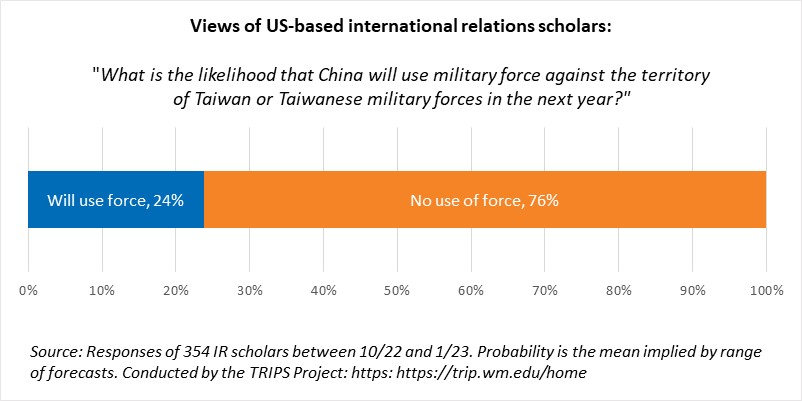
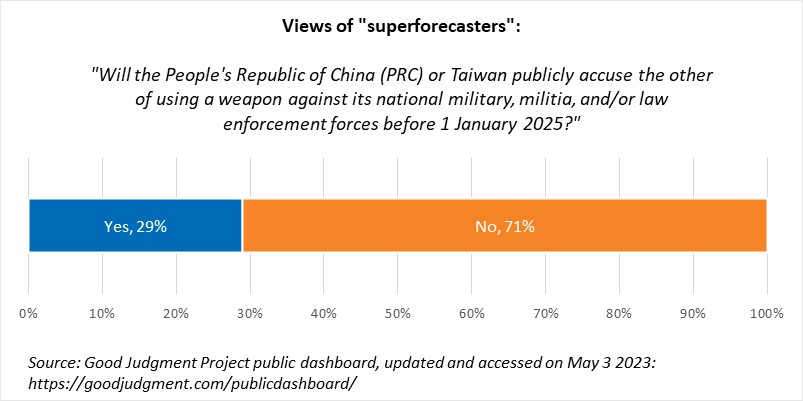
As a reference, the charts below show recent views of US-based international relations scholars and of “superforecasters” (from the Good Judgment Project) on Taiwan risks. The two groups answered different survey questions, but notably each assigned a greater than 20% probability over the next year-plus to a scenario that would likely fall into our “crisis” bucket: use of force by China against Taiwan’s territory or military (IR scholars), and accusation of use of force by China or Taiwan (the “superforecasters”).
Why is the probability of a Chinese invasion in the next several years so low?
Xi Jinping, unlike Russia’s Vladimir Putin, is generally a risk-averse leader. While returning Taiwan to China’s control would be a crowning achievement for Xi, he will weigh that goal against the risks for him and for China. So long as the risks remain high, and the perceived urgency is low, Xi will put off an invasion and focus instead on “gray zone” measures that increase pressure on Taiwan but fall short of military conflict.
For at least the next several years, the risks of an invasion will likely far outweigh the perceived urgency for Beijing. The key risks for China are:
- Military: Recent war games in the US (including one recently run in Congress) have tended to yield results that cast growing doubts on the ability of the US and Taiwan to deter a Chinese invasion. But such simulations rest on huge assumptions about military capabilities (including the impact of new technologies) and political factors such as the willingness to bear the costs of war. Russia’s troubles against Ukraine are also a reason for healthy skepticism about predictions in war. Michael O’Hanlon of the Brookings Institution argues that for at least the rest of this decade, the question as to who wins is simply unknowable with any degree of confidence – including to military planners in Beijing and Washington. For Beijing, an invasion would mean launching an incredibly ambitious amphibious landing and pacification campaign in Taiwan, and likely taking on the world’s military superpower – an enormous gamble for a leader who is generally risk-averse. And should China lose in a conflict, it would jeopardize Xi’s hold power and possibly China’s political stability.
- Economic and diplomatic: Even if China were to successfully invade and integrate Taiwan, it could come at the expense of Xi Jinping’s broader ambitions for China as a global leader and prosperous society. A major conflict with the US would be highly damaging to China’s economy through multiple channels: physical damage (including to vital economic hubs such as Guangdong and Fujian); disruption of trade; loss of external demand as the global economy reels; and punishing Western sanctions and export controls. China would face significant diplomatic isolation and a panicked arms buildup within the region. As put by Jude Blanchette and Gerard DiPippo of the Center for International Studies, the steep costs would mean that China would achieve a Pyrrhic victory at best.
Relative to those risks, the urgency for Beijing to bring about reunification is currently not high:
- While Xi might wish or even plan to reunify Taiwan as his legacy issue, he may be in power for another ten years or more.
- The United States, at least under Biden or another president with a tilt towards conventional US policy, is very unlikely to fundamentally alter the One China Policy.
- Leaders in Taiwan are also conscious of China’s red lines and will not be inclined to declare formal independence.
For all of China’s saber-rattling and verbal threats towards Taiwan, China’s leadership continues to use phrasing that it indicates that it believes time is on China’s side. Signs that this “strategic patience” is eroding would be a worrying development.
What conditions would make an invasion more likely in the next few years?
While Xi is not a gambler, he is more likely to take big risks if he thinks they are necessary to prevent Taiwan from being permanently lost. The most dangerous situation is thus one in which actions by Washington or Taipei convince China’s leadership that they must act now or lose hope of reunification forever. This would happen if Taiwan seemed on the verge of declaring formal independence, and/or if Washington signals that it will move away from the One China Policy and recognize Taiwan as a sovereign state.
As noted above, neither of these is likely anytime soon, but Beijing’s anxiety will increase if Vice President William Lai wins the January 2024 presidential election in Taiwan. Those concerns would likely be compounded if Donald Trump returns to the White House (Beijing will worry about his lack of predictability), or if a president is elected who vows strong support for Taiwan sovereignty on the campaign trail (see discussion further below). In the meantime, foreign policy analysts in the US are becoming increasingly vocal in warning the Biden administration and Congress to avoid major changes in policy towards Taiwan that might force Beijing’s hand.
Why do the risks of an invasion increase over time?
Unfortunately, the risk vs. urgency dynamic laid out above is not a stable equilibrium. Moving out over time, Beijing will perceive that the risks entailed by invasion are decreasing while the urgency of acting on Taiwan may increase:
- China’s military capabilities and ability to deter the US will likely increase given the pace of Chinese investments
- China’s vulnerability to US export controls and sanctions may decrease as Beijing pursues efforts to reduce reliance on US technology and the US dollar (though the challenges to both are formidable)
- Xi’s own sense of urgency to resolve the Taiwan issue may increase as he approaches the end of his tenure (which could stretch to 2035)
- Beijing may feel that its hand is being forced if it perceives the risk of a US president or Taiwan president that change the status quo
Some US analysts and former officials argue that Beijing may move up its timeline to invade Taiwan to within the next several years because it fears that China is now at the peak of its relative power and will not have a better opportunity down the road. We are skeptical that China’s relative power has peaked in this regard and even more so that Beijing perceives that its power is peaking.
What are China’s alternatives to an invasion?
Media narratives tend to focus on the risks of invasion. However, China has a large toolkit of measures to increase pressure on Taiwan, many of which it is already using (saber-rattling to wear down Taiwan’s military resources, economic coercion measures such as restricting imports from Taiwan and mainland tourist travel to Taiwan, cyberattacks and disinformation campaigns, etc.). These can be labelled “gray zone” measures, in that they fall between military conflict and conventional statecraft. Given the risks inherent in an invasion, China is likely to increasingly lean on “gray zone” measures to exert pressure on Taiwan and to extend China’s strategic advantages.
Defense analysts in both the US and Taiwan have increasingly called attention to a scenario in which China imposes a full or (more likely) a selective quarantine of Taiwan. Such a quarantine would be selective in that Beijing would not seek to cut off food and essential supplies to Taiwan, but instead force shipments to go through China. The goal would be to display China’s control over Taiwan and potentially limit some exports or imports. China could use its paramilitary (maritime militia) rather than conventional military, falling into a gray area that could complicate US/allied decisions as to whether to mount a military response.
For markets, such a situation is likely to be deeply worrying. First, investors would worry about the risk that it could escalate into conflict. The scenario could end up looking like a replay of the 1962 Cuban Missile Crisis, in which the US imposed a partial quarantine on Cuba; this time the US would be in the position of deciding whether to try to break China’s quarantine. Defense planners such as RAND worry that a quarantine could be attractive to Chinese military planners but quickly turn more serious as the US responds. Second, the US would very likely respond to a blockade with intensified sanctions and export controls against China, perhaps joined by allies including Japan, the EU and Australia. Third, there would be concern about the possibility that the quarantine or resulting conflict would restrict Taiwan’s export of advanced semiconductors.
The point here is not that a quarantine is likely, but to underscore that there are scenarios that fall short of invasion that would be highly unsettling to markets.
How do semiconductors play into Taiwan risks?
The dominance of TSMC in advanced semiconductor production, and central role of semiconductors in US-China tech competition, has increased the geopolitical stakes involving Taiwan for each side and for the global economy more broadly. The US is increasingly concerned that the risks of a conflict between China and Taiwan could disrupt semiconductor production or put TSMC into the hands of China. The response of policymakers has been to try to reduce reliance on TSMC’s facilities in Taiwan by onshoring some production in Arizona under the CHIPS Act, as well as increased calls to defend Taiwan. Beijing, on the other hand, is angered by US export controls of advanced semiconductor technology, which has restricted China’s access to advanced chips produced by TSMC.
But the role of semiconductors in Taiwan’s geopolitical risks is complicated. Taiwan officials refer to a “Silicon shield”: the notion that China is less inclined to invade Taiwan since: (1) semiconductors provide incentives for the US and allies to support Taiwan; and (2) the risk for China that a conflict that damages TSMC’s facilities would also hurt China, given China’s own dependence on semiconductors from Taiwan. While there is certainly a logic to this argument, not everyone agrees. A study by RAND argues that Taiwan’s semiconductor industry is more of a vulnerability than a threat; in the event of a quarantine, for example, some countries would call on the US not to escalate for fear of disrupting Taiwan’s semiconductor shipments.
Clients also ask: won’t China be motivated to invade Taiwan to gain control of TSMC? This is more complicated than it looks. Taiwan authorities could destroy TSMC’s facilities rather than allow them to fall into China’s hands. But they may not need to: US/allied export controls imposed on a China-controlled Taiwan would deprive TSMC of the supply chain components needed to maintain production.
Simply put, it is hard to say whether Taiwan’s critical role in semiconductor supply chains is more of an accelerant or deterrent on a Taiwan invasion, though we lean towards the latter. What is clear, however, is that it would amplify the shock to global markets should a conflict or crisis scenario come into play.
What are the main watchpoints to determine if Taiwan risks are rising?
The key watchpoints are:
- Political developments that could lead Beijing to conclude that peaceful reunification is simply impossible and thus to increase pressure on Taiwan. Chief among these is the January 2024 presidential election in Taiwan (discussed in next section) as well as the 2024 US presidential election.
- Signs that Beijing is giving up its “strategic patience” towards Taiwan. Rhetoric, including from Xi, continues to signal that Beijing believes that time is on its side. If that changes it would be a worrying development. There are also credible reports that Xi has tasked Wang Huning, a member of the senior leadership, to review the China’s political approach to Taiwan; signs that this process is leading to shifts in policy are also worth monitoring.
- Reliable indications that China is preparing for conflict. John Culver, previously one of the CIA’s senior analysts on China, has explained that Beijing would need to undertake extensive preparations to prepare the population, economy and military for a conflict. These indications, ranging from stockpiling of commodities to mobilizing reserve troops, would be obvious to the wider world months in advance. Culver notes: “If China decides to fight a war of choice over Taiwan, strategic surprise would be a casualty of the sheer scale of the undertaking.”
More ambiguous watchpoints include the following:
- Pronouncements by US officials on China’s likely timeline for an invasion. Comments by former and current military personnel that speculate as to potential timing for a Chinese invasion of Taiwan should be put in context. First, such comments are often meant to drive greater urgency behind US/Taiwan preparations, rather than as an unbiased assessment of the probabilities. Second, these assessments tend to be based on the view of China’s capabilities, whereas the critical aspect of intent is often oversimplified (and on balance exaggerated).
- China’s saber-rattling, such as air incursions into Taiwan’s airspace. China’s incursions into Taiwan’s airspace have increased dramatically in recent years and have spiked during periods of high tensions, such as the Pelosi visit last fall. Such flights are mainly an effort to wear down Taiwan’s military readiness and political/psychological resolve, as well as to expand the PLA’s ability to operate near Taiwan. Hence, they are best regarded as an indication of China’s overall assertiveness, and the risk of accident or miscalculation (such as collision between Chinese/Taiwan or Chinese/US aircraft) that could escalate. But they do not represent precursors to an invasion.
OUTLOOK FOR CROSS-STRAIT RISKS IN THE NEXT YEAR
Why is the Taiwan presidential election important for investors?
On January 13th Taiwan will hold its next presidential election. President Tsai Ing-wen has served two four-year terms and is thus ineligible to run. The candidate from her ruling Democratic Progressive Party (DPP) is the current vice president, William Lai. Lai has been a prominent advocate for Taiwan’s sovereignty – once referring to himself as a “political worker for Taiwan’s independence” – though he has toned down explicit support for independence in recent years and in the run-up to the election. Lai is the early front-runner in public polls.
Beijing would view Lai as even more likely than Tsai to push for greater de facto independence and separation from China. It would also be dispiriting for Beijing to see the opposition Kuomintang Party (KMT), which favors engagement with China, lose an election yet again after 8 years out of power. This would deepen alarm in Beijing that there is no viable counterpart in Taiwan to maintain even a vague fiction of pursuing peaceful reunification.
Should Lai win the presidency, Beijing is likely to increase saber-rattling and gray zone activities (such as military exercises), perhaps in the period between the election and Lai’s swearing in ceremony in May. This will also be a politically sensitive time in the run-up to the US presidential election; Republican candidates may travel to Taiwan and look to meet with Lai and other officials, increasing Beijing’s fears that Washington could embolden Taiwan. Over the next four years, investors should expect cross-Strait tensions to be at least as high under Lai as during the last four under Tsai.
The KMT Party, which ruled Taiwan from 1949 to 2000, most recently held the presidency in 2012-2016. The party performed well in local elections in November, giving it some hope that its political fortunes are reviving. The KMT has yet to choose a candidate, but the mostly likely candidates are Hou Yu-yi (mayor of New Taipei City), Foxconn founder Terry Gou, and Kaohsiung mayor Han Kuo-yu. Former president Ma Ying-jeou, a KMT elder, recently became the first former leader of Taiwan to visit the mainland, a sign of how the KMT is looking to present itself as willing to engage China – and lower risks of conflict – without sacrificing Taiwan’s sovereignty.
Should the KMT candidate win, it would likely lead to a substantial reduction in cross-Strait tensions for at least a year. Beijing would also dangle economic concessions to advertise the benefits of cross-Strait dialogue. However, a KMT victory would not necessarily alter long-term risks for Taiwan given that the party would not have a popular mandate to pursue talks towards reunification. Indeed, there are some risks that Beijing would apply pressure to KMT to seize perhaps a last chance to enter such talks.
Finally, there is also a popular potential candidate from a third party, Ke Wen-je of the Taiwan People’s Party, who stands somewhere in the middle of the DPP and KMT in its views towards cross-Strait relations. Should Ke win the presidency, China is likely to engage him somewhat cautiously, welcoming a break from DPP rule but conscious that Ke’s approach to China is still not fully developed.
22V will be closely monitoring the run-up to the election and its potential investment implications – including the prospect of a rally for Taiwan assets should the KMT win the election.
How does the US presidential election in November 2024 play into Taiwan risks?
The run-up to the election is likely to increase US-China tensions over Taiwan, particularly if the DPP wins the presidency in Taiwan in January. Republican candidates are likely to compete over who can be strongest in support for Taiwan; last month former National Security Advisor John Bolton, a possible candidate, visited Taiwan and others may follow. The Biden administration will have less political leeway to try to lower the temperature on the Taiwan issue as the election approaches.
The outcome of the election will of course also matter. Reelection by Biden would likely keep cross-Strait risks high but probably stable; Beijing knows that Biden will not radically adjust the One China Policy. A victory by Donald Trump would likely increase cross-Strait risks or at least the level uncertainty. Trump combines hawkish views on China with skepticism about the value of US alliances – precisely the set of circumstances that could prompt Beijing to test whether he would be willing to risk war to break a quarantine of Taiwan or other increased pressure. A Republican with more traditional foreign policy views – such as Nikki Haley – would be similar in risks to another term for Biden.
What is the outlook for cross-Strait tensions over the next 12 months?
From now until the run-up to the Taiwan presidential election in January, cross-Strait tensions will remain at the current high level but likely not spike much further. First, while there is a risk that Beijing could increase military threats if it appears that William Lai is poised to win the election, Chinese leaders saw in past cycles that such threats can backfire and drive support for the DPP. Second, Xi Jinping’s likely attendance at the APEC Leaders Summit in November in San Francisco will provide incentives for China to show restraint rather than be seen as increasing global risks.
If William Lai wins the election, Beijing may use the period between the election and his inauguration in May to ratchet up threats and pressure Lai to avoid taking provocative actions when he assumes office. This period would also coincide with the onset of the US presidential election, which could increase Beijing’s sensitivity if the candidates pledge new actions to support Taiwan. On the other hand, if the KMT or TPP should win the election, this period would likely see tensions fall and Beijing make overtures to the incoming Taiwan administration.

