Summary: Two things we have high conviction on; The S&P is not an obvious short (assuming oil prices don’t go to $170 or above) given the extremely high expected cash return yield relative to risk free rates and financial conditions will continue to tighten. Powell will only be “dovish” if the war tightens financial conditions significantly for him. If some sort of peaceful resolution is reached, Powell will be hawkish and rates/rate hike expectations will go higher.
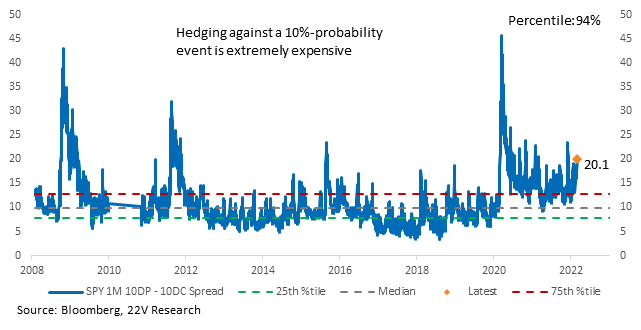
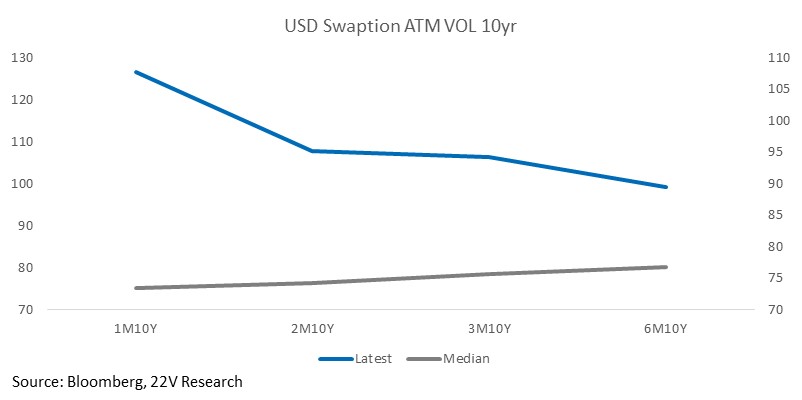
The cost of hedging against a 10%-probability event has spiked higher. If Russia’s attack continues and financial sanctions increase further there is more downside risk, but investors are hedging that risk. Implied vol in Treasury markets is in backwardation, as is the VIX and oil futures.
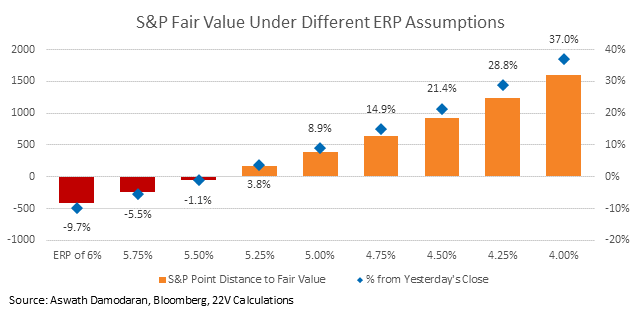
The ERP is currently around ~5.5. If the ERP rose to 6% (near the COVID) while the 10yr yield, earnings growth, and cash return ratio remained flat, fair value would be ~-10% lower. A 5% equity risk premium (very high historically) gets you about 9% upside. Considering oversold conditions, a high equity risk premium, backwardation in energy, vol, and yields, and extremes in hedges, risk assets should rebound if things improve. This is a skew trade not a hope trade.
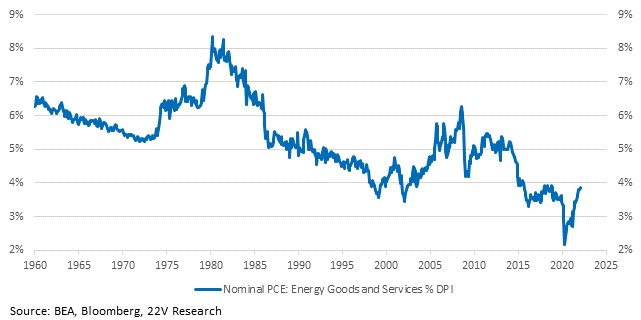
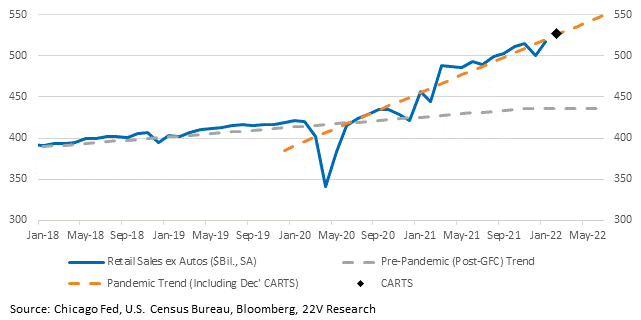
Payroll data was much stronger and thought wage growth was weaker than expected the trend in wage growth remains strong. PCE in the U.S. shows spending growth was still well above trend and the latest estimate from the Chicago Fed on retail sales suggest a still VERY strong trend. Spiking oil prices are a consumer headwind, and a significant risk to Europe, but U.S. Energy goods and services spending is roughly 4% of disposable income, half what it was in 2006/2007.
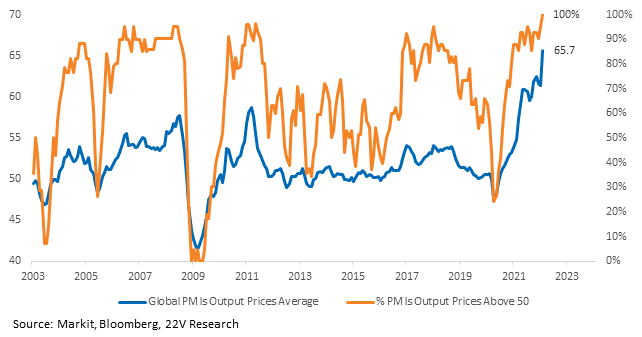
Global PMIs showed a robust economic backdrop heading into Russia’s invasion of Ukraine. The prices component is still spiking. Growth is still too strong for traditional stagflation to be a likely outcome. Global central banks still need to confront price pressures if the Russia-Ukraine crisis doesn’t create demand-destroying commodities prices and/or demand-destroying chaos. As Gerard noted, Powell sounded like a guy trying not to get forced off message by external events, highlighting inflation and describing a series of rate hikes as a done deal in his testimony.
Tightening of financial conditions is the enduring theme we are organizing around. At the stock level that means focusing on companies with pricing power that can maintain profitability as growth slows. At the factor level, that means favoring Quality of Earnings, Low Vol, and Realized Growth. Value and Earnings Turbulence, and Momentum should continue to struggle.
If the hot war turns cold, there will likely be a short term rebound in risk-on industries and factors, but the persistence of the tightening financial conditions trend suggests any factor rebound should be seen as an opportunity to add to Quality/Low Vol positions.
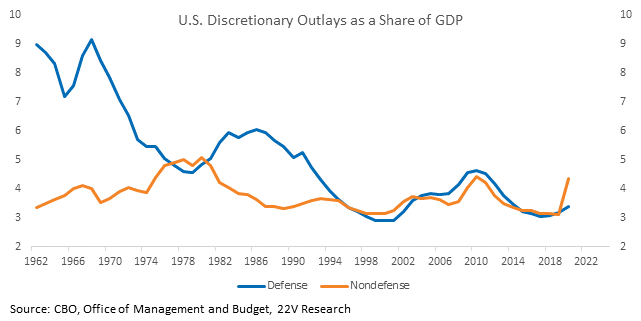
Per Kim Wallace, increased Defense spending is another durable theme. Two ways for investors to focus on the crisis are US defense spending and global cybersecurity companies. He notes that “Congress this week will consider and likely add to and pass the Biden administration’s $6.4 billion request for humanitarian and defense spending. The latest whisper number is for the final package to exceed $10 billion. XAR, the aerospace/defense ETF, is a useful proxy.”
Macro Backdrop: Payroll data was much stronger than expected, but wage growth missed estimates. Per Gerard, “The miss on wages was not due to sectoral mix shift. This raises the odds that the weakness (relative to consensus) is real and not just some technical distortion. This inclines me to view the report as just slightly more hawkish than expected, rather than decisively so.” Bottom line, labor markets have tightened, wage growth is strong, and growth is too strong to bring inflation down.
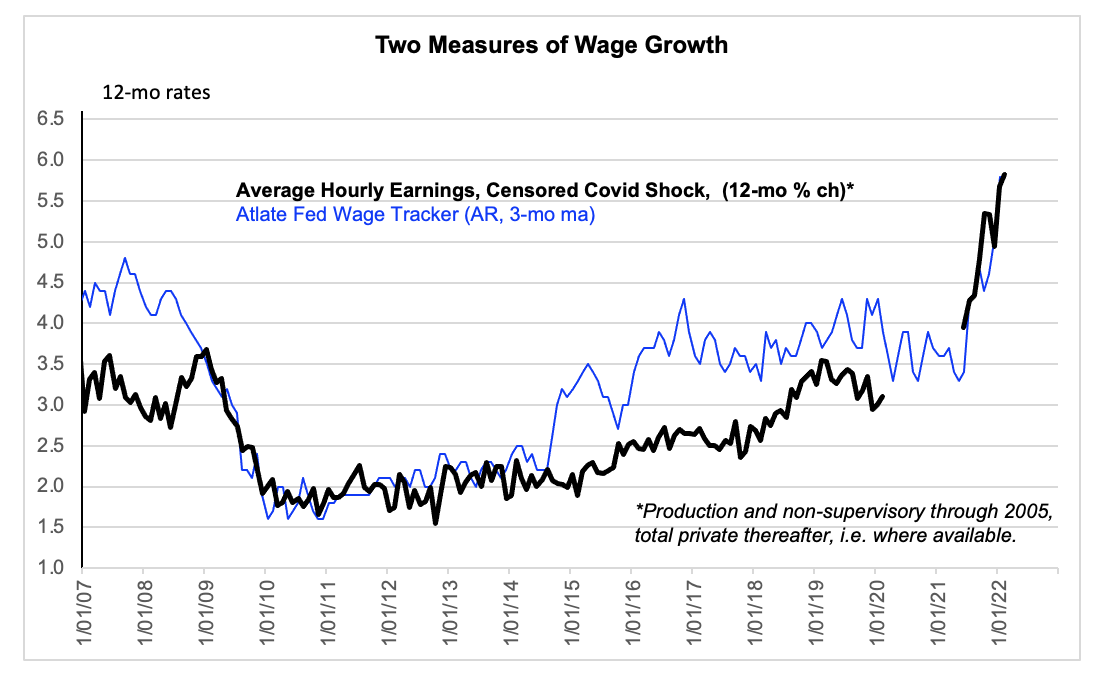
Global PMIs showed a robust economic backdrop heading into Russia’s invasion of Ukraine. The prices component is still spiking. Growth is still too strong for traditional stagflation to be a likely outcome. It seems stagflation-lite – high inflation and slowing growth – is what most people are worried about. How long stagflation-lite fear lasts will dependent on how long the war lasts.
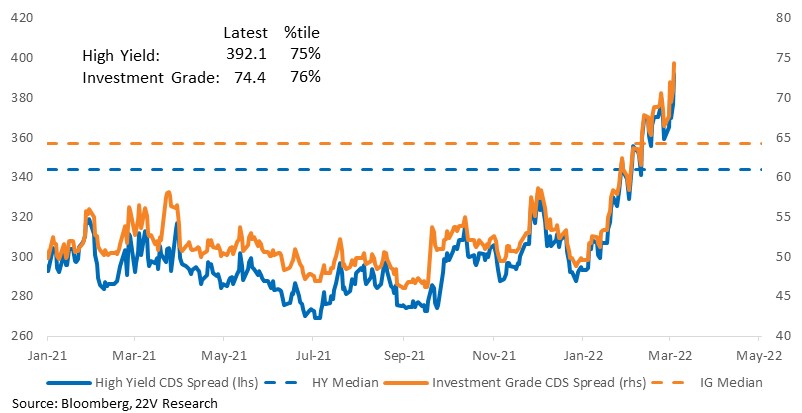
Oil continues to jump higher as sanctions on Russian oil and gas increased. That lead to greater risk of a significant slowdown in European economic growth and knock-on effects to US growth. HY and IG CDS are around their 75th percentiles. They were at their 6th percentiles at the beginning of the year.
It isn’t just oil. Commodity inflation is catching headlines, reinforcing the admittedly well-understood notion that inflation is everywhere.
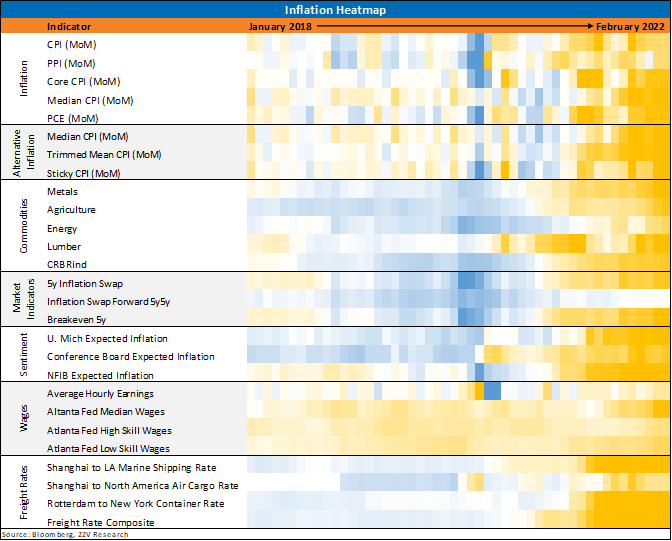
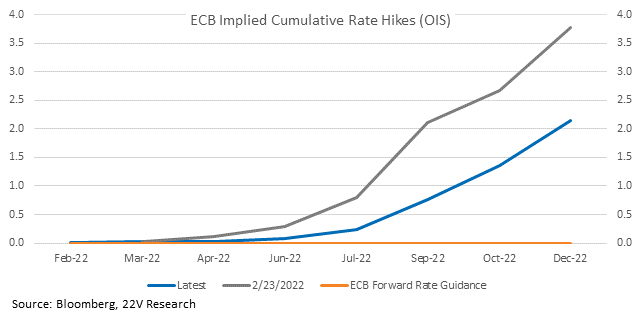
Italian CPI rose to a new Euro-area high, but bets on ECB reactions are falling. The Russia-Ukraine situation gives the Fed and ECB room to adjust policy slower (maybe to a lower end point). Bottom line is growth still needs to slow either through geopolitical shock, central bank tightening, or more likely some combination of both.
The war is tightening financial conditions, largely through increased volatility.
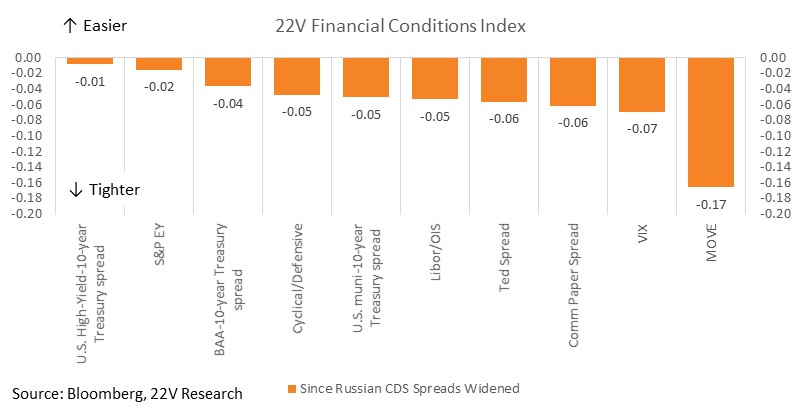
Central banks are unlikely to turn “dovish” unless the war tightens financial conditions significantly for here. If some sort of peaceful resolution is reached, Powell will be hawkish and rates/rate hike expectations will go higher.
Improving S&P Skew: The cost of hedging against a 10%-probability event (the chaos scenario) is in its 94th percentile. It is not surprising that chaos hedging has increased meaningfully. If Russia’s attack continues and financial sanctions increase further there is more downside risk, but investors are hedging that risk.
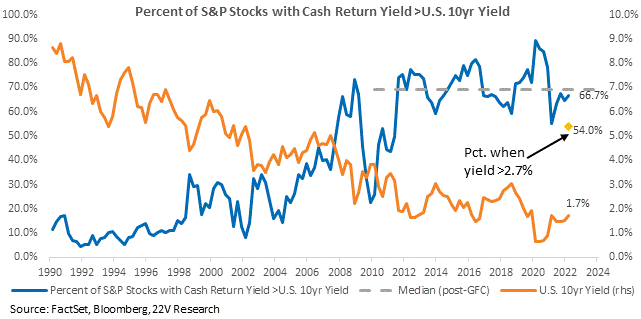
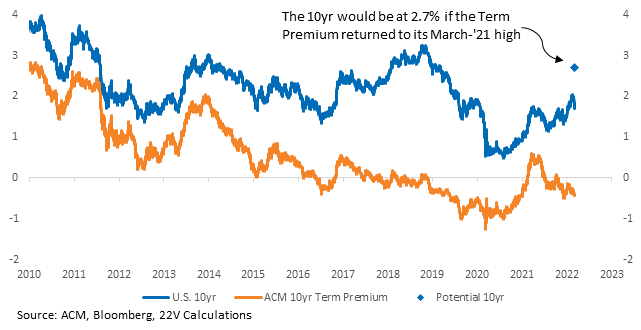
The percent of S&P stocks with a cash return yield above the 10yr has risen to 67%. But even if the term premium returned to its March ’21 high and the 10yr hit 2.7%, 54% of the S&P would have a cash return yield greater than the 10yr. That’d be lower than the post-GFC ‘normal’, but it’s still substantial and we suspect an underappreciated fundamental tailwind.
The ERP is currently around ~5.5. If the ERP rose to 6% (near the COVID high when investors were grappling with a shutdown of the global economy) while the 10yr yield, earnings growth, and cash return ratio remained flat, fair value would be ~-10% lower than the current levels. A 5% equity risk premium (very high historically) gets you about 9% upside. The bottom line, the skew is increasingly to the right on returns (assuming some off-ramp is found) with an implied ERP at these levels.
Potential Near-Term Reversal: Implied vol in Treasury markets is in backwardation just like the VIX.
If the term premium returned to its March 2021 high, the 10yr would be at 2.7%. So, the outlook for inflation and short rates still biases the 10yr yield higher, but the collapse in the term premium is driving the 10yr yield lower. If a resolution comes to fruition, expect a sharp move higher in 10yr yields.
Strong Consumer Trends: Energy goods and services spending is roughly 4% of disposable income, half what it was in 2006/2007. Spiking energy costs don’t hurt the US consumer’s ability to spend as much as they once did. And as Gerard wrote last Sunday, the hit to U.S. real income from higher gasoline prices has already been felt.
PCE in the U.S. shows spending growth was still well above trend and the latest estimate from the Chicago Fed on retail sales suggest a still VERY strong trend.
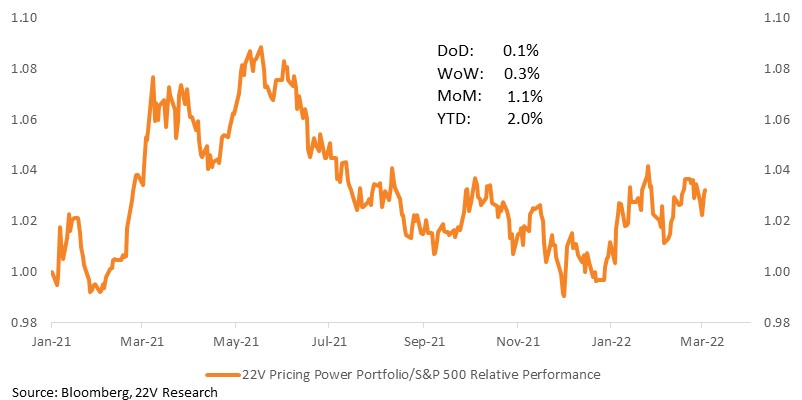
Enduring Themes – Pricing Power, Quality Rotation, Defense Spending: Tighter financial conditions will lead to less ability of companies to pass along higher costs. Input costs will still have upward pressure in a war scenario, but slowing economic growth, tighter credit spreads, slowing consumption will make it harder for companies to pass along costs. The 22V pricing power portfolio (rebalanced last week) consists of companies with high relative pricing powering sentiment expressed during 4Q earnings call. The portfolio has outperformed the S&P by 2% YTD as inflation, the shift in fed policy and now Russia and Ukraine have become a problem.
Factor returns have been consistent with a backdrop of tightening financial conditions. Value and Earnings Turbulence, Value, and Momentum have been poor performers. Quality of Earnings, Low Vol, and Realized Growth have been the best performers. A cease fire/some other reduction in tensions, would likely see a short-term factor reversal that favors Value at the expense of Low Vol. Longer-term, a backdrop of tightening financial conditions and rising real rates supports a Quality rotation.
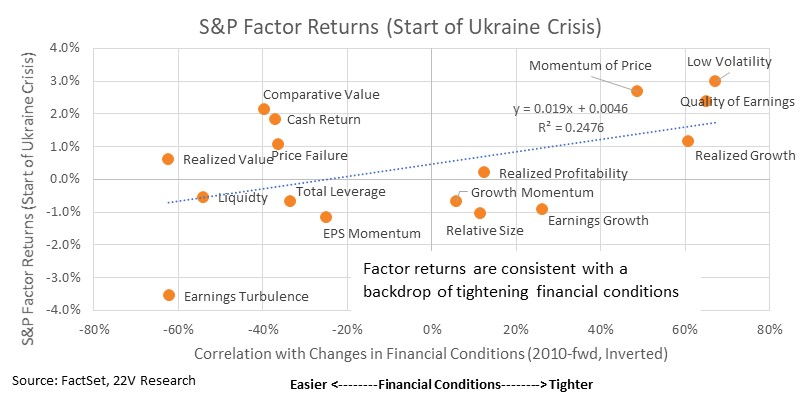
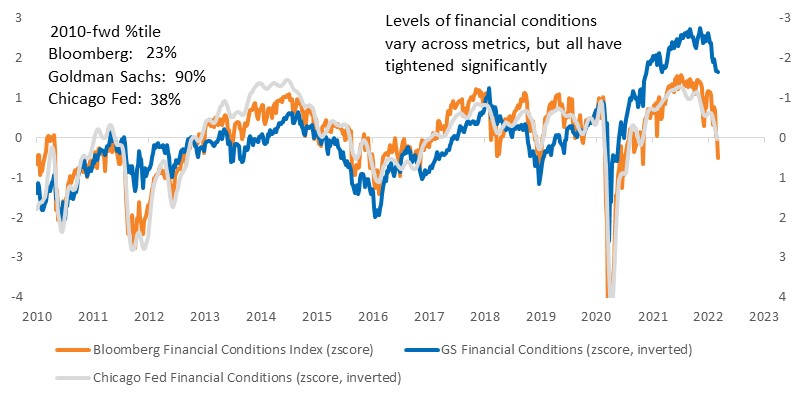
What we can say with some confidence, is that financial conditions are likely to tighten either way. Without a war, demand growth is too firm for the Fed and that requires tighter financial conditions. With a prolonged war/other geopolitical risks, financial conditions tighten without the Fed’s help. Below are the factors that benefit from tighter financial conditions. Stay long Quality, low Volatility and profitability.

Importantly, factor mean reversal has been a poor strategy over most of the past several years. We would expect to see some rebound in risk-on factors short-term, but the lack of mean reverting tendencies at the factor level, along with the persistence of the tightening financial conditions trend suggests any factor rebound should be seen as an opportunity to add to Quality/Low Vol positions.
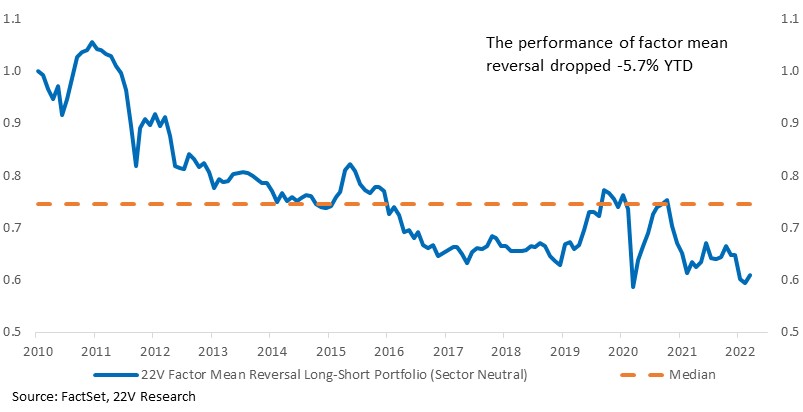
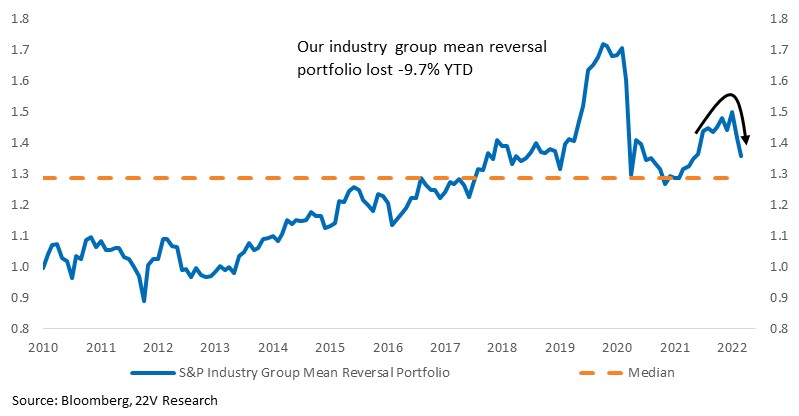
If peace breaks out, there is likely to be some rebound in industries that have suffered the most during the recent period of market declines. Industry and factor trends will be influenced by rising inflation and yields well into 2022 and likely beyond. A short-term reversal in trends is possible and likely if the hot war cools, but that will only encourage the Fed to tighten more aggressively. Which will favor the same factors and industry groups that are working now.
Per Kim Wallace, “Russia has the world’s attention. Two ways for investors to focus on the crisis are US defense spending and global cybersecurity companies. Congress this week will consider and likely add to and pass the Biden administration’s $6.4 billion request for humanitarian and defense spending. The latest whisper number is for the final package to exceed $10 billion. XAR, the aerospace/defense ETF, is a useful proxy.”