

In the last week clients have asked about two tail scenarios involving China’s monetary policy: (1) the prospect that the People’s Bank of China (PBOC) is about to engage in quantitative easing (QE); and (2) the potential for a one-off devaluation of the CNY against the dollar. I see both scenarios – which are implicitly related – as very unlikely for the foreseeable future, for reasons explained below.
Quantitative ease vs. the CNY’s squeeze
Talk of China embarking on “QE” has flared up at several points in the last year and spiked again this week. The media often throws the term around loosely, and in the case of PBOC – which has long used quantity-based tools such as credit quotas, in addition to interest rates – the definitions get especially fuzzy. For this discussion we will define QE as the PBOC departing from its conventional policy by making mass purchases of government securities and other financial assets beyond what is necessary to influence short-term policy rates, with the aim of stimulating growth and investment.
Three developments have helped spur speculation that China is or soon will embark on QE policy, but in each case there is important missing context:
- PBOC’s baby steps towards bond trading. In March, China’s government published a Xi Jinping speech from October 2023 that included a vague call for the PBOC to “gradually increase the buying and selling of government bonds.” Coming at a time of weak growth, that phrasing ignited speculation that China was about to shift its stimulus strategy. This was a misinterpretation. Xi’s original statement came in the context of last fall’s Central Financial Work Conference, which is about long-term financial reforms. It was not about stimulus – let alone QE – but instead PBOC modernizing its monetary policy toolkit. Unlike most central banks, PBOC has done very little trading of government securities, which was reasonable when China’s treasury market was small and illiquid but makes less sense now that it is the world’s third largest government bond market and an important part of the domestic financial system.
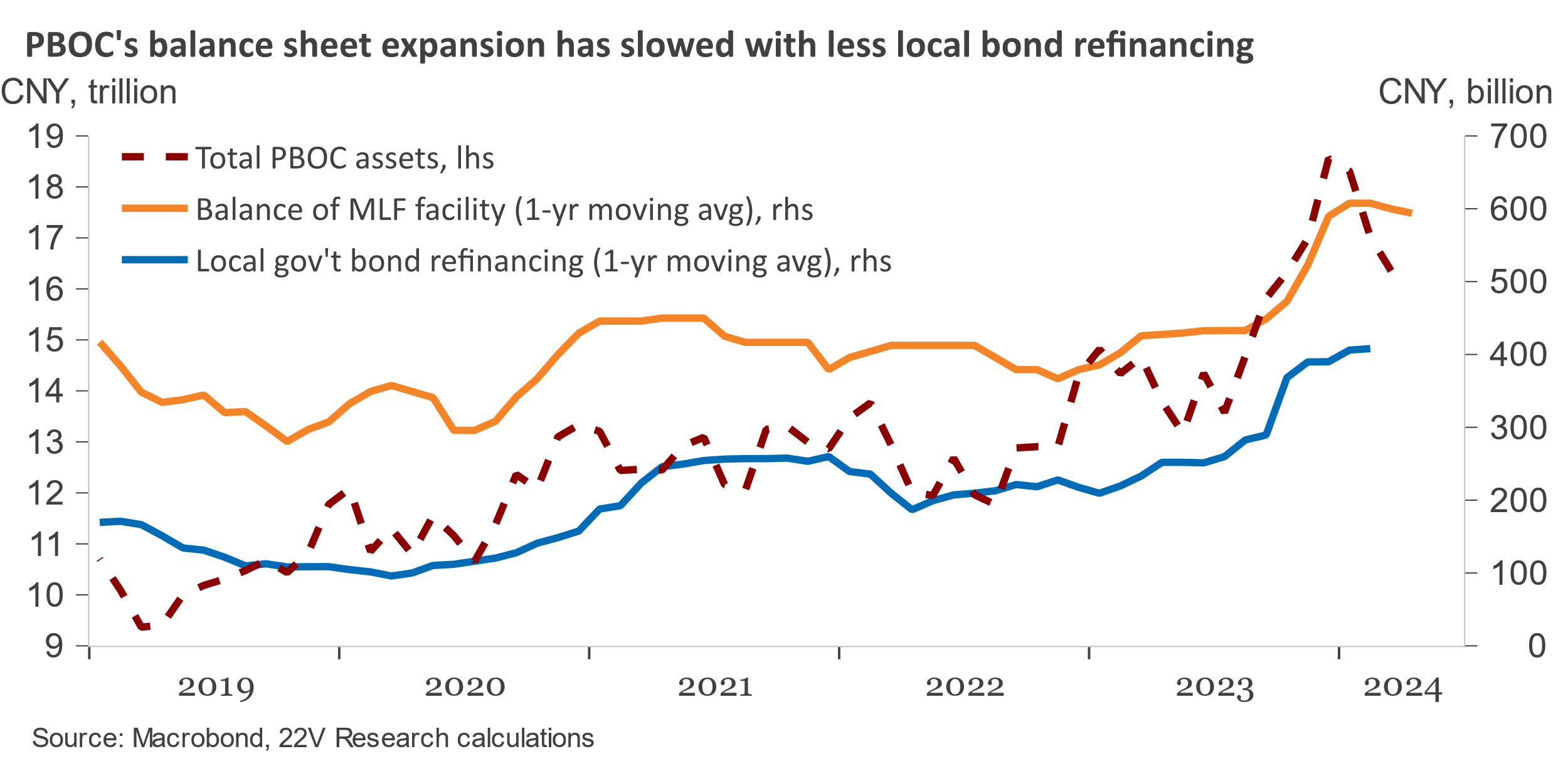
- The expansion in PBOC’s balance sheet in 2023. PBOC’s balance sheet climbed in H2 2023. But as we explained in February, the increase in PBOC assets was not QE but instead a large infusion of liquidity to commercial banks, mainly to help them roll over a wave of maturing local government debt (please see: This is not the QE you’re looking for, February 5, 2024). In other words, this was a move to support financial stability (avoiding defaults of local government debt) rather than to juice growth. And in the last few months, growth of PBOC assets and PBOC lending to banks have leveled off as the local government refinancing wave has crested.
- The decline in China’s long-term yields. The yield on 10-year government bonds has continued to plunge this year and now stands at a historic low of 2.3%. While PBOC has trimmed rates this year, the decline in yields reflects not so much aggressive intentional easing as the weakness of the economy and the outlook: long-term expectations of a low growth and low inflation, and a lack of other attractive places for banks (the largest buyers of government bonds) to deploy their capital. In the last month, PBOC has become increasingly vocal about its concerns that long-term yields are in fact too low (not too high), and that this represents a bond bubble that could end badly if/when yields eventually rise.
China’s Financial Times – a newspaper operated by the PBOC – ran an interview this week with an unnamed official at the central bank to again push back on QE speculation. The interview made two main points:
- PBOC is moving towards trading government bonds, but it is a tool to manage liquidity and conduct conventional monetary policy rather than QE. The official noted that PBOC will be selling as well as buying bonds.
- The decline in long-term yields may be fleeting. The article warned about the risks to financial institutions from aggressive purchases of long-term bonds at low rates, drawing the comparison to Silicon Valley Bank. The PBOC official described the fall in long-term yields as partly due to a temporary lack of supply as government bond issuance has leveled off, noting that supply will pick up again as the central government moves towards issuing the “ultra-long term” treasury bonds announced at the National People’s Congress in March.
- These two points are related. The fact that banks and other financial institutions are piling into bonds at the long-end of China’s treasury curve – where liquidity is limited – helps explain why the PBOC is preparing to become more active in this market. A sudden rise in yields could lead to panicked selling of bonds, forcing PBOC to step in and provide liquidity to safeguard financial stability.
More fundamentally, China’s conventional monetary policy is not out of ammunition – but it is hostage to concerns over exchange rate stability. Interest rates are not close to the lower bound such that unconventional policy is necessary. The main constraint is Beijing’s concern that further monetary easing will add to depreciation pressure on the CNY: PBOC held its one-year policy rate (MLF) steady last week at 2.5%, rather than cutting, to help support the currency. QE would only worsen depreciation pressures. Other constraints on further monetary easing are banks’ narrow net interest margins (pressuring their profitability), and regulators’ concern that low rates will fuel asset price speculation without boosting real growth.
Given those constraints, fiscal rather than monetary policy will have to carry most of the weight in delivering stimulus this year. Fiscal spending buoyed Q1 growth (see our write-up HERE), but its effects are fading and more will be necessary to maintain growth in the second half. The closest that China will come to QE this year is using its Pledged Supplementary Lending (PSL) facility to help finance local government spending on affordable housing and municipal infrastructure. But even here PBOC seems set to be cautious, having learned the lesson from 2014-2019, when overly aggressive use of the PSL helped inflate the last stage of China’s property bubble.
A CNY devaluation would be a huge risk for Beijing
The constraints imposed on monetary policy by the exchange rate raise question: might the PBOC be tempted into a one-time devaluation of the CNY to alleviate depreciation pressure, boost exports, and reduce deflation concerns?
There is no question that PBOC – like the Bank of Japan – faces a difficult challenge in managing depreciation pressures while domestic monetary policy is loose and the Fed is poised to stay higher for longer. Pressure on the CNY has increased since March, with markets closely watching where the PBOC sets the daily fixing rate for the CNY (the middle of the 2% daily trading band) and other signals.
We continue to think that PBOC will adopt a muddle-through approach in which it permits gradual depreciation of the CNY against USD but uses intervention and other tools to periodically surprise the market and make the path towards a weaker CNY a bumpy one. Beijing is not willing to defend the CNY at a given level indefinitely, but it also wants to avoid encouraging one-way bets on CNY depreciation. That would threaten to fuel a vicious cycle of capital outflows and further depreciation pressure – a trap that in 2015-2016 cost PBOC roughly $1 trillion in foreign exchange reserves defending the currency.
This is not to say PBOC has an easy task. The gap in US-China interest rates will make the PBOC’s job of managing depreciation pressures difficult and much comes down to the Fed outlook. PBOC is no doubt hoping for a return to the prospect of Fed cuts, combined with signs that China’s recovery is gaining steam. An additional complication would come if Trump seems poised for electoral victory, bringing expectations of an escalation in the US-China trade war. But PBOC also has important sources of support for the currency: $3.5 trillion in official reserves, additional assets held by sovereign wealth funds and state banks, and a healthy current account surplus (officially 1.3% of GDP in 2023, which is likely to be understated).
Muddling through is still more palatable than a one-off devaluation. While not impossible – there are scenarios where PBOC could have little recourse but to allow swift depreciation – the political and economic risks for China mean that it would be a decision taking only under major duress:
- It may not end depreciation pressures. To convincingly put expectations of further depreciation to bed, the devaluation would need to be large – which in turn would increase the ripple effects in the domestic economy and overseas.
- The move would rattle global markets – with spillbacks to China. Currencies of Asian economies, emerging markets, and commodity exporters will depreciate in reaction to Chinese devaluation. This was the case after China’s minor devaluation (a botched exchange rate reform) in August 2015 (see an IMF study of the global spillovers from that episode HERE), and the CNY’s economic importance and interconnectedness has only grown since then. Global equity and bond markets are also likely to see a sizable negative reaction, particularly if they conclude that the depreciation means that China’s economy is in trouble. The resulting volatility and concerns about global growth will in turn hurt confidence in China’s outlook (see HERE for an ECB study that compares the impact of US and Chinese shocks on global financial variables).
- Trade partners will be incensed. Tensions over China’s export surge, large manufacturing surplus, and excess capacity are already intense (see our special report on the excess capacity issue HERE). Currency depreciation would greatly exacerbate those tensions, threatening trade actions and costing China its reputation – gained in part by not depreciating the CNY during the Asian Financial Crisis – as a source of global stability.
The economic benefits of a devaluation would be limited relative to those risks. China does not need a weaker exchange rate for sake of export competitiveness: thanks to deflation, the real exchange rate (deflated by the PPI) is at its cheapest level since the Global Financial Crisis. China is too big to export its way to a strong recovery, particularly since its move would set off a round of competitive devaluations from other economies.
No mood for bold moves
Both for QE and CNY policy, it is worth noting that China has a strong preference for stable policy and – especially under XI – an intense focus on safeguarding financial stability. The set of factors favoring QE or a devaluation likely need to get much stronger – that is, Beijing would need to get considerably more desperate – for a break from conventional monetary and exchange policy to become attractive.


