

SUMMARY
- The recent expansion of PBOC’s balance sheet mostly reflects the refinancing of maturing local government debt – not the start of an ambitious QE program
- At a smaller scale, PBOC is making more creative use of quantitative tools, including the Pledged Supplementary Lending (PSL) facility and “structural instruments” to direct credit to targeted sectors
- It will be important to monitor the use of these tools but also to recognize their limitations; supporting a strong economic recovery this year will also require conventional easing by the PBOC and a forceful set of fiscal and property measures.
Since mid-2023, the assets on the balance sheet of the People’s Bank of China (PBOC) have expanded by CNY 3.9 trillion (USD 540 billion), driven by the PBOC’s lending to commercial banks (see chart below). This large expansion has some observers speculating that PBOC is in the midst of an ambitious QE program.
That is not the case. The recent growth in PBOC’s lending to banks mainly reflects an infusion of liquidity to help banks refinance maturing local government debt and avoid a wave of destabilizing debt defaults.
When it comes to stimulus, the more interesting story with PBOC’s balance sheet is what is happening below the headline numbers. The central bank is leaning on two key tools – the Pledged Supplementary Lending facility and “structural instruments” – to support infrastructure stimulus and credit growth. It will be important to monitor the expanding use of these tools but also to recognize their constraints. China’s recovery will depend on broader easing measures by the PBOC – not just targeted balance sheet instruments – and on follow-through from fiscal policy and property support.
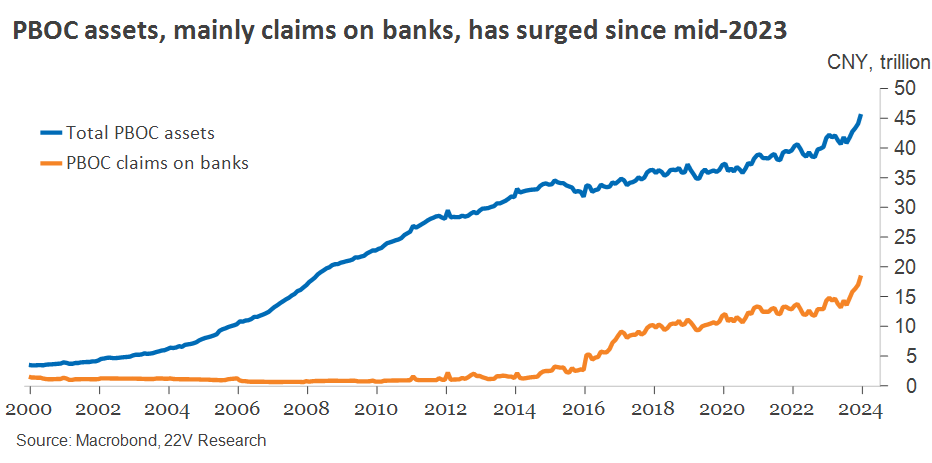
Growth in PBOC assets reflects the rollover of local government debt
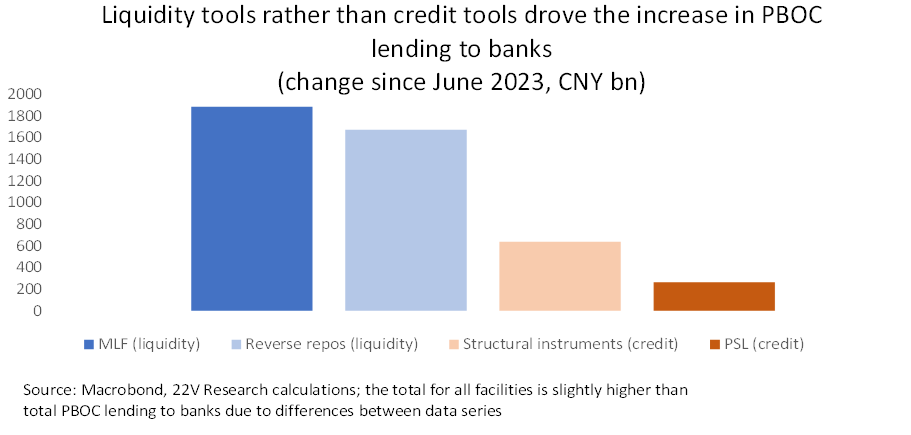
Looking at the specific facilities that PBOC is employing sheds light on what is really driving the growth in its claims on commercial banks. A little less than half of the increase in lending since June 2023 has come through the medium-term lending facility (MLF), which allows large banks to borrow from the PBOC for 3- to 12-months. Much of the remaining increase came from PBOC’s short-term reverse repo operations. In short, this is not so much “QE” as it is a large infusion of liquidity to banks.
Why did these liquidity infusions increase starting in mid-2023? First and foremost, China launched another round of refinancing the debts of local governments and their affiliated enterprises (“local government financing vehicles”). As the chart below shows, the surge in MLF issuance – and indeed the increase in PBOC assets in general – has coincided with issuance of refinancing bonds by local governments. China’s banks hold the majority of government and LGFV bonds (in addition to their lending to LGFVs directly), and thus require significant liquidity to absorb this issuance.

A second factor that contributed to increased borrowing from PBOC in recent quarters was the central bank’s reluctance to cut banks’ required reserve ratios (RRRs). PBOC made small cuts (25 basis points) to reserve requirements in March and September but held back on larger cuts due to concerns over adding to pressure on the exchange rate to depreciate. PBOC expanded MLF financing as a substitute for RRR cuts, but it came with a downside: MLF borrowing is relatively expensive for banks, further narrowing what were already tight bank net interest margins.
PBOC’s surprise 50 basis point cut to RRRs, announced on January 24 (see our write-up HERE), was meant as a show of support to markets but also reflected a need to release more cash directly to banks to reduce their reliance on the MLF and thus lower their funding costs. To the extent that expected Fed easing provides and broader global conditions provide scope for additional RRR cuts in coming quarters, the need for banks to tap the MLF should decrease.
The bottom line is that most of the recent expansion in PBOC’s balance sheet has been “defensive” rather than “offensive” in nature, reflecting not so much an aggressive push to boost growth but instead the need to: (1) rollover maturing local debt to avoid systemic financial risks; and (2) supplement banking system liquidity without adding to pressure on the exchange rate.
Where it gets more interesting: PSL and “structural instruments”
If the headline growth in the balance sheet is less exciting than it seems, there are some aspects of PBOC’s toolkit that bear more directly on the stimulus outlook. Around 15% of the recent increase in lending to banks came from tools geared towards directly boosting real activity and not just banking system liquidity: (1) the pledged supplementary lending (PSL) facility; and (2) PBOC’s “structural instruments.” Both areas are set for further expansion this year.
The PSL is back but unlikely to provide a major boost to housing demand
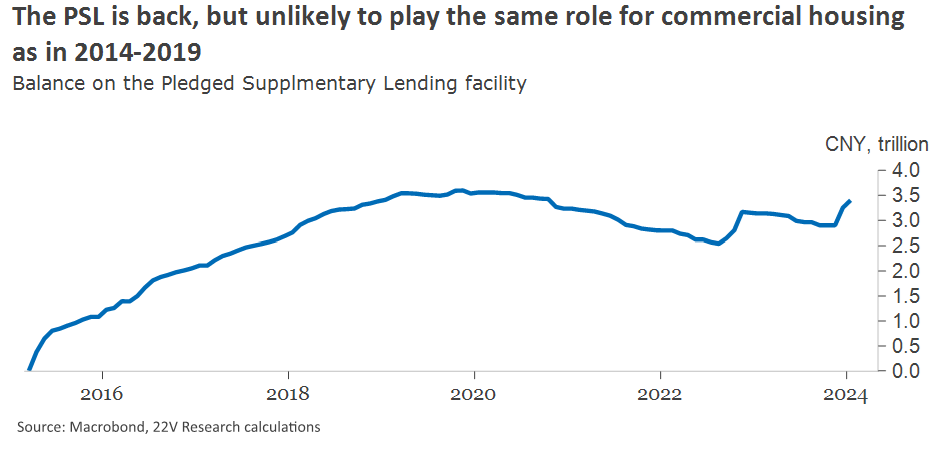
The PBOC uses the PSL facility to lend to China’s three policy banks in support of what are essentially fiscal stimulus initiatives. In 2014-2019, the PSL was the main source of financing for local governments to implement the “shantytown redevelopment” program, which helped fuel the last boom in the property sector. In late 2022 it was used at a smaller scale to complete stalled housing projects and fund infrastructure stimulus.
In December 2023, the PBOC reactivated the PSL and signaled that it will be a key source of support for what Beijing calls the “three major projects” – urban village redevelopment, affordable housing, and emergency municipal infrastructure. The PSL balance increased by CNY 350 billion in December (the third largest monthly increase on record) and another CNY 150 billion in January. PBOC hasn’t yet revealed its specific plans for the PSL in terms of potential scale of issuance and how local governments can tap the facility.
One of the key questions is whether the PSL will be used to support the commercial housing market and not just affordable housing/urban renewal. It seems safe to conclude that in one key respect it will not: Beijing has signaled that the PSL will not provide cash to homebuyers to purchase new apartments, which was the fuel for a surge in home sales and prices during the last cycle.
A more incremental source of support would be if the PSL funds local government purchases of vacant commercial property for conversion to affordable housing. This would help absorb excess inventory in large cities, providing at least indirect support for housing prices and market fundamentals. But it still isn’t clear whether Beijing will endorse this approach at scale or instead encourage local governments to build new affordable housing, which could even end up hurting commercial housing demand through expanding supply. The balance between these two approaches will become clearer as more local governments implement their “major project” proposals.
For now, we assume that the PSL’s main role will be to fund affordable housing and related initiatives, which is positive for construction activity and will offset some of the continued contraction in housing investment this year. The PSL will have a smaller role (and potentially very small role) in supporting the commercial housing sales and prices, whose weakness will continue to be a key macro risk through channels such as weak local government land sales revenues and depressed household consumption.
“Structural instruments” can’t drive credit growth alone
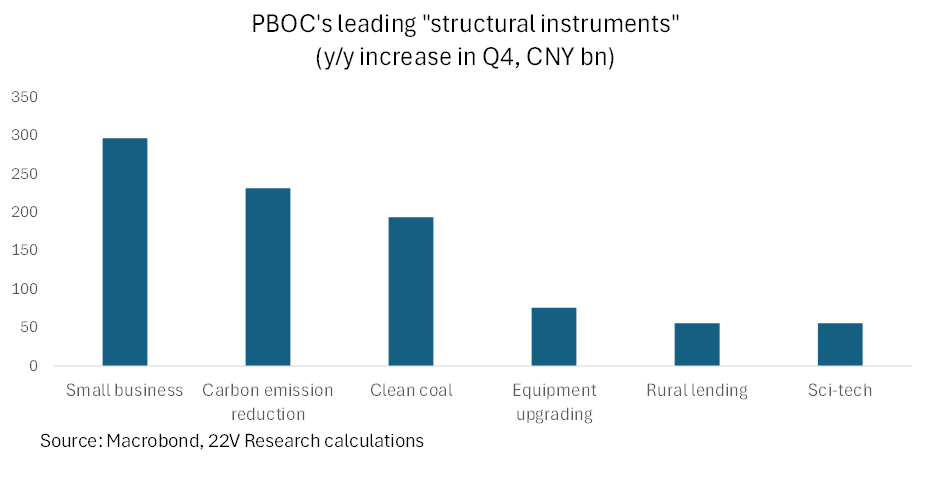
Another key component of the PBOC’s toolkit are the “structural instruments,” which subsidize lending for specific sectors and uses such as green growth. The balance of structural instruments is just 3% of China’s overall loans outstanding, but PBOC has greatly expanded their use since the start of the pandemic and is now doubling down: at the January 24 press conference that elaborated PBOC’s support for the recovery, PBOC governor Pan Gongsheng announced the establishment of a “credit market department” that will focus on promoting financing to high-tech and other sectors. Targeted lending is here to stay.
For China’s leadership, such tools are attractive for advancing strategic priorities such as innovation. For the PBOC, they represent the lesser of two evils: targeting credit to specific sectors is a step back from market-based allocation of credit, but in some cases preferable to broad-based easing measures such as rate cuts. PBOC fears that given political distortions in China’s financial system, broad easing can end up fueling asset price speculation and over-investment without delivering much for real growth – particularly in a climate where private sector demand for credit is low.
The chart below shows that lending for small business and clean tech/emissions reduction led the expansion of structural instruments in the last year. One area that notably did not see a major expansion was the facility to encourage lending to the property sector for the completion of stalled housing projects. Commercial banks have barely taken up use of this facility, due mainly to their concerns over suffering losses on loans to developers. This highlights an important broader point: the key stumbling block to reviving financing to the property sector is the central government’s refusal thus far to bear the potential losses for creditors. Until/unless there is a robust fiscal backstop that provides such guarantees, and/or improves the solvency of private developers, banks and other creditors will remain risk averse.
The PBOC’s expanded use of structural instruments comes at a time when the central bank is under growing pressure to boost growth and repair market confidence. The PBOC has struck a dovish tone of late and has signaled that it will do more to address deflationary risks by targeting not only real GDP growth (likely in a range of 4.5-5%) but also a higher rate of nominal growth. This, in turn, will require accelerating credit growth, of which structural instruments can only play a modest rule due to the following constraints:
- The small scale of structural instruments relative to China’s overall lending
- The risk of exacerbating excess capacity in clean tech (EVs, batteries, solar) and other high-tech sectors favored by Beijing
- The fact that real borrowing rates remain high by historical standards, which is acting as a constraint on private sector demand for credit – that is, rate cuts are also key for boosting credit demand
- The continued decline in property prices, which directly or indirectly collateralize a large portion of loans in China
Boosting credit growth and broader domestic demand in China will require forceful efforts across a range of policy fronts, including monetary, property, and fiscal policies. We will be watching for signs of stepped up policy efforts in all of these areas in the run-up to the start of the National People’s Congress on March 5. Policy signals continue to point to an incremental approach by Beijing, a key reason we remain cautious (link HERE) about the strength of the economic recovery this year.

