SUMMARY
- The debate over excess capacity in China reflects a broader macro trend: the divergence between strong growth on the supply side of China’s economy and anemic growth in domestic demand since the pandemic.
- The divergence helps explain the controversial surge in China’s manufacturing trade surplus, as well as deflation and poor equity market performance within China.
- Despite rising trade tensions and growing domestic concerns over the supply/demand imbalance, Beijing will make only incremental adjustments to its macroeconomic strategy this year; China’s manufacturing strength serves Xi Jinping’s geopolitical priorities, and there is little appetite for the deep structural reforms necessary to address lop-sided growth.
- Implications for global markets include:
- Low probability of a major inflationary impulse from China this year
- Limits on the recovery in the earnings of Chinese companies
- Continued dependence of global supply chains on China
- A mixed blessing for US equities, with some firms benefiting from the positive supply shock from China and others at risk of increased competition and excess capacity, even in the tech sector
On Monday, US Treasury Secretary Janet Yellen concluded a five-day trip to China that focused heavily on US concerns with “excess capacity” and surging exports in China’s manufacturing sector – particularly in clean tech (electric vehicles, solar panels). It is the latest sign of how China’s manufacturing-first strategy is not just an industrial policy but also a global macro issue, which some are calling the next “China shock” (see WSJ article HERE, and econ blogger Noah Smith HERE). In this report we look at the key dynamics, the outlook, and what it means for markets.
BROADER THAN EXCESS CAPACITY
In the trade debate over China’s manufacturing boom, the issue is often framed as one of excess capacity within China. China’s capacity utilization in manufacturing fell to a low in 2023 not seen since 2016-2017. Sectors with the lowest capacity utilization fall into two main groups:
- Emerging and strategically important industries (particularly clean tech) in which the government has encouraged high rates of investment that have outpaced current levels of demand. There is an argument that overcapacity in these sectors is a temporary problem and that demand will catch up, though this is cold comfort to trading partners looking to nurture strategic sectors such as electric vehicles and solar energy.
- Industries linked to China’s real estate sector, such as cement, glass and steel. Here the issue is not so much that investment rates have been abnormally high, but rather that they have not adjusted to the structural decline in demand due to the fall in property investment.
But a strict focus on “excess capacity” is limiting as a frame, as Brad Setser of the Council on Foreign Relations has pointed out (good Twitter thread HERE). There is no precise definition of excess capacity and one can argue over whether China’s production capacity should be measured against domestic or global demand. The enormous scale of China’s manufacturing sector means that even for sectors in which China is mostly producing for its domestic market, it isn’t hard for an imbalance between production and demand in China to lead to swings in exports that dislocate global markets.
More importantly, excess capacity is just one manifestation of a key macro trend: the divergence since the pandemic between strong growth on the supply side of China’s economy (production and investment) and anemic growth on the demand side (particularly household consumption). The same trend helps account for:
- Deflation within China, with nominal growth in 2023 (4.6%) falling behind real GDP growth (5.2%) for the first time since the global financial crisis in 2009.
- China’s weak equity market performance since 2022, as deflation and weak domestic demand hurt nominal revenue and profit growth.
- A surge in China’s manufacturing trade surplus to a new peak close to 2% of GDP (chart from Setser below).
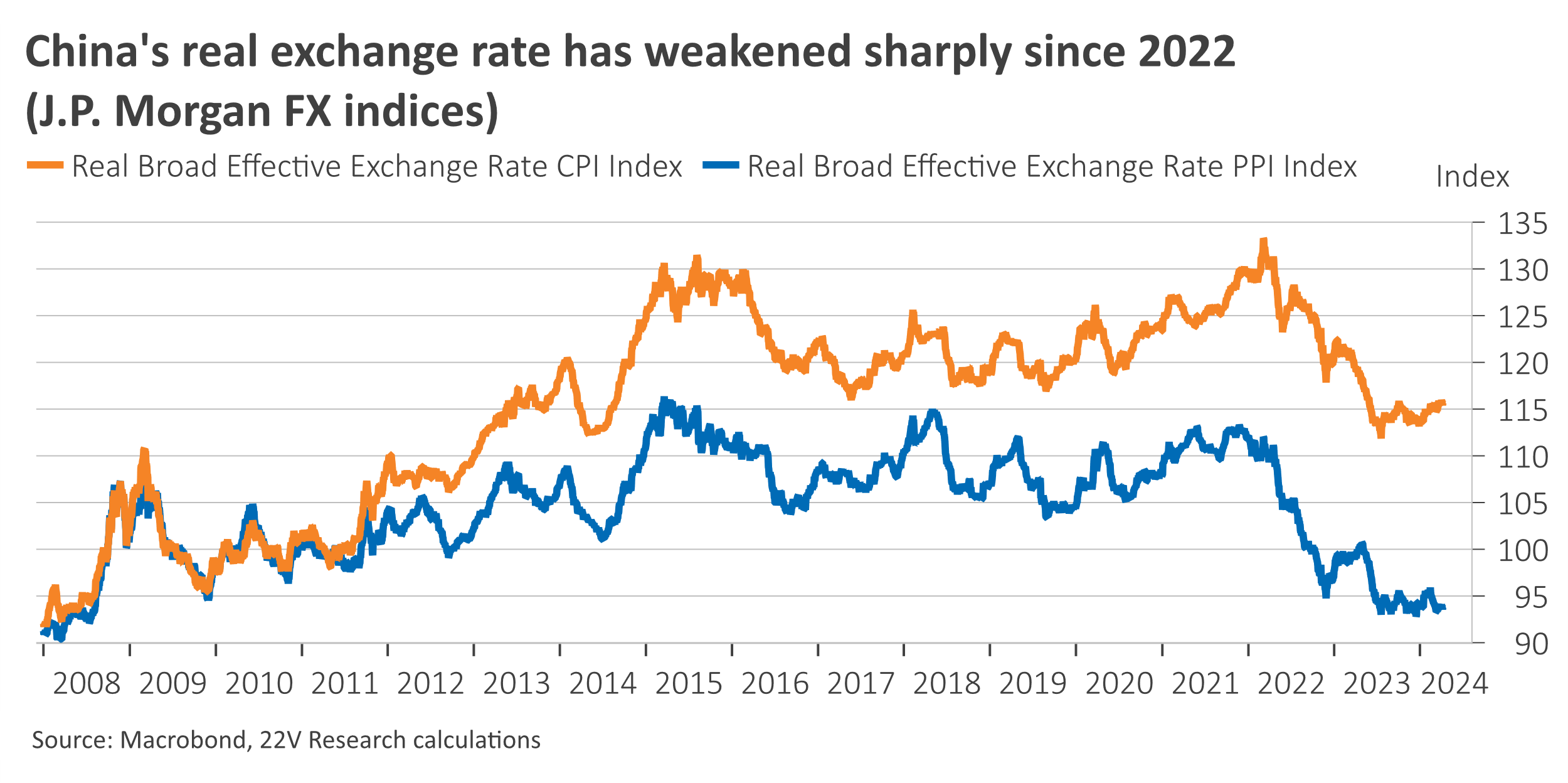
- A deflationary impulse from China to the rest of the world, particularly since late 2022. The combination of industrial deflation and modest exchange rate depreciation has made China’s real effective exchange rate (measured with PPI) the cheapest it has been since 2009 during the Global Financial Crisis.
The chart below shows the dynamics through China’s data: since the pandemic, manufacturing investment has accelerated while production and exports have slowed marginally. The most dramatic shift has been the slow growth of consumption (shown here as retail sales of goods) and imports. The result is a deflationary environment at home and expansion in China’s trade surplus in manufacturing.

As Yellen’s trip, EU investigations into China’s EV and solar sectors, and rising anti-dumping investigations even from Brazil and Turkey all show, the surge in net exports is running into limits of political tolerance. There are growing concerns within China. Prominent economists at Peking University (Huang Yiping and Lu Feng) have publicly warned that the surge in net exports – particularly coming in strategically important sectors – will escalate trade and geopolitical tensions and pose risks for Chinese industry. China’s leadership acknowledged excess capacity as a problem late last year, and even Xi Jinping cautioned local officials against excessive investment in hot new sectors at the March National People’s Congress (see our write up HERE). However, geopolitical tensions as well as politics and structural dynamics within China make it unlikely the underlying trends will shift soon.
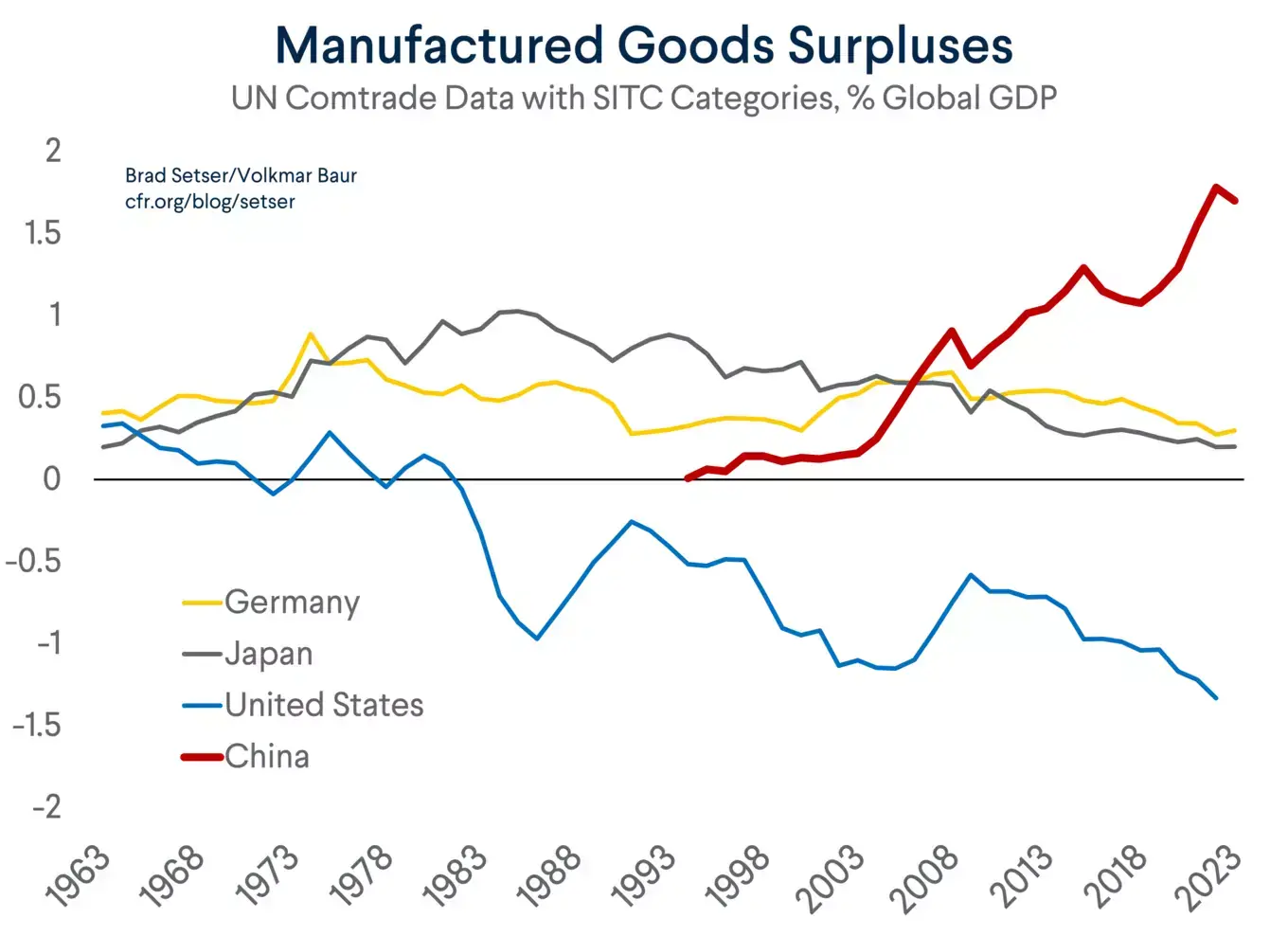
Source: Brad Setser, Council on Foreign Relations (link HERE)
MIND THE GAP
What has caused the supply and demand sides of the economy to diverge so starkly?
- Pandemic effects. China’s supply chains kept operating smoothly during the pandemic (with the exception of Shanghai’s lockdown), allowing China’s export sector to grab further market share when global demand for goods boomed. At the same time, zero-Covid policies had a scarring effect on the domestic service sector and on household income that has continued to depress Chinese consumption.
- The real estate slowdown, which has reduced construction and fixed asset investment and had broad ripple effects to government and household spending.
- Xi’s all-out push on advanced manufacturing. Xi’s focus on advanced manufacturing as the cornerstone of China’s economic and geopolitical strategy has progressively ramped up since 2020 – the latest mantra to invoke this is his call for “new quality productive forces.” The policy preference for manufacturing has translated to a surge in credit and fiscal resources to the sector, as Beijing and especially local governments turned to the sector to replace activity lost in the real estate downturn. Xi’s top-level directive has super-charged the local-level dynamics in China’s political economy that often lead to cycles of over-investment: the desires of local government officials to boost growth; “soft budget constraints” of state-owned enterprises, which can invest in political priorities without pressures of financial discipline; and political control over the banking system, which has been extended credit in records numbers to the manufacturing sector since 2022.
- Underlying structural imbalances. The latest “China shock” has revived long-standing debates over the relatively low share of consumption and high rates of saving and investment in China’s economy. In recent years, savings in the household and corporate sectors have stayed high, while investment has declined due to the real estate downturn and debt burdens of local governments. Unless manufacturing investment becomes large enough to fill that whole – and it won’t anytime soon – than China’s savings must be absorbed by a larger trade deficit. As Martin Wolf notes in the FT (link HERE), China is becoming too large a share of the global economy for that to be sustainable. The solution is to raise consumption and reduce household and corporate savings. This would entail deep reform efforts, including shifting fiscal resources from the state sector to the household sector directly or indirectly (such as expanded spending on social programs). Xi and his leadership team are not showing great urgency to push through these initiatives; the approach instead is to grit through the real estate downturn and wait for manufacturing investment to be large enough to fill the gap and carry growth. The domestic and international pressure on Beijing will likely need to become more acute before the leadership fundamentally shifts its calculus.
BEIJING WILL STAY HIGH ON ITS OWN SUPPLY
As discussed above, the supply-demand imbalance is partly cyclical, partly structural, and very political – in particular, Beijing’s decision to focus on supporting advanced manufacturing as an economic and geopolitical priority, rather than devoting resources to boosting consumption, promoting growth in the labor-intensive service sector economy (another key to consumption), or rescuing real estate.
Despite growing international and domestic concerns, China’s supply side strength is working well enough for Xi – at least for now. China’s manufacturing sector has become ever more central to global supply chains, increasing the rest of the world’s reliance on China while reducing China’s reliance on others, especially the US (see charts below from Richard Baldwin of VoxEU). China dominates clean tech supply chains and is Xi is determined to extend China’s manufacturing strength to areas such as commercial aircraft and semiconductors.
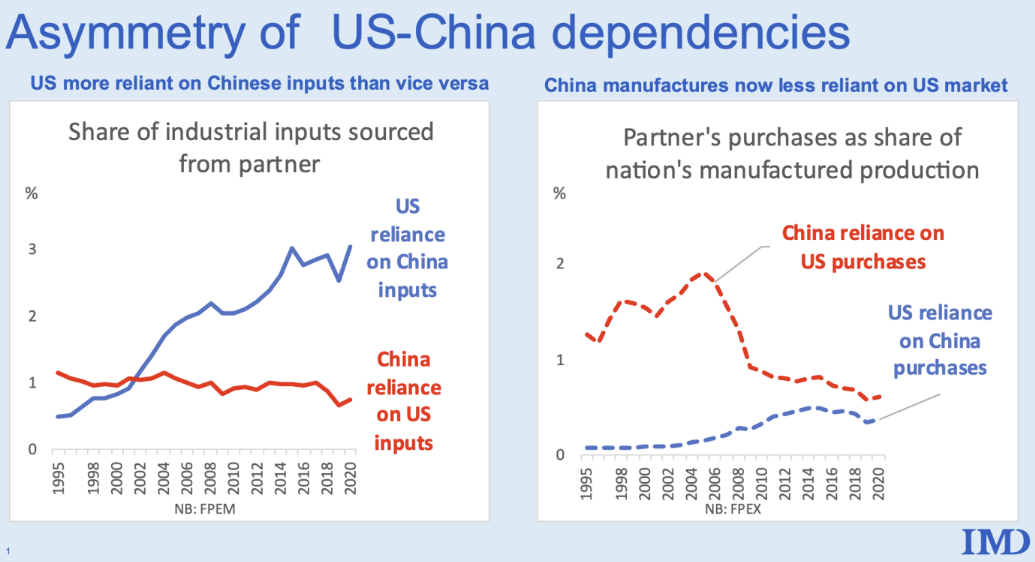
Source: Richard Baldwin, VoxEU (link HERE)
Political and economic conditions are tolerable. Economic activity in the first quarter, even if fueled by the production side (see our write up on the March PMI HERE), will likely be enough to put Q1 GDP in the range of 5% that is Beijing’s target for the full year. Trade partners are threatening action but Beijing is relying on its economic leverage to dissuade aggressive actions; in the EU, for example, German automakers’ fears of losing access to China’s market will likely forestall major tariffs (see the analysis from 22V’s Jacob Kierkegaard HERE). Tensions with the US are a concern but Beijing will wait to see the outcome of the US presidential election before making major policy commitments.
Rather than make major moves, Beijing will likely “muddle through” 2024 with the following approach:
- Investment-driven measures to boost domestic demand (while still augmenting supply). The main initiative in this respect is Beijing’s upgrade program for industrial equipment and consumer items (EVs, high efficiency appliances). The consumer products portion of this initiative is underwhelming given the lack of new budget resources, but the industrial portion will likely have more legs as companies will respond to Beijing’s call to upgrade and PBOC and banks will provide funding. The irony of the upgrade plan is that while it will temporarily boost demand for some industrial goods, it will then further boost supply through enhanced production capacity. China’s fiscal stimulus this year is also focused on manufacturing capacity, with a growing share of local government issuance shifting from traditional infrastructure to industrial parks and other manufacturing initiatives. As we have previously noted, what is framed as demand-side stimulus in China is often just as much about the supply side.
- Sectoral measures to reduce capacity in areas where excess capacity is most egregious. This is likely to include cuts to weed out the most inefficient players in sectors like EVs. However, supply cuts are unlikely to be highly aggressive, and local governments will leverage Xi’s priority initiatives to keep funds flowing to local firms: Bloomberg News cites the recent example of several defunct EV companies that have managed to restart production citing Xi’s push for “new quality productive forces.”
- Trade dialogue to forestall action from trading partners. Secretary Yellen announced during her visit that the US and China will discuss excess capacity and related issues in their existing economic working group. Beijing’s approach will be to acknowledge some of trading partners’ concerns with overcapacity but mostly defend China’s export performance as representing China’s economic competitiveness. Chinese officials, and impacted firms, will also look to defray tensions by making more offers to move some production of goods like electric vehicles overseas. That will be welcomed in countries that view Chinese exports as hurting domestic labor, but much more difficult in the US (and to a lesser extent in Europe) given the focus on reducing dependencies on China.
Beijing is getting some help on overcapacity from the global economic cycle. The recent pickup in US manufacturing implies that strong growth in China’s exports in recent months may persist for a while. Combined with a modest cyclical recovery at home due to infrastructure spending, China’s overall capacity utilization may improve in 2024 – reducing the level of alarm over excess capacity and the urgency by Beijing to address the underlying issues.
But it is unlikely that the muddle-through approach will be economically or politically sustainable. Martin Wolf is right that China is too large now to bank on the rest of the world accepting further increases in manufacturing trade deficits with China. Domestically, the current economic situation is tolerable for Beijing but there is a real risk that the cyclical recovery will run out of steam after the modest stimulus announced at the NPC fades by mid-year. We expect economic conditions to remain weak until domestic demand stages a stronger recovery. That would likely require Beijing to shift its economic strategy towards direct support for household income and consumption, and to take more aggressive actions to restructure the debt of property developers – neither of which is evident. While we do think Beijing will ultimately need to shift its macroeconomic strategy, it is unlikely to happen this year – and will be gradual when it comes.
MARKET AND MACRO IMPLICATIONS
The imbalance between the supply and demand side of China’s economy, and the factors behind it, have several implications for markets, some of which extend to the long term.
- Tariffs: US-China trade tensions over Chinese excess capacity will persist, though tariff moves in 2024 will likely be modest. The controversy over excess capacity and China’s manufacturing surplus makes it even less likely that the Biden administration will lower tariffs on some imports from China, even if those would involve consumer items. Indeed, there is a possibility of increased US tariffs on imports from China in areas such as electric vehicles and solar, but we would expect any such moves to be modest in scale ahead of the US election. Major shifts in US tariff policy would more likely come in 2025, as the Biden administration balances the US-China relationship against industrial policy goals, or a new Trump administration goes on the offensive.
- Global supply chains: dependence on China is only growing. 22V’s Washington Policy team has been among the voices pushing back on a narrative of “decoupling” and “deglobalization” and China’s further ascent to manufacturing dominance reaffirms the wisdom of that call. While a portion of direct US imports are shifting from China to places like Vietnam and Mexico – often just for final assembly – US, European and global dependence on supply chains from China is only growing. Beijing’s strength in manufacturing, and determination to maintain this central role, will make dependencies exceedingly difficult to reduce. One long-term implication of this reality is that supply shocks from China – whether from natural disaster, moves by Beijing to restrict exports, or a geopolitical event such as conflict over Taiwan – will ripple through to the global economy and prices with more force than ever.
- Global inflation and commodity prices: a strong inflationary impulse from China remains unlikely in 2024. Our analytic bias is to assume that with supply continuing to outpace demand, China will continue to experience at least modest deflationary pressures – if less acute than last year due to an uptick in cyclical activity as well as base effects. On the other hand, we noted last week that the NY Federal Reserve has a new study out that examines a scenario in which Beijing’s credit-fueled for support for industry is intense enough to create a “sugar high” of 6% GDP growth in 2024 and 2025 (link HERE). The NY Fed authors project that this scenario would put “meaningful upwards pressure” on US inflation through the channels of commodity prices and intermediate goods prices. While that is a useful counterpoint to assumptions of deflation, we find it unlikely that Beijing will be aggressive or successful enough to engineer a manufacturing-led recovery of that strength this year or next, especially given ongoing headwinds from property. In short, Beijing’s muddle-through on excess capacity means that deflation is unlikely to deepen this year, but neither will there be sufficient demand to generate major inflationary pressures.
- Chinese equities: Over-investment will remain a challenge for earnings growth, even over the long term. China’s stimulus and cyclical recovery led industrial profits to move back into positive territory in Jan/Feb although from a low base. However, the overall improvement in corporate earnings in China is likely to be modest given subdued end-demand and the fact that deflationary pressures are likely to exist in many sectors. In a forthcoming companion piece to this report, we point out that China’s poor equity performance over the last 15+ years is the flip side of China’s strength in manufacturing: the common thread is a pattern of over-investment by Chinese companies that yields low returns for owners/shareholders in exchange for gains in scale and global market share. The causes of over-investment are embedded in China’s political economy (including the large role played by state-owned enterprises), which means that we expect this overall pattern to persist. To be clear, this is a macro-level observation that pertains mainly to China’s onshore markets; there are and will be many Chinese companies that do invest efficiently – especially those listed overseas – and can be selected through a bottom-up process.
- US/G7 equities: The impact of the next “China shock” will be…complicated. Noah Smith’s characterization of Xi’s manufacturing push as the “next China shock” (link again HERE) is somewhat hyperbolic but makes a good point: the US, EU, and other developed economies need to adjust to a new reality in which Chinese competition – and Chinese excess capacity – increasingly impacts leading edge sectors such as tech, rather than traditional sectors of concern such as steel and basic manufacturing. Indeed, there are growing concerns of overcapacity in production of mature semiconductors, though our sense is that the evidence here is mixed. The counterpoint to a negative China shock is the important observation made by Karthik Sankaran (link to his Substack discussion HERE), who notes that the positive supply shock generated by China-centered globalization has been a major windfall for the earnings and valuations of many US corporates, especially tech. Whether the next China shock will be more positive or negative thus gets complicated. Consider the examples of Tesla and Apple, which show both sets of dynamics at work. Production in China has been a huge boon for Tesla, but it now faces growing competition from Chinese firms and a price war (stoked by oversupply) within the Chinese market. Apple is another case, with production in China critical to the iPhone’s success but now subject to rising competition and subdued demand in China’s market. It is hard (for us at least) to make a macro call here – the balance will vary by country, sector and company.
- China’s currency: Beijing will not use nominal CNY depreciation to boost exports. The PBOC faces a difficult balancing act between easing domestic monetary policy to boost growth and managing pressures on the CNY. While PBOC will tolerate gradual depreciation if driven by market forces, we are very skeptical that Chinese authorities will deliberately weaken the currency to boost export growth – a narrative that sometimes emerges in the markets. China’s real exchange rate (deflated by PPI) is weaker than it has been since 2009; the real exchange rate deflated by CPI is at its weakest level since 2014 (see chart below). Not only does China not need to weaken the nominal exchange rate for trade competitiveness, but such a move would further intensify trade tensions over China’s large manufacturing surplus.