

I The ECB as widely expected kept all interest rates on hold this week, while the Governing Council maintained their “data-dependent approach” going forward. President Lagarde then at the press conference stated that the Governing Council “would know a lot more in June”, rhetorically more or less committing the ECB to cut rates by then, unless unforeseen economic events occur. This is fully in line with what earlier notes have discussed and expected.
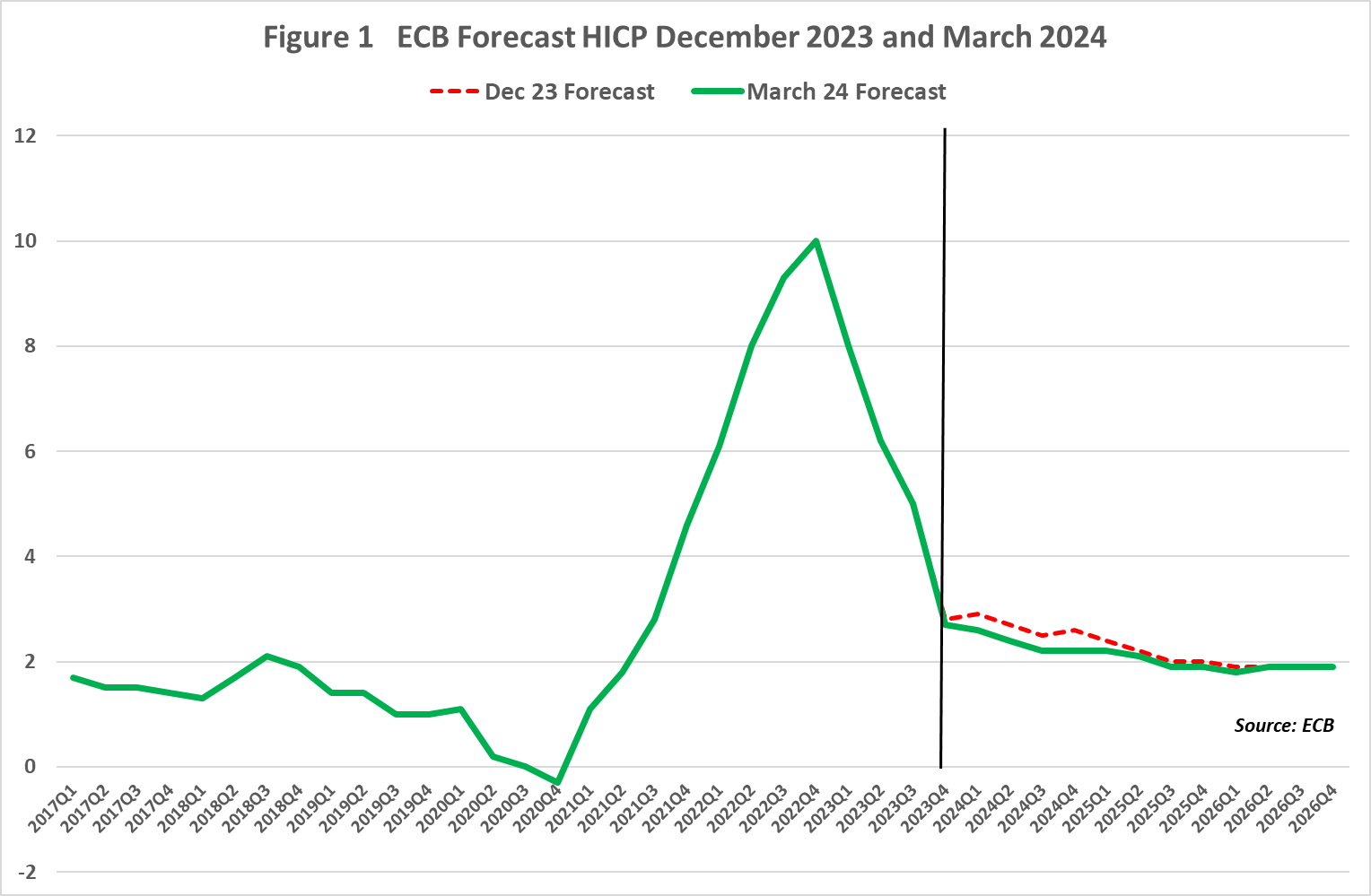
The ECB’s March 2024 forecast revised down GDP growth to 0.6 percent in 2024 in line with earlier discussion here, while HICP levels are now forecast to fall steadily throughout 2024 and reach 2 percent in mid-2025 (figure 1). The earlier upward 2024 bump from the assumed phasing out of energy price support measures has now been superseded by declining energy prices. This is good – if long overdue – news and certainly gives the Governing Council the forecast foundation to cut rates in June. Nominal wage growth data for Q1 2024 will be released in Apr/May, likely providing the Governing Council with the (excessively) high degree of certainty in moderating wage growth data it politically feels is required to cut rates.
While the ECB’s March forecast belatedly makes up for prior excessive growth optimism, it nonetheless holds several striking features. As discussed in earlier notes, the EU27 is after the pandemic and energy price shock rapidly returning to earlier periods of high current account surpluses. The same is true for the euro area, which in 2023 recorded a surplus of 1.8 percent of GDP, or EUR260bn. The ECB has now revised their estimate for the euro area current account surplus in 2024 up by more than 2 percentage points of GDP to 3.2 percent of GDP, or about EUR450bn, and expects it to stay at that range until at least 2026. This implies a sustained and sizable savings surplus in the euro area, implying – given only gradually declining government deficits, gradually rising employment and only modestly recovering GDP growth rates over this period – that investment levels in the euro area will remain subdued. This implicitly acknowledges the (very) dampening effect of the ECB’s tight monetary policy on the private sector’s investment decisions in the euro area. It may not have caused unemployment to rise to bring inflation under control, but euro area investment levels appear to continuously suffer. This in turn points to continued weak productivity growth in the euro area and ultimately the need to cut rates further to restore “animal spirits” among private investors and businesses. A 2 percent euro area policy rate at the end of the rate cutting cycle should now be the base case. Lastly, it is clear that external imbalances of this magnitude are not likely to go unnoticed among the euro area’s main trading partners, especially the United States. Neither Joe Biden nor especially Donald Trump will likely remain silent in the coming years.
II The European Commission is moving closer to a decision in its investigation into government subsidies given to Chinese EV exporters to the EU market. Bloomberg has reported that the Commission has found “sufficient evidence” that Chinese EVs imported to the EU received direct and indirect subsidies, tax breaks or other public goods and services below market prices. A final decision is expected between July and November this year. However, one should be wary at assuming even a decision to levy an EU anti-subsidy countervailing tariff on Chinese EVs will automatically lead to a major trade war between the two economies. First of all, EVs is a product that is currently dropping precipitously in price – EVs share that characteristic with IT hardware and batteries keep getting cheaper – with the latest BYD Seagull now starting at below $10,000. Given that the EU has in previous anti-subsidy cases concerning E-bikes and fiber-optic cables imposed levies of 4-17 percent, it is not clear that a levy at the low-end of that spectrum would bother Chinese exporters much. Correspondingly, in such a scenario apart from probably a performative retaliatory action against an EU product probably from France, the EU member pushing most vocally for the Commission intervention, it is not obvious that China would do much. And Beijing has already initiated its own investigation into EU (but overwhelmingly French) brandy exports to China, a market segment of just $1-2bn a year and much smaller than Chinese EV exports to the EU today.
Further worth noting here that there are powerful economic incentives placed before the Commission to possibly adopt a very low – perhaps intentionally irrelevantly low – anti-subsidy tariff on Chinese EVs. Despite the growth of Chinese EV companies like BYD, VW, Daimler-Benz, BMW and Audi were (with BYD and Toyota) in the top-6 top-selling Chinese car brands in 2023. Yes, their cars are overwhelmingly made in China to be sold in China, so are in a balance-of-payment sense very different from Chinese EV exports to the EU, but this highlights the continuing importance of European car company revenues from the Chinese market – at risk of retaliation, if the EU imposes a material anti-subsidy on EV imports. EU EV subsidies would also negatively affect EV exports by companies like Tesla or VW, which makes EVs in China for sale in the EU. These Western car companies exporting from China are, in contrast to Chinese EV companies like BYD, owned largely by Western investors and continue to utilize a relatively high share of Western produced parts. Very high EV tariffs on cars from China would hence negatively affect also other EU firms and investors (including in VW’s case German state government investors). Particular Chinese firms found to have received particularly high government subsidies might be hit with a higher firm-specific tariff, but Western firms exporting from China would face an average of such tariffs levels faced by specific Chinese firms.
In sum, if the European Commission decides to levy an anti-subsidy tariff on Chinese EV imports, it is overwhelmingly likely to be at a low level and not launch a broader trade war between the two economies.
Jacob

