SUMMARY: If, as more than 70% of investors we polled expect, Powell tries to jawbone financial conditions tighter at Jackson Hole this week, more market volatility will be in store. Inflation expectations are anchored and underlying demand is still firm, that limits tail risk and is why we think the S&P 500 remains in a 3800-4200 range. That being said, underlying demand is still too firm, which is why the Fed will remain hawkish (continue to attempt to slow economic growth).
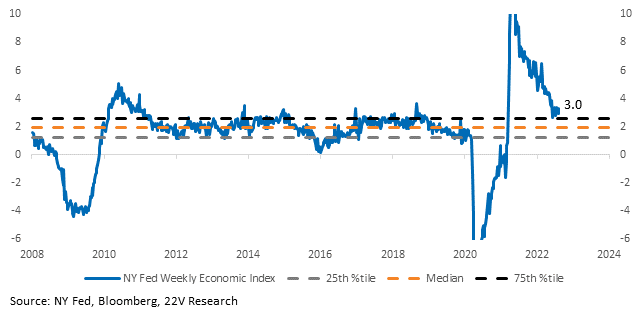
The NY Fed’s Weekly Economic Indicator (WEI), which attempts to pick up underlying demand (consumption/investment) is still running at 3%. That is above its 75th %tile post-GFC. The WEI needs to move down to ~1% for the Fed to have more confidence the labor market will loosen.
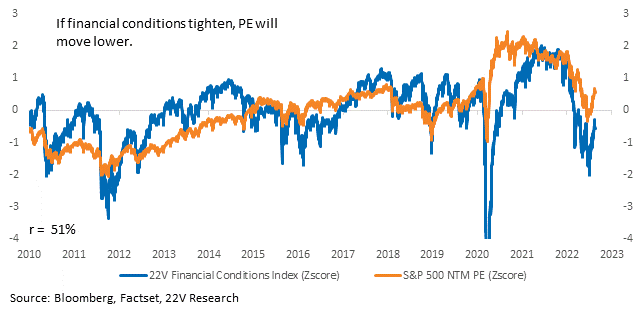
As of today, investors are still pricing in 65% odds of +75bps at the September meeting. Powell talks at Jackson Hole later this week and we are confident that 1) he still needs to be hawkish (needs growth to slow further) and 2) That he would rather not have financial conditions ease more. Financial conditions tightened some last week and PE came down. The Fed funds futures curve has shifted higher recently as investors internalize that financial conditions might have tighten aggressively given how far actual inflation is away from the Fed’s target.
Very short term, investors anticipating a hawkish Powell as European and China risk continue to rise could lead to a sharp de-risking before Powell 10AM ET Jackson Hole speech on Friday.
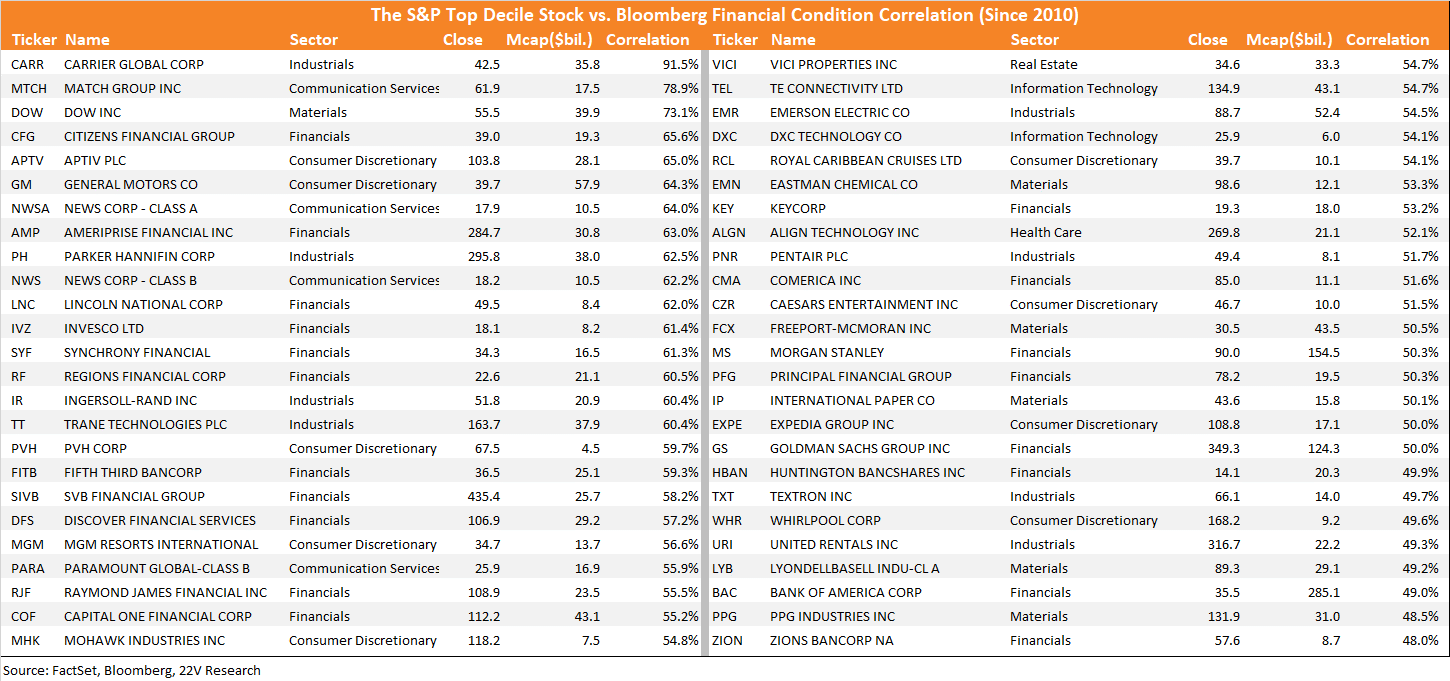
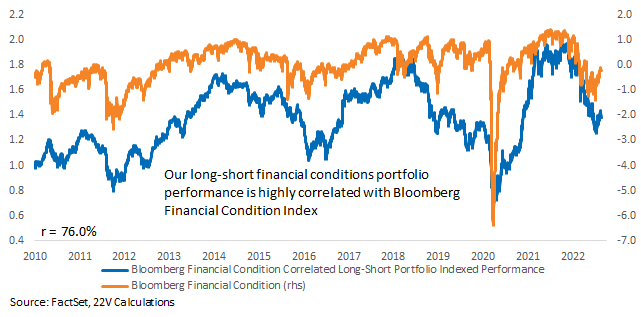
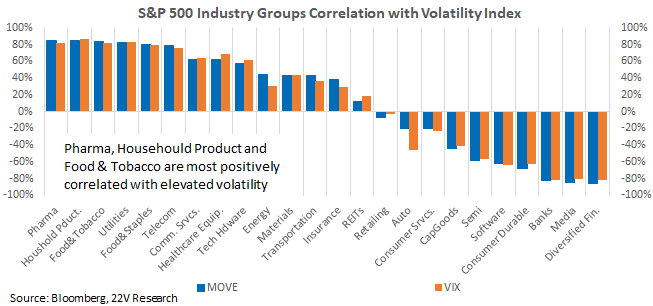
Tightening conditions should favor Low Volatility names at the expense of high Earnings Turbulence as the Quant team discussed last week (HERE). In a Quant report today (HERE) we looked at stock correlations with the Bloomberg Financial Condition Index and constructed a long-short portfolio that benefits from the expected tightening of financial conditions. The constituents of the portfolio can be found at the end of the report. Historically, the performance of the long-short portfolio is highly correlated with the financial condition changes. We also highlight the industry groups with the most positive and negative correlations to higher stock and bond volatility. Defensives have the most positive correlations (Pharma, Utes, Staples) and Software, Consumer Durables, Media Banks, and Diversified fins the most negative.

Full Report Below….
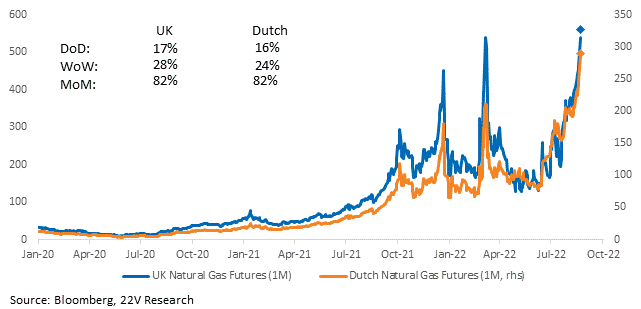
MARKET VIEWS: Nat gas prices are surging in Europe overnight as Russia is shutting down Nord Stream for maintenance for a few 3 days starting August 31st. Global bond yields seem to be getting pulled higher by European yields. Increasing energy prices in Europe comes along concerns over more ECB hikes. The outlook for Chinese economic growth continues to be a headwind as well. Taiwan export orders for July very weak (-1.9% vs +6.2% expected). A -22% decline in orders from China and Hong Kong was the main driver of the decline. China did cut the mortgage reference rate more than expected, so Chinese developer stocks bounced, but the European and China outlooks continue to be a headwind for risk assets.
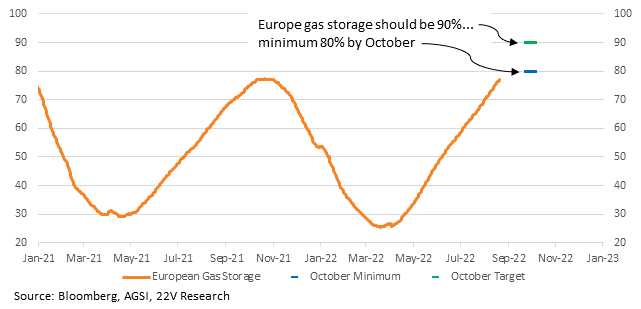
One of the reasons European CDS spreads are not significantly wider has to do with the increase in natural gas storage levels. They are already at 80%, but need to get to 90% or above before winter sets in. If natural gas storage levels get to 90% or above, Europe should be able to avoid shut-ins ins during the winter. Shut-ins would be terrible for the economy (factories shut down).
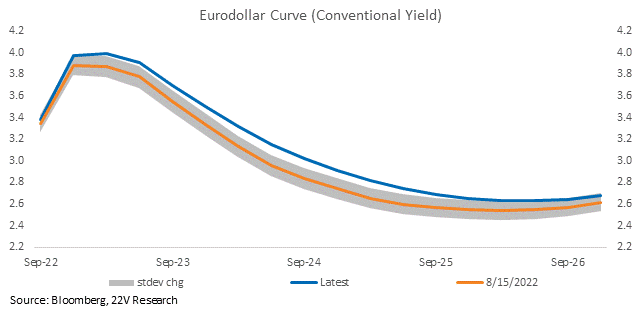
As of today, investors are still pricing in 65% odds of +75bps at the September meeting. Powell talks at Jackson Hole later this week and we are confident that 1) he still needs to be hawkish (needs growth to slow further) and 2) That he would rather not have financial conditions ease more. Financial conditions tightened some last week and PE came down.
The Fed funds futures curve has shifted higher recently as investors internalize that financial conditions might have ease to aggressively given how far actual inflation is away from the Fed’s target.
Keep in mind that the reason the Fed will remain hawkish has to do with strength in underlying demand. The NY Fed’s Weekly Economic Indicator (WEI), which attempts to pick up underlying demand (consumption/investment) is still running at 3%. That is above the 75%tile from the post GFC period forward. The WEI needs to move down to ~1% for the Fed to have more confidence the labor market will loosen.
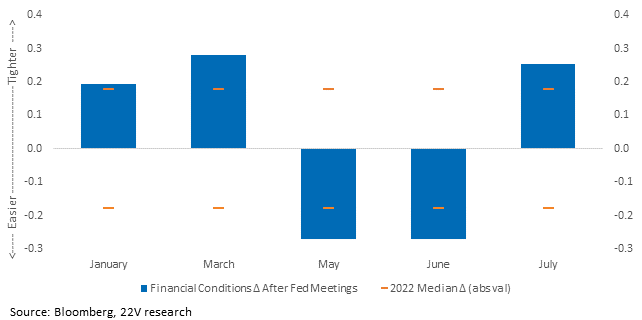
Changes in financial conditions – both easier and tighter – have been more intense the week after Fed meetings than during the rest of 2022. Jackson Hole isn’t a Fed meeting but has become an important event for updating monetary policy.
As financial conditions tighten Low Volatility names should benefit at the expense of high Earnings Turbulence names as discussed in a Quant report last week (HERE). In today’s Quant report (HERE) we ran stock correlations with the Bloomberg Financial Condition Index and constructed a long-short portfolio that benefits from the expected tightening of financial conditions. The constituents of the portfolio can be found at the end of the report.
Roughly in line with historical factor correlations with financial conditions, elevated bond and stock volatility is tailwind for Low Volatility and Momentum names, and a headwind for EPS Momentum and Earnings Turbulence. The leading industry groups positively correlated with volatility are Defensives, including Pharma, Household Product, and Food & Tobacco. Diversified Financials, Media, and Banks are more negatively correlated.
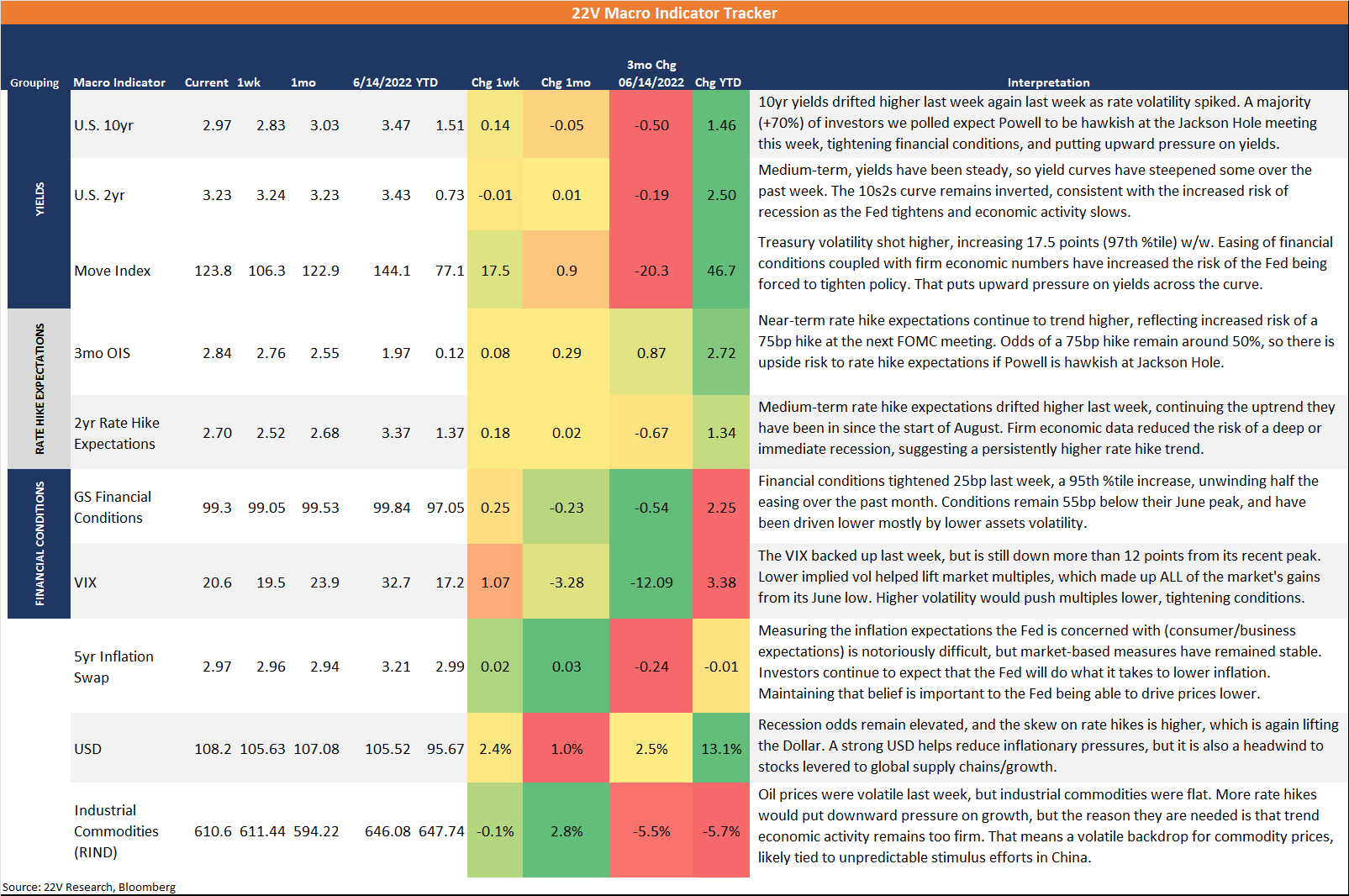
Macro Tracker: Asset volatility moved slightly higher last week, pushing multiples and the S&P lower and Treasury yields higher. 10yr yields have backed up steepening yield curves a little, but the 10s2s are still inverted, and the 10s3mos are at just 33bps. If, as more than 70% of investors we polled expect, Powell tries to jawbone financial conditions tighter at Jackson Hole this week, more flattening could be in store. For now, higher yields and increased medium-term rate hike expectations, coupled with stable inflation expectations, suggest firming real growth into 2023. Inflation expectations are hard to measure, but stability in market-based readings is important for the Fed. Inflation expectations remaining anchored creates a path toward gradually lower price levels, reducing the risk that a recession is needed to reduce inflation. FOMC members do not want to cause a recession but getting price levels under control remains priority number one.
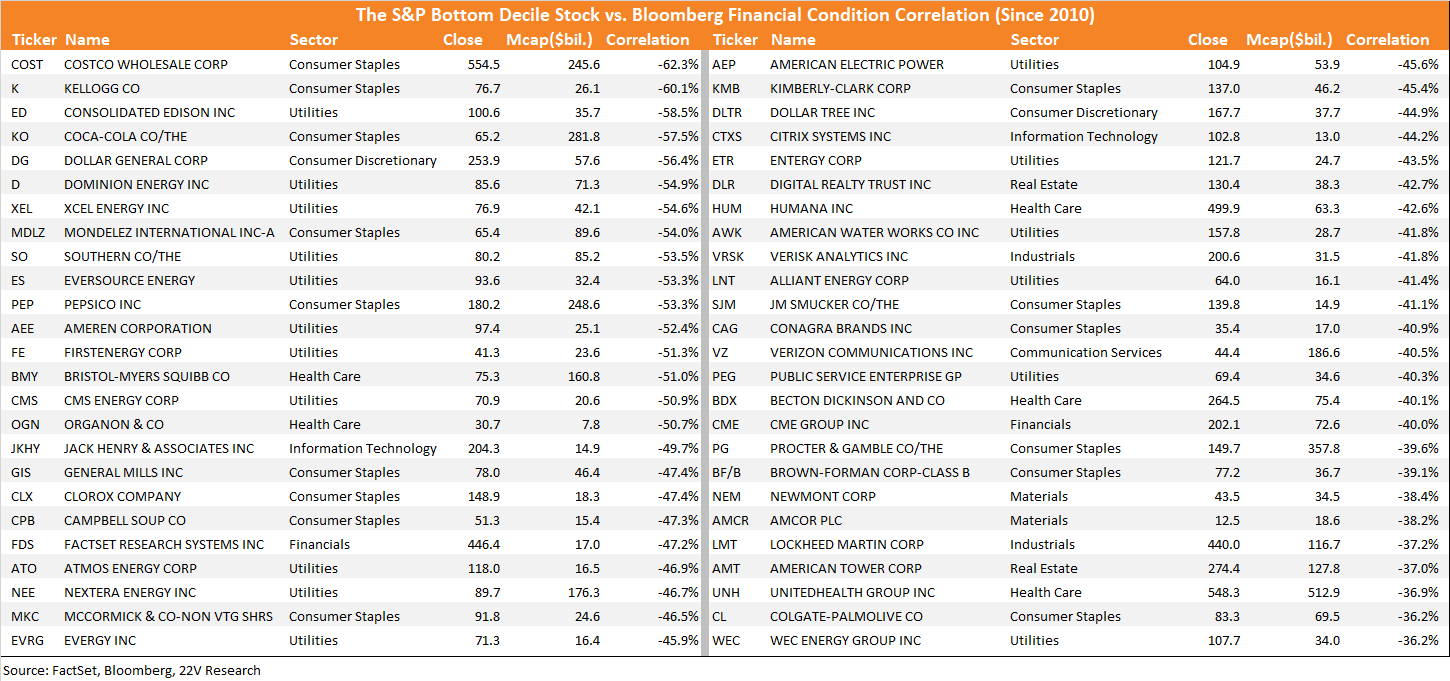
Below we list the S&P names that has the lowest correlation with Bloomberg Financial Condition Index. This is the long side of the tightening financial conditions portfolio and will benefit if the financial conditions tighten. We can also run stock correlations to customized basket. Please let us know if you want us to run your portfolio.
Below are the S&P names most positively correlated with Bloomberg Financial Condition Index and are the short side of the portfolio as financial conditions tightened.