Bottom Line: Takeaways from Investor Dinner
Just about everyone agrees economic growth is sustainably strong despite 10yr yields at 5.3%. The reason being that the surge in consumer net worth (driven by AI’s influence on asset prices) continues to support above 2% consumer spending and AI Capex continues to accelerate. Our strong economic growth call is consensus. If anything, we are a bit out consensus in calling for growth to slow some over the next 6-8 months. Investors at dinner were more skeptical than we are that the recent tightening of financial conditions would slow growth. Investors had 10yr at 5.1% by year-end and the S&P 500 above 8000.
Relevant News: Marine Le Pen Weighs in With Her “Fiscal Plan” For France
Marine Le Pen’s new fiscal plan is unlikely to reassure French bond investors because its assumptions are not credible: it targets roughly €140bn in annual consolidation by 2032 while assuming very little drag on growth and exempting pensions from cuts alongside proposed tax reductions. Her call for ECB intervention could also backfire by making support for French bonds appear politically motivated and raising the bar for ECB action. With markets likely to see through the plan’s “fiscal hawkishness,” French yields could move back higher, while Le Pen may also face greater political pressure as opponents challenge the credibility of her proposals.
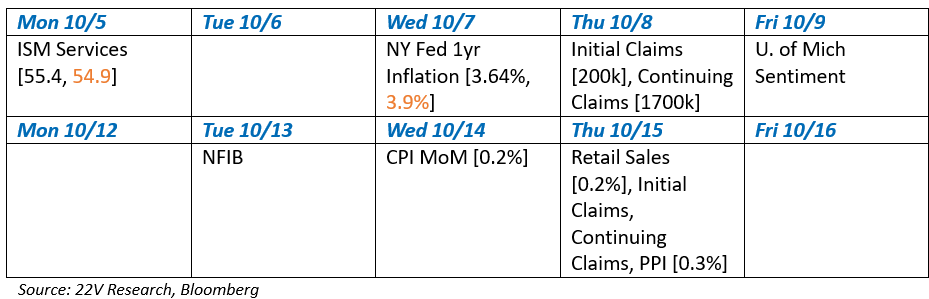
Things to Watch [Consensus, Results]:
Strategy:
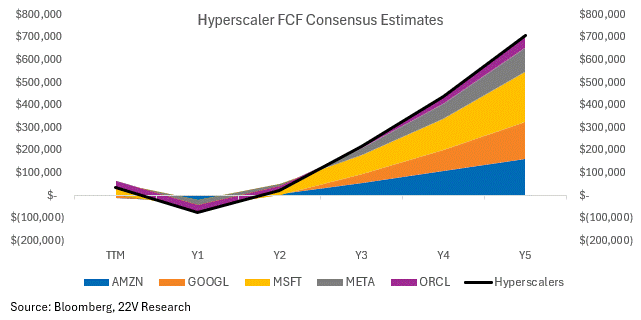
What Investors Think Is Required To Sustain The AI Buildout Baskets– (HERE)
That visibility to something near $1 trillion annualized in 2028–29 is critical. If the $1.4 trillion 2028 capex year is going to earn its cost of capital (apparently GS thinks a 15% ROIC is the minimum) rather than “just get financed”. The more financing that is required, vs some cash flow generated from a 15%+ ROIC from capex + financing, the more skeptical investors were on the ability for the financing to happen. 1-2 trillion in financing on disappointing ROIC investments (below 15%) in a backdrop of increasing interest rates would be an issue. Capex plans would disappoint.
Economics:
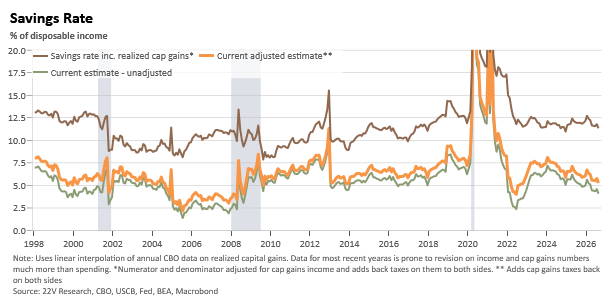
Don’t Worry About the Savings Rate– (HERE)
Seemingly almost every month, there are number of worried headlines around a low and/or declining savings rate and how that means that consumptions is likely to slow appreciably in the ambiguous future. Recent revisions have pulled the savings rate higher, from 2.8% to 4.2% in Q2, nullifying much of this concern and emphasizing the unreliability of the savings rate as a real-time forecasting tool. The observed savings rate suffers from several key flaws for use by policy makers and market participants. It is not a cashflow measure that maps to direct household stresses; it is consistently revised upwards; demographics and net worth would suggest a falling savings rate now, so we’re actually be positively surprised; and its treatments of capital gains and associated taxes are imperfect, especially in an era where cash returns have shifted away dividends to buybacks. If there are worries worth having about underlying consumption growth (i.e. ex. tariffs and tax cuts) it will be because current and prospective labor market prospects are deteriorating, credit conditions are tightening, or household balance sheets have weakened; no savings rate required. Current, appropriately adjusted, measures of the savings rate suggest that households remain in a fine position consistent with more reliable credit metrics and the private sector financial balance.