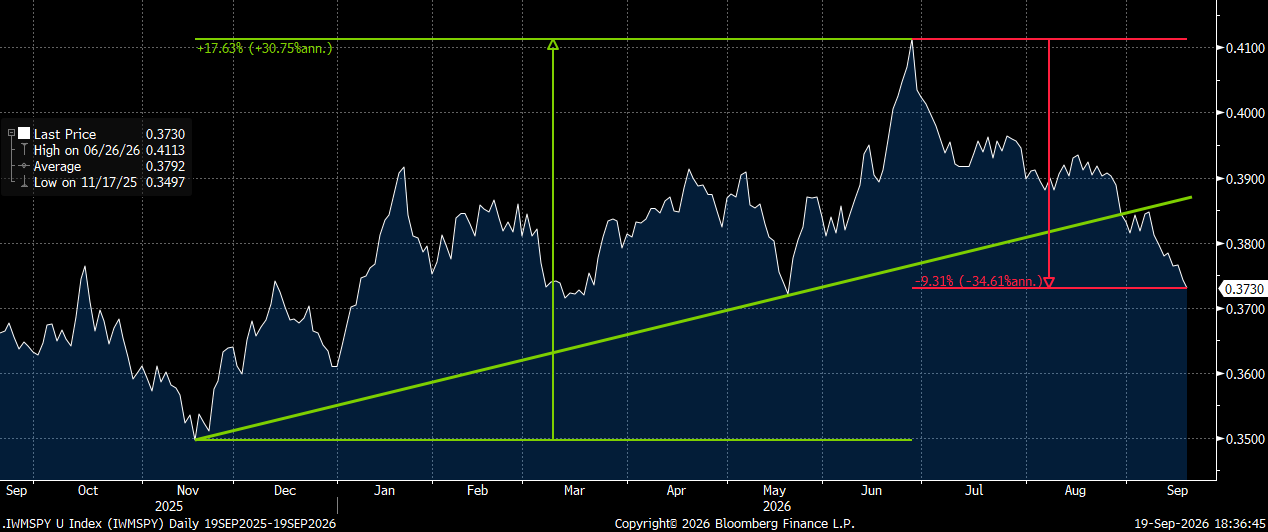
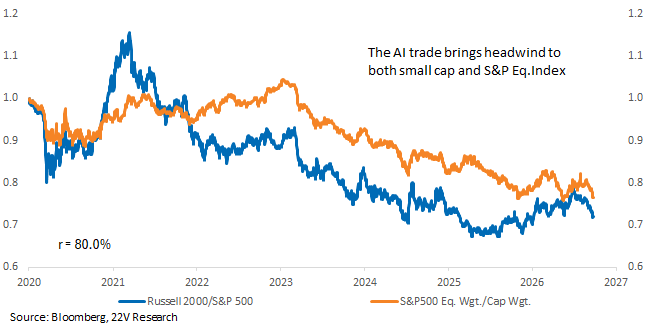
Mega-cap/AI leadership has continued to weigh on small caps, with the Russell 2000 underperforming the S&P 500 since August. The divergence has coincided with further weakness in S&P 500 equal-weight versus cap-weight performance, reflecting continued return concentration in megas. Given the historically strong correlation between the two relative-performance trends, sustained AI-driven mega-cap leadership remains a headwind for small caps near term.
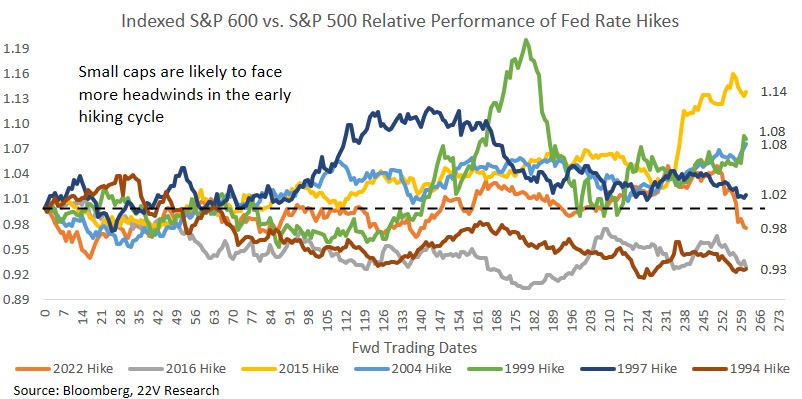
The macro backdrop is not helping small caps either. Historical evidence shows that small caps have generally lagged large caps in the early stages of rate-hiking cycles. Across prior cycles, large caps delivered the strongest forward one-month returns following the first hike in most cases.
Small caps returns are more sensitive to financial conditions given lower cash balances and more limited access to long-duration financing. Conditions have tightened meaningfully over the past few weeks, in part anticipating the start of the rate hiking cycle. The relative pressure on small caps from rate hikes tends to ease as the cycle progresses, with six-month and one-year returns showing greater potential for small-cap recovery. So the start of the cycle is also the start of the easing of longer-term macro headwinds, leaving small cap fundamental trends more important.
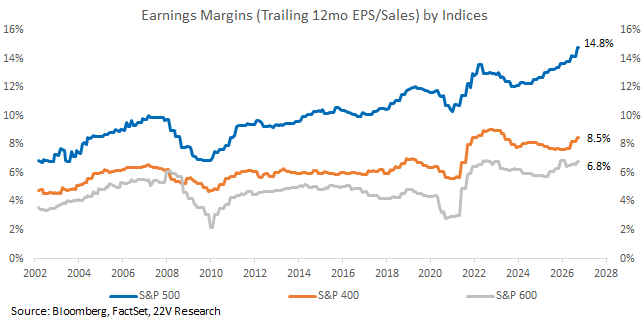
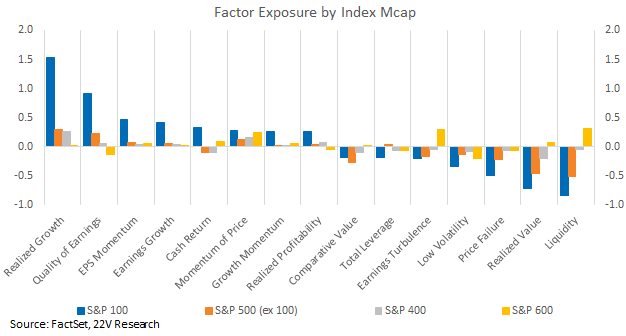
Currently, small-cap margins remain below large- and mid-cap levels, and management margin sentiment is also weaker. Over time, small caps margin spread has been positively correlated with their valuation spread (HERE). At the factor level small cap exposure remains tilted toward Risk-on and Value, while the recent reversal in Risk-on factors offset by Value headwinds in an AI-led market. Technical and derivatives signals likewise point to elevated near-term downside risk. We favor small-cap hedging via IWM Nov. put spread (details HERE).
Small Caps Face Near-Term Headwinds Post-Fed: Large and Mega cap names have seen a sharp reversal following the Fed meeting, driven in part by renewed strength in the AI trade. Small caps have continued to underperform large caps, continuing their trend lower since August. This weakness has coincided with a further deterioration in S&P 500 equal-weight relative to cap-weight performance, reflecting continued concentration in the largest names. The two relative-performance series have historically been highly correlated, suggesting that continued mega-cap/AI leadership could remain a headwind for small caps in the near term.
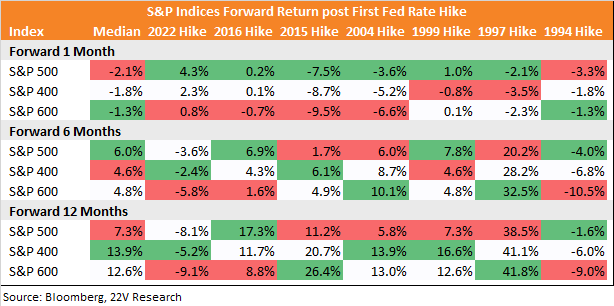
Historical small cap returns have been weaker than large cap as hiking cycle start. The forward 1month return post the first hike was highest for large cap names in most cycles except 1994. As we noted in another report (HERE), 1994 is not a great analog of the current cycle. However, the headwind eased as hiking cycle extended. The forward 6 months and 1 year return into the hiking cycle suggests recovery for smaller names.
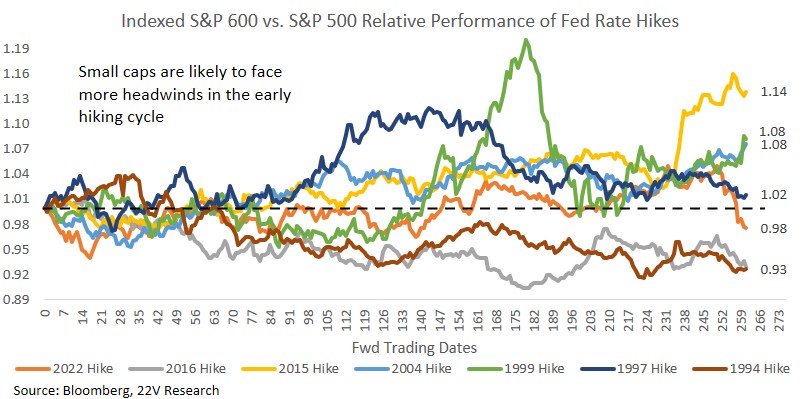
Indexed relative return of small vs. large cap names confirm the historical trend. Small caps reversed in the first three months post the hike but tend to rebound longer term. Near term return for small caps remain weak, while longer term macro headwind should fade and the driver for its performance turns back to its fundamentals. John Roque, 22V Technical Analyst, also scores small cap weak currently, confirming the macro/market headwinds.
For now, margins of small caps remain lower than for the large and mid-cap indices, and management sentiment on margins in the small cap universe is lower than other indices as well. Our Strategy report (HERE) highlights the importance of margin for small cap valuation, and currently the valuation spread has been around the lower end with enlarged margin spread.
On factor exposure, small cap factor exposure remains Risk-on tilted, with more positive exposure to Value factors. The outperformance of risk-on factors offset with Value headwind post the Fed meeting (HERE) in an AI driven market, which may diverge from its traditional pattern with financial conditions.
Jeff Jacbson, 22V’s Derivative Analyst also sees near-term risk on small cap names as its relative trend has broken by key support. The IWM Nov. put spread (buy IWM Nov 280 puts and sell IWM Nov.250 put) is a good hedge for small cap risk (details HERE, contact Jeff for updated trade).