Weekly – The economic speed limit constraint favors Price Momentum, EPS Momentum, the AI Buildout names, High AI Usage Service Companies (Software) with High Cash Returns at the expensive of consumer or non AI Cyclicals. As usual our main themes are highlighted in bold followed by a mark to market.
Theme – Need to Respect the Economic Speed Limit – Marking To Market: The FOMC meeting highlighted a strengthening growth outlook and financial conditions not being restrictive as the main reason for hiking rates. i.e. strong economic growth and broad basket of inflation components being above 3% (not just supply shocks driving inflation according to Warsh) drove the rate hike (HERE). It is fair to push back and point out that if oil prices were closer to $70, the Fed might not have hiked. That is a fair point, but economic growth is MUCH stronger than the Fed expected, the unemployment rate is lower, and AI issuance has been much larger than expected. All those are points Fed Chair Warsh made when essentially confirming the speed limit is a constraint on growth. Bottom line – the direction of travel has been toward higher rates and the oil shock is impacting the timing.
As a reminder, the economic speed limit is the maximum rate real GDP can expand without driving core inflation above the Federal Reserve’s 2% target. The current economic speed limit is roughly 2% because trend productivity growth is ~2% and labor force contribution to GDP growth is close to zero (HERE).
Theme – The implication of the speed limit being a binding constraint on economic growth, and the Fed confirming that constraint, is that economic and labor market strength show up through a more restrictive Fed path OR higher 10year yields. Not higher equity prices. Marking To Market – Essentially what has happened over the last few months and continued last week. The correlation between bond yields and stocks is deeply negative as a result. Slower GDP growth would be helpful for multiples over time.
Theme – We are still constructive on equities over the cycle as EPS growth is unusually strong and inflation is not so far away from the Fed’s target that demand growth needs to be significantly reduced. Marking To Market – Credit spreads tightened and inflation expectations declined post the FOMC meeting, the opposite of July’s reaction to the FOMC meeting, signaling the market views the Fed hike as a cycle-extending move rather than a policy mistake. The logic of the Fed hikes (strong growth the main driver) and the intent to apply mild restraint, not aggressively ratchet back economic growth, is why credit spreads remained unusually tight, the S&P was flat, and inflation expectations declined post the FOMC. A key hawkish risk to watch is the unemployment rate. Given how strong GDP growth is, a move to 3.8–3.9% with still-hawkish inflation data could lead to significantly more hikes being priced and more downside risk to markets.
Economic Trends & Cross Asset Pricing Related to The ~2% Real GDP Growth Speed Limit – Marking To Market – Real GDP growth is currently well above the economy’s estimated ~2% “speed limit”. The Atlanta FedGDPNow for 3Q26 is currently tracking +5% Real! The details of the much stronger than expected retail sales report last week suggest Real Personal Consumption expenditure growth is tracking +3.2% in 3Q. That is meaningfully stronger than the +2.5% trend we referenced last week. The sum of investment and consumption growth is tracking close 5% in 3Q alone! We moved further AWAY from the economic speed limit last week and bond yields acted accordingly (higher).
Gerard puts the underlying trend in real personal consumption expenditure growth at about 2%, by eyeballing a trend line through the level of ex-auto real personal consumption expenditure growth. The speed limit would become much less of a binding constraint if real spending growth headed toward 2%. Follow this figure.
Theme – Because AI investment is unlikely to slow over the next two years, the bulk of the economic slowing needed to reduce inflation is likely to come from the consumer: Marking To Market – Consumer spending NEEDS to downshift from 3.2%+ toward 1–1.5% range. Investors have seemed to internalize this point, which is why the consumer names have not benefitted from strong consumer data. The consumer leading the slowdown is a headwind for Non-AI related Cyclicals (Retail, Transports and Housing in particular) and they traded poorly last week. We would expect that to continue. We will look to reengage with Non-AI related Cyclicals after the economy slows. Or if Oil, Gasoline and Deisel prices move significantly lower.
Theme – AI capex holding up as the rest of the economy slows some favors the AI buildout names, EPS Momentum, Price Momentum and GARP on a relative basis. Or companies that are less cyclical and using AI to increase margins/profits (software). Marking To Market – Price momentum was the best performing long short factor last week. EPS Momentum outperformed. Both AI services and Goods Baskets outperformed. Our view remains that rather than a zero-sum trade where buildout beneficiaries win at the expense of disrupted service companies, both baskets reinforce and propel each other through a virtuous feedback loop. Margins and Earnings for both baskets are increasing as other areas of the market (non AI related Cyclicals) struggle.
Marking to Market Investable Themes – Risk-on Factors have outperformed Risk-off Factors (MS22RISK on Bloomberg) since we went long on August 4th. Risk-on factors are still outperforming risk-off. The risk-on factor is benefiting from Price Momentum.
Longer Term – It’s counterintuitive, but a NON-RECESSIONARY increase in the unemployment rate would be CONSTRUCTIVE for equities. The unemployment rate increased in 2025 and S&P 500 multiples expanded. The unemployment rate is moving lower in 2026 and PEs contracting. FYI, if the unemployment rate were to increase, the speed limit for economic growth would increase. Gerard and I cover this more in a video HERE.
FYI on Supply shocks. As Warsh noted, “what we can do and will do is ensure that any change in relative prices doesn’t broaden out, don’t have second and third order effects in the economy.” This last line is particularly helpful in anchoring inflation expectations. One of the main concerns amongst macro investors was a fed being willing to offset higher oil prices with still easy monetary policy. That would risk a significant broadening out of inflation.
Charts and indicators below…
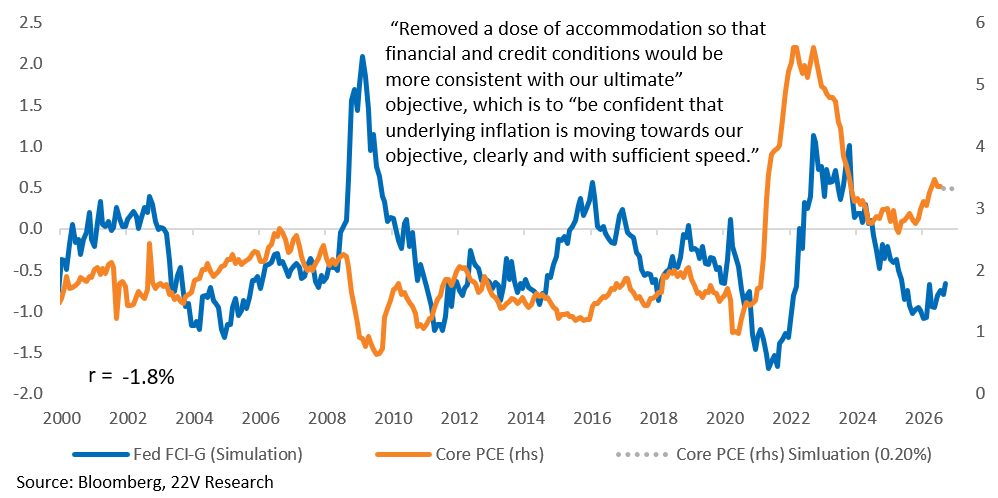
POST FOMC: The FOMC meeting was a bit more hawkish than anticipated, but our calls remain the same. 10yr yields are range bound around current levels (4.8-5.2%), the overall equity market is range bound. We put Warsh’s own words in chart. The financial conditions are biased to tighten (blue line higher) until Core PCE is in check (Orange line lower). That is why being outright bullish is tough. Once inflation starts to decline, being bullish on markets (particularly small caps) will be easier.
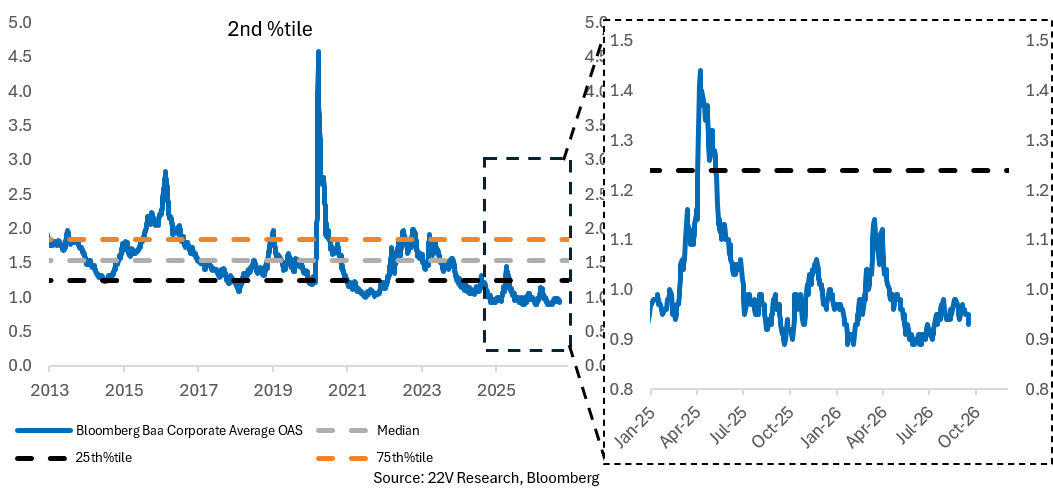
Credit spreads remain unusually tight.
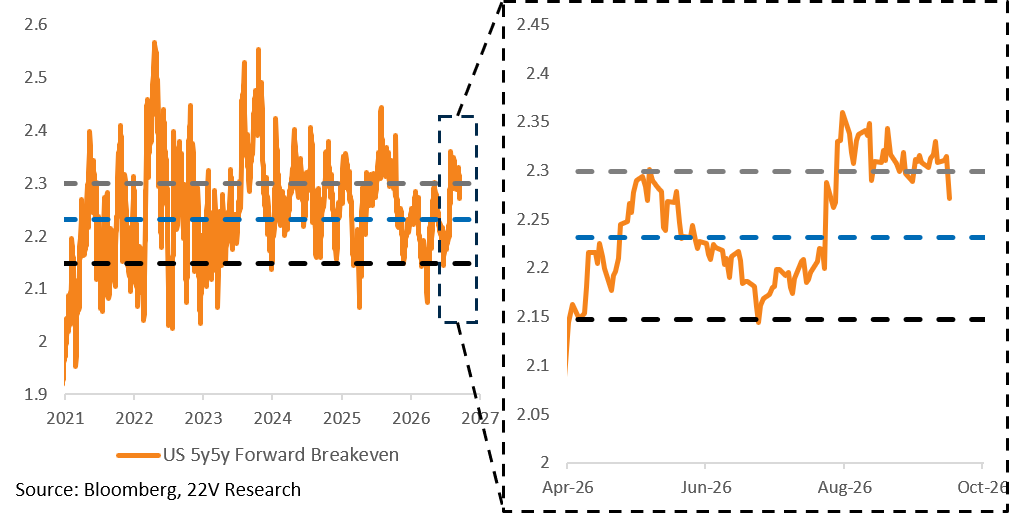
Inflation expectations declined.
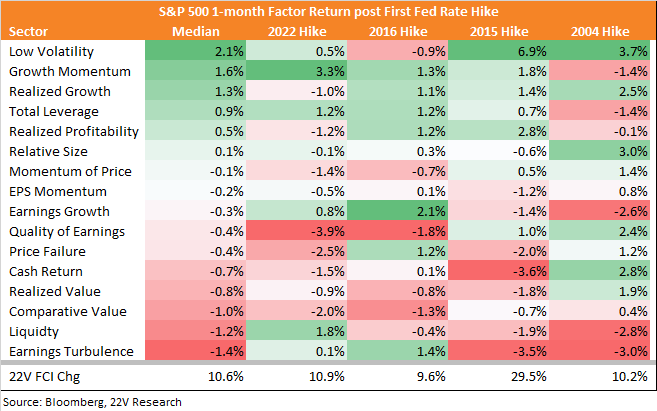
Low Volatility, Growth Momentum and Realized Growth remained top performing factors 1 month after the start of hiking, while Risk-on factors Liquidity and Earnings Turbulence underperformed the most. Fundamental factors should outperform more speculative factors and that was the case last week.
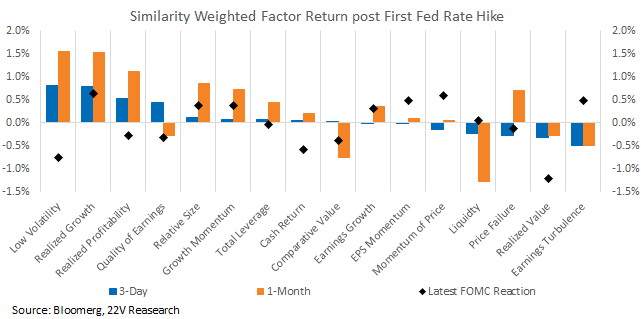
The typical pattern didn’t hold perfectly, but Realized Growth, Price Momentum and EPS Momentum Outperformed. Realized Value faced downward pressure.
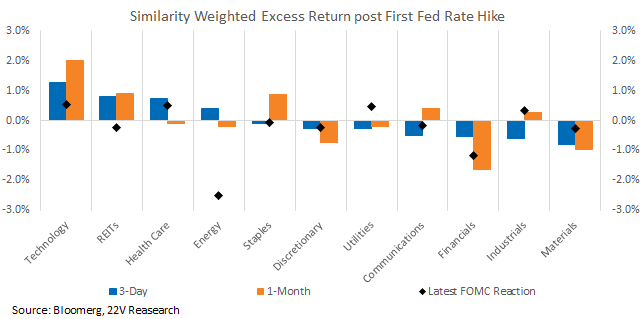
Technology remained the leading sector, while Defensives including Health Care and Staples also performed relatively well. Materials and Financials saw more downward pressure.
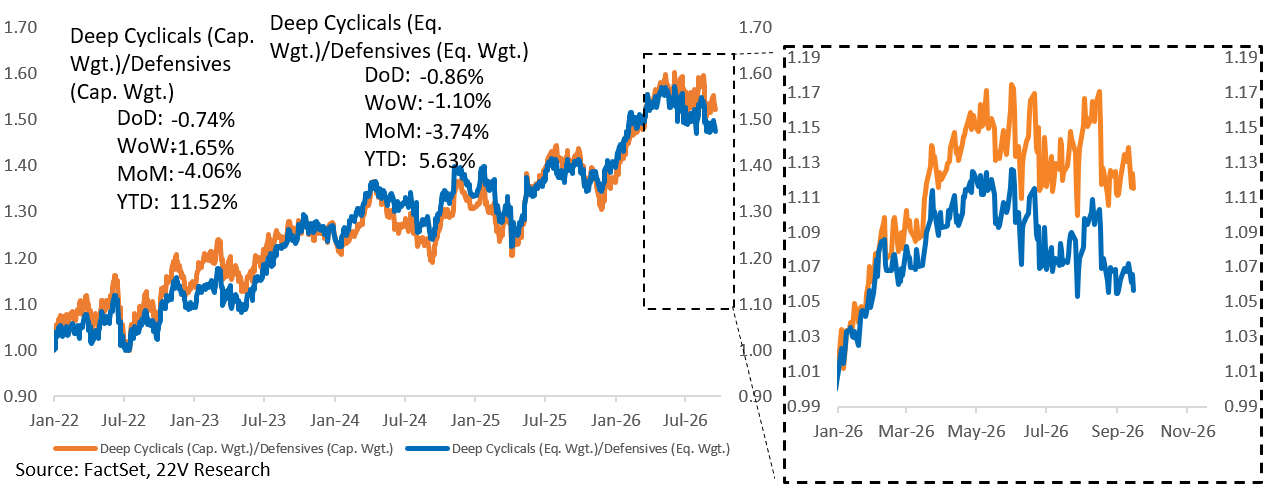
Deep Cyclicals (Energy, Materials and Industrials) have come under pressure relative to Defensives (Staples, Utes, HC and REITS). That should continue.
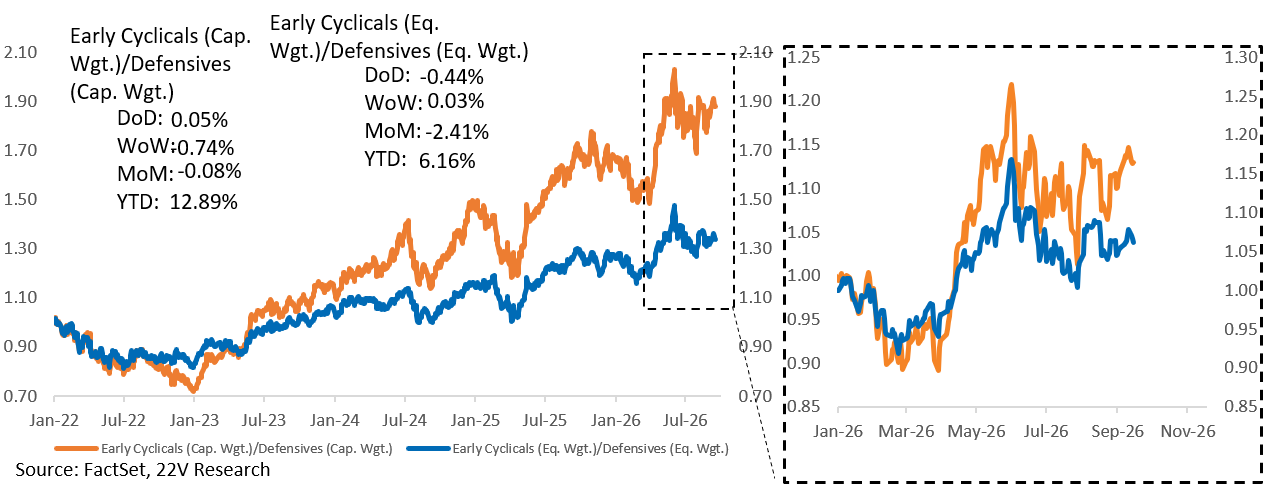
Early Cyclicals (Tech, Communications, Discretionary) have performed better relative to Defensives (Staples, Utes, HC and REITS). We are long Tech and Communications.
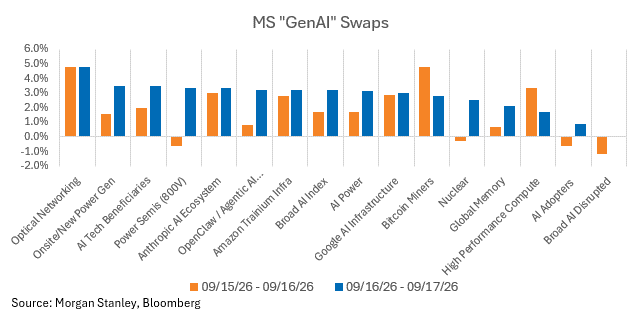
AI UPDATE: Two-day performance of AI themes around the FOMC, when compared to the recent beta of the baskets to financial conditions, implies that financial conditions were not the main mechanism for AI basket performance.
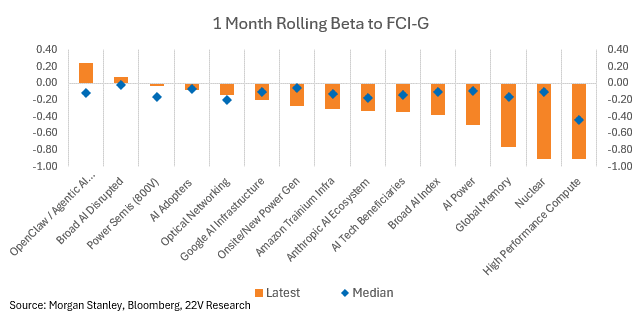
AI headlines will continue to generate volatility that can overwhelm the macro backdrop, like the potential AI development slowdown news from this weekend, but if the macro backdrop does inform the direction of travel, it’s towards the buildout AND AI implementation working together. A decomposition of the returns of our own AI Goods and Services baskets shows that idio is a large contributor to returns.
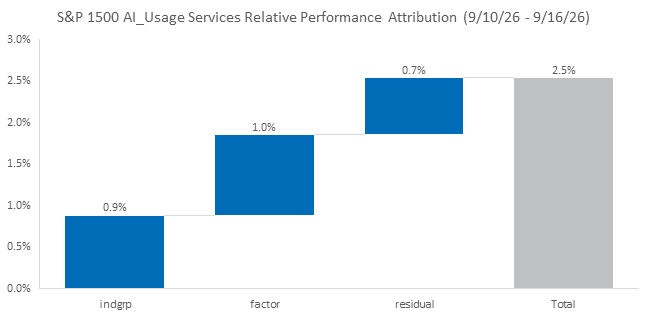
Source: FactSet, 22V Research
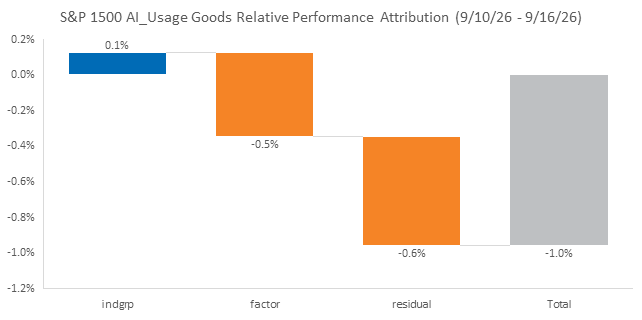
Source: FactSet, 22V Research
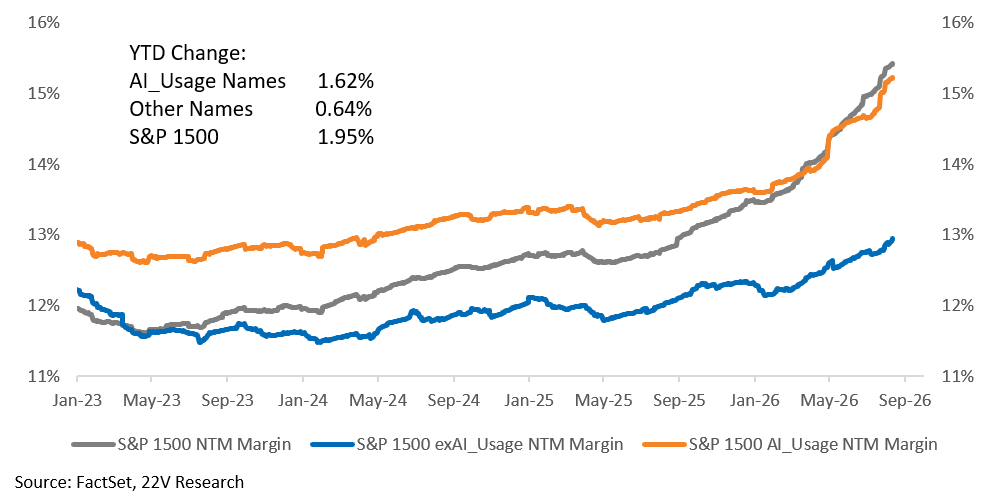
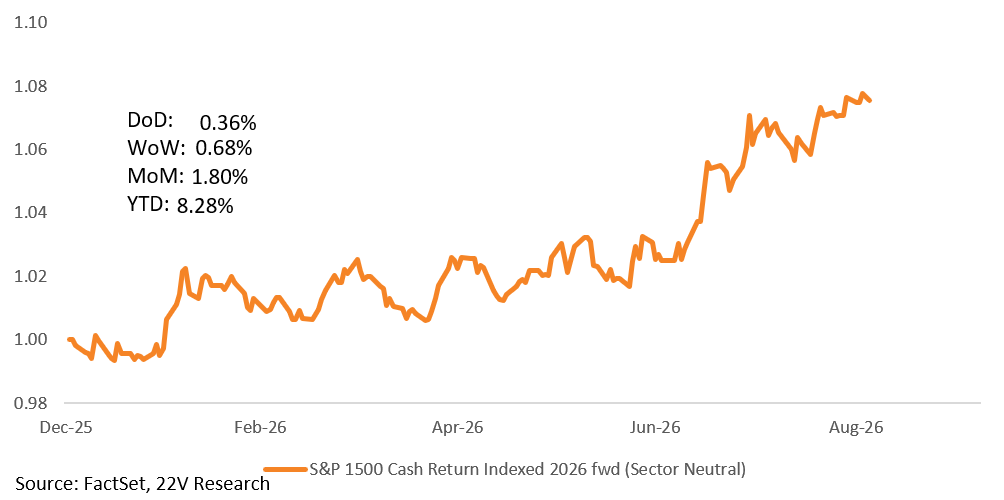
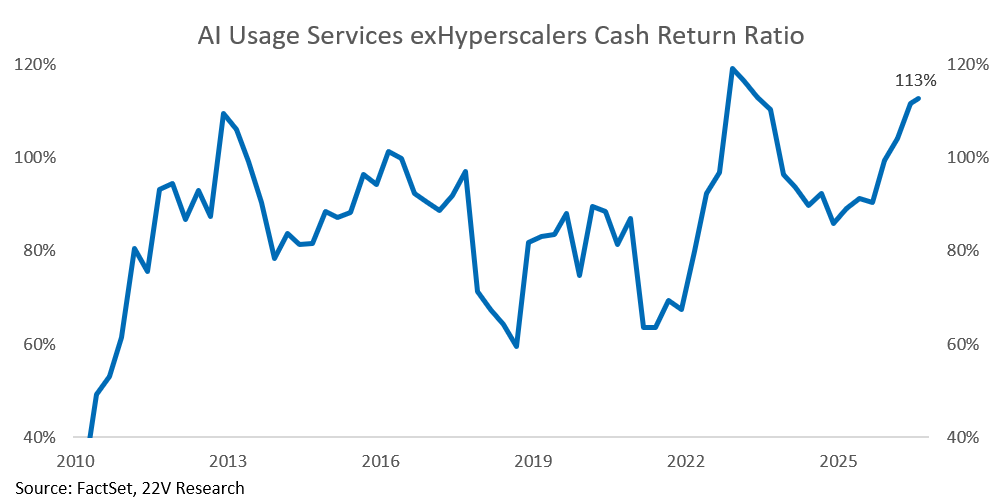
1Q and 2Q earnings reports showed that implementing AI is increasing margins now (HERE). AI Service companies are attractive generally given shifting investor preferences for CURRENT earnings certainty, margin visibility and high cash returns. The cash return factor is the best performer YTD and should be the focus during a growth slowdown.
Cash return is above 100% for AI Services ex Hyperscalers.
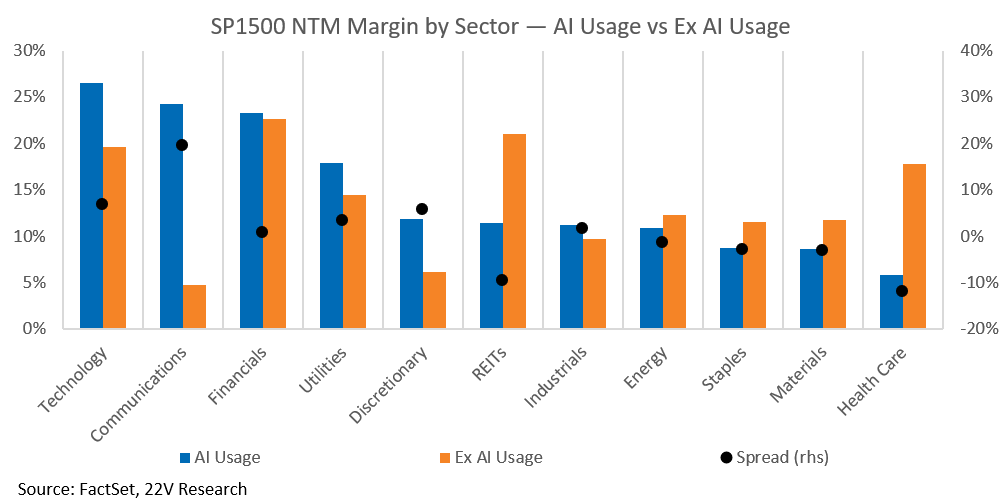
AI is a margin boosting tool. AI users have better ntm margin estimates and express more optimism about the forward outlook for the margins across sectors.