September FOMC: With the Reacceleration, on to the Hiking Cycle
- After failing to see meaningful improvement in inflation over the summer, and with the growth outlook strengthening and financial conditions not restrictive, the Fed hiked and signaled at least one more is likely to come. There were no dissents and only two officials expected a one-and-done cycle.
- The SEP, particularly its changing risk assessments, told a story of a Fed that now sees a midcycle reacceleration underway, despite the drag from myriad supply and uncertainty shocks.
- Given the legacy of above target inflation and recent data that has not “meaningfully improved” the outlook, a hike was appropriate to “support a timelier return” of inflation to 2%.
- These prior two points suggest that the Fed does not yet see itself as needing to impose acutely restrictive, growth impeding, policy but rather to constrain expectations’ risks and preventing further upside demand pressures from building and boosting the underlying inflation outlook.
- Still, the Fed is now worrying more about nominal right tails than left and hiking in response.
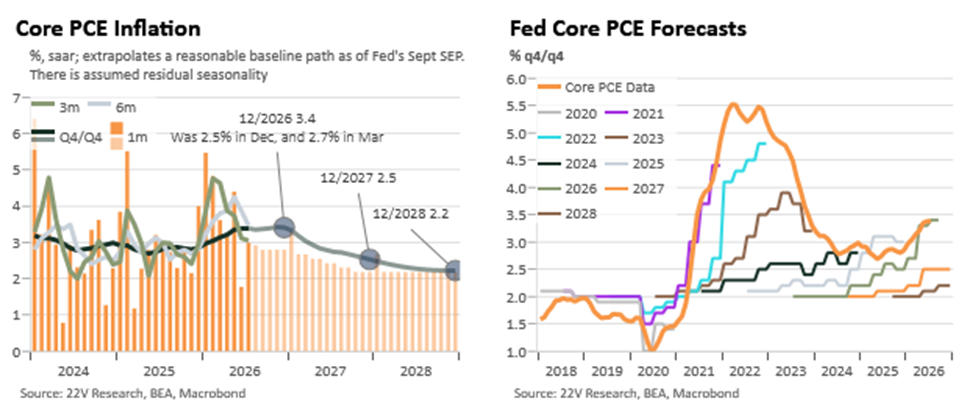
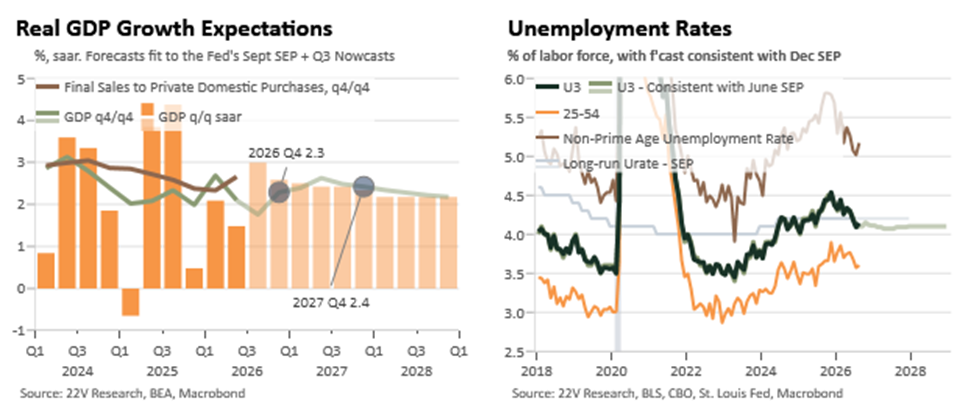
The SEP was Revised in a Hawkish-Optimistic Direction, Speaking to Midcycle Reacceleration. The inflation forecast shifted mildly higher over the medium term (the SEP did not seem to include the looming core PCE revisions in formal submissions given their uncertain nature but Fed officials will be aware of them and acting anyway; Warsh obliquely implied that the staff see the revisions in the 15-20bps range). Growth is expected to run a bit hotter than before over the next few years. The unemployment rate forecast also dipped down to 4.1% but this largely parallel shift just reflects the recent data. It is interesting that with years above potential growth in the forecast, the Fed does not have the unemployment rate dipping farther. It may just be the case that they don’t want to contemplate what a forecast consistent with Okun’s Law would imply for the rate path or, more benignly, that they expect substantial positive hysteresis in domestic labor supply in coming years (something I would be a bit skeptical of given how elevated the prime-age participation rate already is).
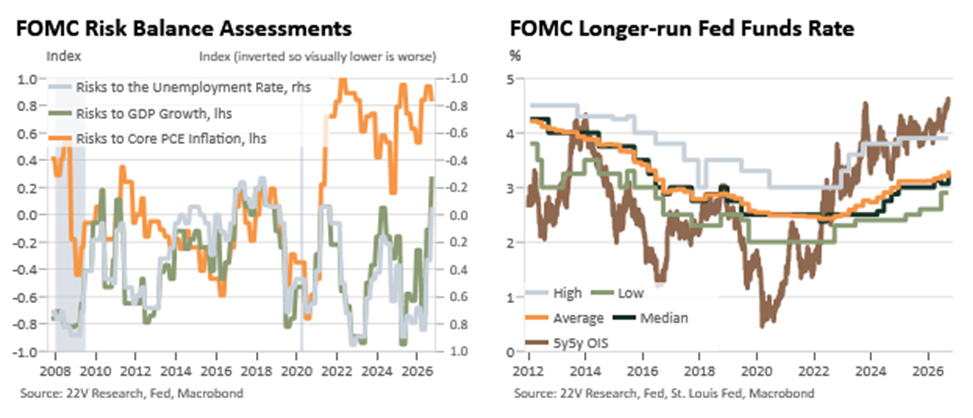
The story in the risk assessments was as clear a signal as the baseline forecasts and revisions; the SEP now has its most optimistic skew ever on growth risks, a rare optimistic skew on unemployment, and still one of its worst on inflation. This boils down to a Fed which is now seeing mid-cycle reacceleration plus lots of supply/inflation shocks, jointly layering on top of an inflation outlook which is already too far from target.
At Least One More Hike to Come. The most hawkish element of the day was not the hike itself but rather the fact that only two dots suggested that the hiking cycle would be one and done. That was an appreciably more hawkish dot plot than expected because the doves seem to have almost universally moved towards accepting the need for near-term policy pivot, despite still largely thinking that neutral is 3%. Four officials expect 3x hikes this year and four more expect to still have realized at least 3x cumulatively by the end of next year. Warsh’s framed the hike hawkishly too, noting that they “removed a dose of accommodation so that financial and credit conditions would be more consistent with our ultimate” objective, which is to “be confident that underlying inflation is moving towards our objective, clearly and with sufficient speed.”
When asked why the Fed chose to hike today after not hiking in July, Warsh gave a litany of reasons which suggest that the move reflected capitulation on older views of the backdrop and thus appropriate policy; he noted that a “wide ranging set of data, including in the labor market, suggest that economy has strengthened… Second, inflation trends… my judgement then was that inflation trends were not passing the test and I’ve seen very little to change that view… the third that’s changed in 7 weeks is geopolitics.” Implicit in some of this pivot is a view that second and third order effects from the war are growing.
The Fed is Not Willing to Keep Ignoring Supply Shock-driven Inflation. The second most hawkish element of the day was Warsh’s response to a number of questions about the war and the Fed’s response to supply-side driven relative price shocks, which may temporarily raise headline inflation. He was quite clear on this point, saying that “what we can do and will do is ensure that any change in relative prices doesn’t broaden out, don’t have second and third order effects in the economy.” His continued emphasis on trend inflation and the breadth of price increases is consistent with this framing; on neither point did he sound comforted. The dovish claim of many forecasters is and has been that, stripped of the shocks, inflation would already be back at target. It almost surely would be lower. Yet that framework’s own medium-term implication was a brief upside to core followed by little net effect by now, with relative price impacts fading and the demand hit from the shocks pulling the other way. Core is still too hot, which suggests the shock story is doing less explanatory work than its proponents allow (that or we should alter our assumptions about trend inflation and the skew of the shocks around it). Speeches and reports from six to twelve months ago made the same case, and did so with forecasts far below what was realized. On top of that, as many corporate leaders have noted and Warsh suggested, those supply and uncertainty shocks have also dented growth over the past year and a half and as/if they fade the real outlook may be become more right-tailed with underlying inflation still too hot. The dovish view also tends to implicitly assume that there will not be additional supply shocks and that the demand- and FCI-driven impacts of the AI boom are not something the Fed will respond to; that argument has always seemed a bit strange to us and Warsh increasingly seems to think that nominal policy rates should respond to the AI boom, even if it should ultimately lead to future productivity growth.
The Fed is Not Yet Aiming for Truly Riskily Restrictive Policy Though. It is important to note that the Fed does not see its hikes as risking the cycle, but implicitly playing a bit of catchup to a more hawkish-optimistic reality as the SEP shows a reaccelerating economy. Warsh repeatedly commented on the “strengthening” economy and an “an attitude of optimism” inside the Committee. The use of “timelier” in the statement to guide how quickly they are aiming to see inflation return to target suggests a degree of caution to me.
Continuing a Building Trend, the Long-run Dot Moved Higher. Given the broader macro, financial conditions, and credit backdrop, it has seemed increasingly difficult to assert that the neutral fed funds rate was as 3.1%. The move to 3.25% was not dramatic but I suspect that their assessment of r* will keep drifting higher until its gets above 3.5% or the cycle ends (whichever comes first). The basic shape of the distribution did not change much though; there is now a smaller group at 3% or just below (7, was 9) with a fairly uniformly distributed group up to 3.9% (7 are now at 3.5% or above, was 4).
Chair Warsh Places Little Emphasis on Neutral Though. “Do I think it [the neutral rate] has much operational effect on decisions we make today? No I don’t.” To borrow an old framing from Chair Powell, Warsh seems to care quite little about the level of neutral itself, placing more emphasis on the “works” and impacts of stance of policy that we can see. The Warsh-ian view of restrictiveness much more clearly focuses on conditions in financial markets, knowing that Fed risk assets and rates jointly reflect economic and policy developments, and, in what seems to be an important incremental shift in emphasis, credit and lending conditions.