Conference Takeaways: Supply Shocks, the Consumer, and the AI Boom.
- Updates from major banks, card companies, and others in recent weeks continued to show that consumer spending remains strong and corporate confidence and willingness to invest is gradually building, even amid the war and a variety of other smaller scale shocks in recent months.
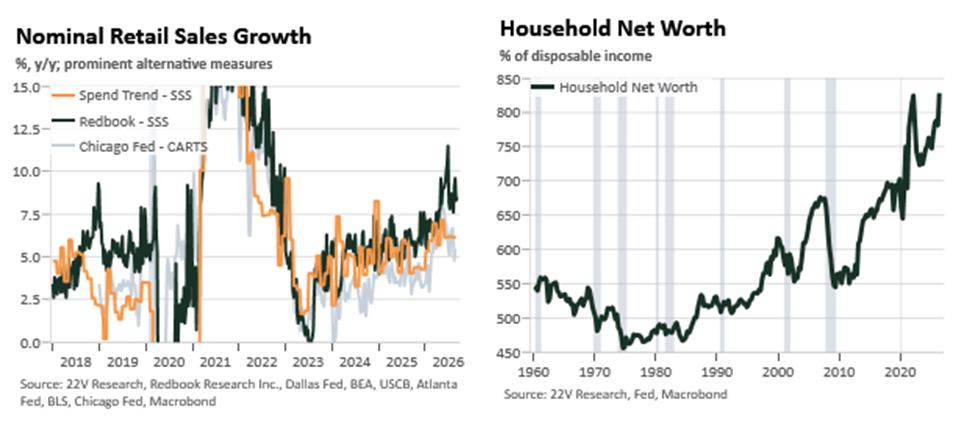
- Consumer spending may have decelerated just a bit from an apparent June peak but continues to grow at a strong pace, with travel and entertainment real standouts.
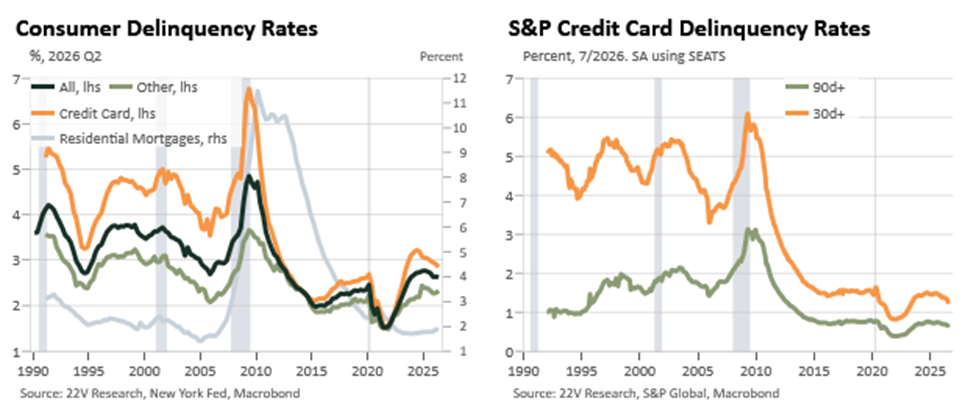
- Despite continued fears of consumer stress, household credit trends keep positively surprising banks across cohorts. Improving delinquencies and no sign of releveraging suggest that the savings rate-based pessimistic stories remain misplaced.
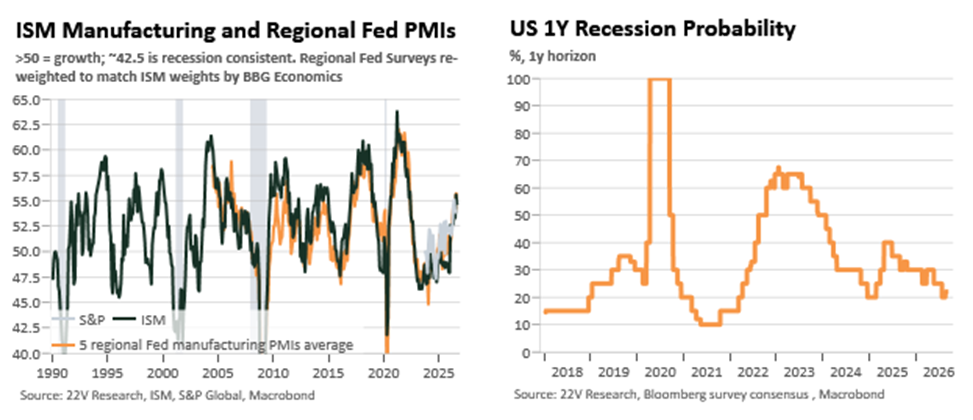
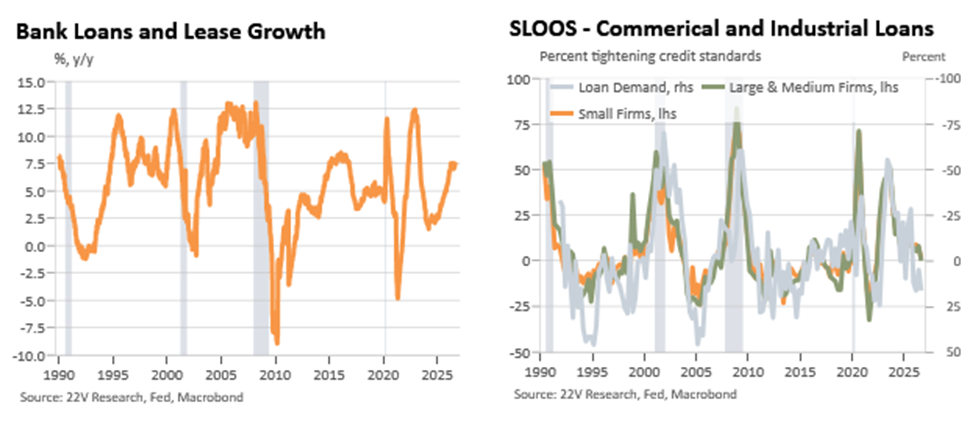
- Corporate sentiment and loan demand seem to be finally picking up some as the mid-cycle reacceleration flagged by the PMIs and other measures starts be reflected on the ground. Margins are strong, signs of stress very limited, and the AI boom has helped catalyze a broader rebound in corporate investment and activity. As Gerard noted, outside the AI boom the non-financial corporate sector is in very strong shape, still deleveraging, and with a supportive financing gap.
Supply Shocks, the Consumer, and the AI Boom. Apollo’s Scott Kleinman summarized the current moment quite well yesterday noting that “everything we looked at, whether it’s the strength of the economy, the persistent low-level inflation, really pointed towards rates staying up… while the tail risk keep growing, geopolitical instability, domestic, political questions, the trade war, inflation, energy prices, the market doesn’t seem to care as long as those two things of consumer spending and AI build-out continue forward.” JPM’s Doug Petno echoed the same sentiment for the US economy, “we have a hawkish fed, hawkish central banks in Europe. Our clients are seeing through the market volatility and the fog of uncertainty… I think the US is a bright spot… we don’t really see anything flashing red and very, very little flashing yellow… a lot of it ties to the strength resiliency of the US consumer [and] the diversity of the US economy. And there are some other big secular forces at work.”
Topline Spending Still Coming in Strong. Many traditional sources of demand continue to remain fairly soft even as the overall consumer powers ahead in topline spending. This rotation has been led by increasing wallet share moving to experiences, travel, and dining; some of this may reflect fundamental preference shifts as well as relative price shifts driving behavior. The overall macro outlook given strong topline spending and the AI boom continues to be strong.
- For the “last year and a half, let’s call it, our business in the US has been growing about 6% to 8% roughly… In the last quarter, our US business grew 10%. If you look at quarter to date through the end of August, it’s been growing about 9%.” – V, 9/8/26
- “The overall macro environment remains very supportive of both consumer spend and business spend. I continue to be impressed by how resilient consumers are… In the first 4 weeks of August, broadly, all of the operating metrics are in line with the first 4 weeks of July [6%]. So that’s really strong and that’s very consistent and its very positive.” – MA, 9/10/2026
- “If you go back to July, we talked about the first part of July being very consistent with the second quarter, which had about an 8% purchase volume growth. I’d sit back and say we’re 2.5 months through the third quarter and that’s held true.” – SYF, 9/14/26
- “I think when you look at the consumer side, I’ve stopped using this word resilient, because it’s just strong. The activity levels have just been strong now consistently for a while. We see spend up across the debit and credit card products every week, year-on-year. Categories move around. Sometimes, as oil or gas prices go up, it shifts a little bit, in terms of the spending.” – WFC, 9/15/26
- “Surprising that the consumer spend rate is up even ex gasoline.” – PNC, 9/14/26
- “We’re seeing credit card spending up 8%, debit card spending up 7%.” – RF, 9/15/26
WMT’s discussion of their use of tariff refunds as temporary offsets to other price pressures is worth flagging on its own. Given their gravity for US consumer staples it seems highly likely that other retailers had mimic their actions with the refunds to try and preserve share and volumes, rather than temporarily flattering margins. This may also explain a bit of the summer’s softening in inflation, which we have been inclined to partially discount due to residual seasonality concerns.
- “We did exactly what we said we were going to do. We took those funds and we reinvested in price and experience…. we had 11,200 rollbacks within the US business. And another way is not taking price increases when we see the cost of goods come up, things like transportation and fuel costs, which have escalated.” – WMT, 9/15/2026
- “As we moved into Q3 and you saw the impact of the price investments, we saw that rate come down below 1%. But again, as we look-forward, we anticipate the back-half to look very similar to what we saw in the front-half of the year [food 1%, general merchandise 2%].” – WMT, 9/15/2026
Consumer Sentiment May Not Be Strong but Their Balance Sheets, Across Cohorts, Are. Despite worries around the war and gas prices stressing consumers, all of the signs in the hard data seem to point the other way so far. This isn’t to say that consumer are happy about the increasing gas, diesel, and ag prices but they are getting by. In recent months, years really, we’ve had many conversations suggesting that the savings rate means an imminent consumer retrenchment is ahead. The savings rate as reported is not a cashflow metric, is very revision prone (almost always higher), and as a measure of households balance sheet stresses is far inferior to directly related measures of delinquency, net worth, and topline spending trends. If the savings rate case was winning out, reliably better than expected consumer credit trends, accelerating topline spending, and improving net worth with no signs of net deleveraging would not be jointly possible.
- “Clearly high-end folks are doing extremely well and they’re getting the benefit of a really high value stock market and home values holding in really nicely. But even as you go down into the lower spectrum, folks are managing okay… But we don’t see a lot of stress. We don’t see delinquency roll rates ticking up or anything like that.” – CFG, 9/14/26
- “The consumer is surprising us. She’s resisting gas prices, she’s resisting worries about tariffs, and she’s spending… The much rumored post-COVID wall that the consumer was going to hit didn’t happen. So what we’re seeing is their spending and their balance sheets are improving. If you look at their balance sheets versus 2019, what they have with us in current accounts, they are up 20% post-inflation since 2019.” – PNC, 9/14/26
- “Credit quality is as good as it’s been in a long, long time… [the pre-covid level credit metrics have normalized to] was like a 40-year low.” – BAC, 9/14/26
- “There’s been strong performance across really every cohort on the consumer side. Delinquencies are a little better than we model, not worse, every time we have the conversation.” – WFC, 9/15/26
- “We showed not only consistency in growth, but really the consumer’s willingness in the face of affordability, in the face of higher gasoline prices, their willingness to do discretionary purchases. We’ve continued to see that in the third quarter. So we’ve not seen the consumer being in any way dissuaded from those discretionary increases.” – SYF, 9/14/26
Travel Demand Remains a Real Highlight. While banks and card companies have noted that movements in gas prices have led to some shifts in other spending habits, although many see an ex-gas price spending growth that’s still accelerated this year, travel related spending remains extremely strong across cohorts. This has been a clear theme across the year and is not just a World Cup related phenomenon. My suspicion is that with housing activity and many financed durable goods purchases relatively less attractive, something tariffs have accentuated, travel demand has been a clear beneficiary of an increasing topline and compositional rotation.
- “If you think about travel… it’s very broad-based both in terms of affluent and also mass consumers.” – MA, 9/10/2026
- “There was more spending on cruise bookings, more spending on restaurants, both quick serve, a lower growth rate, but regular full-serve restaurants at a higher growth rate, so the consumer spending on a broad basis.” – BAC, 9/14/26
- “We saw 7% RevPAR growth in July. We saw 8% RevPAR growth in the U.S. and Canada…demand broadly, the most encouraging thing to me, it’s across geographies, it’s across chain scales, and it’s across demand segments… This notion that the RevPAR trends are almost singularly led by luxury is just inaccurate.” – MAR, 9/9/2026
- “I think I, and many in the industry, had a point of view that there was a more foundational shift, and that has proven to be the case. We see it in the credit card spending data, we see it in the performance of our business, that consumers are, across demographics, prioritizing travel and experiences over consumption of hard goods.” – MAR, 9/9/26
- “The trends we’ve seen in July were consistent with what we’ve seen in the second quarter. Despite oil prices, despite the fact that air ticket prices are up, people are still prioritizing travel.” – EXPE, 9/9/26
Corporate Sentiment and Investment are Recovering. After the 2022-24 mid-cycle slowdown and elevated recessionary fears, 2025 was supposed to be the year of recovery and reacceleration but tariffs delayed that. However, they do not seem to have killed it off. Despite many headwinds noted above, firms seemed to have adopted an attitude of adaptation and improvisation in response to shocks, rather continued outright caution. While there is some variation across banks, in general it seems that SME clients are gradually investing in their business and borrowing, although the upturn remains fairly cautious. Capital markets activity is extremely strong.
- “On the small, medium size, the good news is they’re using their lines of credit a little bit more. They think about all the issues that you read about in the paper every day, but the good news is credit quality is good, and the commercial book that the small and medium size loan growth is solid. They’re using their lines not all the way back to where they used them, but they’re using their lines, which is good news. And they seem to have a stable employee base.” – BAC, 9/14/26
- “It’s a little more throttled and conservative than if we were completely without some of this uncertainty. But they are playing offense. They are investing. They’re out borrowing money.” – CFG, 9/14/26
- Corporate “credit’s in very good shape. There’s a risk-on environment across our commercial base that we’re seeing, and that’s reflected in our results.” – PNC, 9/14/26
- “When you look at the commercial side, again, still good performance. I would say that commercial banking, middle-market-type customer is still being pretty cautious and prudent. We are not seeing big increases in utilization across revolvers at this point.” – WFC, 9/15/26
- “We’ve seen the level of criticized and classified loans come down, non-accruals have come down, charge-offs have come down and we expect those trends to continue. So credit quality is improving still and we don’t particularly see any areas of concern.” – RF, 9/15/26
- “Across those markets, customers are investing… They’re mindful of all the things that are going on around the world and across the country but focused on their businesses and their particular balance sheets. And I think it’s very constructive.” – RF, 9/15/26
- “The massive investment in digital energy infrastructure that’s taking place is, of course, a historically powerful engine, which we’re obviously experiencing… Now we see that now diffusing into the further into the economy. Despite the scale of the AI buildout these investments, you know, so far remain less than 1% of GDP. Um, that’s well below prior investment cycles, starting with railroads all the way through the dotcom era, which I think were more like in the 2 to 5% of GDP range.” – BX, 9/15/26
- “In our own portfolio, we’ve seen margins expand around 700 basis points on average over that same time period, up to the sort of high 30s. So it is while it’s a little bit uneven, we see it as a pretty strong environment for companies to grow and make profits.” – BX, 9/15/26
- “We’re seeing broad based strength across CIB and investment banking, strength across all products and all geographies. We started the year with a strong pipeline. We started this quarter with a strong pipeline that continues. I touched on management and board confidence. That’s driving tremendous amount of M&A activity. It’s as high as we’ve seen in some time.” – JPM, 9/15/26