Bottom Line: The right tail for equities has increased
REALTIVELY benign labor market and inflation data suggest financial conditions can remain easy in the coming months and potentially much longer. Continued easy financial conditions, along with a firm fundamental backdrop supports risk assets. EPS growth remains strong, and confidence in the durability of AI demand continues to rise. Stronger AI demand also increases the probability that hyperscalers can generate attractive returns on their AI investments, supporting continued capex spending. Against this backdrop, we continue to favor both AI goods and AI services. We remain constructive on non-AI cyclicals, particularly Retail, Banks, and Transports. We are long Cyclicals in aggregate and short Defensives, Low Earnings Vol names and other “risk off” factors.
Relevant News: Atlanta Fed Wage Tracker
The Atlanta Fed Wage Tracker edged up to 3.8% in July from 3.6% in June, providing a slightly more hawkish signal than the continued wage disinflation evident in average hourly earnings. However, the increase partly reflects the headline series’ three-month smoothing, while the unsmoothed measure actually decelerated and remains broadly consistent with core ECI growth stabilizing around, or slightly below, its June pace. Overall, the wage data are modestly hawkish at the margin but are outweighed by July’s relatively benign goods and services inflation data once volatile portfolio management and advisory fees are excluded.
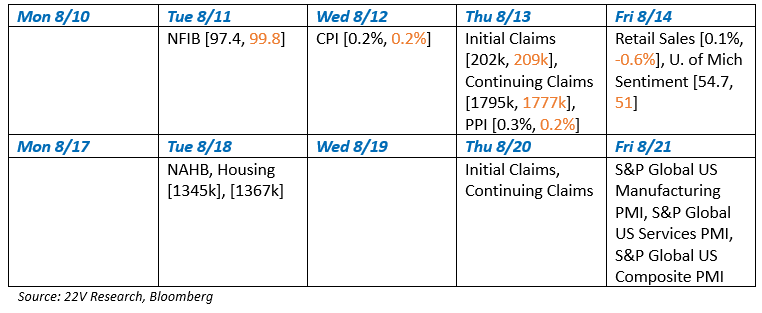
Things to Watch [Consensus, Results]:
Strategy:
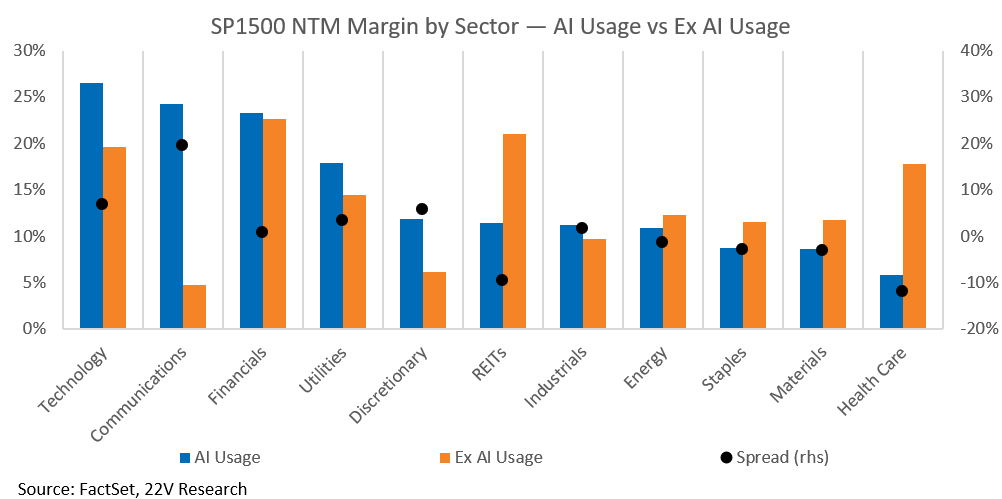
The Right Tail for Equities Increased Following CPI/PPI Data + AI Update – 2Q Reporting Provided More Evidence that AI is Improving Profitability – (HERE)
Through most of 2Q, the NTM margin estimates for companies that have specified use cases of AI (AI Users) continued to outpace non-AI Users, both in level terms and rate of change. The sentiment expressed by the management teams of AI Users about the forward outlook for their company’s margins is also better than non-AI Users. The margin advantage is highest in Tech and Communication Services, but not exclusive to it. AI users also have higher margin estimates within Financials, Utilities, Discretionary, and Industrials. AI Usage is not yet an advantage aggregated across REITs, Energy, Staples, Materials, or Health Care.
European Strategy/Geopolitics:
End of Summer Russia-Ukraine War Update – No End In Sight – (HERE)
The war in Ukraine remains a grinding conflict of attrition, with limited net territorial change but an increasingly consequential battle of long-range strikes against economic and infrastructure targets. Black Sea attacks are raising risks to grain and energy flows, while Ukraine’s shortage of Patriot interceptors leaves it vulnerable to Russian ballistic missiles; successful domestic programs such as the Freya interceptor and a long-range ballistic missile could therefore materially alter the strategic balance. With underlying military trends increasingly challenging for Moscow, Russia is more likely to escalate than pursue peace, potentially through additional manpower, North Korean support, and increasingly aggressive hybrid attacks across Europe. The base case remains that the war continues into or through 2027, with rising risks of spillovers into European security, confidence, trade, and inflation.
Financials:
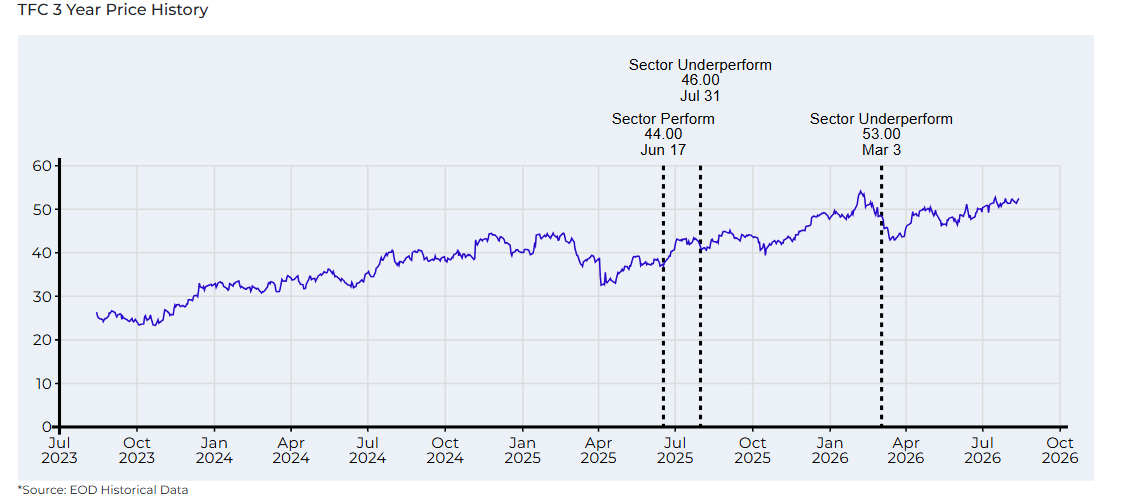
Truist Financial – 10Q Refresh and Thoughts on What’s Next – (HERE)
Following Truist’s 10-Q and with incoming CEO Mike Lyons set to take the helm on September 1, we refreshed our model and revisited the paths to improving returns. TFC continues to wrestle with the legacy impact of its low-yielding securities portfolio and, more recently, a sizable cash flow hedge position that leaves earnings increasingly exposed to higher short-term rates. While current FY’26 NII guidance now looks achievable, we estimate each additional Fed hike could reduce PTPP/share by roughly 1%, making the rate path particularly important. We believe one of Lyons’ more plausible early actions would be to restructure or terminate a portion of the swap portfolio, accepting some near-term earnings drag in exchange for reducing downside should rates move higher and potentially improving transparency around future earnings. We raise our FY’26/FY’27 EPS estimates to $4.66/$5.04 on better fees and lower provision, partly offset by weaker NII, but continue to rate TFC Sector Underperform as the Fed path and potential balance-sheet actions create a wider range of outcomes into year-end.