

Bottom Line: Inflation Risk
Economic data continues to be trend well above 2% real and this week’s economic data reinforced that (PMIs, JOLTs, high frequency demand indicators). Earnings data continues to come in much better than expected and is the fundamental driver of the market. The constraint on the market and economic cycle is inflation. Not lack of economic demand or poor company fundamentals. Elevated inflation risk is why the overall market and most fundamental factors and cyclicals sectors trade inversely with 10yr yields. Oil prices and 10yr yields have moved lower this week, clearing the way for investors to focus on strong fundamentals.
Relevant News: June JOLTS Show Just a Little Hint of Firming
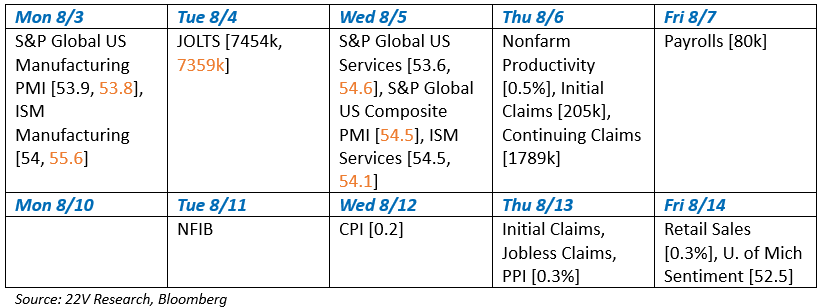
June JOLTS data offered only modest signs of labor market stabilization, with little reason to materially change the outlook. While job openings eased after a strong May, greater emphasis remains on hires and quits, both of which suggest job churn likely bottomed around the start of the year and has improved only slightly since. Other labor market indicators, including vacancies-to-unemployed and excess labor demand, tell a similar story, pointing to steady wage growth unless labor market conditions weaken further.
Things to Watch [Consensus, Results]:
Strategy:
Immediate Macro Catalysts & the Longer-Term Direction of Travel + AI Quantifiers and S&P Valuation – (HERE)
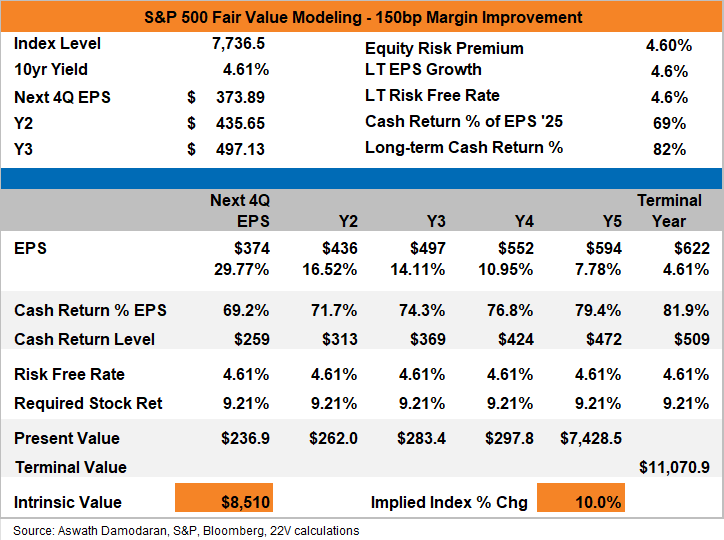
So far this quarter, 25 companies have quantified the impact from using AI. In aggregate, those 25 companies guide to ~180bps of margin improvement. Several of the companies lumped AI together with other cost saving initiatives, so 180bps is likely too high. Excluding those messier names, the margin improvement was ~100bps. We don’t want to ignore a subset of the Quantifiers, so haircutting the messier the names and blending them with the cleaner reads, unscientifically, implies something like ~150bps of margin improvement. Direction matters more than precision in these early estimates, and the direction is towards more AI users reporting better margin improvement than last quarter. Extrapolating 150bps of margin improvement to the index* would imply a minimum of ~+10% upside to S&P 500 Fair Value.
Data Infrastructure/ Commodities:
SPCX: Q2 Earnings; Contemplating the Faster Pace of Growth – (HERE)
SpaceX delivered a strongly bullish Q2 update, raising 2026 exit revenue guidance to $100B and outlining a much faster-than-expected AI infrastructure buildout, with Nvidia-exclusive compute scaling from roughly 2GW to more than 8GW by the end of 2027. While investors will debate the implications of higher capex, improving free cash flow, accelerating compute monetization, and progress toward Starship 3 and orbital data centers suggest the company is building a significantly larger long-term earnings power, with a credible path toward materially exceeding current 2027–2028 revenue expectations if execution remains strong.
Washington:
Democrats Anger at Trump and Their Own Leaders Anchors Midterm Enthusiasm – (HERE)
Jacob Rubashkin of Inside Elections argued that the 2026 midterm environment is being driven by unusually intense Democratic frustration directed at both President Trump and Democratic leaders, reinforcing historical trends that typically favor the opposition party in midterms. He highlighted inflation and Iran as key factors weighing on the President’s approval, identified Alaska, Iowa, Maine, Michigan, North Carolina, Ohio, and Texas as the most important bellwether states, and suggested outcomes in races such as the Michigan Senate contest and the Texas governor’s race could shape the broader political landscape. Rubashkin also expressed confidence in election integrity due to state-level safeguards and noted that concerns over AI and data centers are prompting many candidates to keep their distance from the issue.

