

July FOMC Preview: To Hike or Not to Hike
- My base case continues to be that the FOMC’s next move will be a hike. Whether this comes in July or, more likely, around the turn of the year largely hinges on if we see a preemptive vs reactive FOMC. I lean towards ‘not July’ but with little real conviction.
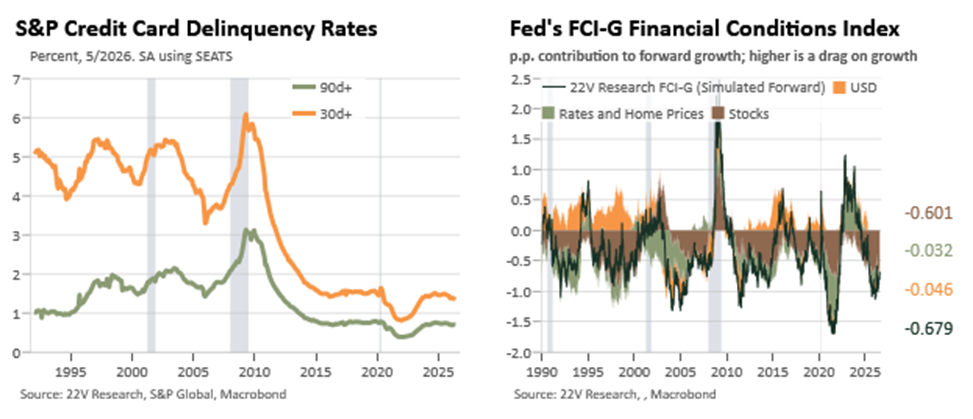
- Financial conditions are easy, credit conditions supportive, fiscal policy is stimulative, and the economy is facing, and so far weathering remarkably well, a bevy of inflationary shocks.
- If we are to get a hike in July, the case largely hinges on a view that the median FOMC participant increasingly senses that there is an inevitability to a future increase and there may be a benefit from doing so sooner rather than later. Warsh can seize the moment and establish his price stability bona fides early.
- In the event of a hike, I would expect long-term forward rates to be pleasantly surprised and remain fairly steady, offsetting some of the impact of higher short-term rates, leading to a flatter curve along with a higher USD.
- The case against hiking, now and in the near-term, hinges on benign future inflation (1 month down) and view that the overall stance of policy is still slightly too restrictive. Over time, I expect the accumulating inflationary evidence and a gradually retightening labor market to falsify those views.
Data and FCIs Don’t Point to Restrictive Policy
The recent data flow has been strong and broadly pushes back on the notion that policy is restrictive and suggest that the current monetary policy stance might, given the broader structural, policy, and cyclical backdrop, be slightly stimulative on net.
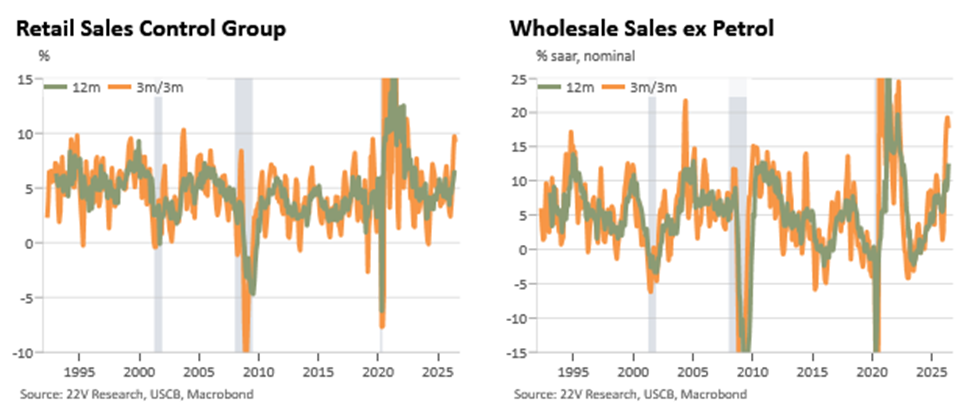
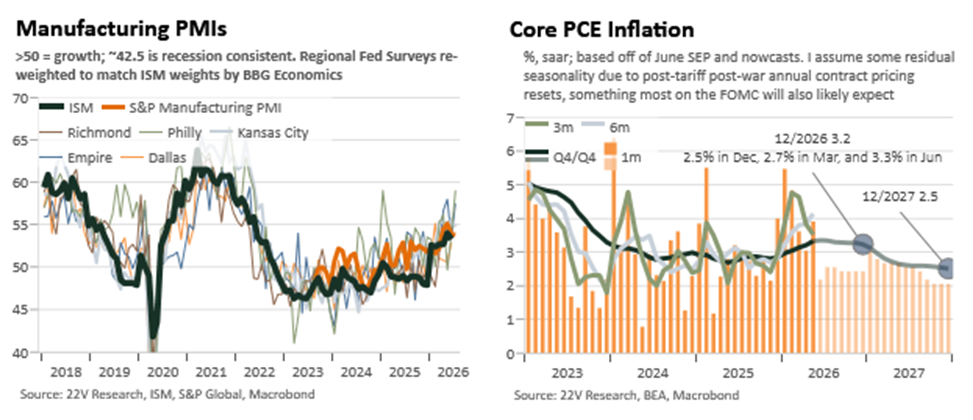
Recent corporate commentary (see here for the read after the first week of earnings season), high-frequency spending, and overall GDP tracking all look solid-to-strong. Consumer spending has been extremely strong to start the year in nominal terms (there is a natural inclination to discount some of the very strong card spending numbers, but the retail sales control group is up nearly 8% y/y). Despite the war, and perhaps accentuated by tariffs making goods consumption less appealing, travel and services spending has been the real standouts with early reporting from the airlines pointing to exceptional demand and pricing power. Given underlying demographic and productivity trends there may simply be too much nominal spending for inflation to durably be able to return to target; Gerard’s read of the GDP data YTD points in a similar direction. The acceleration in the PMI data has matched corporate commentary in broadly pointing to an economy which, despite the bevy of supply shocks, is seeing cyclical reacceleration after 3-4y in the doldrums. Easy financial conditions, improving willingness to and demand for bank lending, and continued consumer deleveraging all point in similar direction.
Not surprisingly, the strong growth outlook and recovering corporate sentiment have been tied to a stabilizing and perhaps gradually improving labor market. Jobless claims continue to steadily improve, June’s employment report was a bit strange but the unemployment rate is clearly stable-to-declining now, and hiring has improved from its mid-2025 trough. Net hiring (NFP growth) is likely to slow a bit from its recent pace as the recent boost to labor supply (linking NFP and the urate) seems unlikely to be sustainable and may reflect immigration enforcement related whipsaws; the more important signal from the NFP data is that it continues to run faster than the Fed’s view of its underlying demographic pace and that hiring breadth has improved some recently. The paragraph in the June Minutes about the fairly unified reaction function around different inflation outlook was premised across both hiking and patient outcomes on the labor market remaining steady; this implied clearly enough to me that a retightening of the labor market substantially lowers the threshold for non-hike inducing inflation by changing the medium-term inflationary skew.[1]
June’s inflation data was the first good print since November. 2026’s inflation core PCE has been revised up by 80bps since Dec and one good month will not allay those underlying concerns. This is particularly true with the labor market and growth outlooks no longer necessarily suggesting a disinflationary bias over the medium-term. The restart of the war and the still building physical disruptions which have resulted; the continued, if slowing, pass-through of new and old tariffs; and the currently inflationary impacts of the AI boom are acting to attenuate some of the dovish hopes the June data flagged; none of these three inflationary risks flagged in the June Minutes look more comforting than they did then.
The Case for a July Hike
A July hike, priced at roughly a one-third chance, seems to be less about a precise constellation of data or a clean shift in the Fed’s forecasts than about a change in the reaction function. The broader data increasingly point toward a modest tightening cycle by early next year, but July would imply that the Committee is already more unhappy with inflation than its public communication suggests and that Warsh wants to reassert the price-stability mandate and establish credibility early, at a moment when the economy can weather a modest hawkish monetary policy surprise. The argument would be that underlying demand, fiscal support, easy financial conditions and the AI boom have both reduced the cyclical cost of tightening and pushed short-run neutral closer to 4% than 3% and that policy should end up being a little bit restrictive.
This would fit the Fed’s tendency to hold onto a thesis (too high a neutral rate after the GFC, too benign on inflation post-covid, worries about recessions at various points in the past 3y) and then pivot fairly quickly once the median official reaches a point of falsification. Labor-market downside risks have faded, the inflation baseline still looks optimistic, and the pattern of misses on growth, inflation, and neutral increasingly point in one direction. A July move would effectively be a bet that the surprise and signal of resolve can tighten financial conditions and inflation expectations in the real economy beyond the mechanical effect of the rate level itself.
With 6 FOMC participants viewing multiple hikes as appropriate policy in June, if Warsh (and likely then Jefferson and Powell) decides a July hike is appropriate, it will happen.
Doves Have Patience and Priors on their Side for Now
The dovish case largely rests on two key pillars. They still represents most of the FOMC on paper, but the momentum in the data and articulated policy views has been clearly moving against the patient dovish approach.The first underlying view is that many see the recent uptick in inflation as being largely driven by supply shocks which the FOMC should not respond to. Tariffs and the war have clearly played a role in raising inflationary but the doves are leaning into that view aggressively in asserting that underlying inflation has been steady or falling. This makes a fairly heroic assumption in my view that there will not be further future inflationary supply shocks; alternatively, this could be framed as a view that domestic inflation is still moving towards target and the Fed should look through any upside surprises resulting from supply shocks.[2] Second, which builds on the inflationary assumptions of the first, is that many Fed officials still see neutral as close to 3% in nominal terms. Over the medium term this means that policy is sufficiently restrictive to slowly push inflationary back down to target.
The dovish patient case may well carry day in July, and perhaps for a few more meetings, but unless inflationary surprises sharply swing and the labor market does not retighten it seems unlikely to be sustainable.
“In such scenarios, almost all of these participants noted that it would likely be appropriate to maintain or eventually lower the target range for the federal funds rate. Most participants, however, also pointed to scenarios in which, in the context of stable labor market conditions, inflation would remain elevated due to strong AI-related demand, the conflict in the Middle East, or the effects of tariffs. In such scenarios, almost all of these participants indicated that some policy firming would likely be warranted to return inflation to 2 percent.” ↑
I would argue that this another, more subtle, version of ‘assume away all the bad components’ which it does seem like many on the FOMC are increasingly uncomfortable with. We now seem to have a mild upside deanchoring where the median, non-supply shock impacted, print is maybe tolerably close to target (still fairly high all things considered) but all the skew (now from negative supply shocks and the impacts of the AI boom) is to the upside. This reverses and further extremizes the post-GFC problem of median inflation near-target with a sharply negative skew. ↑

