

Early Earnings Season Wrap-up: Strength Broadens Out
- Despite plenty of shocks, the early macro read from earnings season has been very strong.
- Card spending accelerated at every major bank from already strong paces in Q1 to extremely strong, flirting with overheating, ones. JPM saw card spending at 10% (9% in Q1), BAC 9% (7%), general purpose card spending at C was 12% (6%), WFC was 9% (5%), and DAL’s AXP card program spending grew a wild 16% (12%).
- Balance sheets are improving, delinquencies in-line or better than expected, and investment and loan demand are broadening out beyond the AI trade.
- Management teams’ uncertainty from last year and the war seems to be fading as the mid-cycle rebound continues to broaden out and they adapt to the new structural and policy backdrop.
- BAC’s Moynihan summed up the quarter well: “overall, the US economy has proved more durable than expected, supported by the strong consumer, ongoing AI-driven investments across the board and easing energy costs, though inflation and tighter monetary policy remain key risks.”
- The note below is largely management team quotes, grouped thematically, to let them speak for themselves with sectoral lean to the banks given their early reporting.
Consumer Spending Accelerated Further. The accelerations and high absolute levels in the card spending numbers above are consistent with very strong consumer spending across the board. Tariffs and the war have scrambled some signals but even airlines are reporting minimal-to-no volume losses and surprising abilities to pass through costs to highly engaged consumers.
- “The US Economy remains resilient. Supported by strong employment, rising household incomes and significant wealth accumulation… Card spend has grown double digits for the past seven quarters, with particular strength among our premium reserve cardholders.” – DAL
- “TRASM was up 12.1% year-over-year with load factors up slightly, which indicates strong demand for United’s products.” – UAL
- “Spend is kind of fine. You know, robust and across income segments. Seems like a bit of a tailwind there from tax refunds.” – JPM
- “As we look ahead, consumers and businesses remain strong, consumer spending is higher, charge-offs are lower and savings investments are growing across customer segments.” – WFC
- “We continue to see strong consumer spending activity, which at the end of the day shores up the US economy.” – BAC
Balance Sheet Concerns Have Failed to Materialize. There is no sign of consumer exhaustion despite tariffs and the impacts of higher gas prices. Delinquencies have been in-line or better than expectations and aggregate data show they are mildly falling on net. Given the narratives around lower-income consumer struggles and the typical dissaving responses to large gas price shocks, the improvement in delinquency trends is a very important piece of disconfirming optimistic evidence which points to underlying cyclical improvement when looking through the shocks.
- “Now turning to outlook, demand remains strong and broad-based cash sales improved through the quarter across the entire booking curve in both premium and main cabin products… We expect September quarter revenue to grow mid-teens versus last year… And while it remains early, December quarter bookings are coming in strong.”– DAL
- “Delinquencies are a little lower than we expected. And again, that’s a better performance. You see that pretty much across the board by FICO score.” – JPM
- “Consumers remain resilient as average deposit investment balances and spending all showed linked quarter increases. Additionally, consumer credit quality remain strong, and in line with our expectations.” – BAC
- “On the consumer side, it really is good. The delinquency trends are better than we model most months, really every month that we’ve seen now for all year across each of the portfolios.” – WFC
- “Within the sectors that you mentioned, retail, restaurants, things that are closest to the end consumer, it’s been surprisingly resilient” – FHN
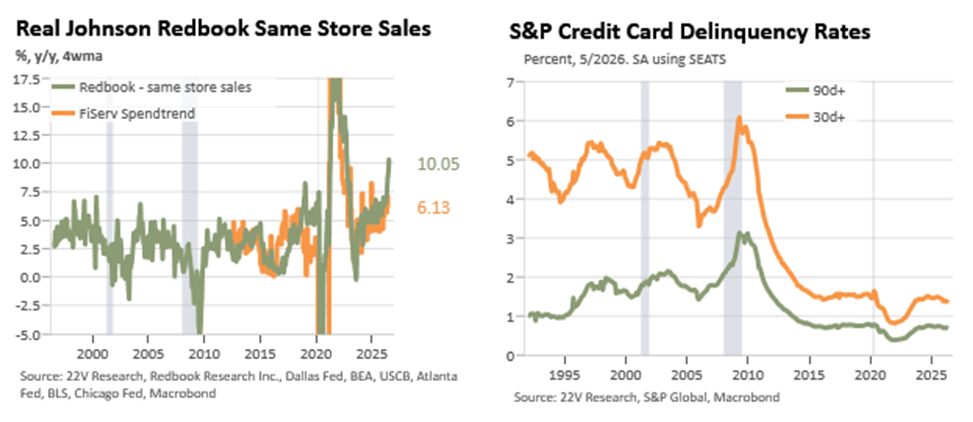
K-Shaped Wedge in the Economy Seems to be Closing. Related to the above point on the strength of household credit, discussions of the k-shaped economy where much more limited so far in this earnings season than from what I recall in prior ones. The explicit tended more towards rebuttals than acknowledgements.
- “Some of that economic heterogeneity data came out from the Fed recently, which also, I think doesn’t give a lot of support to the K-shaped narrative, essentially. So again, we think about this, we worry about this, we look at it, but from our perspective, all the various dimensions, there’s not that much there in terms of support for the K-shape narrative.” – JPM
- “Whether you break it by FICO or other ways to look at higher or lower income levels, we’re not seeing any of the trends in any of the cohorts change really at all.” – WFC
- BAC and PNC have also both had recent notes out highlighting the reacceleration in lower-income households consumption growth over the course of 2026 in their internal datasets. This lines up with some early signs of cyclical wage growth retightening and the broader mid-cycle rebound.
Business Sentiment is Solid and Investment Broadening Out. Management teams frequently highlighted the increasing breadth and pace of sales beyond core consumer and AI-related demand. The macro data is showing that the halting, policy dented, recovery from late 2024-on is seeing further signs of reacceleration this year. It is not a universal, nor particularly well loved, recovery but it is broadening out and topline growth is quite strong. Loan demand and willingness to invest are picking up and broadening out across banks as firms accept and adapt to increased policy and economic volatility; accelerated depreciation in the OBBB is likely helping as an offset to the myriad other shocks as well.
- “Customer sentiment remained favorable throughout the quarter… Overall, demand conditions were stable to modestly positive.” – FAST
- “You’re seeing a complete sort of steadiness in our credit cost. And importantly, the issues of the moment, whether it’s real estate four, five years ago or whether it was private capital lending and all this stuff just aren’t surfacing the way people thought they would.” – BAC
- “We’re seeing really good credit performance. I think people are still being very cautious about big investments… You’re not seeing people make big investments in terms of hiring lots of people, but you’re also not seeing people fire a lot of people, at least from what we can tell in our book. “– WFC
- “On the commercial loan growth, yes, it’s broader than just an AI theme… It’s very broad-based loan growth at this point. It’s consistent loan growth in commercial.” – BAC
- “We have heard it certainly in the middle American footprint that we have had. A lot of people who had paused last year to say where is all of this going are seeing a very resilient consumer and a lot of demand and beginning to lean into that in a fair way. It’s very, it’s more broad based and healthier loan growth and loan demand than just a concentrated AI trade.” – USB
- “A lot of them [core customers] are just rebuilding, putting on new equipment. If you look at our leasing businesses, both small ticket leasing and our equipment leasing grew really nicely this past quarter. So, there’s really just good core demand out there.” – MTB
- “It’s too broad-based to lay it all on AI. At the margin it’s impacting what we’re doing… People are otherwise used to the chaos in the environment and have figured out that they need to operate through it and grow… Look, the economy’s strong. People are spending money. While I appreciate the impact AI is having on GDP, that can’t be the only driver of the loan growth that we’re seeing given the industry dispersion and the geographic dispersion.” – PNC
- “C&I growth was fairly broad-based with the pickup in loan demand reflecting a positive backdrop for corporate clients with new investment and increased working capital needs.” – CFG
- “Demand in many industrial markets is improving and US consumer demand remains resilient.” – JBHT
- “For the quarter, volumes were up 10% year-over-year, the first double-digit volume growth quarter in over a decade. On a monthly basis, volumes were up 9% in April, up 9% in May and up 12% in June.” – JBHT
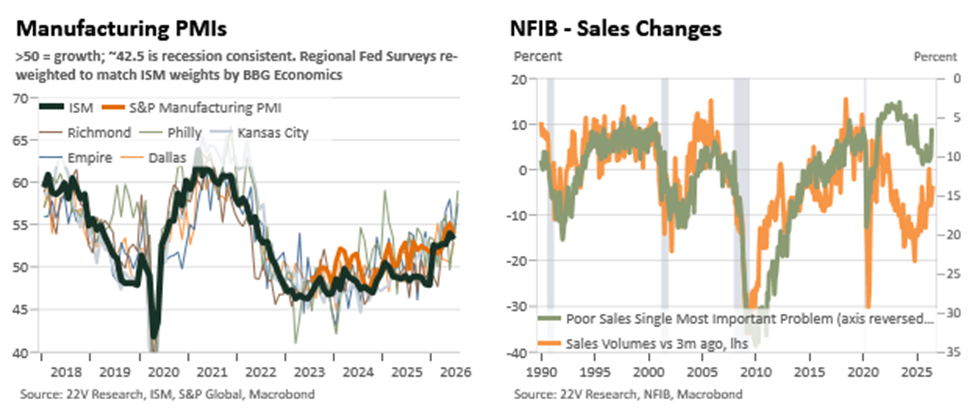
Inflation is Present but Adapted to. The macro backdrop and inflationary shocks of the past few years have presented numerous challenges for management teams and potentially posed an appreciable headwind to overall demand. That has not been realized. Instead, the tone was one of pushing price and seeing very minimal elasticities in response. The overall strength noted above, on top of supply constraints in key sectors like airlines, chips, and domestic freight, likely allows for much of this ease in pricing passthroughs. Pre-covid firms were not able to preserve margins so easily in the face of supply shocks but now underlying inflationary dynamics do appear to have shifted, which even if one wants to assume that
- “The cost of production, not just for fuel, is up, but the cost for labor is up. The cost for airports are up. Cost for technology is up. Planes you can’t get, and if you can get them, their costs are higher.” – DAL
- “We expect to recover 80 to 90% in third quarter and full recovery by the fourth quarter at today’s prices… Our focus on efficiency has helped offset some of the fuel headwind, but our ability to drive higher yields has been critical in helping cover the heightened cost of our operation.” – UAL
- “While trade and tariffs uncertainty stayed in the picture, its impact this quarter showed up through cost planning and pricing discussions rather than demand… cost inflation remained less predictable.” – FAST
- “As demand improved and capacity tightened, pricing and planning conversations with customers became more transparent, more frequent and more flexible.” – JBHT
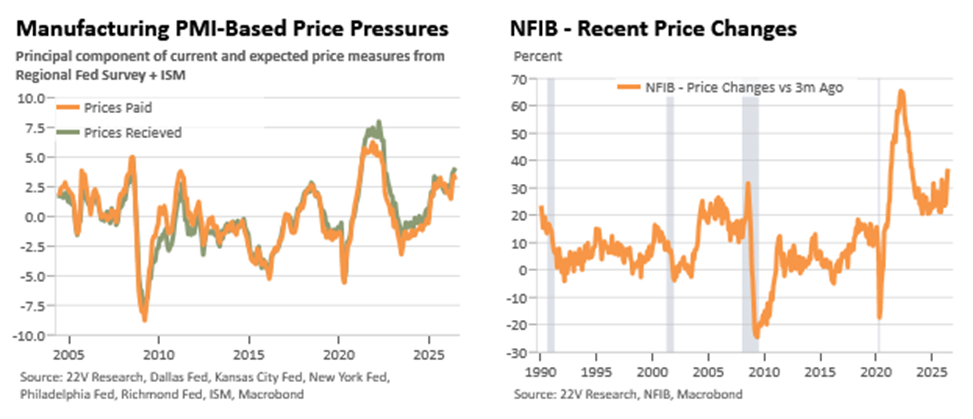
Worries the Party Can’t Last. Related to the inflation point above and highlighting the odd moment in the cycle which has contained so many shocks and sectoral dislocations, there were some concerns about cyclical overextension or overheating. These worries were driven mostly by inflation and potential monetary policy tightness but there’s a general sense of caution, although whether we are late, mid, or early cycle very much depends on where one looks.
- “The markets and U.S. economy have absorbed macroeconomic and geopolitical uncertainty well, strong environments like this don’t last forever and we see large amounts of capital being deployed by both banks and non-banks across a broad range of risk assets. Often when times like this continue, leverage and risks develop that are sometimes hard to see.” – WFC
- “I think the economy is surprised on the upside and consumer strength is surprised on the upside, and that inevitably makes everyone worry about fragility and about the things that could change it.” – JPM
- “So, overall, the US economy has proved more durable than expected, supported by the strong consumer, ongoing AI-driven investments across the board and easing energy costs, though inflation and tighter monetary policy remain key risks.” – BAC

