

A Post-Fed Stocktaking: Hawkish-Optimism Ascends
- Last week’s FOMC meeting was less outright hawkish than a reflection of the shifts in the data and risk balances across the mandates. Rates expectations moved up because labor risks fell and inflation outcomes moved hotter over the last 6 months.
- Fed policy is far below what any plausible policy rule would suggest and has been doing quite a lot of looking through the impacts of tariffs and the war.
- While there are natural concerns about the impacts of a Fed pivot on the economy and risk assets, this potential shift is happening with solid growth, a strong consumer, solid corporate earnings and balance sheets, and inflation which, even after plenty of adjustments, remains well above target. That is hardly a recipe for a substantial slowdown instead of a signal of an intent, expectations management, and desire to prevent further froth. Taking away the strongest punch at the party, not kicking out the guests.
- My base case is that the Fed’s next move will be a hike, most likely around the turn of the year.
- The rest of this note lays out my current read of the economy and plausible scenarios.
Nominal Growth Trends are Surprising to the Upside. Growth remains strong and the war’s real income hit has shown a consumer with substantial ability to accelerate spending in the face of a large nominal shock. Contra even optimistic expectations, consumer spending seems to have accelerated ex-gas since the start of the war. A soft Q1 for real GDP growth (partially a natural consequence of yet another round of residual seasonality in the inflation data) has meant that estimates for the year have seen relatively little movement on net, despite the war. This implies that without the war growth would have been even stronger and worries about potential overheating more prominent than they currently are.
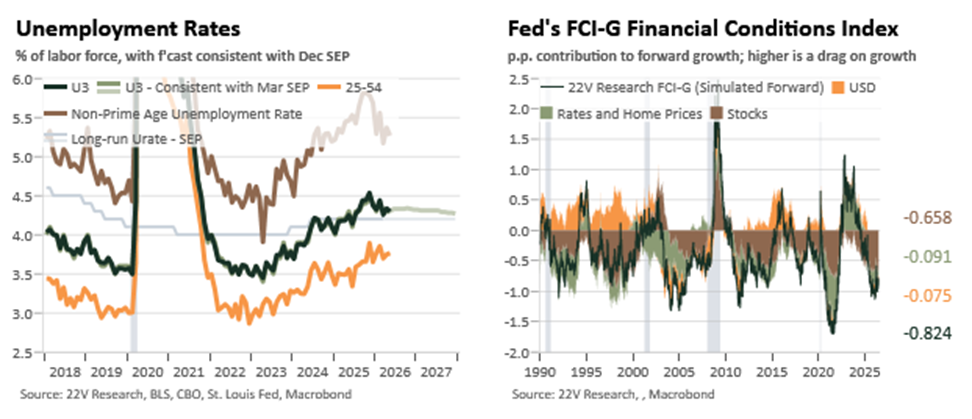
After a multi-year bout of easing, the labor market seems to have finally stabilized. It may atart to reheat. Most every measure of hiring, layoffs, or slack seem to have cyclically troughed at some point in Q4 2025 and seen either stabilization or improvement since then. Over the next few months, it seems likely that the pace of NFP growth will slow a bit from its blistering 3mma of 188k to something closer to underlying trends but this deceleration should not be seen as altering the cyclical outlook in any appreciable way. The shift towards positive benchmark revisions to the NFP data is another notable positive swing in a reassuring direction. With such a low underlying pace of breakeven labor supply growth, Given residual seasonality in the jobless claims, and less certainly the unemployment rate, we may see a bit of mild softening in measure of slack over the next few months as well, but unlike over the past few years that residual seasonality builds on improving rather than softening fundamentals.
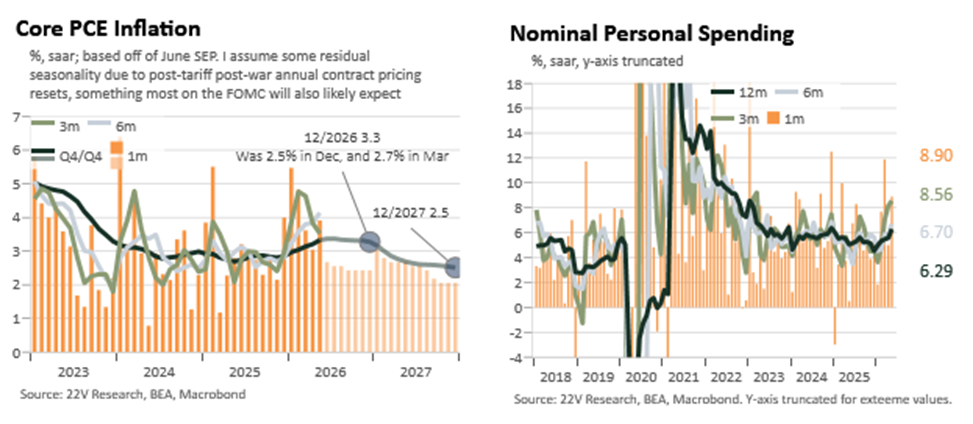
Inflation Got Worse. Unlike the labor market which is seeing its wrong-way risk fall, inflation has moved further away from target and risks remain skewed to the upside. After May’s data, the median Fed official assumes roughly 0.21% print for core PCE for the rest of the year, not exactly a high barrier under the circumstances. The war has complicated the precise read on inflation but the basic facts seem fairly clear. Core inflation troughed last fall and has appreciably moved higher since then. Tariffs have played a contributing role, as has the war, but there have also been clear second and third order effects of the sort Warsh said he wants to guard against. As Apple’s announcement yesterday highlighted, the AI boom is starting to have clear impacts on consumer goods prices (IT goods are up ~19%, not SAAR, since November). Core services ex housing’s move higher, with or without non-market prices, after over a year of stability at least 1pp above its pre-covid level is far more concerning than the goods inflation.
The strength in nominal spending, now running at over 6% y/y, with core just a bit slower, and nearly 9% saar in recent months, points to a fundamental inflationary baseline which many seem overly sanguine on. In an environment of elevated inflation volatility, I have generally found it more helpful to forecast real growth on the basis of nominal growth – inflation = real activity, rather than the convention of treating real side as the baseline anchor across all horizons. Nominal trends have been steadier building blocks than real or inflationary ones with the composition of that nominal growth whipping around. Over the medium- and long-term, real supply-side forces matter too of course. In this framework, the recent slower trend in real activity, most concentrated last fall as tariff inflation started to bite, is less cyclically concerning because it reflects supply-shocks drags on activity, and productivity, growth as temporarily increasing inflation eats away at spending power and most productive prior practices (depending on if one wants to emphasize the demand or supply-side).
If nominal spending is growing at a 5% pace or hotter, given labor supply growth between 0.0% and 0.5% and productivity growth of roughly 2% that may be slowing, inflation is naturally a concern. There is little evidence that nominal spending faces appreciable headwinds given aggregate income growth at or above 4%, depending on measures, very strong household balance sheets with only emerging signs of household releveraging beginning, fiscal policy which will remain supportive into late 2026 or early ’27, and improving delinquency trends and signs the bottom part of the K-shaped economy is turning up. Whether or not underlying inflation of up to 2.5%, or even a bit higher, is really consistent with “price stability” is an open question and one which Fed officials seem increasingly hawkish on, given the fading risks on the labor market side of the mandate.
Two Paths to Hikes. I see two main plausible paths to hikes depending on how the inflation data over the next few months evolves. It seems that many Fed officials are at a point of near capitulation in their baseline views which makes any given data print have an outsized impact. The White House and allied economists have been increasingly supportive of either extended pauses or an outright hike if necessary. The shift in tone seems designed to carve out room for Warsh to hike should that be deemed necessary to weigh on inflation and provide hawkish credibility to a process that has lacked it with inflation increasingly, again, politically toxic.
September/October Likely Requires Upside Surprises this Summer. In the first case, we see a few particularly hot inflation prints over the next few months and the median Fed official’s inflation forecast becomes even more worrisome. The narrowness of the gap between the 3.3% core PCE median and the 3.5% consistent with the most hawkish Fed official seems oddly narrow under the circumstances and suggests that officials near the median could be forced into a more hawkish posture by relatively small shifts in the data. Hot inflation, core PCE for 2026 at or above 3.5%, likely means a September hike while an actively retightening labor market lowers that threshold a little bit further. I lean against less because of the data and more so because for the median official to get there so quickly given their current views still seems like a large ask.
Delayed Hikes Driven by Neutral and Hawkish Credibility. If inflation trends a bit too hot but has no singular moment where the forecasts have to be reset higher, we are likely to end up with hikes starting in either December or ‘27Q1. This scenario is less about a specific urgency to hikes but rather a recognition that nominal neutral, at least in the short-term, is more likely above 3.5% than below it and that policy should likely be just a little bit restrictive on net in order to prevent post-supply shock reheating of the economy and reanchor underlying inflationary dynamics (the ease with which firms have passed through the cost shocks and household pulled forward demand is clearly concerning after so long above target).
An Extended Pause, or Perhaps 1x more Cut, is Not Impossible. My hawkishness on inflation and cyclical optimism about the economy should be clear enough from the above. But that does not mean that hikes are an inevitability. If inflation comes in a bit below the Fed’s baseline path, with firms eating war-related hits to preserve customers rather than margins, there will be less in favor of hiking for most officials as they get the first positive surprises on inflation since fall ’25. If the labor market shows only stability from here the Fed will be naturally less concerned about the medium-term given the Phillips Curve framework and their assessed stability in long-run inflation expectations.[1] Given the supportive cyclical backdrop, there is little reason to think that barring appreciable weakness in the labor market most Fed officials will move to more than 1 cut over the next 12 months and most would likely favor an extended pause with only an ambiguous presumption towards further easing after 12m or so have allowed them to gain greater clarity on inflation.
Assessing the Odds. While admittedly subjective and prone to possible rapid revisions depending on the data over the next few months, my rough assessment of the odds of these scenarios is I hope helpful. Given the macroeconomic conditionality above, the shifting relative position of these scenarios should be fairly clear as data comes in. September seems roughly 25%, largely reflecting the odds that the data pushes up the 2026 CPCE forecasts to 3.5% in the next 2 prints, the delayed hike case 40%, the extended pause roughly 25%, and more extensive cuts driven by a markets, plumbing, or other sharp one-off shock are a bit below their unconditional value but still count at ~10%.[2] This is an unhelpfully flat distribution I admit, but reflect the high volatility of the inflation data and the uncertainty around changing directions for the Fed. In the event of a hike, it is likely to be a modest data dependent hiking cycle of 2-4 hikes cumulatively over at most 1y and likely a bit faster.
Warsh’s dislike of the usual Phillips Curve framing and emphasis on financial and credit conditions, as well as fiscal policy, is clearly a hawkish framework under the current circumstances. ↑
Macroeconomic forecasters almost always have too narrow of distributions of outcomes, even during fairly normal times, a tendency I try to fight when giving probabilities for scenarios such as these. ↑

